A network portal of Wine Idea. Discover the world of Wine idea

Wine press review for Sunday April 5 – 2026

Italian wineries, Italian wine producers, and current wine news.

Italian wineries

Terre del Barolo: Revenue and profits on the rise. The Langhe cooperative winery closed its latest fiscal year with positive results: revenue of nearly €22 million (up 8%) and net profit of €2.7 million , compared to €2.3 million the previous year. Despite tariffs, geopolitical tensions, and declining purchasing power, management confirms its commitment to continuing to invest .

Florio Wineries relaunches Marsala at Vinitaly. The historic Sicilian winery presents a new, contemporary interpretation of Marsala in Verona. The focus is on the “Vino Florio” project, alongside the New Geography line, which showcases the wine’s diverse expressions through long aging in wood.

Cantina Tollo distributes Champagne Le Mesnil in Italy. The Abruzzo-based group becomes the exclusive distributor of Champagne Grand Cru Le Mesnil , a cooperative in the Côte des Blancs. The agreement will be presented at Vinitaly along with the new TO be – Fresh & Light line, designed for the international market and younger consumers.

Vernaccia Serra revamps and wins the 2026 Vinitaly Design Award. The F.lli Serra di Zeddiani winery has launched a major rebranding of its range and won gold at the Vinitaly Design Award . The Sardinian winery, among the first to obtain the Vernaccia di Oristano DOC in 1971, is focusing on a new identity and commercial innovation.

The rebirth of viticulture on the island of Capraia. The La Mursa winery, founded by Francesco Cerri and Gianna Zito, represents an example of the revival of heroic viticulture in the Tuscan Archipelago, bringing wine production back to an island characterized by volcanic soils and extreme conditions.

Franciacorta: the history of the Enrico Gatti winery. In Erbusco, in the heart of Franciacorta, the winery founded by Enrico Gatti continues its family tradition of producing classic method sparkling wines , contributing to the region’s growth as a top-notch wine tourism and production destination.

Italian wine and Italian oenology

Trentodoc: turnover stable at €180 million in 2025. These mountain sparkling wines confirm the sector’s solidity, with 12.2 million bottles sold and a value of €180 million , maintaining their position in the premium segment of classic method sparkling wines.

Piedmont is relaunching Asti worldwide. With approximately 100 million bottles produced annually , 90% of which is exported , Asti remains among the best-selling Italian wines globally. The Piedmont Region is launching an international promotion plan through 2026.

Alcohol-free: Italy accelerates investment. Following the decree on excise duties and regulations, industrial interest in no- and low-alcohol wines is growing. The phenomenon is concentrated primarily in Northern Italy, with initiatives in Veneto, Piedmont, and Emilia-Romagna, while the domestic market is still in its infancy.

Nebbiolo takes center stage at the Best of Valtellina 2026 tasting. Falstaff experts selected the best Nebbiolos from Valtellina through a tasting of 28 wines evaluated using the 100-point system , confirming the grape variety’s central role in the Alpine panorama.

Pinot Grigio Sanct Valentin: an iconic white from Alto Adige. The Sanct Valentin line from the St. Michael-Eppan winery, founded in 1986 by Hans Terzer, continues to represent one of the pinnacle of quality in Italian white wines, with a structured Pinot Grigio capable of long aging.

Wine and health: new scientific insights. A study published in Nutrients and discussed at the Irvas conference highlights how moderate wine consumption during meals , as part of the Mediterranean diet, presents different epidemiological characteristics than other alcohol consumption patterns.

Valpolicella: the Wine and Stone Trail is born. A new 160-kilometer wine tourism itinerary in eight stages connects Valpolicella, Lessinia, and the Adige Valley, strengthening the experiential tourism offering in an increasingly attractive region.

Valdichiana Aglione on the road to PGI status. This iconic Tuscan product takes the final step toward European recognition with a public meeting of the Ministry of Agriculture in Montepulciano.

Chianti Classico: restaurants and wineries increasingly integrated. In the area between Florence and Siena, the winery-cum-restaurant model is growing, combining tastings, gastronomy, and experiential tourism.

International

The Marzotto family acquires vineyards in Oregon. Through Herita Marzotto Wine Estates , the group expands its presence in the United States by purchasing the Domaine Lumineux vineyards, founded by filmmaker Francis Ford Coppola in the Dundee Hills region.

Artificial intelligence is entering restaurants. In the United States, some customers are photographing the wine list and asking chatbots like ChatGPT or Gemini for recommendations. According to the New York Times , AI helps with selection but doesn’t replace the sommelier’s expertise .

Wine events

Vinitaly 2026: over 4,000 companies in Verona. From April 12 to 15, Veronafiere hosts the 58th edition of the world’s leading wine fair. New features include the Vinitaly NoLo Experience, dedicated to dealcoholized wines, and the Xcellent Spirits pavilion for mixology and spirits.

Landini brings its specialized tractors to Vinitaly. The Argo Tractors brand will present the Rex 4-080GT Low Profile and Rex 110F models, designed for vineyard work, confirming the link between mechanical innovation and viticulture.

ViniVeri 2026 in Cerea. From April 10th to 12th, the event dedicated to artisanal wine returns, featuring over 100 European producers , a benchmark for the natural wine movement.

Only Wine 2026 in Città di Castello. The young winemakers’ show will be held April 25–27 and will bring together over one hundred producers under 40 alongside emerging European wineries.

Friuli Doc Spring arrives in Grado. The spring preview of the historic Friulian food and wine festival will take place May 29th – June 2nd , with tastings and events dedicated to regional products.

The wines not to be missed at Vinitaly according to Daniele Cernilli. DoctorWine journalist offers a selection of wines to taste during the Verona fair in the Vinitaly Tasting – The DoctorWine Selection space.

Thanks for listening, we remind you that today’s wine press review was brought to you by WINEIDEA.IT .

See you tomorrow.

Wine press review for Saturday April 4 – 2026

Italian wineries, Italian wine producers, and current wine news.

Italian wineries

Cantina Valle Isarco celebrates 65 years. The South Tyrolean cooperative is celebrating its 65th anniversary with the launch of new vintages in its Aristos line. Founded in 1961 by 24 families, it now has 135 members who cultivate vineyards between 500 and 1,000 meters above sea level, where viticulture remains largely manual due to the steepness of the terrain.

Italian Wine Brands focuses on premium and large-scale retail. The IWB group is responding to the challenging market environment with a strategy focused on high-end wines and strengthening its supermarket and hospitality channels. Despite US tariffs and slowing consumption, volumes continue to grow and revenues remain stable.

Partesa expands its wine portfolio with five new Italian wineries. The Heineken Group company strengthens its wine offering by introducing five new producers from regions such as Pantelleria, Sardinia, Chianti Classico, and Alto Adige. The goal is to meet the growing HORECA demand for authentic, niche, and local wines.

A family of musicians produces Soave on the Veronese hills. In Roncà, in the heart of the classic Soave area, the Franchetto family combines winemaking tradition and a passion for music to produce one of the most representative white wines of the denomination.

Domini Castellare and its parcel-based production model The Tuscan company founded by Paolo Panerai has built its success on a production model based on research, sustainability, and the valorization of Sangiovese, developed with the contribution of oenologist Emile Peynaud and the support of Italian universities.

In Gallura, a young winemaker is reviving a nearly extinct grape variety. Luca Depperu Sassu, a young Sardinian producer, has been working for years to save and promote a nearly lost local variety, reclaiming abandoned vineyards and rebuilding a new winemaking identity in upper Gallura.

Italian wine and Italian oenology

PIWI Grape Varieties: Significant Agronomic Progress, Still a Uncertain Market. Fungal-resistant varieties drastically reduce vineyard treatments—from around 20 to 4-5 treatments per year—but are still struggling to fully establish themselves commercially and narratively in the wine market.

Robots and artificial intelligence in vineyards. Agricultural robotics is entering the winemaking sector with autonomous systems capable of navigating between rows and learning tasks like pruning. The project stems from the work of the Dynamic Legged Systems laboratory, which developed the HyQ quadruped robot in 2010.

Piedmont experiments with no- and low-alcohol wines from native grape varieties. The Devino project involves Barbera, Dolcetto, Cortese, Moscato, and Brachetto in a cross-border experiment with France and Italy to produce low-alcohol or dealcohol-free wines, responding to climate change and new consumption patterns.

Asti DOCG introduces Rosé. With its publication in the Official Journal, the rosé version, made from Moscato Bianco and Brachetto, has been added to the Asti DOCG regulations. Its official debut is scheduled for the upcoming Vinitaly.

Asti DOCG “Piedmontese Wine of the Year 2026” The Piedmont Region has designated Asti as the symbolic wine of 2026. With 100 million bottles produced and 90% destined for export, it represents the most widespread Piedmontese wine product in the world.

Italian wine: rising costs and declining consumption. Sicilian cooperative wineries are raising new alarm about the sector: rising energy and material costs, climate change, and declining consumption are squeezing the margins of many companies.

New wine consumption habits in Italy. According to an MCO Report survey, men consume wine almost twice as much as women, and among young people, white wine outweighs red wine. Daily alcohol consumption in Italy has dropped from 33.3% in 1999 to 19% in 2023.

International

Made in Italy: exports among the strongest in the world According to a report by the Ministry of Business and the Edison Foundation, Italy remains among the world’s leading exporters, with a trade surplus of $122 billion and a 20% growth in foreign investment over the past three years.

Fine wines: signs of recovery in the secondary market. The Liv-Ex market closed the first quarter of 2026 with a slight increase (0.2%). Some Italian labels are among the best-performing, including Bruno Giacosa’s Barolo Falletto Vigna Le Rocche Riserva 2016 and Masseto 2022.

CeSVin joins the UNESCO wine network The International Centre for Studies on the History of Vine and Wine joins the academic network of the UNESCO Chair “Cultures and Traditions of Wine”, strengthening Italy’s presence in international research on viticulture and wine heritage.

Wine events

Vinitaly 2026: Awards and Key Players of Italian Wine Among the event’s main awards are the Vinitaly International Award to Lamberto Frescobaldi and Antonio Stopper, the Lifetime Achievement Award to Professor Attilio Scienza, and the “100 Years of Excellence” award to Valdo Spumanti and the Bardolino Consortium.

Vin Friularo DOCG Experience at Dominio di Bagnoli On April 18th, Dominio di Bagnoli will host a guided tour and tasting dedicated to Vin Friularo DOCG, with insights into the estate’s thousand-year history and the connection between wine and territory.

Visit Cantina 2026 in the Prosecco Hills The Prosecco and Conegliano-Valdobbiadene Hills Wine Route launches its wine tourism calendar with 67 participating wineries and events that will accompany tourists and enthusiasts throughout the season.

Vinitaly and rail access difficulties The temporary suspension of high-speed trains on the Rome-Florence route during the opening days of the fair risks complicating travel to Verona during one of the world’s most important wine events.

National Wine Tourism Observatory The new Nomisma report, a preview of the 21st Wine Tourism Observatory Report, will be presented at Vinitaly, highlighting the increasingly strategic role of wine tourism in the competitiveness of Italian wineries.

Wine tourism and food experiences in wine regions: From winery tastings like the one at Cantina Vivallis in Rovereto to tours of restaurants and wineries in Chianti Classico, the range of experiences that integrate wine, cuisine, and the region is growing.

Pizza and Wine Event in Amalfi On April 10th, Carlo Fiamma – Pizza e Cantina will present the book “Calici & Spicchi – Atlas of Pizza and Wine” by Antonella Amodio, dedicated to pairings between pizza and Italian wine varieties.

Thanks for listening. Today’s wine press review was brought to you by WINEIDEA.IT .

See you tomorrow with new news from the wine world.

Wine press review for Friday April 3 -2026

Italian wineries, Italian wine producers, and current wine news.

Here’s a brief press review of the main news from the Italian and international wine sector, highlighting the most relevant topics for businesses, wineries, and wine market participants.

Italian wineries

Tenute Nicosia relaunches the Hybla brand at Vinitaly 2026. The historic Etna winery presents the redesign of its Hybla line, dedicated to Vittoria wines, at Vinitaly. The company, founded in 1898 and now in its fifth generation, manages approximately 85 hectares on Etna and 60 in southeastern Sicily, all organically farmed.

Argentiera, the Bolgheri project with an international vision. The Bolgheri estate Argentiera strengthens its position among the leading producers in the appellation. With the arrival of Austrian entrepreneur Stanislaus Turnauer and the technical guidance of winemaker Nicolò Carrara and general manager Leonardo Raspini, the company consolidates a strategy focused on quality and international reach.

Rechsteiner: wine, culture, and sustainability in Veneto. The historic Piavon estate in Oderzo (Treviso), led by Baron Florian von Stepski-Doliwa, integrates viticulture, culture, and tourism. With 54 hectares of vineyards and approximately 120,000 bottles produced, the company focuses primarily on Prosecco DOC, mostly destined for export.

Biondi-Santi between wine and culture with “La Voce di Biondi-Santi.” The historic Montalcino winery continues the cultural project that accompanies the release of new vintages. The fifth edition features young writers from the Holden School of Turin, creating a literary podcast that explores the value of the “Generation” between tradition and the future.

Cantine Rivera hosts the Master of Wine course. In Andria, Cantine Rivera hosted an introductory course from the Institute of Masters of Wine for the first time in Puglia. The initiative involved professionals from nine European countries, strengthening the connection between international education and the region.

New commercial synergies with “Galassia – World Wine Network” A commercial network uniting Medici Ermete, Cantine Giacomo Montresor, and Terre Cevico has been established. The goal is to optimize commercial resources and strengthen their presence in international markets through a shared strategy.

Terre d’Oltrepò, rescue increasingly uncertain. The future of the Lombardy cooperative Terre d’Oltrepò is becoming more complicated. Collis Veneto Wine Group has withdrawn its interest due to low grape deliveries expected for 2026, far below the volumes needed to support the business plan.

Trebbiano di Spagna returns to prominence in Emilia. The Trebbiano di Spagna grape variety was featured on the Rai program “È sempre mezzogiorno.” The Buonariva winery in Castelvetro is focusing on the revival of native varieties to strengthen the identity and originality of local wines.

Italian wine and Italian oenology

Dealcoholization: Italy accelerates its efforts to develop low- and no-alcohol wines. Following the Masaf-Mef decree clarifying the issue of excise duties, businesses are increasingly interested in producing dealcohol-free wines. Northern Italy is leading the way, with initiatives in Veneto, Piedmont, and Emilia-Romagna, and initial developments in Puglia.

Caviro launches Tavernellow 3%. The Romagna-based cooperative group has invested €1.8 million in a dealcoholization plant at its Savignano plant. The facility can produce up to 30,000 liters per day, with an annual potential of over 9 million bottles.

Piedmont experiments with dealcoholized wines from native grape varieties. The “Devin0” project, developed between Italy and France, studies dealcoholization applied to varieties such as Barbera, Dolcetto, Cortese, Moscato Bianco and Brachetto, with the aim of creating zero-alcohol wines without losing their territorial identity.

Vermentino increasingly a symbol of Maremma The Top Ten of the Vermentino Grand Prix 2026, promoted by the Consorzio Vini Maremma Toscana, confirms the growth of this iconic white wine, which represents approximately 32% of the DOC’s production with over 2.4 million bottles.

Pizza and wine: an increasingly popular pairing. More and more Italian pizzerias are introducing structured wine lists and tasting menus. Wine and pizza pairing is evolving toward a more informed approach, overcoming the traditional dominance of beer.

Forest and Vineyard: New Scientific Discoveries According to Professor Attilio Scienza, biological communication exists between trees and vines through volatile organic compounds that promote resistance to climate stress and parasites, improving the balance of viticultural ecosystems.

The aperitif market shows signs of crisis. In 2025, out-of-home consumption grew in value (1.5%) but with fewer visits (-1.1%). The geopolitical context and economic uncertainty are changing consumer behavior, especially in the HoReCa channel.

Agricultural Diesel Tax Credit Agriculture Minister Francesco Lollobrigida announced the introduction of a tax credit to offset the rising cost of agricultural diesel, a measure requested by industry organizations.

International

Prosecco under pressure from EU-Australia deal. Producer Sandro Bottega criticizes the trade agreement between the European Union and Australia, which would allow the use of the term “Prosecco” for some Australian wines destined for the domestic market for ten years. According to the producer, the measure risks causing significant economic damage to Italian businesses.

Wine events

Vinitaly and the City livens up Verona. From April 10th to 12th, the Vinitaly off-site event will bring tastings, shows, and cultural initiatives to Verona’s historic center. Purchased tokens can also be used along the Valpolicella Wine Route until May 3rd.

Vinitaly 2026: Lombardy takes center stage between wine and tourism. The region will be present at the fair with a pavilion integrating wine, gastronomy, and local promotion, also focusing on the international visibility linked to the 2026 Milan-Cortina Olympics.

Lazio brings the “Dolce Vita” concept to Vinitaly. Sixty-one companies and three regional consortia will be present with a space of over 2,000 square meters. The project aims to showcase wine as part of a broader system of cuisine, culture, and hospitality.

Alto Adige Wine Road: Spring among vineyards and villages With 4,400 hectares of vineyards and a 150-kilometer route through 15 villages, the Alto Adige Wine Road is one of Italy’s main wine tourism itineraries.

National Exhibition of Dessert and Meditation Wines . The 22nd edition of the event dedicated to dessert wines will be held in Volta Mantovana from May 1st to 3rd. Greece will be the international guest of honor for the 2026 edition.

Strategic Summary The Italian wine landscape highlights three strong trends: technological innovation (dealcoholization and new products), growing integration between wine, tourism, and culture, and increased international competitive pressure on the most iconic appellations. In this scenario, companies are focusing on territorial identity, commercial synergies, and new consumption models to strengthen their positioning.

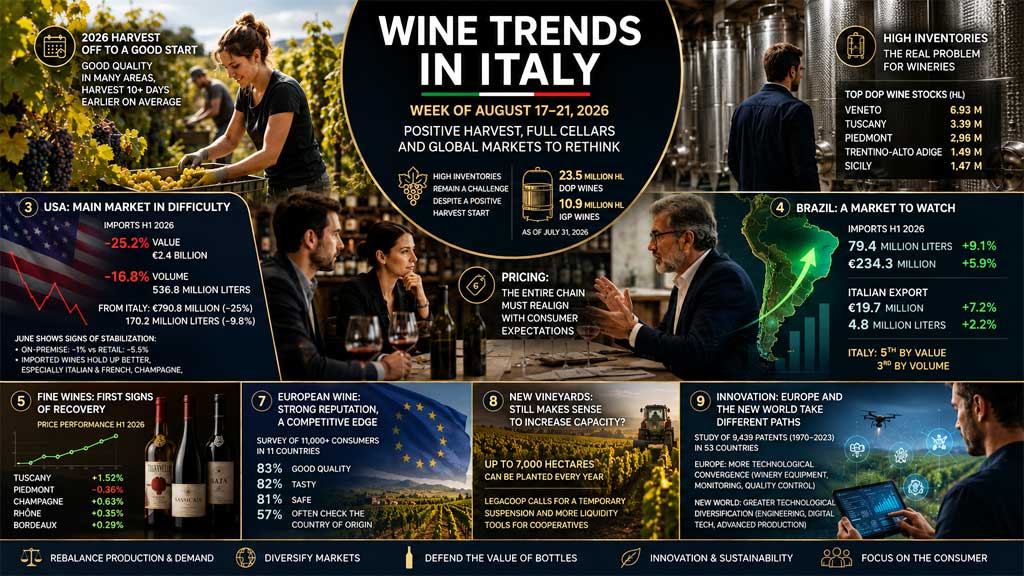
Wine Trends and Performance in Italy – Week of March 30-April 3 – 2026

Italian wine closes the week with a complex picture, but not without prospects.

On the one hand, there are clear signs of pressure on markets, consumption, and exports, especially to the United States; on the other, a more strategic approach to the sector is gaining ground, based on the quality, positioning, adaptability, and cultural value of Italian wine.

The underlying theme this week is clear: the sector is not going through an easy phase, but it still has the extraordinary assets to remain competitive. Strong territories, recognized appellations, consolidated brands, international leadership in many categories, and growing integration with tourism, restaurants, and lifestyle continue to make wine one of the pillars of Made in Italy.

In terms of sentiment, the strongest message conveyed at the launch of Vinitaly 2026 was one of responsible optimism. The testimonies of iconic figures in modern Italian wine, from Piero Antinori to Marco Caprai, from José Rallo to Paolo Damilano, and from Gaetano Marzotto, portray a sector that has already endured profound crises and has regenerated from them. The reference to the fortieth anniversary of the methanol scandal was not merely commemorative: it served as a reminder that one of the most difficult moments for Italian wine also marked the beginning of a structural modernization based on controls, quality, international reputation, and a new awareness among businesses, distributors, and consumers.

And it is precisely this industrial memory that today fuels a less defensive vision of the future. The widespread belief is that Italian wine must stop portraying itself merely as a sector under pressure and instead return to more strongly promoting its unique strengths: territoriality, culture, conviviality, biodiversity, narrative ability, and the connection to Italian cuisine. In other words, the sector cannot simply endure the slowdown, but must use this phase to better reposition itself.

The most sensitive issue remains exports, particularly to the US. The start of 2026 appears challenging: the first few months show a sharp decline in value, with January reported at -35% and the first two months projected to decline by 28% compared to 2025. American tariffs, the euro-dollar exchange rate, the slowdown in consumption, the slowdown in out-of-home sales, and a general instability in inventories and distribution are all weighing on the situation. The United States remains a key market for Italian wine, accounting for 23% of the sector’s total exports, and for this very reason, the focus is on the utmost.

The emerging response, however, isn’t simply a wait-and-see approach. There’s open talk of a special promotional plan to relaunch Italian wine in the US, involving institutions, ICE (Italian Trade Agency), Coldiretti (Italian Farmers’ Federation), Filiera Italia (Italian Supply Chain), American buyers, and trade operators. The strategic message is twofold: on the one hand, we must defend Italy’s presence in the world’s leading market; on the other, we must accelerate geographical diversification to reduce dependence on a single market. In this scenario, Vinitaly confirms itself not only as a trade fair, but also as a platform for the industrial and commercial policy of Italian wine.

Within the domestic market, however, more nuanced and less negative signs are emerging than often reported. The UIV-Vinitaly Observatory reports a very significant finding: in Italy, wine consumers remain just under 30 million, equal to 55% of the population. The audience, therefore, is holding steady. The number of consumers isn’t declining; rather, the way they consume is changing. Daily consumption is declining and occasional consumption is increasing, with the ratio now reversed compared to the past: 61% drink wine occasionally, while 39% consume it daily. This is a sign of a structural transformation in the relationship with wine, increasingly less tied to habit and increasingly focused on choice, occasion, and quality.

This shift should be viewed less alarmistly and more progressively. Italians drink less, but seek higher quality, greater gratification, and a more informed relationship with the product. Moderation is therefore part of the sector’s new balance, not necessarily a sign of disaffection. The problem isn’t that wine is disappearing from consumer behavior; the problem is that the marketing language is changing, and those who sell wine must adapt.

Perhaps the most interesting data of the week concerns young people. Contrary to a narrative that has been prevalent for years, young people are not primarily responsible for the decline in consumption. Indeed, the only significant increase in wine penetration is among the 18-24 age group: from 39% to 47% of the category compared to 2011. This share is still numerically small, but strategically very important, as it indicates that wine continues to enter the aspirational universe of the new generations.

Young people’s relationship with wine, however, is radically different from that of older generations. It’s not based on everyday life, but on curiosity, taste, image, discovery, and experiences outside the home. For Gen Z, wine is enjoyable, represents sophistication, and is associated with well-being and relationships. This explains why young people spend more on average on out-of-home consumption and are particularly active in restaurants and bars. This is a crucial strategic key: the future of wine lies less and less in the repetition of everyday gestures and more and more in the ability to create desirability, narrative, experience, and orientation.

Also of note is the reversal of some clichés about consumption preferences. The data shows that Prosecco remains the most versatile and powerful wine among Millennials, Gen Xers, and Boomers, confirming its role as a major contemporary consumer platform. But among younger consumers, a surprising trend emerges: Gen Z favors great Italian reds. Amarone, Barbaresco, Taurasi, Bolgheri, and Chianti top the list of preferences, demonstrating that red wines have by no means disappeared from the younger consumer’s horizons, as long as they are marketed correctly, with appropriate language, context, and advice.

This aspect has very concrete commercial implications. It means that the problem isn’t the product itself, but the way it’s positioned and presented. Younger people are proving more open to experimentation, more willing to seek advice, more inclined to read online reviews, and more receptive to alternative formats and packaging. This means the supply chain must work harder at the point of sale, in restaurants, on digital communication, and on the readability of the product offering. Wine must not just be good: it must be understandable, accessible in its narrative, and consistent with the language of the contemporary consumer.

On the overall economic level, the sector nevertheless retains enormous importance. Wine is worth approximately €14 billion in revenue, net of related industries, with a positive trade balance of €7.2 billion and an overall impact of €45 billion when considering indirect effects. The area under vine, the number of businesses, employment, and production confirm that it is not just an agricultural sector, but an economic and territorial system of primary national importance. For this reason, too, the current situation requires a calm, non-emotional approach: 2025 was challenging but relatively resilient, while 2026 remains entirely unpredictable.

In the domestic market, large-scale retail trade shows stability in value but declining volumes, once again confirming the “less is more” paradigm. Sparkling wines continue to be the most dynamic category, while reds are struggling and whites remain largely stagnant. Rosés are growing, but still at low levels. Prosecco remains the most resilient and cross-sectional phenomenon, while the entire sparkling wine segment continues to play an important countercyclical role for the sector.

The dynamics of fine wine are also interesting. The secondary market for fine wines appears to be slowly stabilizing, with signs of recovery expected towards the end of 2026. After a long period of price correction, lower interest rates and increased interest from European operators are bringing renewed attention to the collectible wine segment. Despite a still cautious outlook and a more uncertain position for the US, fine wine appears to be emerging from its weakest phase. For high-end Italian wine, this is a sign worth watching carefully, as it confirms that the value of great terroirs and iconic labels can once again become central, even in a selective environment.

Another theme that emerged forcefully is the growing need to integrate wine with other worlds: tourism, cuisine, experience, landscape, and culture. This is now an irreversible trend. Companies that can present themselves not just as producers of wines, but as interpreters of local areas and lifestyles, will be best equipped to navigate the new market cycle. Italian wine retains a unique strength: it sells not just product, but a combination of origin, story, hospitality, reputation, and Italianness. This is where a crucial part of future competitiveness will be played out.

This week also highlights the mistake of indiscriminately cutting back on promotion, events, and visibility. In a complex market environment, rationalizing investments is necessary, but reducing commercial presence and market presence risks further weakening brands. Promotion must be made more selective, more targeted, and more measurable, but it cannot be sacrificed. The sector needs more strategic presence, not less.

Style Selector
Select the layout
Choose the theme
Preset colors
No Preset
Select the pattern