A network portal of Wine Idea. Discover the world of Wine idea

Advanced Container-Based Vending System for Wine, Water and Beverages – Industrial Technology with Full 24/7 Sales Control

In today’s wine and mineral water market, the real challenge is not only producing well, but selling better: protecting margins, managing stock, tracking flows, securing payments, and doing it 24 hours a day.

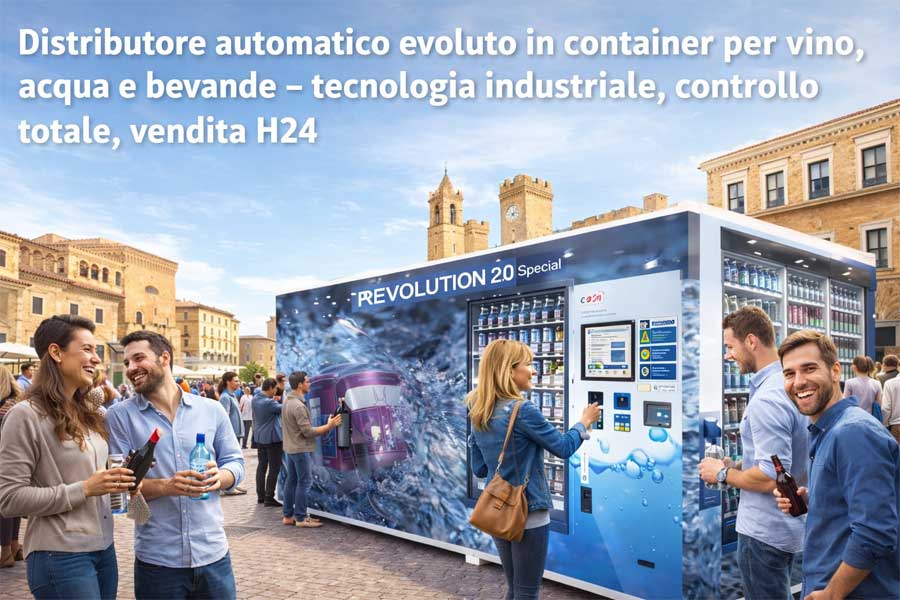
The REVOLUTION 20 2.0 Special was designed with this logic in mind: not a simple vending machine, but a technological platform housed inside a 20’ High Cube container, ready to be installed and operational in tourist areas, town squares, wineries, mineral water springs, logistics hubs, or company premises.

It is industrial automation applied to direct sales.

A Smart 20-Lane Storage System

At the core of the system is a high-capacity automated warehouse.

It features 20 storage lanes, arranged on 4 overlapping levels, each composed of 5 parallel lanes.

Each lane can hold up to 35 packages, for an overall average capacity of approximately 768 units, depending on the format (for example, 1.5 or 2-liter square packages).

Maximum package dimensions:

  • Width: 200 mm

  • Length: 310 mm

  • Height: 350 mm

Compatible with:

  • Bottled water

  • Beer

  • Bag-in-box wine

  • Coffee capsules or pods

  • Other packaged products within compatible dimensions

Each lane is driven by a chain with push paddles that convey the product toward the robotic handling system.

Activation is managed through gear motors with patented automatic clutches, ensuring precision, safety, and operational continuity.

The pushing speed is 10 meters per minute, adjustable depending on cycle settings.

Dual-Axis Robotic Arm: Industrial Precision

The picking system is based on a 2-axis robotic arm (X and Y) with transfer grip.

  • X axis: ball recirculation guides, closed-loop chain motorization, encoder reading

  • Y axis: ball recirculation guides, closed-loop chain motorization, encoder reading

Inverters integrated with encoders allow axis interpolation to optimize picking and unloading times.

The result is higher speed, reduced wear, and greater reliability.

A belt conveyor installed on the arm shelf can pick up to 2 packages per cycle and direct them toward the exit system.

Dual Guillotine Exit System: Security and Control

The ejection system is designed to guarantee:

  • Protection against tampering

  • Product safety

  • Controlled flow management

It consists of a double guillotine mechanism positioned above the discharge belt:

  1. The robotic arm deposits the product into the compartment with the first guillotine open.

  2. The first guillotine closes automatically.

  3. The second guillotine opens, allowing controlled release toward the free-roller conveyor.

This mechanism prevents unauthorized access inside the machine.

Control Panel: Industry 4.0 Ready

The REVOLUTION 20 2.0 Special integrates an advanced management system.

Main components:

  • 2.0 sheet metal panel with increased depth, weather-protected

  • Internal air conditioning unit for cooling and dehumidifying monitors and payment systems

  • Industrial PC with data exchange toward basic warehouse management software

The industrial PC enables:

  • Integration with management software

  • Sales traceability

  • Remote monitoring

  • Compliance with Industry 4.0 technological requirements

Electrical setup requires:

  • A 0.3 A differential switch

  • An Ethernet cable for data connection

Integrated and Autonomous Payment Systems

The system is designed to maximize revenue collection and simplify financial management.

It includes:

  • Coin acceptor with change dispenser (Innovative Technology – hopper)

  • Banknote reader with change dispenser (NV200 Innovative Technology)

  • MYPOS Sigma card terminal

The myPOS Sigma terminal features:

  • Wi-Fi, Bluetooth, and integrated SIM

  • Electronic money account with free IBAN

  • Immediate transaction settlement

  • Compatibility with magnetic stripe, chip, and contactless cards

It allows SEPA/SWIFT transfers to any bank account worldwide.

No dedicated traditional bank account is required.
It operates autonomously and does not require external apps.

Optional:

  • CRT288 age verification reader (for alcohol sales)

  • Internal lockable protection box for readers and coin systems

Customer Interface: Simple and Modern Experience

The customer interacts through:

  • 21” touch screen

  • 32” monitor (optional for advertising)

  • Audio system (optional) with voice guidance

Through the touch screen, users can:

  • Select product and quantity

  • View total amount

  • Choose payment method

The system automatically manages change for cash payments.

20’ High Cube Container: Ready-to-Use Structure

The vending system is installed inside a 20-foot High Cube container, ready for operational installation.

Dimensions:

  • Length: approximately 6000 mm

  • Width: approximately 2400 mm

  • Height: approximately 2900 mm

Technical features:

  • 40 mm insulated walls

  • Complete electrical system

  • Wall-mounted air conditioning unit

  • Marine plywood flooring with metal sheet covering

It is a self-contained, transportable, and immediately installable structure.

Why It Is a Strategic Solution for Wineries and Mineral Water Sources

This system is not just a vending machine. It is a tool for:

  • Direct margin control

  • 24/7 sales without personnel

  • Controlled stock rotation

  • Traceability and management integration

  • Monetization of tourist areas or corporate spaces

For a winery, it means selling wine, bag-in-box, or complementary products continuously, even outside opening hours.

For a mineral water source, it means controlling the territory, eliminating intermediaries, and collecting revenue in real time.

Here, technology is not decorative; it is functional to economic performance.

The future of direct sales is not only digital. It is physical, automated, integrated, and remotely controllable.
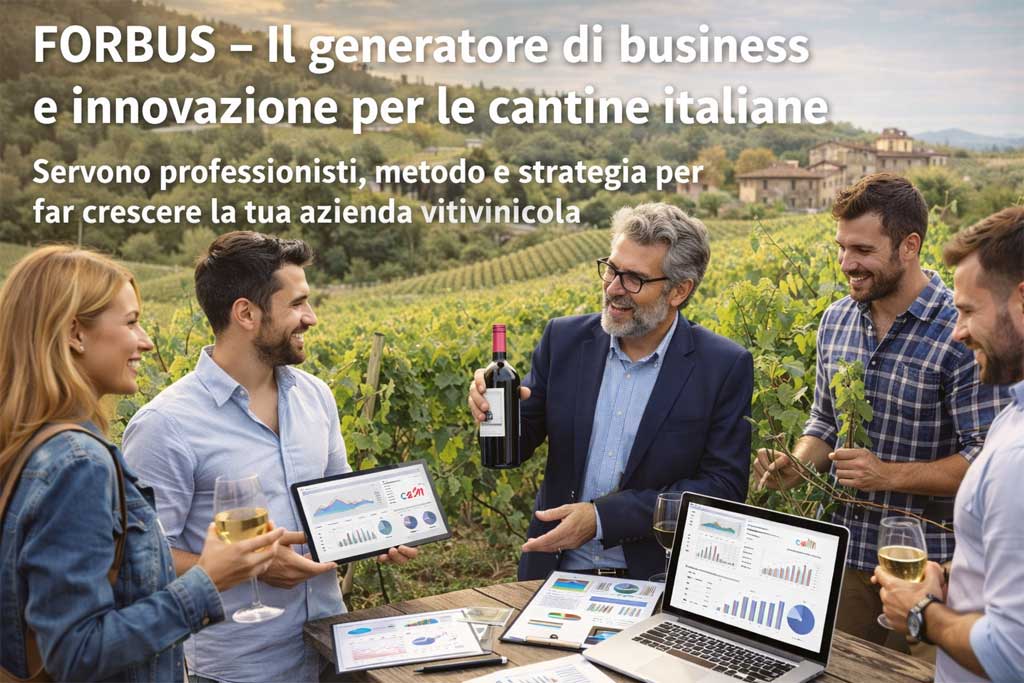

FORBUS – The Business and Innovation Generator for Italian Wineries

In today’s wine industry, quality alone is no longer enough.

You may have an outstanding terroir, a modern winery, an elegant label. But if you do not control numbers, cash flows, margins, positioning, and distribution channels, the market will control you.

What is needed is method.
What is needed is vision.
What is needed is direction.

FORBUS was created from this awareness. It is a structured network of professionals developed by QUIDQUID Srls, a company that for fifty years has supported entrepreneurs, industrial groups, and investors in decisive moments: acquisitions, divestments, expansions, joint ventures, industrial investments, and strategic repositioning.

FORBUS does not provide theoretical consulting.
It builds operational solutions and supports the company all the way to results.

What FORBUS Is

FORBUS – Business Generator for Wineries is a structured joint venture of professionals with real experience across the wine and oenological supply chain.

It is not a list of services.
It is a unified strategic direction capable of transforming a winery into a stronger, more recognizable, and more profitable enterprise.

The objective is clear: to create measurable value.

The Five Strategic Pillars

FORBUS operates across five key areas, because profitability does not originate from a single department, but from the intelligent integration of the entire value chain.

Viticulture
Vineyard enhancement, cost optimization, and economic and production sustainability. The vineyard is not just agronomy; it is the structural foundation of margin.

Winery Management
New organizational and decision-making tools. Flow analysis, inventory management, and production planning aligned with real market demand.

Oenology
Product optimization and stylistic coherence. The wine must express identity, but it must also be understandable and positioned for the market.

Sales
Concrete strategies to sell better and sell more. Channels, pricing, product mix, export management, and direct sales.

Communication & Branding
Clear and credible positioning. Good storytelling is not enough; product, price, and market must be aligned.

FORBUS Operational Projects

FORBUS goes beyond analysis. It activates concrete and replicable business models.

1) Management Lease & Joint Venture

A tool designed for complex phases without losing control of the company.

  • Lease of the business unit for 5–7 years with fixed and variable fees

  • Purchase option at pre-agreed values

  • Time to rebalance financial structure

  • Joint ventures and new companies to share facilities and technologies (dealcoholized wines, new beverages, innovative lines)

A strategic solution that protects the business today and creates industrial options for tomorrow.

2) Open the Winery on Weekends

Wine tourism is growing, yet too many wineries remain closed when visitors are available.

FORBUS creates a simple and profitable model:

  • Organized opening on Saturdays and Sundays

  • Guided tastings

  • Structured visits

  • Increased direct sales

  • Greater territorial visibility

The winery becomes a living place again, not just a production site.

3) Rent to Buy for Agricultural and Wine Businesses

A sustainable model to facilitate intelligent acquisitions.

  • Easier access for young entrepreneurs

  • Enhancement of existing businesses

  • Generational continuity

  • Managerial innovation

The project also operates through the Tenute Agricole 24 portal, specialized in professional matching between supply and demand.

4) “Stop by the Winery… There’s a Gift for You”

A platform that generates real visitor flows.

  • Dedicated corner with personalized gifts

  • Free introductory tasting

  • Loyalty card valid across participating wineries

  • Restaurant, hospitality, and B&B bookings

  • Seasonal offers and events

Word-of-mouth becomes a structured sales tool.

5) “Water & Wine” Project

Smart vending systems with PET and glass eco-compactors.

  • Incentivized collection and recycling

  • Points convertible into vouchers or cash

  • Tangible sustainability

  • Local community involvement

Circular economy that generates both economic and reputational value.

6) Electronic Nose and Palate

Technology applied to sensory analysis.

A portable device capable of:

  • Analyzing wine vapors

  • Collecting olfactory and gustatory chemical data

  • Comparing them with reference databases

  • Delivering objective qualitative reports

Applied research, not science fiction.
A tool that opens new perspectives on product quality and consistency.

7) Wine Days – The Winery Wine Festival

Eight days per year, before harvest.

  • Irresistible pricing

  • Intelligent inventory reduction

  • Direct engagement with consumers

  • New commercial relationships

A logistical necessity becomes a value-generating event.

8) Connected Vineyard 4.0

Digital and predictive vineyard management through the HO-W system.

  • Real-time monitoring of weather, soil, plants, and pests

  • Alerts and timely decisions

  • Reduced treatments

  • Lower costs

  • Greater production efficiency

Technology serving profitability.

Why FORBUS Is Different

FORBUS is not for those seeking an opinion.
It is for those seeking transformation.

It is for entrepreneurs who understand that wine is culture, but it is also business.
That passion is essential, but without structure it is not enough.
That markets select, and those who do not organize themselves will be organized by events.

FORBUS provides strategic direction that integrates viticulture, production, sales, technology, and finance into a single coherent project.

If a winery truly wants to grow, the starting point is not a new slogan.
It is a new method.

Wine press review for Tuesday March 3 -2026

Wineries, Italian wine producers, and wine news.

Italian Wineries

Veraison Group grows 7% and expands its regional platforms

A holding company controlled by Edoardo Freddi’s FreedL Group, it closes 2025 with three acquisitions: acquisition of Cantine Alcesti (Sicily), a joint venture with Vallebelbo (Piedmont), and management of the Conti Sertoli Salis brand (Valtellina). Its strategy is clear: to build identity hubs capable of competing globally without losing its roots.

Rauscedo Winery Appoints Flavio Geretto

A Friulian cooperative with 2,000 hectares between the Tagliamento, Meduna, and Cellina rivers. The new management team focuses on integrating governance, production, and the market. Cooperatives today must think like industrial platforms.

Mosnel celebrates 190 years

Founded in 1836, now the fifth generation at the helm. Family continuity and territorial identity remain key competitive factors in contemporary Franciacorta.

Pio Cesare, fifth generation

Federica Boffa Pio (born 1997) represents the generational transition of one of the Langhe’s historic brands. She has economic vision, deep roots, and international responsibility.

Lisini: Brunello between tradition and modernity

From 1846 to today, a new generation has been working in one of the founding companies of the Brunello Consortium.

Tre Monti Winery triumphs at the Albana Dèi 2025.

Vitalba 2024 wins the technical award and popular vote. The Romagna Albana DOCG demonstrates stylistic dynamism.

Cellar Days

Architectural restoration and family planning in Basilicata: territorial development and hospitality as a lever for growth.

Chionetti Quinto and Son

Riccardo Montolivo visits the historic Dogliani DOCG estate: sport and wine as local ambassadors.

Palmieri Domus Vinaria

A family project in Pallagrello and Casavecchia: indigenous roots and progressive growth.

Italian Wine and Oenology

Alcohol-free wines: a growing segment

Global market already at $2.4 billion, expected to reach $3.3 billion in 2028. The health trend is driving the sector. An open technical issue: the production process and the perception of “ultra-processed.” The No-Lo segment is no longer marginal.

Masi – Amarone Costasera 2020

Amarone Classico DOCG with structure, balsamic notes, and a complex tannic texture. Stylistic continuity and premium quality.

Domìni Veneti – Recioto Amandorlato Amando 2015

Reintroducing Amandorlato into the production regulations: a middle ground between the sweetness of Recioto and the structure of Amarone. A smart revitalization of its identity.

Alto Adige Wine Consortium publishes “Wine in Alto Adige”

A monumental work on geology, zoning, and history. A territory that tells its story with scientific rigor.

Methanol Wine: 40 Years Later

Since 1986, DOC and IGT wines have risen from 10% to 60% of the total. From systemic crisis to structural qualitative leap.

Wine Spectator celebrates the Italian Next Generation

Twelve iconic families on the cover. Generational transitions are the central theme of Italian wine 2026.

Customer-centricity in wine

The article in Il Corriere Vinicolo relaunches the paradigm: “We serve people, not wine.” Less self-referentiality, more attention to the market.

Genevitis: democratic wine

A project by Mack & Schühle Italia featuring narrative QR codes for young people. Mini-videos, an affordable price, and straightforward language.

Duo – Altea Illotto

Organic blend of Monica and Sardinian Barbera. Young vineyard on calcareous marl in Campidano.

International

ProWein Business Report 2026

Stability in the short term, slight recovery expected in 2027. White wines are stable and sparkling wines are healthy. Most attractive markets: Germany, the Netherlands, and Japan. The United States is penalized by tariff uncertainty.

Wine and Culture Events

TourismA invites you to Vinitaly

ArcheoVinum Project: Integration between archaeological sites and wineries. Wine as a driver of advanced cultural tourism.

Turin Wine Fair

Micro-productions, lesser-known grape varieties, and new languages are emerging. Piedmont surprises beyond the clichés.

The Art of Wine – Casa Paladin

A sensory journey through historic training systems (Bellussera, Pergola Veronese, Guyot, and Alberello). Technical culture as a tourist experience.

EVO oil: quality before price

Nomisma survey for Sol Expo: 42% buy directly from the producer. Trust and local identity matter more than savings.

Assets & Innovation

Strategic Asset – Tenuta Chianti Classico (18 km from Florence)

120 hectares, active DOCG rights, historic brand. Platform ready for industrial integration or wine resort development. Iconic land mass = defensive value.

REVOLUTION 20 2.0 Special

High-capacity vending machine in a 20-foot High Cube container. 24-hour sales, Industry 4.0 integration, data and margin control. Automation as a sales tool.

FORBUS – Business Generator for Wineries

Audits, operational plans, and ongoing management of production, branding, and sales. In a selective market, structure and governance make the difference.

The common thread today is clear: generational transition, emerging segments (No-Lo), integration between culture and tourism, more mature industrial governance.

Italian wine isn’t simply changing. It’s selecting those capable of evolving.

Today’s wine press review was brought to you by WINEIDEA.IT .

See you tomorrow.

Wine press review for Monday March 2 -2026

Wineries, Italian wine producers, and wine news.

Italian wineries

Calabria – Cirò

  • Brigante Vigneti & Cantina : conscious craftsmanship and modern techniques for a new identity for Cirò, capable of excelling in white wines as well. A viticulture of choice, not nostalgia.

Romagna – Montiano

  • Donegato Winery : The Berretti brothers’ winery celebrates its first anniversary and presents five new labels. Its architecture blends seamlessly into the landscape, its strong wine tourism vocation, and its panoramic views are a welcome sight.

Valpolicella

  • Cantina Valpolicella Negrar / Domini Veneti : Transitioning from organic to integrated pest management. A pragmatic reflection on quality, sustainability, and agronomic results.

Langhe

  • La Spinetta : stylistic continuity and the Rivetti family’s distinctive vision. A wine concept based on density, tension, and memory, between Moscato, Barbera, and Barbaresco.

Friuli – Rauscedo

  • Cantina Rauscedo : Flavio Geretto is the new general manager. Strengthened governance and a new phase of development for one of Friuli’s major cooperatives.

Emilia – Modena

  • Ventiventi : Classic Method wines aged for 40 and 50 months. Slowness is a stylistic choice and a defining characteristic.

Veneto – Conegliano Valdobbiadene

  • L’Antica Quercia : La Ghiandaia Farmhouse is born. Farmhouse hospitality is a natural extension of the organic and biodynamic winemaking project.

Campania – Sannio

  • Giovanni Iannucci Winery : respectful viticulture, varietal recovery (Camaiola) and in-depth soil analysis between Guardia Sanframondi and Castelvenere.

Italian wine and oenology

Markets

  • Italian agri-food exports will reach 73 billion euros (5%) in 2025. A record figure according to Coldiretti based on Istat.

Denominations

  • Chianti Classico : growth driven by Riserva and Gran Selezione, awaiting UNESCO recognition. The region consolidates its position and value.

Technique and culture

  • Red or white wine: structure, acidity, aroma, and pairings explained in a popular way.
  • Valtellina Superiore Sassella 2015: a critical reflection on the market, prices, inventory, and rotation difficulties.

Territori

  • Collio: Quality Pinot Bianco under €15, an example of balance between value, terroir, and affordability.

Production scenario

  • A record 2025 harvest in Puglia (11 million hl), but cellars are full and exports are slow. National stocks exceed 60.9 million hectoliters .

International

Burgundy

  • François Carillon: the “anti-star” winemaker. Highly sought-after white wines, limited production, and strong international demand.

New categories

  • Dealcoholized wines at Mundus Vini 2026: blind tasting of over 300 samples. A rapidly evolving category, with uneven quality but a structural trend.

Wine events and supply chain

Extreme refinements

  • Tenuta del Paguro: wines aged underwater in the Adriatic Sea return to the World’s Best Sommeliers’ Selection 2026.

Fairs and competitions

  • Sol d’Oro – Northern Hemisphere: Awards for global olive oil excellence. Redoro Frantoi Veneti stands out among the Big Organic Producers.
  • SOL Expo Verona: excellent oils from 10 countries, Puglia the most awarded region.

Sector policies

  • National Olive Oil Plan: up to €500 million to relaunch Italian extra virgin olive oil and increase production by 25%.

Demonstrations

  • Sorgentedelvino LIVE in Reggio Emilia: 150 natural winemakers exploring culture, territory, and craftsmanship.
  • Wines of the Heart in Genoa: tastings with over 45 wineries, focusing on wine lovers and professionals.
  • AIS Veneto – Alba Vitæ : €5,000 raised for the “Gli Occhi di Bea” charity project.

Strategic focus QUIDQUID

Three assets. Three key territories. A single value logic.

  • Hilly Friuli (Udine): a winemaking and agritourism platform ready for expansion.
  • Conegliano (TV): a highly flexible industrial and logistics hub.
  • Cison di Valmarino (TV): a farming village in the UNESCO Hills, an integrated rural ecosystem.

Thanks for listening. Today’s wine press review is brought to you by WINEIDEA.IT .

See you tomorrow.

Style Selector
Select the layout
Choose the theme
Preset colors
No Preset
Select the pattern