A network portal of Wine Idea. Discover the world of Wine idea

Wine press review for Saturday April 18 -2026

Italian wineries and Italian wine producers.

Italian wineries

Colle Santa Mustiola, the “off-the-map” Sangiovese that wins over Vinitaly. Among the most interesting wineries to emerge at the fair is Colle Santa Mustiola, a small Tuscan winery near Chiusi that has built its identity around Sangiovese, with a radical approach and long aging times. It’s an example of a niche winery that focuses on stylistic consistency and distinctive positioning.

Fratelli Alessandria, Barolo Monvigliero 2022: elegance and precision. From Verduno comes one of the most refined interpretations of Barolo Monvigliero 2022: a refined aromatic profile, gentle tannins, and a strong connection to one of the appellation’s most celebrated crus. A wine that confirms the value of historic terroirs and the wineries capable of expressing them with precision.

Lungarotti, Umbria’s wine as a complete experience. Located between Torgiano and Montefalco, Lungarotti is presented as a model of integration between wine, hospitality, landscape, and culture. A concrete example of how a winery can extend its value beyond the bottle, transforming the land into an experience.

Cantine di Venosa, the return of the Dry Muscat Terre di Orazio 2004. An old tasting brings attention to a wine that stands out from the crowd: the Dry Muscat Terre di Orazio, a dry white wine from Lucania, still produced today by the historic Cantina di Venosa. A testament to its production identity and ability to endure over time.

Cav. Mennato Falluto awarded by the Prosit Guide. The Torrecuso winery stands out at Vinitaly thanks to the recognition it received in the Prosit Guide, with awards for its Aglianico del Taburno Riserva, Coda di Volpe, Falanghina, and other labels. This is a positive sign for Taburno and for wineries that promote native grape varieties.

The Sardinian wineries of the Sant’Isidoro District are presenting at Vinitaly. Mulleri, Cantine Fraponti, and Cantina di Quartu, together with the rural district of the Cagliari metropolitan area, have brought to Verona a model of territorial development based on networking, rural identity, and local culture. The centenary of Cantina di Quartu stands out.

Italian wine and Italian oenology

Vinitaly 2026 closes with positive results, but the sector remains under pressure. The 58th edition closed with approximately 90,000 attendees, 4,000 exhibitors, and professionals from 135 countries. However, the climate remains complex: some foreign attendance is declining, geopolitical tensions are weighing on the sector, and the slowdown in some strategic markets is weighing on it. For the sector, the message is clear: it’s holding up, yes, but it’s undergoing a reorganization phase.

CMO Promotion: €98 million for non-EU markets. The Italian Ministry of Agricultural, Food and Forestry Policies (MASAF) is bringing forward the new CMO Wine Promotion call for proposals for the 2026/27 marketing year and is making €98 million available to support internationalization. This is an important measure to help companies plan ahead for entry or consolidation in third-party markets.

New EU rules for no- and low-alcohol wines. The new EU Regulation 2026/471 introduces harmonized criteria for the labeling of dealcoholized and low-alcohol products. This is an important step because the no- and low-alcohol segment is increasingly becoming part of the strategic scope of European wine.

Organic wine: Italy confirms its global leadership. A quarter of the world’s organic vineyards are located in Italy, with over 132,000 hectares of organic vineyards and approximately 3 million hectoliters produced. This data reinforces the country’s position on sustainability, an increasingly central theme, including in commercial terms.

Organic Wine Labeling: Growing Attention to Regulatory Requirements The European regulatory framework is increasingly complex regarding organic wine labeling requirements: the inspection body, EU logo, origin of raw materials, and consistency of the ingredient list are becoming increasingly strategic elements for transparency and compliance.

Le Marche, a laboratory of Italian organic wine . Nearly 40% of the Marche region’s vineyards are certified organic. Le Marche remains one of the most advanced regions in terms of agriculture, although the issue of converting organic value from the vineyard to the bottle and, therefore, to the market remains unresolved.

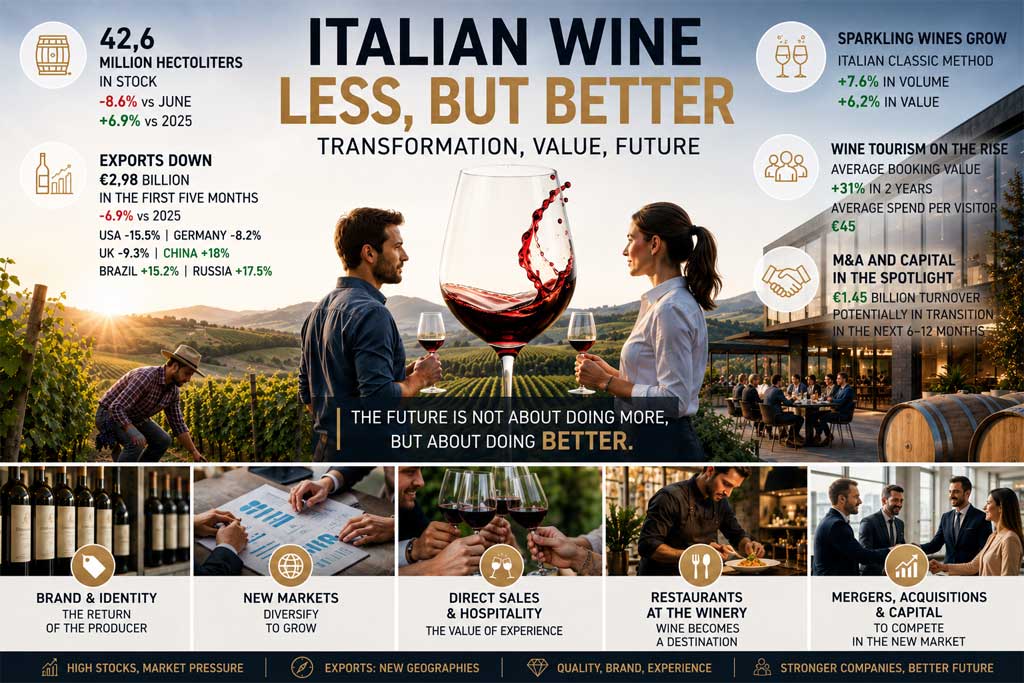
Producing less and better: the strategic direction emerging from Vinitaly. From discussions among operators, observers, and institutions, an increasingly clear direction emerges: less volume, more quality, a focus on niches, consumer focus, and new market models. This synthesis accurately describes the future trajectory of Italian wine.

Circana: Prosecco to be the top-selling wine in Trentino-Alto Adige in 2025. According to data presented at Vinitaly, the best-selling wines in Trentino-Alto Adige are Prosecco, Merlot, and Teroldego. Lagrein is also growing. This data confirms the importance of sparkling wines and the market’s ability to reward both major national drivers and certain local labels.

Piedmont, Prosecco continues to dominate supermarkets. Prosecco is also the best-selling wine in Piedmont’s large-scale retail trade, ahead of Barbera and Lambrusco. Nebbiolo is growing strongly. Modern retail continues to offer valuable insights into the true tastes of Italian consumers.

Puglia’s rosés confirm quality and dynamism. According to Gambero Rosso, Puglia’s best rosés signal a region undergoing rapid evolution, with a turnover of award-winning wineries and a qualitative growth that consolidates Puglia’s role as an important laboratory for this type of wine.

Science, health, and wine: the International Academy of Healthy Drinking is born. A new front for reflection on the relationship between wine, health, and longevity has opened at Vinitaly. The goal is to bring the debate back to a scientific basis, avoiding simplifications and placing wine within a broader vision of lifestyle and food culture.

The energy cost of wine is becoming a strategic issue. Italian wineries are increasingly sensitive to energy issues, both due to the impact on margins and industrial sustainability. Technical and operational guidelines, also in light of the ENEA guidelines, are pushing for greater efficiency and cost reduction.

International

Vinitaly exceeds expectations, despite the international storm. The Verona show held up well, despite a challenging global context: geopolitical tensions, fears over tariffs, logistical blockades, and trade uncertainty accompanied the entire event. The sector is holding up, but feels the need for alternative markets and greater strategic protection.

Foreign markets and new routes: Italian wine looks beyond the US. The new CMO tender and the debate that emerged at the fair confirm that Italian wine must expand its reach into non-EU markets and diversify its risks. Mercosur, Australia, India, and other markets are becoming increasingly important in a period of high instability.

The Mediterranean in a glass: 11 wines that express a broad identity. A tasting dedicated to Mediterranean wines highlighted how sea, wind, light, and culture can become international keys and powerful narratives, capable of uniting diverse territories under a common winemaking sensibility.

Wine events

Vinitaly 2026 closed with 90,000 attendees and buyers from over 70 countries . The event confirmed its central role and international appeal. Beyond the numbers, the true value lies in the quality of demand, with selected top buyers and a significant international presence despite the challenging global environment.

“Excellence of Italy,” a super tasting of great vintages. From Terlano to Bellavista, Quintarelli to Vietti, San Guido to Antinori, and Donnafugata: Vinitaly hosted a tasting event dedicated to Italy’s great historic wineries and the iconic vintages that have shaped the country’s wine.

90 bottles to tell the story of Italy’s wine. A long journey from North to South through 90 labels offered a broad interpretation of the country’s winemaking heritage, including territories, styles, innovation, packaging, and new consumer sensibilities.

The 10 unmissable wines tasted at Vinitaly 2026 From South Tyrolean Schiaves to the great Barolos, from the Giulio Ferrari Riserva del Fondatore to a 1988 Verdicchio Riserva and a historic Marsala: the most memorable tastings of the fair confirm the depth and breadth of the Italian and international offering present in Verona.

Wine tourism: visitors buy, but accessibility remains a key issue. Data presented at Vinitaly Tourism shows that over 77% of winery visitors purchase wine, with an average purchase price of around $100. However, transportation and the ease of access to wine regions, especially for foreign visitors, remain an issue.

Digital wine tourism: the connected winery becomes a necessity. Among the event’s emerging themes is the digital transformation of winery hospitality: reservations, data management, experience personalization, and continuity of the visitor relationship become true competitive assets.

Parma takes center stage at Vinitaly. With stands, meetings, and a widespread presence of industry professionals, the Parma region carved out a prominent position at the fair, confirming the increasingly close connection between wine, gastronomy, and regional identity.

Final strategic summary: The day confirmed three key pillars. First, Vinitaly 2026 reaffirmed the solidity of Italian wine , but within a much more fragile and unstable international landscape. Second, sustainability, organic, energy, no/low alcohol, and labeling are no longer peripheral issues, but structural levers of competitiveness. Third, wine tourism, digitalization, and high-value niches remain crucial areas for building margins, direct relationships, and positioning.

Thanks for listening, we remind you that today’s wine press review was brought to you by WINEIDEA.IT .

See you tomorrow.

Wine press review for Friday April 17 – 2026

Italian wineries, Italian wine producers, and current wine news.

Italian wineries

Masciarelli and the strategy of wine by the glass: Marina Cvetic relaunches the theme of restaurants as a commercial lever: according to the Abruzzo-based producer, even high-end labels must be offered by the glass to capture new consumption and respond to the slowdown in the sector.

Valdo Spumanti honored for 100 years of excellence. At Vinitaly 2026, Treviso-based Valdo Spumanti received the special “Vinitaly – 100 Years of Excellence” award, a recognition that recognizes a century of history, international growth, and entrepreneurial vision in the world of Prosecco Superiore.

Classese, the Oltrepò Pavese region presents its 40 pioneers. The Oltrepò Pavese Consortium is launching the first bottles of Classese at Vinitaly, the new Pinot Noir-based classic method intended to strengthen the region’s identity and visibility. Forty wineries are already participating in the project.

Herita Marzotto expands in the United States. The Veneto-based group is accelerating its presence in America with the acquisition of Domaine Lumineux in Oregon, formerly owned by Francis Ford Coppola. This transaction confirms its commitment to consolidating its position in one of the most renowned areas for Chardonnay and Pinot Noir.

Alto Adige wines on tour with Italian cuisine The Alto Adige Wine Consortium launches “The Alto Adige You Don’t Expect,” a calendar of traveling dinners showcasing the versatility of Alto Adige wines paired with iconic dishes from Italy’s regions.

Sicilian wineries take center stage in Verona. Sicily presents itself at Vinitaly with 164 wineries and a rich program of masterclasses, panels, and initiatives dedicated to the sector’s new challenges, including wine tourism, organic farming, and local development.

Lento Winery on the Papal Flight Two Calabrian labels from the Lento winery in Lamezia Terme, the Rosà di Lento and the pure Magliocco, were selected for the onboard service of the papal flight to Africa, strengthening the winery’s international profile.

Crifo launches Rosso di Seta. The historic Ruvo di Puglia winery presents a new label at Vinitaly designed to appeal to a younger, more female audience, without sacrificing its connection to local tradition.

Fasoli Gino is among Forbes’ 21 must-visit wineries in the world. This Verona-based winery has received international recognition, not only for the quality of its wines but also for the hospitality experience built around the Magari Estates Hotel, in the heart of the Illasi Valley.

Terredora Di Paolo looks to a female future. Daniela Mastroberardino confirms the winery’s positioning as an example of a company capable of innovating while maintaining a strong connection with tradition.

Italian wine and Italian oenology

Double pruning and two harvests per year. Climate change is prompting new technical considerations in the vineyard. Double pruning is proposed as a possible response to the early growth cycle, to limit the effects of high temperatures on grape quality.

Wine is changing tone, style, and strength. At Vinitaly 2026, a sector emerges that remains central but speaks new languages: greater attention to experience, storytelling, and low- and no-alcohol categories, while interest in spirits and mixology is growing.

Female leadership leads to stronger, more forward-thinking companies. Research presented at Vinitaly by Mib Trieste and Le Donne del Vino highlights that the growth of female leadership leads to more advanced governance models, greater attention to human capital, and a more long-term vision.

The Leonardo Awards celebrate Italian wine and food. Among the protagonists of the 2026 edition are Marchesi Frescobaldi, awarded as a historic company, and companies that combine wine, catering and lifestyle such as Oniverse and Da Vittorio.

The 40 Under 40 of Taste The generational turnover in wine continues to show positive signs: young producers, often under 30 and with a strong female presence, are demonstrating an increasingly competent, courageous, and distinctive approach.

Energy Efficiency in the Winery: At Vinitaly, ENEA presents a practical guide to help Italian wineries reduce energy consumption and costs, improving competitiveness and sustainability with already applicable solutions.

Erbaluce di Caluso, the strength of the late harvest Cantina 366’s “Scelte di Vite d’Ottobre 2021” label offers an advanced interpretation of Erbaluce: neither a passito nor a sparkling wine, but a late-harvest wine, complex and capable of expressing great aromatic depth.

Great white wines that defy time. The vertical tasting of Terlano’s Vorberg presented at Vinitaly relaunches the theme of long-aging Italian whites, demonstrating that some labels can evolve for over twenty years while maintaining their identity and tension.

Leonardo Marras and Graziana Grassini also appear among the 100 most influential names in Italian wine, confirming the growing importance of Maremma in the national wine system.

Native Calabrian Grape Varieties: A Heritage to Be Rediscovered Vinitaly once again focuses on the value of Calabria’s native grape varieties, considered by international observers to be an important key to understanding the deepest roots of Italian wine.

The wine system under pressure. According to the UCI, the main risks for the sector currently stem from the climate, production model, and market tensions. The sector requires structural interventions to avoid a progressive weakening in the long term.

International

Vinitaly closes with 90,000 attendees. The 2026 edition closed with 90,000 visitors overall, 26% of whom came from 135 countries. Strong participation from international buyers, confirming the fair’s role as a platform for the internationalization of Italian wine.

America is strategic for Italian groups The acquisition of Herita Marzotto in Oregon confirms that the United States remains a decisive axis for the growth of large Italian wine companies, despite the complex international context and fears linked to tariffs.

Italian wine between geopolitics and the global economy The 2026 Wine Power List crowns American importer Victor Owen Schwartz in first place, highlighting how the wine supply chain is increasingly influenced by international trade dynamics.

Wine events

Vinitaly 2026, a positive final outcome. The 58th edition closes with solid results and a strong international profile. For Veneto Governor Alberto Stefani, the event must increasingly become a “Veneto Agora,” a place for discussion, business, and regional identity.

The Political and Symbolic Side of Vinitaly On the final day, Stefani reiterated Vinitaly’s value as a showcase for the region and also shared his more personal side, citing Valpolicella Ripasso and Amarone among his favorite wines.

The “cringe” of Vinitaly 2026 Between questionable slogans, over-the-top communication campaigns, and questionable statements, the more ironic and controversial side of the Verona fair is not missing this year either.

Grand Tasting of Great Italian Vintages Among Vinitaly’s flagship tastings, “Eccellenze d’Italia” brought together historic wineries and iconic wines from Alto Adige, Tuscany, Piedmont, Veneto, Sicily, and other major Italian wine regions.

Only Wine 2026 looks to young producers From April 25th to 27th, the market exhibition dedicated to young winemakers and small emerging wineries returns to Città di Castello, increasingly a point of reference for authenticity and new energy in the sector.

Sicilia DOC at Milan Design Week The Sicilia DOC Consortium participates in the Fuorisalone in the Brera Design District with events that intertwine wine, design, music, and contemporary lifestyle, strengthening the presence of wine in urban and creative contexts.

Women of Wine from the Marche region at Vinitaly: Leadership, territory, and wine tourism are the focus of the meeting promoted by the association’s Marche delegation, focusing on the role of women as interpreters of biodiversity, culture, and new entrepreneurial visions.

Thanks for listening, we remind you that today’s wine press review was brought to you by WINEIDEA.IT .

See you tomorrow.

Wine Price Trends in Italy for the Week of April 13-17 – 2026

The week of April 13-17, 2026, marked by the Vinitaly trade fair in Verona, provided a clear picture of Italian wine: a sector that remains a world leader in production, strong in reputation, export capacity, and the value of its territories, but which is facing a profound transformation.

The picture that emerged is not that of a simple and temporary crisis, but of a real structural change in consumption, markets, and the strategies needed to compete.

The clearest message coming from institutions, consortia, observers and operators is one: it is no longer enough to defend wine, we need to rethink it in an offensive, selective and higher-value way .

From defense to relaunch: the sector’s new strategic line

Among the most powerful statements to emerge during the week was the position expressed by Agriculture Minister Francesco Lollobrigida, who emphasized the need for a change of approach: not a policy of retreat, but a strategy of relaunch.
The concept is clear: it makes no sense to incentivize exit from production, while it is strategic to support a model that leads to better production, greater value and more effective communication .

This approach comes at a time when Italian wine needs to strengthen its position not only with numbers, but also with a modern narrative capable of capturing new consumers, new markets, and new consumption styles.

Domestic consumption: large-scale retail trade confirms declining volumes

The most recurring data of the week concerns modern distribution.
In 2025, wine sold in large-scale retail outlets confirmed a contraction in volumes, while value held up better thanks to the increase in average price and the shift towards higher-end products.

According to Circana analyses, the wine and sparkling wine sector in large-scale distribution closed the year with a value of approximately 3.2 billion euros and 737 million litres sold , with a 2.7% drop in volumes and substantial stability in turnover ( -0.5% ), supported by an increase in the average price of 2.3% .

The data confirms a now consolidated trend: Italians are buying less wine, but when they do buy, they choose more carefully.
The suffering is concentrated above all in the lower price ranges and less distinctive products, while labels with greater perceived value, territorial identity and premium positioning are holding up better.

Sparkling wines still dominate, while reds and semi-sparkling wines are struggling.

This week too, the most dynamic segment remains that of bubbles.
Sparkling wines remain the category that bucks the trend, with growth of 1.5% in volume and 1.2% in value in large-scale retail trade in 2025. Rosé and white sparkling wines are particularly strong, driven by more informal consumption, home aperitifs, and greater versatility across consumption occasions.

The performance of the Classic Method is even better, growing both in volume and value and confirming itself as one of the most interesting categories for the sector’s premiumization strategy.

The situation is more difficult for still wines, especially reds, which, despite maintaining the largest market share, continue to lose ground.
Sparkling wines are among the most penalized segments, with evident declines in both volumes and values.

The overall picture therefore indicates a change in tastes: consumers are increasingly orienting themselves towards fresher, easier-to-drink, less demanding wines and often with lower alcohol content .

Premiumization: people drink less, but they seek higher quality

One of the most notable trends that emerged this week is premiumization.
Consumers aren’t simply reducing their purchases: they’re changing their criteria for choosing. Price ranges above €10 are performing better than entry-level segments, signaling a market that’s shrinking in volume but improving in value.

This trend is particularly visible in higher-end white wines, but in general it affects the entire sector, which manages to maintain a certain economic stability thanks to a favorable “mix effect”: fewer purchases, but more selective ones.

For the sector, this means that future competition will no longer be based on quantity, but on the ability to build coherent assortments, strong identities, distinctive positioning and credible storytelling .

Wine e-commerce: digital growth and sparkling wines dominate

While traditional distribution is showing signs of slowing down, the online channel is showing signs of dynamism.
In the first quarter of 2026, online searches for wine exceeded 657,000 , an increase of almost 10% compared to the same period in 2025. On an annual basis, overall searches reached 2.67 million in 2025, confirming that wine is now a structural category even in the digital landscape.

Sparkling wines once again dominate online interest, accounting for 52% of searches , ahead of red wines with 36.7% . Whites, rosés, and dessert wines lag further behind.

This data is important because it indicates that the digital channel is not just a space for purchasing, but also for discovery, comparison, and the creation of desire.
Furthermore, the web increasingly favors premium labels and recognizable brands, with a strong focus on price comparisons and the best time to buy.

Young consumers: less faithful to traditional models, more curious and more selective

Among the most interesting signs of the week is the renewed attention towards young consumers.
According to IWSR and UIV analyses, the 34-year-old demographic isn’t abandoning wine, but rather reinterpreting it. Younger consumers are more inclined to experiment, more attentive to sustainability, more open to low-alcohol and alcohol-free wines, and, in many cases, more willing to spend on products perceived as authentic, innovative, and consistent with their values.

Their consumption is less frequent and less ritualistic than that of previous generations, but more oriented towards the experience, quality and identity of the product.
This makes it clear that the future of wine lies not so much in recovering old consumption patterns, but rather in the ability to dialogue with new lifestyles and new cultural codes.

Dealcolati and NoLo: from niche to segment to observe

During Vinitaly 2026, an important part of the discussion also focused on dealcoholized wines and NoLo.
The segment is still small, but it has now firmly entered the industry’s radar. The creation of the Vinitaly NoLo Experience and the dedicated focus groups by UIV and Veronafiere clearly indicate that this is no longer a marginal area of development.

In large-scale retail, the sector is still worth just a few million euros, but distribution is expanding and the topic is taking on strategic importance, especially for reaching younger consumers, international audiences, and alternative consumption opportunities.

It is not the heart of Italian wine today, but it could become an important complementary lever in the medium term.

Exports: Italy strong, but in a more complex scenario

On the international front, Italian wine confirms its structural strength, but in a much more complicated context than in previous years.
Italy remains the world leader in production , with 47.3 million hectolitres in 2025 , and confirms its position as the world’s second largest exporter in value , with exports of around 7.8 billion euros .

However, 2025 ended with a contraction in exports, particularly penalized by the slowdown in the United States and the international geopolitical situation. The US remains the primary destination market, but tariffs and trade uncertainty have had a significant impact. Pressure on the American market remains strong in the early months of 2026.

Alongside this criticality, however, important opportunities emerge.
Indeed, positive signals are growing from alternative and emerging markets such as Mercosur, India, Eastern Europe, Brazil, Vietnam, and some areas of Southeast Asia . The acceleration of the European Union’s free trade agreements is seen as a concrete lever for the geographical diversification of Italian exports.

The key point that emerged this week is that Italian wine can no longer afford to be excessively dependent on a few key markets: it must broaden its reach, better segment its targets and address new demand niches .

Prosecco, the driving force of the system

In this scenario, Prosecco DOC continues to represent the driving force of Italian wine.
In 2025 it closed with a growth of 2.3% at global level , with 667 million bottles bottled and 82% of production destined for foreign countries , for a total value of 3.6 billion euros .

Very positive data from the United States, France, Germany, and several emerging markets confirms the denomination’s great ability to adapt to markets, speak contemporary languages, and intercept international demand.
Prosecco thus continues to be not only a winning denomination, but also the symbol of an export model based on accessibility, recognisability and distribution strength.

High inventories: the structural crux of overproduction

One of the most sensitive issues that emerged this week was that of inventories.
The data from “Cantina Italia” updated to 31 March 2026 indicate 55.9 million hectolitres of wine in stock , with an increase of 5.7% compared to the same period in 2025. To these are added musts and new wine in fermentation.

The data confirms a problem of balance between production and market absorption.
Many operators, from Uiv to retailers and observers, have reiterated that the current level of inventories is essentially equivalent to a harvest and a half in the cellar , a situation considered unsustainable in the medium term.

This is where one of the clearest messages of the week comes from: intelligent production containment is needed , especially in areas and segments where supply clearly exceeds market capacity.
Producing less, but better, is no longer just a slogan: it is the condition for protecting value, prices and profitability.

Territories, identities, and regions: the case of Emilia-Romagna and the role of Veneto

The week also showed how the territories remain the true competitive capital of Italian wine.
Emilia-Romagna presented itself at Vinitaly 2026 with a strong, integrated, and growing regional system: over 14,000 companies , more than 52,000 hectares of vineyards , approximately 5.37 million hectoliters produced in the 2025 harvest, and €433 million in exports . The renovated regional pavilion, the integration with the Food Valley, and the link between wine, PDO and PGI products, and tourism represented one of the clearest models of advanced territorial narrative.

At the same time, Veneto continues to confirm its position as the leading region for exports, with Verona still the leading province in Italy for beverage exports, almost entirely represented by wine.
The province of Verona closed 2025 with 1.21 billion euros in exports , albeit a slight decline, confirming its position as a strategic center for Italian wine both economically and symbolically.

CMO Promotion: More resources and flexibility for internationalization

Another important front of the week is that of support policies.
Over 98 million euros have been made available for the 2026-2027 CMO Promotion campaign, of which 22 million for national programmes and the remainder allocated to regional calls for proposals and multi-regional programmes.

The new tender structure aims to simplify access, digitize procedures, accelerate deadlines, and increase flexibility, helping companies operate more effectively in non-EU markets.
The purpose of the intervention is clear: in an unstable global scenario, international promotion is no longer an afterthought, but a crucial tool for competitiveness.

Wine press review for Thursday April 16 -2026

Italian wineries, Italian wine producers, and current wine news.

Italian wineries

Gavi DOCG returns to Vinitaly after three years. The Gavi Consortium relaunches its presence in Verona with a wine talk dedicated to the different interpretations of the appellation: classic, sparkling, reserve, and older vintages. This return strengthens the Piedmontese white’s positioning among tourism, culture, and regional storytelling.

Derthona Due.Zero confirms the success of Timorasso. The Colli Tortonesi are consolidating their position as a contemporary and dynamic area, capable of attracting growing interest thanks to the quality of their white wines, the stylistic openness of their producers, and the valorization of Timorasso as a distinctive wine.

Cantine Lento to Star on the Papal Flight Cantine Lento’s Rosà and Magliocco labels will accompany Pope Leo XIV’s apostolic journey to Africa, offering a symbolic and prestigious showcase for Calabrian wine and the region’s native grape varieties.

Cantina Futurista, an urban winery opens in Treviso. A new model of integrated winery with catering and artisanal distillation debuts: open-view winemaking, a strong urban identity, and a fusion of wine, hospitality, and reclaimed industrial design.

Cantine del Notaio shines at Vinitaly 2026. Five wines selected by an international jury in the 5StarWines guide confirm the Lucanian company’s qualitative strength and the growing importance of Vulture in the national wine scene.

Agricola BES, wine as a family life project From Monferrato comes the story of a small winery born from a radical life choice: leaving the city, rediscovering nature and building a farming business tied to family values and the well-being of their children.

1701 presents new vintages in Franciacorta The winery launches Dosaggi Zero Riserva 2019 and Ellessedì 2022, confirming a production line oriented towards expressive purity, technical precision and small, high-quality runs.

Tenuta Venissa among the best wine travel destinations The Venetian winery has been nominated for the 2026 Wine Travel Awards, strengthening its position in the high-end segment of international wine tourism and collectible wines.

Abruzzo wineries enjoyed a positive outcome at Vinitaly. Abruzzo closed the event with encouraging results: 97 wineries exhibited, over 300 labels showcased, and a strong tribute to Luigi Cataldi Madonna, a historic figure in the region’s wine industry.

Italian wine and Italian oenology

Wine must be understood before it is consumed. The April issue of Il Gusto puts wine back at the center as a cultural and not just commercial phenomenon, underlining the need to better communicate it in a complex phase for the entire sector.

Businesses and institutions join forces. A clear consensus emerges from the Wine Table at Vinitaly: more effective international promotion, less bureaucracy in the CMO Wine, and shared actions between businesses, the Ministry, and ICE to address the current economic situation.

Dealcoholized wines could grow by 90% Italy sees strong potential in dealcoholized wines, but production expansion remains hampered by regulatory uncertainties and procedures that are still too complex.

Resistant Glera opens a new phase. Vivai Rauscedo and the University of Udine present new clones resistant to the main grapevine diseases, capable of maintaining the grape variety’s identity and supporting more sustainable viticulture.

Langhe, the debate over glyphosate returns. The issue of chemical weed control reignites debate in an area where wine, landscape, tourism, and international image are closely intertwined.

US exports decline, India sees strong growth for Prosecco. Federvini reports a decline in exports to the United States (-3.6%), while Prosecco in India has seen a 165% increase in five years, a sign of new growth regions.

The grape moth threatens Tortona vineyards. Municipalities in the Tortona area are launching a shared monitoring project using pheromone traps to limit damage to Barbera and Timorasso vineyards.

Female Leadership, 5% Higher Incomes CREA and Donne del Vino research confirms that women-led companies are among the most solid and innovative in the sector today, with better overall economic performance.

Agea digitizes the story of Italy’s vineyards. An immersive app has been presented that integrates cartography, audio-video content, and company data to tell the story of the country’s winemaking heritage in a more accessible way for buyers, tourists, and enthusiasts.

Ten years after Tachis, his legacy remains central. A celebratory masterclass at Vinitaly recalled Giacomo Tachis’s decisive role in the renewal of Italian wine, through some of the labels that have marked the recent history of national winemaking.

Large-scale retail trade: lower volumes, but value holds thanks to premium In 2025, wine on the shelves will decrease by 2.7% in volume, while the value remains almost stable thanks to the shift in consumption towards medium-high price ranges.

Producing less and better: the new direction for wine. From discussions between operators and analysts, a shared vision emerges: focusing on niches, quality, sustainability, and greater awareness of new consumer behaviors.

Wine bars are changing the way we drink wine. New, more dynamic and cultural formats are transforming the wine bar into a space for discovery, storytelling, and selection, closer to contemporary consumers.

Valcalepio invests in young people and wine culture. The Bergamo Consortium strengthens its ties with the local area and looks to new generations through projects with schools.

Wine and Health in the Mediterranean Model Vinitaly returns to discuss the relationship between wine, moderation, and well-being: the Mediterranean model is proposed as a cultural and nutritional key, distinct from abuse.

In Lazio, a €1.2 million call for proposals for wine. The Region supports innovation, competitiveness, and efficiency of winemaking businesses with grants of up to 40% of investments.

International

Canada remains a winning model for exports The CETA agreement confirms its success story: since 2017, European wines in Canada have been growing at a significantly higher rate than those of non-EU competitors.

Italian wine seeks new global routes. Amid US tariffs, slowing consumption, and market restructuring, the sector is increasingly looking to new areas of development, from India to other emerging markets.

Coldiretti Trentino Alto Adige calls for an extraordinary European plan. The new CMO rules are considered useful but insufficient: a European structural intervention is needed to support exports and business profitability.

Wine events

The Prosecco Hills: Photography, Art, and an International Vision At Vinitaly, the UNESCO landscape of Conegliano and Valdobbiadene is showcased through an editorial and photographic project that aims to strengthen its global visibility.

Città del Vino promotes the territory and regional identity. From Friuli Venezia Giulia comes the call for increasingly coordinated promotion between institutions, municipalities, and producers to strengthen the link between wine, landscape, and local culture.

Vinitaly: Trentino’s revitalization and a strong political presence The event confirms its central role as a platform for the sector, but also continues to be the scene of a very strong political presence.

Roberto Giacobbo talks about his wine project. The well-known television personality brings to Vinitaly a narrative that combines family memories, passion, and innovation, transforming wine into a personal and entrepreneurial story.

Lario wines are growing, driven by tourism. The Lario area sees tourism and the international reach of Vinitaly as a concrete lever to consolidate its winemaking development.

In short, April 16th represents a sector still under pressure, but not stagnant: Italian wine is seeking new avenues for growth through exports, varietal innovation, premiumization, new consumption models, and an increasingly strong integration between territory, culture, and international promotion.

Thanks for listening. Today’s wine press review was brought to you by WINEIDEA.IT.

See you tomorrow.

Style Selector
Select the layout
Choose the theme
Preset colors
No Preset
Select the pattern