A network portal of Wine Idea. Discover the world of Wine idea

Wine press review for Saturday February 14 – 2026

Wineries, Italian wine producers, and wine news.

Italian wineries

Temporary Wine by Andrea Moser (Alto Adige) A project outside the box born in Mazzon (Caldaro) that rewrites the story of Alto Adige Pinot Bianco. “Fly,” a 100% Pinot Bianco produced in just 1,280 bottles, has been named one of the 50 Rare Wines in the 2026 Italian Wines Guide with a score of 96/100. This result confirms the career trajectory of a winemaker who has already been a key player at Cantina di Caldaro and at Franz Haas.

Colline Novaresi: Davide Carlone’s dream. A mosaic of vineyards amidst woods, dry stone walls, and natural parks, with Monte Rosa in the background. A project that unites landscape, heroic viticulture, and territorial identity, transforming the hillside into a cultural as well as agricultural attraction.

Brunello “A Diletta” – Col di Lamo Wine and music meet in the story of Gianna Neri and her daughter. A Brunello that symbolizes resilience and female continuity, with the 2019 vintage expressing elegance, complexity, and technical precision.

Umbria del Vino: 20 wineries win. The fifth edition of the national wine competition promoted by the Umbria Chamber of Commerce has concluded. Twenty wineries were recognized for their quality and identity, confirming the region’s increasingly structured winemaking scene.

Emilia-Romagna awarded in Brussels Fifteen regional wineries were recognized at the Concours Mondial de Bruxelles 2025. This result strengthens the region’s international standing, capable of expressing diverse styles and territories under a common qualitative denominator.

Italian wine and Italian oenology

2025 Harvest: Less Wine, More Problems. Production stable at 44.3 million hectoliters, but inventories rising to 61 million (68 million including must). The paradox of a system no longer able to absorb even ordinary production. The UIV’s warning points to a structural, not a cyclical, crisis.

Falling prices and rising stocks . Despite the reduction in yields, quotas aren’t enough. Surpluses of common wines and IGT white wines are growing, while PDO wines are holding up better. Financial pressure on wineries will become the real issue for 2026.

Tuscany: Less Volume, More Value. A clear strategy emerged at the PrimaAnteprima in Florence: focus on quality and identity. Ninety-seven percent of the vineyards are PDO. Exports are slightly up in volume but declining in value, interpreted as a readjustment after record years. On the domestic market, the region is holding its position better than the national average.

EVO oil, like wine, is changing the narrative of Made in Italy: extra virgin olive oil follows the path already blazed by wine, from commodity to cultural product. Territory, supply chain, research, and storytelling become levers of value.

Water Management in the Winery Water as a Critical Process Factor: Timely Measurement, Sensors, Optimization of Washing Cycles, and Wastewater Management are at the Center of New Strategies for Operational Efficiency and Sustainability.

Young people and alcohol consumption: Ferrara’s alarm bells ring. University students are already drinking Spritz in the morning: data on youth addiction is growing. This issue is raising questions about responsibility, communication, and new consumption patterns.

International

Mercosur, the post-2027 CAP, and wine. In Strasbourg, the European Parliament unanimously voted on the new support framework for the wine sector (625 votes in favor). This is a strong political signal, but the system remains fragile amid trade liberalization, transition, and generational change.

Zorah Winery, Armenia A new chapter in Armenian viticulture with ancient roots and an Italian soul. Zorik Gharibian’s project combines historical memory and contemporary vision, putting Armenia back on the map of quality wine.

Italy and France: the art of living through wine. The cultural dialogue between two superpowers of taste is strengthened at Wine Paris, between territory, aesthetics, and UNESCO heritage. Wine as a common language of identity and cultural industry.

Wine events

Zero-alcohol cocktails in Cortina d’Ampezzo. Bartenders at top hotels are once again experimenting with zero-alcohol mixology using Castagner products. A clear signal: the out-of-home experience is evolving and embracing sports, wellness, and new consumption styles.

Irresistible PIWI – Lazise, April 26–27, 2026. The third edition of the event dedicated to resistant varieties. Not just a tasting, but a discussion on sustainability, research, and the future of viticulture.

The best bottles for Valentine’s Day From reds to whites to sparkling wines: a selection of iconic labels to celebrate the occasion, with a focus on Alto Adige and Pinot Bianco.

Thanks for listening. Today’s wine press review was brought to you by WINEIDEA.IT .

See you tomorrow.

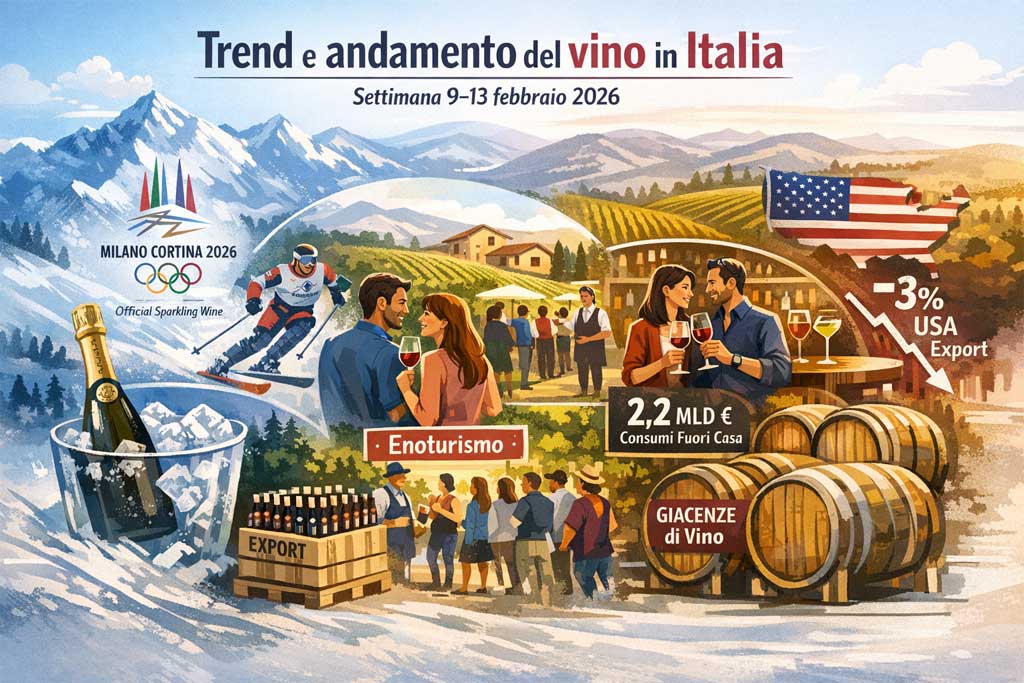
Wine Trends and Performance in Italy – Week 9–13 February 2026

The week of February 9–13, 2026, captures a sector moving on two parallel tracks: on one side, the global “showcase” (Olympics, major events, exports, and international promotion), on the other, the daily industrial reality of more selective consumption, pressure on margins, and a structural issue that is once again central: inventories.

In the meantime, a third, increasingly crucial route to business profitability is gaining ground: wine tourism, now seen as a countercyclical asset

1) Milan Cortina 2026: Prosecco DOC uses the Games as a global megaphone

The most symbolically powerful event of the week is the activation of the Prosecco DOC Consortium as the Official Sparkling Wine of the Milan Cortina 2026 Olympic and Paralympic Winter Games, defined by the Consortium as the most important partnership in the history of the denomination , with the declared aim of bringing the Veneto-Friuli region before a global audience estimated at over 3 billion spectators .

The strategy is “capillary”, with the presence of:

13 race venues (family lounges) between Cortina, Milan, Val di Fiemme and Valtellina
6 Live sites / Fan villages (Milan, Bormio, Livigno, Cortina, Predazzo, Brunico)
Casa Italia (Milan Triennale, Cortina, Livigno) and related projects such as the “Musa” wine selection
a proprietary hub with high media impact: Prosecco Doc Sparkling Hub (a 600 m2 lounge in Milan’s San Babila area), designed for media and opinion leaders, with content that intersects haute cuisine, mixology, art, and technology.

Sixteen DOC companies involved in official activities are participating in the operational management, while the visibility campaign will reach strategic hubs (airports, ski resorts, tourist destinations) with very high exposure estimates (e.g., 23 ski lift stations and an estimated 6.6 million impressions ). Completing the plan: educational tours with operators and journalists from the USA, UK, Canada, Japan, China, and Germany, to transform the sporting event into a commercial and narrative bridge to the markets.

Key message: Prosecco DOC is pushing for a positioning that is not “just wine”, but territorial identity, a productive community, a global story , using the Olympics as an accelerator of reputation and demand.

2) Out-of-home consumption: 2.2 billion and a changing beverage market

On the domestic front, out-of-home consumption of alcoholic and non-alcoholic beverages has returned to the pre-pandemic level of €2.2 billion . The most interesting data is not just the recovery, but the composition of this growth , which reflects a more “hybrid” consumer:

24% carbonated soft drink
alcoholic cocktails : purchases from 69 to 91 million (32%)
liqueurs and spirits : from 58 to 76 million (30%), with a 23% acceleration over the last year.

The “low & no alcohol” theme is firmly on the radar: non-alcoholic beers reach 49 million purchases (18% compared to 2025 and 79% compared to pre-Covid), and the system event Beer & Food Attraction 2026 (Rimini, 15–17 February) is positioning itself as an evolutionary observatory, with the debut of Mixology Attraction dedicated to spirits, cocktails, soft drinks and low/no alcohol products.

Implication for wine: competition for “consumption occasions” in the out-of-home market is growing. Wine must better address contemporary social gatherings (evolving aperitifs, smart pairings, more “dynamic” glasses), because growth is driven by alternative categories that are more agile and narrative.

3) USA: consumption in structural decline, Italy “holds up” thanks to three denominations – still

The US market continues to lose ground: wine consumption has fallen for the fifth consecutive year , with sales in distribution (horeca retail) down 7% in value and around 9% in volume .

In this context, Italy does better than average , but remains in the red:

Italian wine: -3% in value, -5% in volume
the denominations that support the estate are above all:
Chianti Classico (strong growth, 12% in value; in the other reading also 12% and 17.2% in volume)
Prosecco (approximately 3% in value; with growth in volumes as well)
Brunello di Montalcino (2% in value; with increasing volumes)

The rest of the basket shows widespread suffering (with explicit mentions of Moscato d’Asti, Pinot Grigio delle Venezie, and Valpolicella). The UIV analysis adds a crucial industrial point: the five-year decline should be interpreted as a coherent and structural phenomenon , aggravated by market saturation and inventory accumulation along the supply chain, with prices also affected by tariffs (a trend increase of around 4% in December) while producers have already “sacrificed” average price lists (quoted cuts of 10% in the six-month period).

Key message: In the US, wine isn’t “collapse” due to a single factor, but rather to a shift in the landscape: less automatic, more selective demand, and channels that absorb less inventory. Those who grow do so because they have a strong category (bubbles) or a denomination with a very clear premium identity .

4) Export and business models: the case of Edoardo Freddi International

In a period of global complexity (geopolitics, inflation, barriers), emerging players confirm that the issue isn’t “wine in crisis” in general, but rather the marketing model . Edoardo Freddi International closes 2025 with:

6% in value and 9% in volume
over 38 million bottles
presence in 112 markets , with a focus on Europe (approximately 45% of exports) and stability in the USA (indicated at -1% in their perimeter).

Among the trends cited for 2026: resistant/climate-adapted varieties, lighter and more gastronomic wines, and growing interest in no- and low-alcohol options . Also interesting is the “anti-obvious” approach to packaging/format: for example, the 500 ml Amarone in Denmark (a market with a high share of singles), to increase rotation and willingness to purchase.

Key message: you win not only with “good” wine, but with formats, channels, storytelling, and positioning designed around real consumer behavior.

5) Italy, large-scale retail trade: 2025 negative but not falling, bubbles bucking the trend

The large-scale retail channel remains central to volumes and shows a “resistance” dynamic:

2025 sales: 618 million liters ( -3.1% ), value 2.3 billion euros ( -0.5% )
average price: €3.77/litre ( 2.6% )

Within the general data, a polarization can be seen:

0.75 l bottle (including bubbles): 1.8 billion (0.2%) but volumes -1.9%
sparkling wines : 3.6% in value and 3.1% in volume , average price €7.29/litre (0.4%)

Market analysis: Large-scale retail trade emphasizes the “less quantity, more value where there’s desirability” mix. Sparkling wines remain the category that best captures social interaction and attendance.

6) Cantina Italia: high and concentrated stocks, with the North (and Veneto) at the forefront

The structural data that weighs on the bargaining power of companies is the snapshot of inventory:

as of January 31, 2026 : 60.9 million hectoliters in stock
2.4% on 31 December 2025 (1.4 million hl)
5.9% on 31 January 2025 (3.3 million hl)

Added to these are:

6.4 million hl of must
601,663 hl of VNAIF (new wine still fermenting)

Territorial and qualitative concentration:

56.8% of the stocks are in the North, with Veneto at 26%
53.5% of the stocks are DOP (32.5 million hl), 26.7% IGP (16.2 million hl)
strong concentration by denomination: 20 denominations out of 531 make up 58.5% of the GI stocks
Prosecco DOP accounts for 11.7% of stocks (5.7 million hl), followed by several significant IGP and DOC/DOCG wines (including Chianti DOCG 1.45 million hl).

Key message: Inventories aren’t just “a number”: they represent commercial pressure , promotional risk, and a brake on investment. Supply management (even with crisis measures) is once again a key issue for industrial policy.

7) Rules and Politics: EU Wine Package, Transparency on Alcohol-Dealcoholized Products and Crisis Levers

On the regulatory-institutional level, the week saw a strong push from the European Parliament towards a new package for the sector (broad approval: 625 in favour), with measures ranging from:

support for promotion in third countries (EU co-financing up to 60% )
Clearer definitions for dealcoholized wines :
“non-alcoholic” with the wording “0.0%” only up to 0.05% vol
“reduced alcohol content” for wines over 0.5% vol with a reduction of at least 30% compared to the origin
Recognition and support for wine tourism (projects up to three years, renewable up to nine)
uniform crisis measures, and the possibility of drastic interventions such as eradication in the event of a structural oversupply
25% cap on the national budget for crisis distillation and green harvesting.

Coldiretti emphasizes that simplification and transparency are steps forward, but that adequate resources are now needed to make the reform truly effective, noting the economic size of the sector (estimated turnover of €14.5 billion, 241,000 businesses, 681,000 hectares).

8) Wine tourism: countercyclical lever, potential 1 billion with more incoming visitors

Contrary to the slowdown in wine consumption, wine tourism continues to grow and is being described as a strategic asset . Key points that emerged:

Global wine tourism market: $46.5 billion , Europe at 51%
In Italy, the foreign component is still relatively low (around 32% ), with room for growth compared to other benchmarks
77% of companies have invested in wine tourism (2022–2024), with average investments exceeding 14% of turnover ; for 2025–2027, over half plan new investments (digital, sustainability, accessibility, quality of experience)
Each tourist presence generates over 150 euros of added value in the area (broad supply chain: catering, services, crafts, culture)
Estimate: with 5% international tourist presence, approximately 1 billion euros could be generated as an additional result.

The main obstacle remains fragmented governance (many non-integrated local actors), but there is a growing willingness to “work as a system” with public-private consortia for territorial marketing.

Key message: for many wineries, wine tourism is no longer “hospitality”, but a business unit : margins, direct sales, loyalty and deseasonalization.

9) Culture and communication: Cotarella pushes for an offensive and responsible narrative

In terms of public discourse, Riccardo Cotarella’s appeal stands out: enough defending ourselves, we need to make ourselves heard again . The key point is the distinction between moderate consumption and abuse, and the shift in international language toward “harmful use of alcohol” rather than generalized demonization. In this context, the Irish postponement of health labels is also cited as a political and cultural signal that “the issue is complex” and cannot be reduced to uniform messages.

Key message: Demand is rekindled not only by discounts or increased production, but also by cultural legitimacy , clarity, responsibility, and coordinated communication.


Wine press review for Friday February 13 -2026

Wineries, Italian wine producers, and wine news.

Italian wineries

A winery in a 16th-century quarry: a €10 million project in Manduria. A new wine citadel is being built in the heart of Puglia, nestled in a 16th-century tuff quarry. The project, spearheaded by entrepreneur Luigi Blasi, calls for a futuristic winery nestled within a 130-hectare estate, with an estimated employment impact of dozens. This operation combines historic restoration, territorial development, and an industrial vision.

Cantina dell’Arte: Vivallis celebrates Depero in Rovereto. The Vivallis Winery in Nogaredo dedicates a permanent room to Fortunato Depero, merging art, territory, and wine. The initiative strengthens the winery’s cultural positioning and highlights the Depero Bianco and Rosso wines as expressions of the Vallagarina’s identity.

Italian wine and Italian oenology

“Yes!” Prosecco DOC: Italian sparkling wines conquer France. In the homeland of Champagne, Prosecco DOC consolidates its position: France becomes the world’s third-largest market. In 2025, 667 million bottles were declared (1.1%), with over 82% destined for export to over 160 countries. At Wine Paris, the Consortium was a key player with 34 companies.

The Gentleman ranking crowns Gaja’s Barbaresco Sorì Tildin 2022 as the best Italian red wine . Giacosa, Antinori, and Sassicaia also make the podium: a collective tale of Italian excellence according to international critics.

Over 60 million hectoliters in the cellar: the inventory issue. At Wine Paris, Lamberto Frescobaldi (UIV) reports the most significant data: inventories are at an all-time high, the market is slowing, and bulk wine is struggling. The “Italian winery” is growing, but its value is struggling to keep pace with volumes.

Tuscany’s wine industry holds its own on the markets. With €1.2 billion in exports (15% of the national total), Tuscany looks ahead with confidence, despite recording a 2.7% decline in labeling and bottling in 2025. The shared awareness: a change of pace in communication is needed, especially for the great reds.

Vino Nobile di Montepulciano soars abroad. In 2025, 64.5% of sales will be on international markets. With a total value approaching one billion euros, Nobile confirms its position as an economic pillar and regional ambassador, ahead of the 2026 Preview.

Guaranteed PGI | “Post-Natural” Wine After decades of debate, the concept of natural wine is evolving. A “post-ideological” phase is emerging, where method, transparency, and consistency are key, overcoming the rigid distinction between natural and conventional.

Prosecco DOCG: trucks removed from the UNESCO hills. The Ecolog project aims to reduce traffic and smog by up to 40% by moving logistics hubs outside of Valdobbiadene and introducing electric vehicles. This is a key step towards sustainability and landscape protection.

International

French wine exports plummet: down 8% in value in 2025. According to FEVS, France has hit a 25-year low. The United States, China, and the euro/dollar exchange rate are weighing on exports. Champagne also grew in volume but lost more than 4% in value, a sign of pressure on margins.

Krug Vintage 2013: A Surprising Vintage Presented in Milan, Krug ‘s first 2013 vintage stands out for its freshness and acidic tension. A sign of how climate and style are redefining even the great maisons.

Wine, Mercosur, and the post-2027 CAP: Europe accelerates. The European Parliament overwhelmingly approves the new support framework for the wine sector. The message is clear: the crisis is structural and requires new tools for the market, protection, and transition.

The Wine Package is now law: what’s changing? The definitions for “0.0%,” “alcohol-free,” and “reduced alcohol” wines have been approved. This is a crucial step for a rapidly growing no/low alcohol category, which now gains regulatory clarity.

Wine events

Wine Paris 2026: Italy Takes Center Stage CEO Rodolphe Lameyse announces a unique pavilion dedicated to Italy for 2027. With 6,500 exhibitors from 63 countries, Wine Paris consolidates its position as a global wine hub.

Southern Roots: Registration is now open for the 21st edition. From June 3 to 8, 2026, in Gioia del Colle, the event celebrates Southern Italian wines and oils with competitions, B2Bs, tours, and historic vertical tastings of native grape varieties.

From Paris to Tokyo: the Area39 model at the top of fairs At Wine Paris, Area39 designs the largest single-management space in Italy, involving over 160 entities in an integrated B2B hub.

Spazio Vignaiolo at Hospitality 2026 In Riva del Garda, 80 FIVI wineries will enliven the area dedicated to wine tourism and experiential hospitality, with tastings, seminars, and Slow Food cuisine.

Franciacorta takes center stage in Paris Between Wine Paris and an evening on the Seine, the Franciacorta Consortium strengthens its international positioning, bringing the Italian Metodo Classico to the iconic locations of the City of Light.

Thanks for listening. Today’s wine press review is brought to you by WINEIDEA.IT . See you tomorrow.

BIOFACH – “The World of Organic Agriculture 2026″

FederBio: European organic consumption peaks at nearly €59 billion, with Italy leading the way in UAA and organic producers.

Surface areas substantially unchanged while consumption of organic food is growing in Europe and globally, reaching an all-time high.

This is the picture that emerges from the report ” The World of Organic Agriculture 2026 “, relating to 2024, just presented at Biofach by the Organic Agriculture Research Institute FiBL in collaboration with IFOAM , the Federation of Global Organic Associations.

According to the analysis, organic land in Europe remains stable at 19.6 million hectares. Of this, 18.1 million hectares are concentrated in the EU, where organic farming represents 11.1% of total agricultural area, compared to 3.9% for the entire continent.

Among the countries with the largest organic land areas, Spain stands out with nearly 2.9 million hectares, followed by France with 2.7 million hectares, and Italy, which ranks third with 2.5 million hectares . However, it leads in terms of organic UAA, which exceeds 20%, almost double the European average. Italy also maintains its leadership position in terms of the number of organic producers, with over 87,042 operators out of the 490,637 active in Europe as a whole.

Retail sales of organic products in Europe are significant, reaching a record €58.7 billion in 2024 (an increase of 4.1%), a trend that reinforces consumers’ growing focus on healthier and more sustainable consumption choices.

In 2024, Germany remained Europe’s largest organic market (€17.0 billion), followed by France (€12.2 billion) and Italy (€5.2 billion). Switzerland, meanwhile, recorded the highest per capita consumption in the world, at €481 per person.

Globally, according to analyses in ” The World of Organic Agriculture 2026 ,” organic agricultural area remained essentially stable at 99 million hectares in 2024, while global retail sales of organic food and beverages reached €145 billion. The United States remains the largest market with €60.4 billion, followed by Germany with €17 billion and China with €15.5 billion.

“European analyses provide us with a clear picture: citizens are increasingly shifting their food choices toward organic,” says Maria Grazia Mammuccini, President of FederBio . “The significant finding is that, for the first time in 2024, the percentage growth in consumption exceeded the percentage growth in organic farmland. However, the increase in organic sales must go hand in hand with an increase in production. This is why we must not slow down the objectives of the Green Deal: EU strategies supporting agroecological development, combined with significant investments in research and innovation, are key to growing the sector. The paradox is clear: while citizens are choosing sustainability, Brussels is holding back. Instead, we must resolutely move forward towards a resilient agriculture and food system that respects ecosystems. It’s not just about the environment, climate, and health, but about the real economy: the future of our agricultural businesses and that of future generations is at stake.”

Style Selector
Select the layout
Choose the theme
Preset colors
No Preset
Select the pattern