A network portal of Wine Idea. Discover the world of Wine idea

Agricultural land: why some increase in value and others lose it

Regulations, supply chains, and trends that are redrawing the value map.

Something less visible than a revolution, but much more impactful, is happening in the agricultural world: a silent selection of value.

Some lands are becoming increasingly sought-after, while others remain stagnant or are declining. This isn’t by chance, nor is it simply a matter of agronomic quality. What makes the difference today are the rules, supply chains, and consumption .

2024 captures this transition well. The average value of agricultural land in Italy reached €22,400 per hectare , a 1% increase. A modest but significant increase: after years, it outpaces inflation and signals that land is once again being viewed as an economic asset , not just an inherited legacy.

But talking about “land prices” in a generic sense is misleading. The market isn’t a single thing: it’s a constellation of local micro-markets, which react very differently to the same stimuli.

An increasingly polarized geography of value

The 2024 numbers show a clear divide:

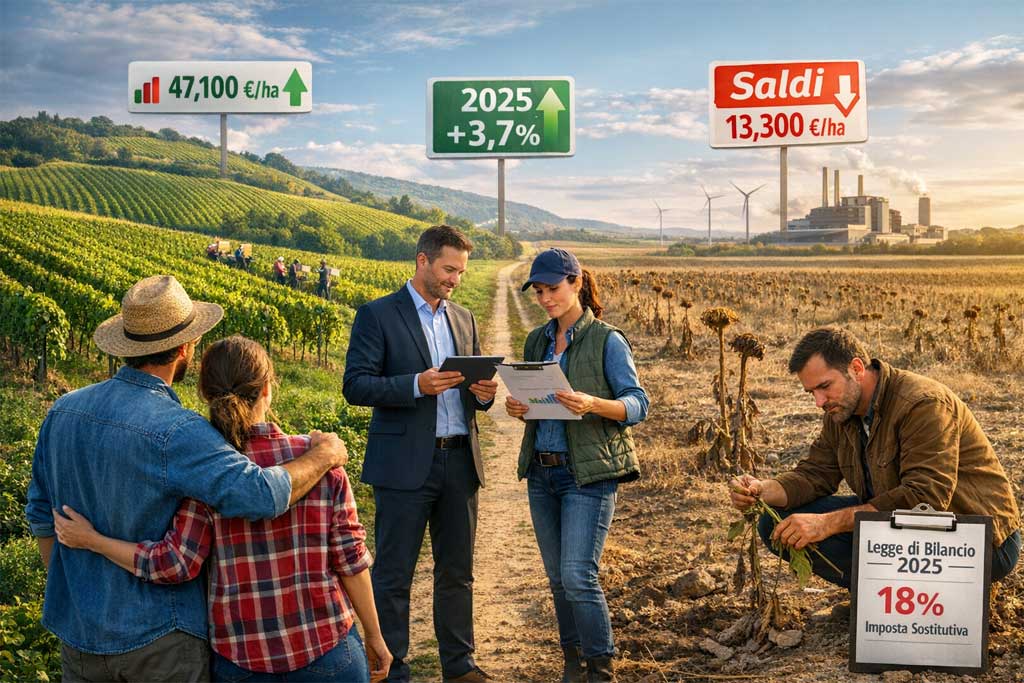
  • Northeast : €47,100/hectare, the most expensive and competitive area
  • North-West : €35,200/hectare (2.3%)
  • Center : €15,100/hectare
  • South : €13,300/hectare (1.9%)
  • Islands : €8,600–9,000/hectare

These differences aren’t the result of market sentiment. They’re the result of concrete factors: logistics, water availability, the presence of structured supply chains, leading companies, strong brands, and the real possibility of turning land into income .

Where a major brand arrives, or where a denomination becomes a driving force, the landscape changes status. Where, however, a crop loses commercial appeal or is left out of the mainstream, its value tends to decline.

The 2025 signal: the market starts moving again

Another indicator deserves close attention. In the first half of 2025, sales showed a shift in pace:

  • –2% in the first quarter
  • 3.7% in the second quarter

It’s not a boom, but it’s a sign of a return to decision . After a long wait-and-see phase, investors and operators are beginning to evaluate concrete operations again. The main reasons are two:

  • CAP 2023–2027 , which offers a more stable framework for those investing in the medium to long term
  • More readable regulations , especially on the fiscal and patrimonial level

When the rules become less opaque, capital tends to come back into play.

Why land is worth (or isn’t worth) today

The value of a piece of land doesn’t depend on its size, but on its economic function within its context . The question to ask isn’t “how beautiful is it,” but: what can it realistically become in the next ten years?

The factors that have the greatest impact today are:

  • location and logistical accessibility
  • urban planning destination and constraints
  • water availability (often decisive)
  • inclusion in certified supply chains or strong brands
  • environmental and landscape constraints
  • exposure to climate risks
  • compatibility with energy or multifunctional projects

Land increases in value when it enters a credible economic narrative . It declines when it remains outside of the flows, or when it produces something the market no longer demands.

The fiscal lever that changes strategies: 2025 Budget Law

The real break comes at the regulatory level. With the 2025 Budget Law, the ability to revalue land for tax purposes becomes a structural possibility.

Owners of land owned as of January 1, 2025, can update the market value by paying a substitute tax of 18% (it was 16% in the previous two years).

Key conditions:

  • Expiration: November 30, 2025
  • certified appraisal drawn up by a qualified professional, based on technical-economic criteria

It’s not a technical detail: aligning tax value with real value changes the way we plan sales, generational transitions, corporate transactions, and investments . Land ceases to be an “uncertain” variable in the accounts.

Owners and investors: two different effects, same direction

For landowners, reassessment is a strategic assessment: updating today can reduce future rigidities . It’s not an automatic choice, but a tool to be evaluated with capital considerations.

For buyers, the effect is equally significant: more transparency means fewer negotiating deadlocks and greater fluidity in transactions. Real estate markets function better when values are legible.

Unused lands and new projects: the potential to change the map

In the long term, the real playing field is different. Italy has over 4 million hectares of uncultivated land and approximately 14,000 hectares of public land , with an estimated value of around 180 million euros .

Over €1 billion is planned for the 2024–2028 period for recovery, innovation, and sustainability, with a focus on young entrepreneurs and new management models.

If these policies become real projects, their value will not only depend on the initial price, but on the ability to transform the territory into a business , using modern tools: water management, technology, short supply chains, economic sustainability even before environmental sustainability.

It’s not a fad: it’s a phase change

The real turning point isn’t a single fact. It’s the changing climate:

  • prices that are holding up again
  • more stable tax rules
  • more selective investors
  • lands that are valuable if they are “useful” for something

Land is no longer an indistinct commodity. It has once again become a strategic choice , rewarding those who understand supply chains, anticipate consumption, and understand where major market flows are going—and where they are leaving.

My dad always told me, remember that the earth always gives you food!

Wine press review for Wednesday December 3 – 2025

News on Italian wine and oenology.

ITALIAN WINERIES

Conte Collalto Winery – Christmas as a Rite of Identity. The historic Conegliano-Valdobbiadene winery offers Manzoni Bianco and Vinciguerra for the holidays, wines that tell a tale of millennia-old roots and conviviality. The hills cultivated for over a thousand years by the Collalto family are once again the focus.

Cantine Ermes – Investments in Oltrepò and new “Oltrepo” line: Eight new tanks (40% capacity), the first line of seven wines dedicated to the region, and a confirmed growth path. President Rosario Di Maria speaks of strong synergies with producers and institutions following the acquisition of the Canneto Pavese winery.

Cantina Belpoggio – Twenty Years Celebrated in Montalcino At Benvenuto Brunello, the winery recounted two decades of history with “Decanting2Decades.” An immersive celebration between Castelnovo dell’Abate and the Abbey of Sant’Antimo, the ideal cradle of Sangiovese.

ERT1050 – The Classic Mountain Method according to Oniwines. A sustainable vertical viticulture project for Trentodoc Classic Method has been launched in Brentonico (Trentino). The winery is a “fortress” nestled in Monte Baldo.

Palazzo Lodron – Day 2 of the Advent Calendar Between Trento and Lake Garda, an elegant, handcrafted production takes shape, with award-winning wines and an underground cellar that showcases a four-century-old heritage.

La Sabbiona – Special Go Wine Award for its Famoso The Faenza winery wins the “Good… I didn’t know it!” award for its “VIP” Ravenna IGP Famoso, the fruit of a journey that began 18 years ago to relaunch this ancient grape variety.

ITALIAN WINE AND ITALIAN OENOLOGY

40 years since the methanol scandal. The scandal that changed Italian wine forever. Since late 1985, over 2.5 tons of methanol were discovered illegally used by multiple wineries: 23 deaths, 150 poisonings, and a turning point for regulations and the perception of quality.

Italian wine: between new frontiers and the sparkling wine boom. The Nomisma study describes a sector with 30,000 processing companies, a €16 billion turnover, and a key role in sparkling wines. Growing importance for exports and perceived quality.

Italy sells more wine to China. According to the Federvini Observatory, despite tariffs and global uncertainty, Italy is holding up better than its competitors. Its ability to adapt to new markets is growing, while France and Chile are experiencing more severe contractions.

Gangmastering in Agriculture – 2,500 “Shadowed” Workers in Friuli Venezia Giulia. The phenomenon of “landless self-employed workers” of Pakistani origin leads to unfair competition and exploitation. The regional observatory reports a 68% increase in two years.

INTERNATIONAL

Libby Brodie – The teetotaler consultant rewriting the rules of wine. An influential figure in the drinks industry, a technical taster and “Wine Translator,” she aims to democratize wine by eliminating snobbery. Seemingly paradoxical: she’s teetotal.

France looks to Italy for promotion Jérôme Bauer (Cnaoc) points to the Italian model as a reference: Italy invests 100 million/year in promotion, France only 40. A unitary “Wine of France” project has been called for.

The wine crisis in France: tariffs, climate, 70-year low harvests, war in Ukraine, and plummeting sales in China. Thousands of winemakers take to the streets demanding a bailout.

The renaissance of natural wines in Turkey. Thanks to the work of Sabiha Apaydin, Turkey (the world’s fifth-largest grape producer) is reshaping its identity with native grape varieties and natural wines. The “Kök, Köken, Toprak” symposium is becoming an international reference.

WINE EVENTS

Open Cellars at Christmas 2025 – Wine tourism celebrates December. A national event of the Wine Tourism Movement: tastings, illuminated villages, and a green approach thanks to the collaboration with Earth Day Italy.

Go Wine – Presentation of “Cantine d’Italia 2026” 911 wineries selected, 270 Impronte d’Eccellenza (Imprints of Excellence), 5,180 wines nominated. Focus on hospitality, wine culture, company museums, and storytelling.

Cantine d’Italia recognizes Brescia’s wine tourism. Franciacorta and Garda confirm their position as cutting-edge hubs. Bellavista is among the 25 wineries awarded the Tre Impronte (Three Fingerprints) award.

Michelin – The “Wine Selection” and “Grappoli” system are launched. “Michelin Grapes” are now available, with scores ranging from 1 to 3 based on agronomic quality, technique, identity, balance, and consistency. France leads the way (Burgundy and Bordeaux), while Italy is expected to join in 2026.

Civitas Vini – Cori celebrates history and cellars A new widespread event is born on December 7th and 8th: museums, cellars and art dialogue in an experiential journey dedicated to the Cori DOC.

The Wine & Spirits Vintage Auction – December 11 in Milan: Wannenes is auctioning 585 lots from three prestigious collections, including Giorgio Manenti’s historic cellar. A tasting of rare labels is also scheduled.

Sicily’s Wine Region – The 2026 Guide Presented. Il Giornale di Sicilia and Slow Wine present a mosaic of excellence, from large wineries to small family-run businesses.

Italian City of Wine 2026–27: Vulture Conegliano-Valdobbiadene doubles its title. For the first time, two regions share the title, uniting Basilicata and Veneto in a two-year program of wine tourism and cultural initiatives.

2025 Rome Wine Award – Calabria on the podium The 2024 Terre di Gerace Bianco (Barone Macrì) takes second place among white wines made from native vines in the national selection.

EXTRA / SOCIETY

Nduja, wine, and lobbying at the Chamber of Deputies – The “Calabrese ceremony” A political tasting featuring Pecorino Reggino and Greco Nero cheeses, organized by MP Domenico Furgiuele. Guests included parliamentarians, managers, and the inevitable presence of the President of the Republic.

Thanks for listening: today’s press review is brought to you by WINEIDEA.IT . Tomorrow, a new look at the wine landscape, always keeping our compass focused on the essential: reading the signs before they become evident.

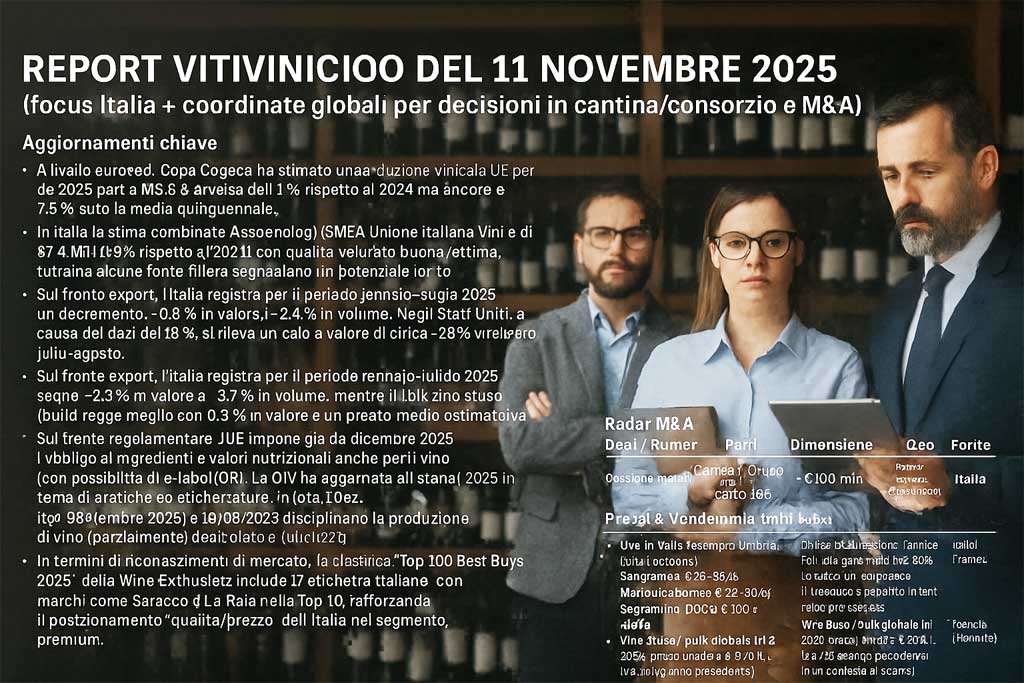
Wine Report of November 11, 2025

(Focus on Italy, global coordination for winery/consortium decisions and M&A)

Key updates

  • At European level, Copa‑Cogeca has estimated EU wine production for 2025 at 145.5 Mhl , up 1% compared to 2024 but still ‑7.5% below the five-year average .
  • In Italy, the combined estimate by Assoenologi-ISMEA-Unione Italiana Vini is 47.4 Mhl (8% compared to 2024) with quality rated good/excellent; however, some industry sources report a potential adjustment towards the “low-forties”.
  • On the export front, Italy recorded a decrease for the period January-July 2025: -0.9% in value / -3.4% in volume . In the United States, due to the 15% tariffs, a decrease in value of approximately -28% was recorded in the two-month period July-August.
  • Stocks in Italy as of September 30, 2025 amount to approximately 36 Mhl , with a decrease of -9.6% compared to July but still 1.3% on an annual basis: this implies pressure on bulk and on the margins of more generic grapes.
  • Globally, wine trade in the first half of 2025 recorded a -2.3% in value and a -3.7% in volume , while bulk wine filter held up better with a -0.3% in value and an estimated average price of around €0.78/L (2.1%).
  • On the regulatory front, the EU has already mandated the inclusion of ingredients and nutritional information for wine (with the option of e-labeling/QR) since December 2023. The OIV has updated its 2025 standards regarding practices and labeling. In Italy, the decrees of December 20, 2024, and May 14, 2025, regulate the production of (partially) dealcoholized wine and its use in mixed-use premises.
  • In terms of market recognition, Wine Enthusiast’s “Top 100 Best Buys 2025” ranking includes 17 Italian labels , with brands such as Saracco and La Raia in the Top 10, strengthening Italy’s “value for money” positioning in the premium segment.

M&A Radar

Deal / RumorPartsSizeGeoSource
Transfer of the Cinzano & Frattina brandsCampari Group → Caffo Group 1915~€100 millionItalysource Reuters (June 26, 2025)
Tannico acquisition closedCASTEL‑Vins ↔︎ Tannicnot disclosedItaly/FranceForvis/Mazars press release (October 6, 2025)
Binding offer for Valle Talloria (former Giordano site)Caffo Group 1915 ↔︎ Italian Wine Brandsnot disclosedItaly (Piedmont)IWB press release (October 9, 2025)

Prices & Harvest (mini-box)

  • Grape varieties in Italy (e.g., Umbria, October price lists): Sangiovese €26-30/q; Merlot/Cabernet €28-30/q; Sagrantino DOCG €100-140/q. Trends: -~30% y/y , in some cases up to -50% vs 2023 ; the only exception is Trebbiano Spoletino, which is rising sharply due to scarcity.
  • Global bulk wine H1 2025: average price ≈ €0.78/L (2.1% vs previous year) in a context of weak trade and cautious demand.
  • Italian stocks: ~36 Mhl as of September 30; with an estimated 2025 harvest of ~47.4 Mhl (quality declared good/excellent) but with a risk of reductions in some areas due to weather/yield.
  • France: Harvest forecast ~36.2 Mhl, influenced by heat waves and summer drought which are limiting both volume and qualitative uniformity.

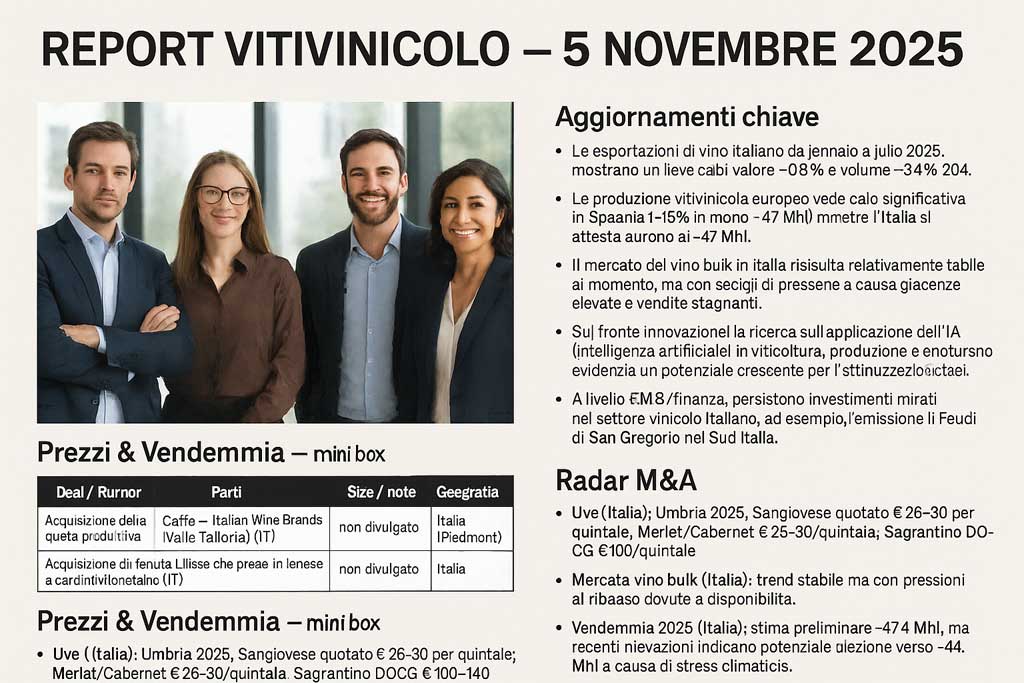
Wine Report of November 5 2025

Current trends in Italian and world wine.

Key updates

  • Italian wine exports from January to July 2025 show a slight decline: value -0.9% and volume -3.4% compared to the same period in 2024.
  • European wine production saw a significant decline in Spain (~15% less, ~31.5 Mhl) while Italy stood at around ~47 Mhl and France at ~37 Mhl.
  • The bulk wine market in Italy is currently relatively stable, but with signs of pressure due to high inventories and stagnant sales.
  • On the innovation front: Research into the application of AI (artificial intelligence) in viticulture, production, and wine tourism highlights growing potential for cost optimization and sustainability.
  • At consumer level, Italy has seen a very modest increase in wine prices over the last 10 years (7.4%), a sign of initial “resistance” from the medium-high segments of the sector.
  • Under M&A/finance, targeted investments in the Italian wine sector persist: for example, the bond issue by Feudi di San Gregorio in Southern Italy.
  • In the export channel, the USA is becoming a source of concern (tariffs, accumulations), and the need to diversify towards new markets with medium-long term strategic planning is essential.

M&A Radar

Deal / RumorPartsSize / noteGeographySource
Acquisition of the production share of Italian Wine Brands (Valle Talloria) by Gruppo Caffo 1915 (IT)Caffo ↔ Italian Wine Brandsnot disclosedItaly (Piedmont)
Acquisition of Tenuta Ulisse, which takes over management of the Montevetrano winery (IT)Tenuta Ulisse (investment firm) ↔ Montevetranonot disclosed

Prices & Harvest – mini box

  • Grapes (Italy) : Umbria 2025, Sangiovese priced at €26-30 per quintal; Merlot/Cabernet €28-30/quintal; Sagrantino DOCG €100-140/quintal.
  • Bulk wine market (Italy) : stable trend but with downward pressure due to high availability.
  • Harvest 2025 (Italy) : preliminary estimate ~47.4 Mhl, but recent findings indicate a potential reduction towards ~44 Mhl due to climatic stress.
Style Selector
Select the layout
Choose the theme
Preset colors
No Preset
Select the pattern