A network portal of Wine Idea. Discover the world of Wine idea

Wine Trends and Performance in Italy — Week 16–20 February 2026

The week of February 16–20, 2026, shows a sector that is holding steady in “certified” quality volumes, but experiencing growing industrial tension: weak global demand, slowing exports, bulk prices under pressure and inventories that continue to rise despite a “contained” 2025 harvest.

The result is a two-speed Italian wine industry: DOP, whites, and sparkling wines are more resilient, while reds and “generic/IGT” labels are suffering much more.

In the background, a structural theme emerges: fragmentation of denominations and, simultaneously, greater industrial concentration in certified volumes.

1) Bottling 2025: -2.1% overall, but the DOP range is growing

Valoritalia data (updated to December 31, 2025) indicates an overall decline of -2.1% compared to 2024 in certified bottling. However, the message is not a “collapse,” but rather a stabilization : volumes remain higher than pre-Covid , and the contraction is considered limited .

Inside that -2.1% is the most interesting part:

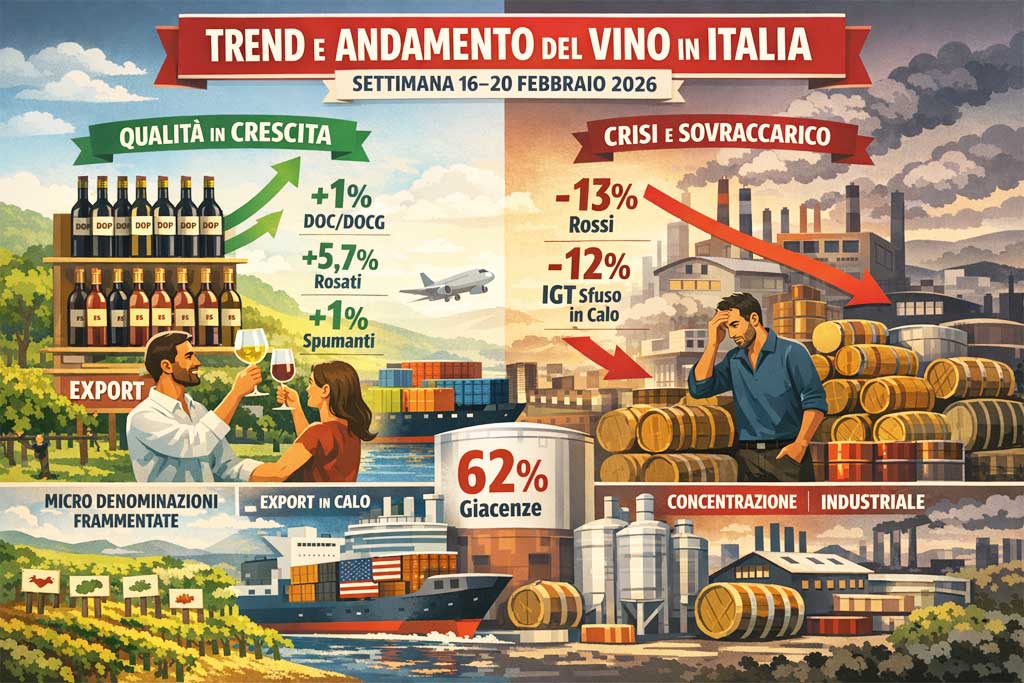
  • DOC/DOCG: 1% (on an annual basis and compared to the average of the last three years) → “organized” quality continues to act as a driving force, especially for exports.
  • IGT: -12% compared to 2024 (and -10% on the average of the previous three years) → net decline of the largest and often most “commodity” or least identifiable segment.

Strategic reading: the market is rewarding identity, recognisability and positioning , penalising what is perceived as “interchangeable”.

2) The demand is changing: whites, rosés, and sparkling wines are ahead; reds are slowing down significantly.

The typological divide is now structural and will become even more evident in 2025:

  • Sparkling wines: 1%
  • Rosé: 5.7%
  • Still whites: 2.7%
  • Rossi: over -13%

What it really means: It’s not just “trend.” It’s a shift in consumption (in Italy and around the world) toward fresher, less demanding wines , often more compatible with new drinking styles and a growing awareness of alcohol, lightness, and immediacy. Regions historically associated with full-bodied reds risk paying a double price: declining demand and stagnant inventory.

3) Micro-denominations: many acronyms, little critical mass (and more vulnerability)

The appellation breakdown by size is a key point this week. The micro-appellations (under 10,000 hl) are:

  • 70% of certified DOs , but
  • only 2% of bottled volumes , and in 2025 they will be -7.2% (worse than average).

The dynamics by size range show that critical mass matters :

  • 10–20,000 hl: 3%
  • 20–50,000 hl: -4.7%
  • 50–150,000 hl: 4%
  • over 150,000 hl: -2.7%

Diagnosis: Micro-DOs struggle to cope with market fluctuations, costs, and commercial complexity. Having a name isn’t enough: you need a strong structure (a strong consortium, planning, promotion, and channels).

4) Production structure: hyper-fragmented at the base, concentrated at the top

The numbers confirm a sector made up of many small operators and very few large ones:

  • over 75% of certified bottlers sell less than 65,000 bottles
  • only 171 companies (3.2%) exceed 1.3 million bottles
  • the first 5 operators bottle 18% of the total certified volumes, despite being 0.1% in number

Implication: competition is no longer just “product vs. product,” but increasingly an organized system vs. fragmented system . Small businesses must choose: either they become ultra-specialized and premium , or they merge (commercially or industrially).

5) The major industrial hub: stable production, but growing inventories

Here lies the “paradox” that is squeezing margins and financial serenity.

  • 2025 harvest: 44.38 million hl (approximately 0.7% compared to 2024)
  • Wine stocks: 61 million hl ( 6% per year)
  • Wine and must stocks: almost 68 million hl ( 7.5% )

According to UIV, after two campaigns of just over 44 million hl, even these volumes are no longer sustainable if demand is not absorbed.

Where the surplus is concentrated:

  • common/varietal wines: 11.3%
  • White IGT: 10.5%
  • DOP: 3.6% (more stable, but still increasing)

Immediate effect on the market:

  • Cellar sales: -20% compared to 2024 peaks
  • Bulk prices: weak, with common whites down over 10% in several areas

Brutal translation: more inventory = more idle capital = more pressure on prices and liquidity, especially for those operating in segments less protected by brands/names.

6) Exports and markets: relative stability, but the direction is still negative

The international picture remains complex. The aforementioned analyses (Nomisma Wine Monitor) report a 3% decline in the value of Italian exports , in a context where other competitors (Australia, Chile, France) are performing worse. It’s a “victory on points,” not a triumph.

On the US front and trade tensions, UIV reports:

  • US shipments 2025 estimated -9% in value
  • extra-EU around -6.5%
  • many companies have reduced their price lists by ~10% to defend their shares (margins under stress)

At the same time, in the US alcohol market, wine is declining (-3.5%) , while ready-to-drink products are growing strongly (16.4%), i.e. simpler, cheaper and “immediate” to enjoy.

The underlying message: simply “being present” in traditional markets isn’t enough. We need to reallocate our energies to third-party markets , trade agreements (Mercosur/India), and a more aggressive and continuous presence on the markets.

7) Data, control and planning: TESSA and the new reporting system for Consortia

An often underestimated but strategic point: data quality becomes a competitive lever.

Valoritalia is pushing the TESSA platform (developed with Microsoft) to process the movements of over 90,000 companies across 219 certified denominations , and is introducing monthly reporting for Consortia with indicators on:

  • sampling, bottling
  • bulk sales/transfers
  • downgrades/reclassifications
  • analytical parameters, stocks, volumes
  • socioeconomic indicators (members/non-members, concentration indices)

Why it matters: in 2026, those who know how to plan (supply, yields, inventories, channels) will win, not those who “suffer” the market.

What this week really tells us (in one sentence)

Italian wine enters 2026 with a supply chain that relies on organised quality , but must face an industrial challenge that cannot be postponed: too many inventories compared to demand , with the need for production flexibility, organisational consolidation and commercial repositioning .
Italian vineyard market 2026: values are falling, but it really is the best time to invest.

Vineyards in Italy: falling prices and new investment opportunities.

The Italian vineyard market is going through a profound adjustment phase.

After years of sustained growth, driven by exports, food and wine tourism, and strong international interest, 2025–early 2026 marks a turning point: falling land values, slowing wine sales, and greater investor selectivity .

But as often happens in mature markets, it is precisely in moments of uncertainty that the best opportunities arise .

Falling Vineyard Prices: What’s Really Happening?

In recent months, a clear fact has been recorded:

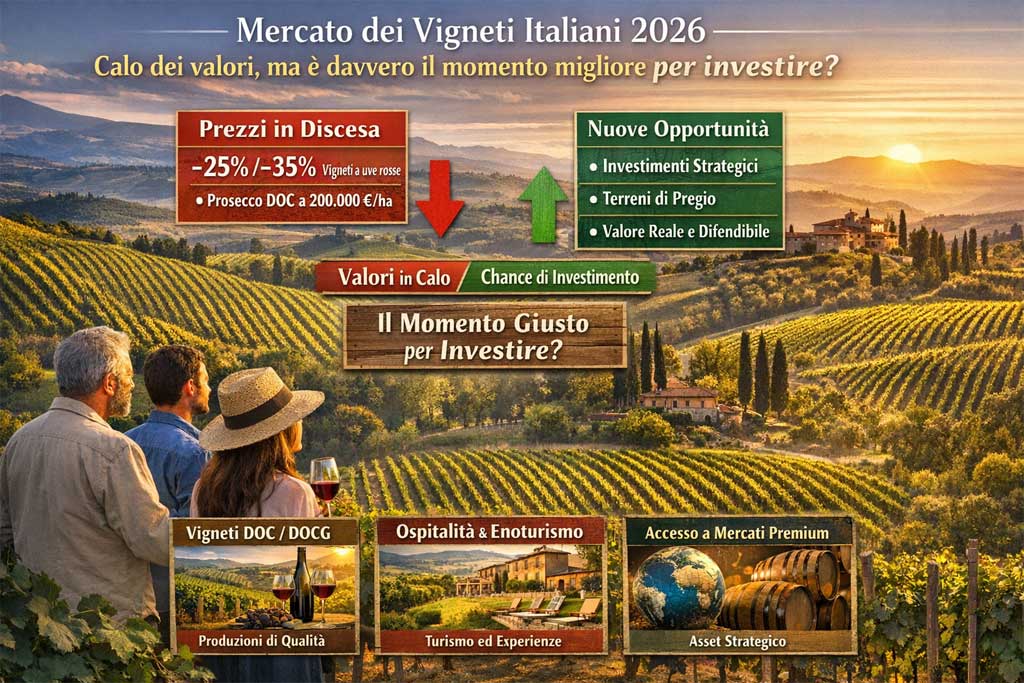
  • red grape vineyards : average declines from –25% to –35%
    (Montepulciano, Chianti, Morellino, Valpolicella, Amarone)
  • white grape vineyards : greater retention of values
  • Prosecco DOC : in some areas it drops to €200,000/ha ,
    while the DOCG quality areas remain between €360,000–€500,000/ha
  • All Italian wine-growing areas , without exception, show signs of reduction in values, except for very rare new emerging micro-areas

This doesn’t mean a structural crisis. It means the end of the speculative phase and a return to a more rational market.

Average value of vineyards in Italy: updated data

According to the latest land market analyses:

  • National average value of vineyards : approximately €58,000/hectare
  • Vineyards are worth 4–5 times more than standard farmland
  • High-quality appellations maintain high values
  • The gap between “commodity” vineyards and “strategic” vineyards is widening

Today, value is no longer “how much a hectare costs”, but where it is located, what it produces and what business model it enables .

Why vineyards remain a strategic asset

The Italian vineyard is not just agricultural land. It is:

  • production right (DOC, DOCG)
  • territorial reputation
  • access to premium markets
  • basis for wine tourism, hospitality, brand experience

In a context of inflation, financial volatility and unstable intangible assets, the quality vineyard remains a real, identifying and defensible asset .

The main Italian wine regions and their investment potential

Abruzzo and Molise – Montepulciano and Trebbiano

Areas with still affordable prices , good agronomic yields and room for growth for those focusing on quality, organic and direct processing.

Langhe, Roero and Monferrato

UNESCO zone, very high values for Barolo and Barbaresco.
Selective market, but very high stability over time .

Bolgheri

A territory that is a symbol of modern Italian wine.
High prices, but global territorial brand .

Friulian Collio

Hillside vineyards, quality white wines, strong foreign interest.
Excellent balance between price and potential value.

Conegliano Valdobbiadene – Asolo – Prosecco

Prosecco remains a driving force, but the market is increasingly distinguishing:

  • DOC = price pressure
  • DOCG = estate and selection

Franciacorta

Classic Italian method.
Vineyards with a strong real estate and tourism component.

Gavi

Historic white, stable markets, suitable for industrial integration operations.

Lazio – Frascati

Area under revaluation.
Affordable prices, proximity to Rome, strong wine tourism potential.

Montefalco

Sagrantino as a niche wine of high identity.
Small market, but very consistent .

Puglia

Primitivo and Negroamaro.
Land values still competitive, strong international demand.

Sicily

Big island, big differences.
Etna is growing strongly, while other areas are still undervalued.

Trentino-Alto Adige

Among the most expensive vineyards in Italy.
Quality, precision, premium markets.

Valpolicella

Amarone is under pressure today, but it remains a global brand.
Interesting time for selective acquisitions .

Valtellina

Heroic viticulture, Alpine Nebbiolo.
Limited production, strong identity.

Verdicchio – Marche

White undergoing a strong qualitative revaluation.
Prices still attractive for far-sighted investors.

Why investing in Italian vineyards makes sense today

1. More rational prices

The market is realigning.
Those who enter today buy better than those who bought 3–5 years ago .

2. Natural selection

Improvised operators are exiting the market.
What remains are solid projects and informed investors.

3. Integration of services

Today, value is not just in the bottle:

  • wine tourism
  • farmhouse
  • rural hospitality
  • direct sales
  • wine experience

A vineyard without a business model is nothing.
An integrated vineyard is a high-value agricultural enterprise .

Conclusion: it’s not a crisis, it’s a change of phase

The Italian vineyard market is not collapsing.
It’s maturing .

For those who can read:

  • the territory,
  • the denomination,
  • the positioning,
  • economic sustainability,

This is one of the most interesting times to invest in the last 15 years

Wine Trends and Performance in Italy – Week 9–13 February 2026

The week of February 9–13, 2026, captures a sector moving on two parallel tracks: on one side, the global “showcase” (Olympics, major events, exports, and international promotion), on the other, the daily industrial reality of more selective consumption, pressure on margins, and a structural issue that is once again central: inventories.

In the meantime, a third, increasingly crucial route to business profitability is gaining ground: wine tourism, now seen as a countercyclical asset

1) Milan Cortina 2026: Prosecco DOC uses the Games as a global megaphone

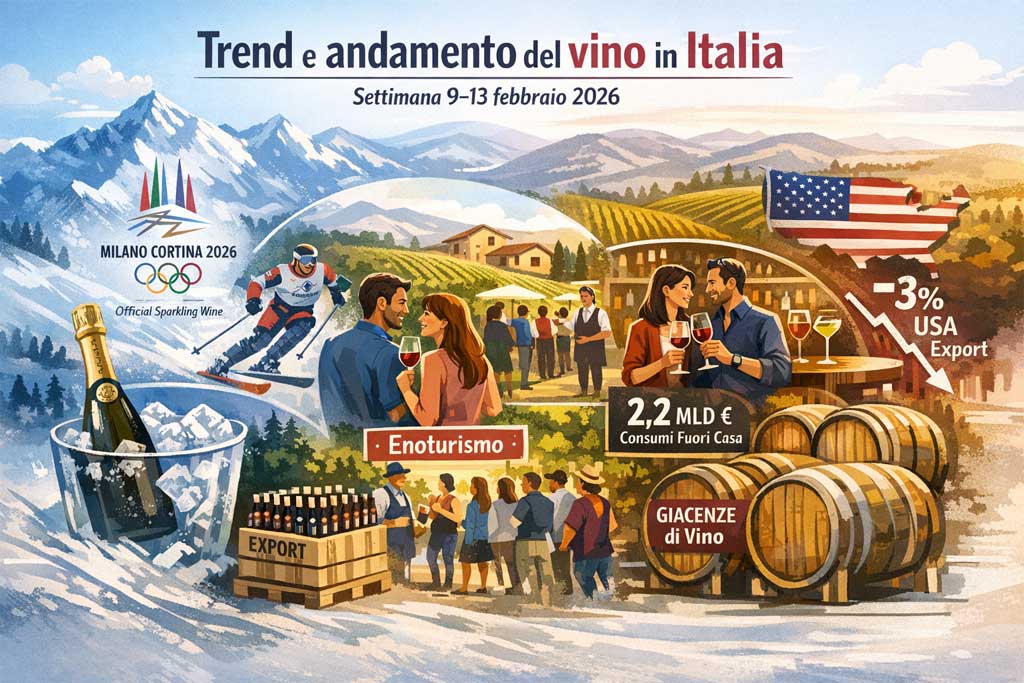
The most symbolically powerful event of the week is the activation of the Prosecco DOC Consortium as the Official Sparkling Wine of the Milan Cortina 2026 Olympic and Paralympic Winter Games, defined by the Consortium as the most important partnership in the history of the denomination , with the declared aim of bringing the Veneto-Friuli region before a global audience estimated at over 3 billion spectators .

The strategy is “capillary”, with the presence of:

13 race venues (family lounges) between Cortina, Milan, Val di Fiemme and Valtellina
6 Live sites / Fan villages (Milan, Bormio, Livigno, Cortina, Predazzo, Brunico)
Casa Italia (Milan Triennale, Cortina, Livigno) and related projects such as the “Musa” wine selection
a proprietary hub with high media impact: Prosecco Doc Sparkling Hub (a 600 m2 lounge in Milan’s San Babila area), designed for media and opinion leaders, with content that intersects haute cuisine, mixology, art, and technology.

Sixteen DOC companies involved in official activities are participating in the operational management, while the visibility campaign will reach strategic hubs (airports, ski resorts, tourist destinations) with very high exposure estimates (e.g., 23 ski lift stations and an estimated 6.6 million impressions ). Completing the plan: educational tours with operators and journalists from the USA, UK, Canada, Japan, China, and Germany, to transform the sporting event into a commercial and narrative bridge to the markets.

Key message: Prosecco DOC is pushing for a positioning that is not “just wine”, but territorial identity, a productive community, a global story , using the Olympics as an accelerator of reputation and demand.

2) Out-of-home consumption: 2.2 billion and a changing beverage market

On the domestic front, out-of-home consumption of alcoholic and non-alcoholic beverages has returned to the pre-pandemic level of €2.2 billion . The most interesting data is not just the recovery, but the composition of this growth , which reflects a more “hybrid” consumer:

24% carbonated soft drink
alcoholic cocktails : purchases from 69 to 91 million (32%)
liqueurs and spirits : from 58 to 76 million (30%), with a 23% acceleration over the last year.

The “low & no alcohol” theme is firmly on the radar: non-alcoholic beers reach 49 million purchases (18% compared to 2025 and 79% compared to pre-Covid), and the system event Beer & Food Attraction 2026 (Rimini, 15–17 February) is positioning itself as an evolutionary observatory, with the debut of Mixology Attraction dedicated to spirits, cocktails, soft drinks and low/no alcohol products.

Implication for wine: competition for “consumption occasions” in the out-of-home market is growing. Wine must better address contemporary social gatherings (evolving aperitifs, smart pairings, more “dynamic” glasses), because growth is driven by alternative categories that are more agile and narrative.

3) USA: consumption in structural decline, Italy “holds up” thanks to three denominations – still

The US market continues to lose ground: wine consumption has fallen for the fifth consecutive year , with sales in distribution (horeca retail) down 7% in value and around 9% in volume .

In this context, Italy does better than average , but remains in the red:

Italian wine: -3% in value, -5% in volume
the denominations that support the estate are above all:
Chianti Classico (strong growth, 12% in value; in the other reading also 12% and 17.2% in volume)
Prosecco (approximately 3% in value; with growth in volumes as well)
Brunello di Montalcino (2% in value; with increasing volumes)

The rest of the basket shows widespread suffering (with explicit mentions of Moscato d’Asti, Pinot Grigio delle Venezie, and Valpolicella). The UIV analysis adds a crucial industrial point: the five-year decline should be interpreted as a coherent and structural phenomenon , aggravated by market saturation and inventory accumulation along the supply chain, with prices also affected by tariffs (a trend increase of around 4% in December) while producers have already “sacrificed” average price lists (quoted cuts of 10% in the six-month period).

Key message: In the US, wine isn’t “collapse” due to a single factor, but rather to a shift in the landscape: less automatic, more selective demand, and channels that absorb less inventory. Those who grow do so because they have a strong category (bubbles) or a denomination with a very clear premium identity .

4) Export and business models: the case of Edoardo Freddi International

In a period of global complexity (geopolitics, inflation, barriers), emerging players confirm that the issue isn’t “wine in crisis” in general, but rather the marketing model . Edoardo Freddi International closes 2025 with:

6% in value and 9% in volume
over 38 million bottles
presence in 112 markets , with a focus on Europe (approximately 45% of exports) and stability in the USA (indicated at -1% in their perimeter).

Among the trends cited for 2026: resistant/climate-adapted varieties, lighter and more gastronomic wines, and growing interest in no- and low-alcohol options . Also interesting is the “anti-obvious” approach to packaging/format: for example, the 500 ml Amarone in Denmark (a market with a high share of singles), to increase rotation and willingness to purchase.

Key message: you win not only with “good” wine, but with formats, channels, storytelling, and positioning designed around real consumer behavior.

5) Italy, large-scale retail trade: 2025 negative but not falling, bubbles bucking the trend

The large-scale retail channel remains central to volumes and shows a “resistance” dynamic:

2025 sales: 618 million liters ( -3.1% ), value 2.3 billion euros ( -0.5% )
average price: €3.77/litre ( 2.6% )

Within the general data, a polarization can be seen:

0.75 l bottle (including bubbles): 1.8 billion (0.2%) but volumes -1.9%
sparkling wines : 3.6% in value and 3.1% in volume , average price €7.29/litre (0.4%)

Market analysis: Large-scale retail trade emphasizes the “less quantity, more value where there’s desirability” mix. Sparkling wines remain the category that best captures social interaction and attendance.

6) Cantina Italia: high and concentrated stocks, with the North (and Veneto) at the forefront

The structural data that weighs on the bargaining power of companies is the snapshot of inventory:

as of January 31, 2026 : 60.9 million hectoliters in stock
2.4% on 31 December 2025 (1.4 million hl)
5.9% on 31 January 2025 (3.3 million hl)

Added to these are:

6.4 million hl of must
601,663 hl of VNAIF (new wine still fermenting)

Territorial and qualitative concentration:

56.8% of the stocks are in the North, with Veneto at 26%
53.5% of the stocks are DOP (32.5 million hl), 26.7% IGP (16.2 million hl)
strong concentration by denomination: 20 denominations out of 531 make up 58.5% of the GI stocks
Prosecco DOP accounts for 11.7% of stocks (5.7 million hl), followed by several significant IGP and DOC/DOCG wines (including Chianti DOCG 1.45 million hl).

Key message: Inventories aren’t just “a number”: they represent commercial pressure , promotional risk, and a brake on investment. Supply management (even with crisis measures) is once again a key issue for industrial policy.

7) Rules and Politics: EU Wine Package, Transparency on Alcohol-Dealcoholized Products and Crisis Levers

On the regulatory-institutional level, the week saw a strong push from the European Parliament towards a new package for the sector (broad approval: 625 in favour), with measures ranging from:

support for promotion in third countries (EU co-financing up to 60% )
Clearer definitions for dealcoholized wines :
“non-alcoholic” with the wording “0.0%” only up to 0.05% vol
“reduced alcohol content” for wines over 0.5% vol with a reduction of at least 30% compared to the origin
Recognition and support for wine tourism (projects up to three years, renewable up to nine)
uniform crisis measures, and the possibility of drastic interventions such as eradication in the event of a structural oversupply
25% cap on the national budget for crisis distillation and green harvesting.

Coldiretti emphasizes that simplification and transparency are steps forward, but that adequate resources are now needed to make the reform truly effective, noting the economic size of the sector (estimated turnover of €14.5 billion, 241,000 businesses, 681,000 hectares).

8) Wine tourism: countercyclical lever, potential 1 billion with more incoming visitors

Contrary to the slowdown in wine consumption, wine tourism continues to grow and is being described as a strategic asset . Key points that emerged:

Global wine tourism market: $46.5 billion , Europe at 51%
In Italy, the foreign component is still relatively low (around 32% ), with room for growth compared to other benchmarks
77% of companies have invested in wine tourism (2022–2024), with average investments exceeding 14% of turnover ; for 2025–2027, over half plan new investments (digital, sustainability, accessibility, quality of experience)
Each tourist presence generates over 150 euros of added value in the area (broad supply chain: catering, services, crafts, culture)
Estimate: with 5% international tourist presence, approximately 1 billion euros could be generated as an additional result.

The main obstacle remains fragmented governance (many non-integrated local actors), but there is a growing willingness to “work as a system” with public-private consortia for territorial marketing.

Key message: for many wineries, wine tourism is no longer “hospitality”, but a business unit : margins, direct sales, loyalty and deseasonalization.

9) Culture and communication: Cotarella pushes for an offensive and responsible narrative

In terms of public discourse, Riccardo Cotarella’s appeal stands out: enough defending ourselves, we need to make ourselves heard again . The key point is the distinction between moderate consumption and abuse, and the shift in international language toward “harmful use of alcohol” rather than generalized demonization. In this context, the Irish postponement of health labels is also cited as a political and cultural signal that “the issue is complex” and cannot be reduced to uniform messages.

Key message: Demand is rekindled not only by discounts or increased production, but also by cultural legitimacy , clarity, responsibility, and coordinated communication.

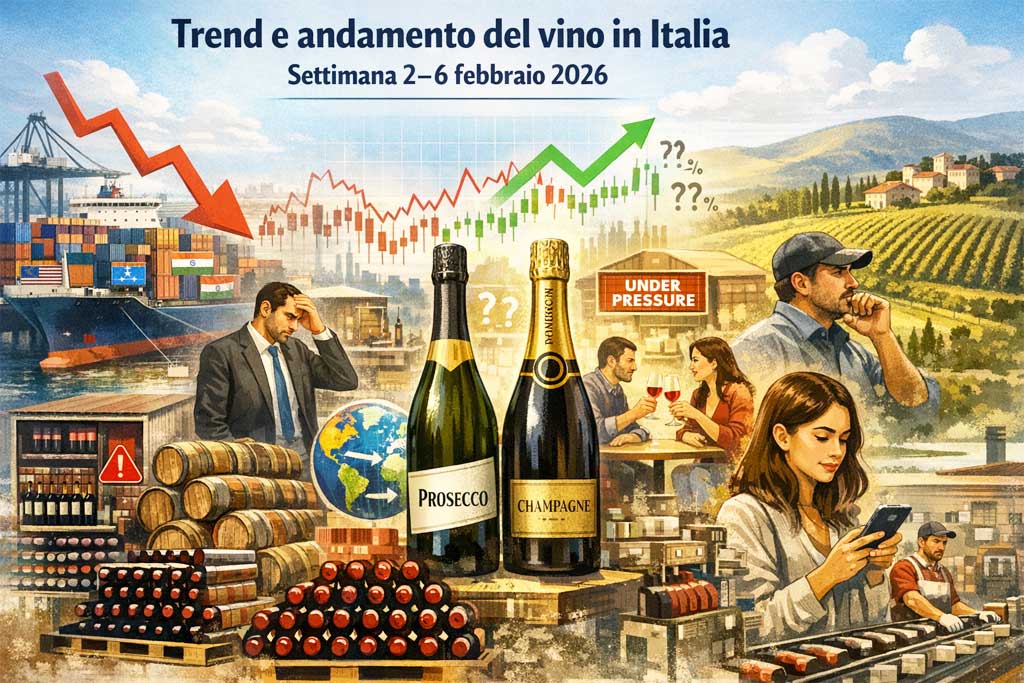
Wine trends and performance in Italy Week 2–6 February 2026

In 2026, Italian wine is entering a phase that is no longer cyclical but structural. The key is not the crisis itself, but rather the changing rules of the game.

As observers and leading international players have pointed out, “uncertainty is the new normal”: unstable markets, selective consumption, pressure on margins, and a growing gap between those who govern change and those who endure it.

Exports: record behind us, adjustment underway

2024 closed with an all-time high in Italian exports of €8.1 billion (up 5.5%) . However, 2025 saw a slowdown: -2.2% in value and -1% in volume , with a global scenario in which volume growth no longer guarantees value. Dependence on mature markets, primarily the US, exposes the economy to systemic risks (tariffs, inflation, and declining purchasing power). Hence the growing focus on new geographies: Mercosur and India are no longer theoretical options but mandatory trajectories, even if the implementation timelines remain long.

Prices and margins: the unresolved issue

Wine is suffering from an increasingly evident disconnect between price and perceived value. In key markets, particularly the United Kingdom and the United States, production, logistics, and bureaucratic costs are squeezing the trade’s profitability. The entry-level segment is shrinking, while the compression of margins is leading to reduced product assortments, lower investment, and job losses. Without a rethinking of business models, the “race for volume” risks turning into a systemic devaluation of the product.

US consumption: structural decline, Italy more resilient

In the United States—the world’s largest market by value—wine consumption is declining for the fifth consecutive year ( -8.8% in volume in 2025 ). Italy is holding up better than its competitors ( -5.2% in volume, -3% in value ), thanks primarily to sparkling wines. According to the Italian Wine Union , Prosecco remains the true driver, while denominations like Chianti Classico and Brunello maintain a defensive position. The structural trend is clear: in the US, people are drinking less wine, but they are seeking recognizable, consistent products that can justify their price.

Prosecco vs. Champagne: A Historic Watershed

2025 marks a symbolic and substantial leap forward: the Prosecco system surpasses Champagne in terms of market dynamics. While Champagne production has fallen to 266 million bottles, Prosecco approaches 800 million , embodying a model of “accessible luxury.” It’s not just a question of numbers: it’s a clash between two visions. On the one hand, defensive premiumization; on the other, the ability to interpret consumption, sociality, and immediacy. The market has chosen the latter.

Communication and the consumer: the real enabling factor

Wine isn’t rejected: it’s often poorly communicated. New generations are curious, but demand simpler language, immediate experiences, and authentic stories. The cultural and relational value of wine remains intact, but it needs to be revitalized with less self-referential communication and more connected to real life. In this sense, the new Italian institutional campaign on conscious consumption represents a significant political and cultural signal.

Overproduction and system under stress

The most critical data comes from the wineries: over 8 billion bottles in storage . This surplus fuels dumping, price pressures, and imbalances throughout the supply chain. The selection process has already begun: small, fragile producers, undercapitalized models, and confused positioning are at risk of being forced out of the market. This isn’t a collapse, but a fracture. And like any fracture, it redraws the perimeter of the survivors.

Strategic conclusion

Italian wine is not in decline, but in transformation. Those who manage inventory, margins, and positioning are the winners; those who invest even in difficult times; those who build value before even selling volume. 2026 will not reward inertia or nostalgia. It will reward industrial vision, product line clarity, market presence, and the ability to speak to today’s consumer. In an uncertain world, wine remains a powerful economic and cultural tool. Provided it is used wisely.

Style Selector
Select the layout
Choose the theme
Preset colors
No Preset
Select the pattern