Italian wineries, Italian wine producers, and current wine news.
Good morning,
The main news from the world of wine, wineries, viticulture, and markets: Italian companies, the 2026 harvest, exports, winemaking innovation, regions, guides, wine tourism, and events.
ITALIAN WINERIES
Muzic: four generations of winemakers in the Collio
In San Floriano del Collio, Friuli Venezia Giulia, the Muzic family continues a winemaking tradition that began in 1927. The company has grown steadily since purchasing the first five hectares in 1963, maintaining a strong family identity and a deep connection to the Ponca grape and the border region between the Italian Collio and Slovenian Brda.
Sarah Dei Tos: The Night Harvest Becomes the Object of Research
The nighttime harvest of Glera is included in a scientific study conducted with the University of Bolzano, CREA, and the Consortium for the Protection of Conegliano Valdobbiadene Prosecco DOCG. The research will analyze the effects of temperature, light, and environmental conditions on the aromatic characteristics of the grapes and the quality of work in the vineyard.
Candido: Brand Relaunch, New Wines, and Wine Museum
In San Donaci, Puglia, the Paolo Leo family continues the relaunch of the historic Candido Winery, acquired about a year and a half ago. The project includes renovating the headquarters, reclaiming the production spaces, redesigning the wines, and developing wine tourism with a new Wine Museum. The sale of historic labels has returned to profitability, with revenues up 33%.
Casanova di Neri: Brunello di Montalcino on the world markets
Founded in 1971, Casanova di Neri continues to build its international presence through a philosophy based on experience, understanding of the terroir, and style. Giacomo Neri continues the work begun by his father Giovanni, with wines designed to express territorial identity, elegance, and depth.
La Trama reclaims family vineyards in Valtellina
Mauro and Paolo Beltrama and Laura Arena created a new winery from approximately three hectares of vineyards between Tresivio and Piateda that were at risk of abandonment. The first wine, “Trio,” a Rosso di Valtellina DOC, was produced in approximately 1,200 bottles.
Le Macchiole: A 100% Syrah from the Bolgheri area
Scrio is a pure Syrah produced by Le Macchiole in approximately 4,000 bottles per year. This is a unique project for Bolgheri, a region known primarily for Cabernet Sauvignon, Merlot, and Cabernet Franc. Over time, the winery has modified its winemaking and aging process, seeking greater freshness, precision, and balance.
Carlo Cracco and Rosa Fanti: Agriculture, Wine, and Hospitality in Romagna
On the 18 hectares of Vistamare, in the hills of Romagna, Carlo Cracco and Rosa Fanti have developed a project that integrates an organic farm, vineyards, olive groves, and hospitality. Three old farmhouses have been renovated to create a small agriturismo nestled in the rural landscape.
ITALIAN WINE AND OENOLOGY
Italian wine exports to the US: July returns to positive territory
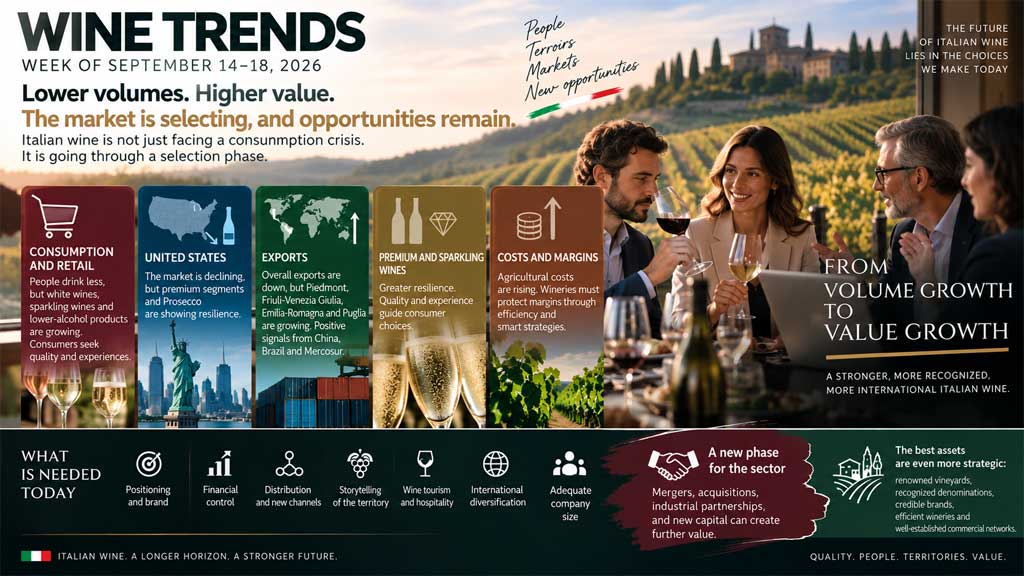
In July 2026, Italian wine exports to the United States grew by approximately 9.5-10% in value and 1.3% in volume. The average price increased by approximately 8%. This recovery reduces the cumulative decline seen in the first seven months, but according to the Italian Wine Union, it’s still too early to talk about a real reversal of the trend.
Strategic USA, but the market remains complex
According to an analysis by Banca Akros, the United States accounted for approximately 23% of the value of Italian wine exports in the first half of 2026. However, weak consumption, inflation, and growing competition from alternative categories such as sparkling wines, ready-to-drink cocktails, and hard tea remain.
CMO Sicilian Wine: 11 projects approved for non-EU markets
Eleven projects promoting Sicilian wine in third-party countries have been approved, totaling over €4 million in funding. The program finances up to 50% of the costs of advertising campaigns, international trade fairs, trade missions, incoming visitors, and market research.
Brazil: Growing interest in Italian wine
In the first half of 2026, Brazil imported Italian wine worth €20.1 million, an 8.1% increase compared to the same period in 2025. The market remains relatively small, but it represents one of the areas to monitor in the international diversification strategy of Italian wine.
Valtellina: more land, new subzones, and high-altitude vineyards
Valtellina boasts approximately 750 hectares of terraced vineyards, supported by over 2,500 kilometers of dry stone walls, with vines reaching altitudes of 800 meters. Approximately 90% of the vineyard area is devoted to Chiavennasca, the local name for Nebbiolo. The debate is moving toward an increasingly precise territorial definition and greater valorization of the subzones.
2026 Harvest in the Larian Lands: Early Harvest
The heat accelerated the growing season and significantly brought forward the harvest in the Terre Lariane IGT. The first sparkling wine bases were harvested in early August. The Consortium reports generally healthy grapes and positive initial quality results.
Viticulture: How to Propagate Grapevines by Cuttings
Grapevines can be propagated using one-year-old woody shoots. The recommended time for harvesting is during the vegetative dormancy period, generally between January and February. A cutting of about 30 centimeters should have at least three or four buds and come from a healthy, vigorous plant.
Harvest and training: in Lamezia Terme, the vineyard becomes a laboratory.
At the Professional Institute for Agriculture and Rural Development in Lamezia Terme, students participate directly in vineyard and winery activities. Harvesting is used as an educational experience, combining theoretical training, agricultural work, and knowledge of the local area.
Bibenda 2027: Over 700 Award-Winning Wineries
The 29th edition of Bibenda awards over 780 “5 Grappoli” recognitions to 701 wineries. Among the companies with three award-winning wines are Giacomo Conterno, Gaja, La Spinetta, Ca’ del Bosco, Cantina Terlano, and Fontodi. The presentation is scheduled for November 28th in Rome.
DoctorWine 2027: The selection of the best Italian wines continues.
The 2027 Essential Guide to Italian Wine continues to publish wines awarded the “DoctorWine Face.” The selections include, among other regions, Campania, Lazio, and Umbria. The guide will be presented in Milan on October 3rd.
Tre Bicchieri 2027: Spotlight on Sicilian Wines
The tastings dedicated to Sicily highlight the region’s great diversity: coastal vineyards, inland areas, hilly terrain, islands, and Mount Etna. The hot and dry year produced varying results depending on altitude, exposure, water availability, and soil characteristics.
INTERNATIONAL
Domaine de la Romanée-Conti 2022: nine Grand Crus for tasting
At Villa d’Este on Lake Como, Domaine de la Romanée-Conti’s entire 2022 portfolio was tasted: nine Grand Crus, including Échézeaux, Richebourg, La Tâche, Romanée-Conti, Montrachet, and Corton-Charlemagne. It was an exceptional opportunity to compare some of Burgundy’s most prestigious expressions.
Queen’s Roger Taylor signs a Côtes de Provence Rosé
The Queen drummer enters the world of wine with Queen Côtes de Provence Rosé. The project was developed with Sony Music, Watermill Wines, Les Caves du Commandeur, and Rupert Clevely. Taylor participated in defining the blend, concept, and bottle design.
Champagne: In Como, tasters will choose what to import.
On September 30th, Olmo Vini and Captain Drake are organizing a tasting for approximately 15 participants. Nine Champagnes from three French houses will be tasted, and participants will contribute to the selection of labels for future import.
WINE EVENTS AND WINE TOURISM
Great Wine Festival: 153 exhibitors from 29 countries
On September 26 and 27, Villa Farsetti in Santa Maria di Sala will host the 19th edition of the Grande Festa del Vino. 153 exhibitors from 29 countries, 132 wineries, approximately 420 labels and 8,000 bottles are expected, along with tastings, masterclasses, and a food court.
Welcome Brunello 2026 meets Vespa
The 2026 Benvenuto Brunello commemorative tile will be dedicated to Vespa, marking the 80th anniversary of the historic Piaggio scooter. The 2026 Benvenuto Brunello event will take place in Montalcino from November 19th to 23rd.
Pizzolato celebrates 45 years
The Pizzolato winery is celebrating 45 years of business by opening its doors to the public. The program includes tastings, food specials, DJ sets, and activities, including those for families, while keeping the company’s history and commitment to organic production at its core.
Gessopalena: Rare Native Grape Varieties Take Center Stage
The “Gli Irrepetibili” (Unrepeatable) tour offers tastings of micro-vinifications made from local varietals and ecotypes from the Abruzzo mountains. The Bio Cantina Sociale Orsogna project aims to preserve viticultural biodiversity and promote ancient varietals.
Cartizze: wine, landscape, and trekking
The Anello del Cartizze offers a route through the vineyards, villages, and hills of Conegliano Valdobbiadene. The itinerary combines landscapes, outdoor activities, food and wine, and the discovery of Cartizze DOCG, strengthening the connection between wine and tourism.
Merano WineFestival looks to Brazil
The Merano WineFestival is heading to São Paulo at a time when Brazil is showing growing interest in Italian wine, gastronomy, and lifestyle. The initiative is part of the search for new international markets and the growing relationship between wine promotion and tourism.
THE PICTURE OF THE WEEK
The news of September 19th shows an Italian wine sector engaged on multiple fronts. Exports to the United States are showing initial positive signs, but remain under pressure; Brazil is emerging as a market to watch; wineries are investing in identity, terroir, wine tourism, and new hospitality models; research and innovation are increasingly entering the vineyard, from night harvesting to the promotion of native varieties.
At the same time, the importance of the territory as a distinctive element is growing: Collio, Valtellina, Bolgheri, Montalcino, Sicily, Etna and the Prosecco Hills confirm that the value of Italian wine increasingly depends on the ability to connect product, origin, experience and story .
Today’s wine press review is brought to you by WINEIDEA.IT.
See you tomorrow.