

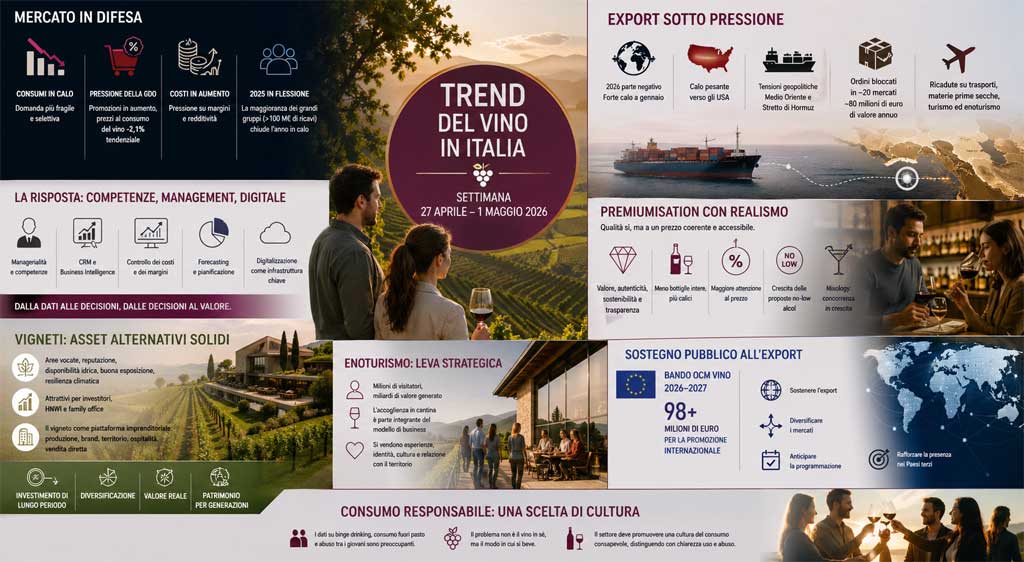


Italian wine is going through a complex phase, marked by declining consumption, pressure on exports, rising costs, and severe market selection.
2025 also put large groups under stress: among the main companies with revenues above 100 million euros, the majority closed the year with declining turnover.
The data confirms that the difficulty no longer concerns only small wineries, but the entire system.
The economic picture shows a market in defensive mode. Exports and domestic sales are slowing, large-scale retail trade is pushing promotions, and consumer wine prices are still declining, at a 2.1% annual rate. This signals a more fragile, selective demand that is less willing to absorb price increases, despite the higher production, logistics, and energy costs borne by businesses.
On the international front, Italian wine is facing renewed tensions. Exports in 2026 got off to a slow start, with a sharp decline in January and a particularly severe decline to the United States. Added to this are the geopolitical challenges related to the Middle East and the Strait of Hormuz: according to the UIV (Italian Wine and Spirits Association), orders in approximately twenty markets, with an estimated annual value of around €80 million, have been blocked. The impact also affects transportation, dry raw materials, tourism, and wine tourism.
In this scenario, the sector’s response increasingly relies on managerial skills, expertise, and digitalization. Italian wine companies are challenged to better manage margins, markets, price lists, distribution, and sales data. CRM, business intelligence, cost control, forecasting, and digital tools are no longer ancillary elements, but essential infrastructures to remain competitive.
Premiumization remains a viable option, but with a clear limit: the market rewards quality only if the price remains consistent and accessible. Consumers are drinking less, but are seeking greater value, authenticity, sustainability, and transparency. The way restaurants consume wine is changing: fewer full bottles, more glasses, greater attention to price, a growth in no- and low-alcohol options, and competition from mixology.
Despite the challenges, Italian vineyards remain solid and attractive alternative assets for investors, HNWIs, and family offices. Suitable areas, with reputation, water availability, good exposure, climate resilience, and wine tourism potential, continue to represent a long-term investment. The vineyard is no longer just an agricultural asset, but a business platform that integrates production, brand, territory, hospitality, and direct sales.
Wine tourism remains one of the most important levers for the future. With millions of visitors and billions in value generated, hospitality at the winery has become an integral part of the business model. The most advanced companies sell not just wine, but experiences, identity, culture, and a connection with the local area.
At the public level, the new CMO Wine 2026-2027 call for proposals, with over €98 million earmarked for international promotion, represents a strategic tool to support exports and foster market diversification. In a time of significant uncertainty, anticipating planning and strengthening presence in third countries is crucial.
Finally, the topic of responsible consumption enters the debate forcefully. Data on binge drinking, drinking outside of mealtimes, and abuse among young people show that the problem isn’t wine itself, but how it’s consumed. The industry must move beyond defensive positions and contribute to a culture of conscious consumption, clearly distinguishing between use and abuse.