

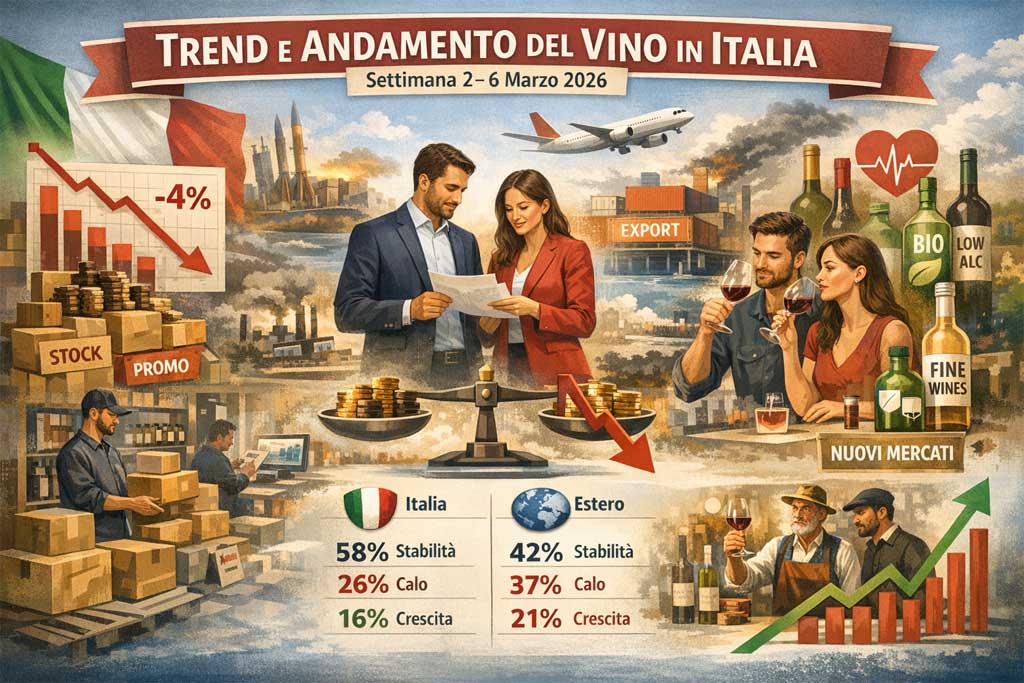



The first full week of March 2026 portrays an Italian wine sector in a phase of “difficult resilience.” The industry is not collapsing, but it is moving in a fragile balance between structural declines in volumes, pressure on margins, geopolitical and trade uncertainty (tariffs and key export markets), and changing consumption patterns driven by new lifestyles and health awareness.
At the same time, some niches—particularly fine wines and top brands—are showing early signs of recovery, while price competition and consumer selectivity continue to increase.
1) 2025 Financial Results: More Stability Than Growth, Widespread but Limited Declines
Evidence from the sample of wineries analyzed (high-profile companies with aggregated revenues exceeding €2.5 billion) shows that 2025 closed as a complex year of consolidation.
- 53% of companies: reported stable financial results.
- Most of the remaining companies: recorded revenue declines mainly between -1% and -5%, with very few cases of slight growth.
However, the sector is coming from a high baseline:
- 2024 was a record year for exports, reaching €8.1 billion, following several favorable post-Covid years.
The key issue is not only how much is being lost, but how companies are reacting. Many wineries are defending their results through tactical decisions involving:
- pricing strategies
- promotions
- channel mix adjustments
- tighter control over inventory and sales networks
2) Italy vs Export Markets: More Stability at Home, More Volatility Abroad
The gap between the domestic market and exports remains evident.
Domestic Italian Market
- 58% report stability
- 26% report decline
- 16% report growth
Changes are generally limited (1–3 percentage points), but the signal is clear: the market is stable but lacks strong momentum, and growth remains a minority trend.
Export Markets
- 42% report stability
- 37% report decline (sometimes significant, from -3% to -15%)
- 21% report growth (generally +1% to +3%)
Supporting data confirm a “cool” 2025 market environment:
- Large-scale retail (GDO): -0.5% in value and -3.1% in volume
- Exports (first 11 months of 2025): -3.6% in value and -2% in volume
In summary: the domestic market holds up better but does not accelerate, while exports remain more volatile, influenced by external shocks and shifting demand patterns.
3) Expectations for 2026: Operational Realism with Hopes for a Modest Recovery
Expectations for 2026 remain cautious but relatively stable.
- 70% of companies expect stability or slight recovery
- 30% fear a further (mild) decline
More specifically:
- some expect results in line with 2025
- some foresee a -3% to -5% decrease
- others anticipate +2% to +4% growth — more a recovery than a boom
The strategic interpretation is clear: 2026 is not a year for inertia.
Performance will depend more than ever on:
- commercial agility
- channel management quality
- price, packaging and format strategy
- the ability to make brands clear, understandable and desirable
4) Investments: Communication Stable, Sales Strengthened
An important operational signal emerges from the sector: despite pressure on profitability, companies are not massively cutting the functions that drive sales.
- Marketing & communication:
- 79% expect stable budgets in 2026 compared with 2025
- budget cuts exist but are not the norm (generally -5% to -20%)
- Sales support:
- no companies expect reductions
- 37% plan to increase investments, typically around +5%, with peaks up to +10%
In other words, the industry message is clear:
“The market is tough, so we must strengthen our commercial engine and protect brand perception.”
5) Consumption and Drinking Culture: Less Automatic, More Selective (Gen Z and Beyond)
Changes in consumption are not simply a decline—they represent a shift in the grammar of drinking.
- Overall consumption is decreasing across several countries.
- Generation Z is not disappearing from the market — it is selecting more carefully.
Drinking is becoming:
- more occasional
- more aligned with personal wellbeing and identity
- more sensitive to authenticity, sustainability and transparency
Interest is growing in:
- sparkling wines
- fresh white wines
- lighter styles that are easier to drink
At the same time, low/no alcohol products are gaining attention, but there is no widespread belief that they will “save volumes.”
A notable divide emerges in the data:
- 26% of wineries are investing or planning to invest in low/no alcohol products
- 74% are not considering it (at least for now)
This reflects a sector split between those who see a strategic opportunity and those who fear brand dilution or low margins.
6) Pricing and Restaurants: The Challenge Is How Wine Is Sold
In the Ho.Re.Ca. channel, the challenge is not only fewer customers but also price perception and spending thresholds.
Wine lists become problematic when consumers are more cautious and psychological price limits decrease.
Signs of adaptation are emerging:
- renewed interest in smaller formats (half bottles)
- increased sensitivity to promotions and commercial formulas
- experimentation with new packaging and formats
The strategic challenge here is critical:
transforming the wine list from a barrier into a lever, making it easier for consumers to choose—and easier for them to trade up without feeling overcharged.
7) International Markets: New Attractive Geographies and Trade Shocks
The international environment highlights two key messages.
- Increasing focus on intra-European markets
Markets perceived as more attractive in the short term include:
- Germany
- The Netherlands
- Japan
The United States is dropping in priority, mainly due to tariff uncertainty and market volatility.
- Mercosur opportunities
The provisional implementation of the EU–Mercosur agreement is viewed positively, especially regarding Brazil, where tariffs historically have been very high:
- up to 27% on still wines
- up to 35% on sparkling wines
The operational idea:
today it remains a marginal market, but with growth potential if trade barriers decrease and structured promotion is implemented.
Another contextual signal:
Russia remains a market where Italy is the leading exporter, although volumes have declined compared to 2024, consistent with an overall contraction in imports.
8) Fine Wines: A Small Niche, But a Meaningful Signal
The secondary market for fine wines (Liv-Ex) shows moderately positive signals at the beginning of 2026:
- main indices show slight growth
- Italian labels are performing strongly in some top segments
This niche does not rescue the sector as a whole, but it indicates that:
- brand equity and rarity remain resilient
- the premium segment may recover earlier than the mainstream market
- the premium strategy remains valid, provided it is supported by distribution, storytelling and coherent positioning
9) Strategic Implications for Italian Wineries
The picture emerging from the week of March 2–6, 2026 leads to a clear conclusion:
this is not a cycle to wait for—it is a cycle to manage.
Operational priorities emerging from sector data include:
- Protect margins before volumes: pricing, promotions and formats must be managed as a strategic architecture, not reactive measures.
- Strengthen sales networks and conversion capability: increased sales budgets highlight where 2026 will be won or lost.
- Simplify value for consumers: clearer product ranges, consumption occasions, by-the-glass offerings, pairings and formats.
- Reposition portfolios toward more demanded styles: whites, sparkling wines and freshness; reds more selective and better narrated.
- Open alternative markets with real strategies: Germany, Northern Europe and urban Asia; Brazil as a strategic option if properly supported.
- Low/no alcohol: a strategic decision, not a trend. For some wineries it may become an entry channel; for others it conflicts with identity. In both cases, the choice must be clear and deliberate.