


A network portal of Wine Idea. Discover the world of Wine idea

Wine press review for Monday January 19 -2026

Wine news, cellars and Italian wine.

ITALIAN WINERIES

Terre d’Oltrepò, UIL’s fears over the sale. Unions are concerned about the possible acquisition by Collis Veneto Wines: guarantees regarding employment and territorial identity are needed to prevent a grape “shopping” that would distort the Oltrepò brand.

A winery at 2,000 meters above sea level: the Prié Blanc from Morgex La Cave Mont Blanc leads the promotion of heroic viticulture in the Aosta Valley, with Prié Blanc grown up to 1,200 meters as a symbol of extreme territory and Alpine identity.

From Cilento, Albamarina’s Valmezzana 2014. A portrait of longevity and slow living: a Campanian white that transcends time, evoking the value of patience and territorial expression.

Bio Cantina Sociale Orsogna welcomes the “winemakers of the future.” Eleven newborns in the families of its members: a symbolic gesture that speaks of community, generational continuity, and leadership in organic and biodynamic winemaking in Abruzzo.

A winery blending tradition and modernity in Frascati. From historic caves to a new, fully equipped cellar: a controlled supply chain and a production capacity of over 1,700 hl.

The excellence of Frascati DOC. Certified organic estate since 1996 in Montecompatri: 11.36 hectares in the heart of the Frascati DOC and DOCG regions, combining agricultural investment and cultural heritage.

ITALIAN WINE AND ITALIAN OENOLOGY

Wines to drink in 2026: six appellations to bet on. Eight Italian wines, including new ventures and rediscoveries: emerging appellations and wines penalized by changes in consumption.

EU Rural Development Funds: Italy Spends 99.43% of the Fund. Over €14 billion spent between 2014 and 2022: Spending capacity for the primary sector strengthened.

The horizons of the Veneto wine system. Harvest 2025: 1,000 hectares of vineyards, 104,397 hectares total, 75% white grapes. Veneto confirms its role as a national driving force.

Alcohol-free wine: why (for now) it’s not convincing. In Lazio, there’s little inclination to eliminate alcohol: high costs, regulatory limits for DOP and IGP products, and investments that are difficult to sustain.

Italian Wine – Key Trends | Week of January 12–16, 2026 2026 is a year of selection: lower volume, more commercial discipline, higher value per bottle.

FORBUS: when quality is no longer enough Strategic management as a true competitive factor: integrated management of viticulture, cellar, sales and branding.

INTERNATIONAL AND MARKETS

The myth of wine as an investment crumbles. The Liv-ex Fine Wine 100 Index has fallen 11% in two years. Bordeaux, Burgundy, California, and Italy are all down. Luxury wine is entering a phase of structural correction.

Garda DOC Consortium and the Euchronicles project: Four European PDOs come together to showcase their quality and origin: wine, cured meats, and cheeses as pillars of the EU agri-food model.

CULTURE, EDUCATION AND OENOLOGY

Monvigliero 2021 Barolo DOCG – Burlotto Portrait of a collectible Barolo: extreme finesse and territorial identity from Verduno.

How to Taste Wine with Quantum Physics. A thesis in Pollenzo: a philosophical-scientific approach to tasting, between consciousness and perception.

The Wine Gym Educational tasting for grape variety recognition: five single-varietal red wines to practice sensory analysis.

WINE EVENTS

Genoa – “All the Colors of White” Winter Edition January 19: tasting with wineries from 15 Italian regions, focusing on the biodiversity of white wines.

Valentine’s Day in the Cellar – Bortolomiol February 14th: Romantic candlelit visit with Prosecco DOCG and harp music.

Stories of the Langhe at the Cantina Comunale in La Morra, January 22: Theater and film on memory and emigration in the Langhe.

Native is born – Milan, January 22: Over 100 native grape varieties for tasting, closing of the national Go Wine tour.

Grandi Langhe 2026 – Turin, January 26–27: Over 2,000 accredited operators and 515 companies present at the OGR.

OPERATIONS AND STRATEGIC ASSETS

You’re not looking for a listing. You’re looking for a transaction. TenuteAgricole24 and RuralEstate24: reserved access to selected assets.

Strategic asset in Friuli Venezia Giulia: 74 hectares, 10,000 hl cellar, 70% exports: already an industrial platform, not a project to build.

If you like, in the next issue we can add a concluding editorial summary with 3–4 key messages for entrepreneurs and investors, useful for strengthening the strategic positioning of the review.
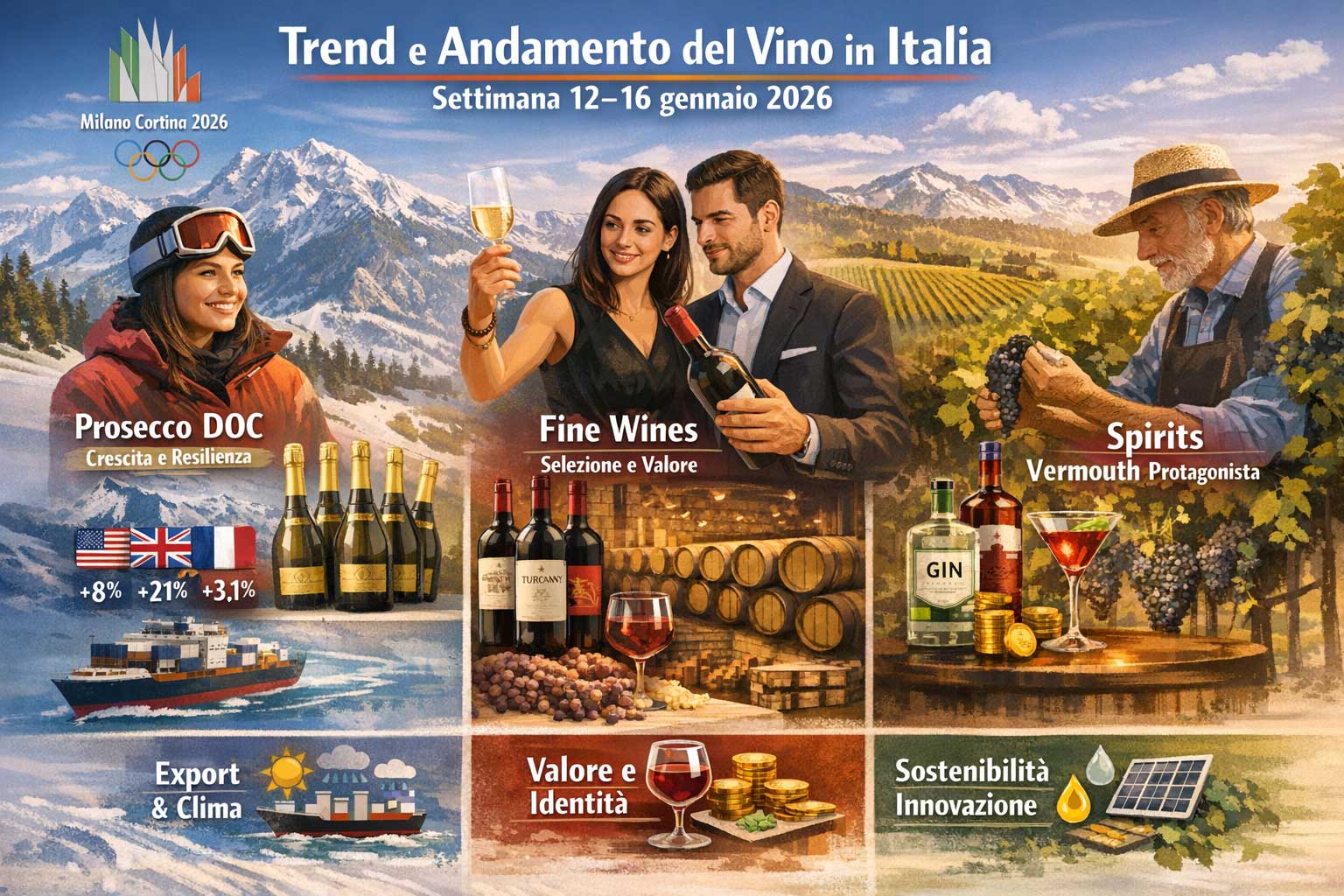
Wine Trends and Performance in Italy Week 12–16 January 2026

The week of January 12–16, 2026, captures an Italy of wine in the midst of a structural transition: on the one hand, the Prosecco “locomotive” continues to grind out volumes and value, on the other, the system as a whole must manage high inventories, more selective consumption and a 2026 that will reward those who defend margins, channels and identity.

In the middle, three decisive levers are at work: exports (with new opportunities but also tougher rules), repositioning towards value (not volume), and industrial adaptation to the climate.

1) Prosecco DOC: growth, resilience, and momentum 2026 (Milan-Cortina as a global showcase)

Prosecco DOC confirms its role as the driving force of Italian wine: 667 million bottles produced in 2025 (1.1% compared to 2024) , of which 60.3 million are Rosé (10% of the category) , for a total value of 3.6 billion euros . The denomination remains strongly oriented abroad: over 82% exports to 164 countries . The winning narrative is clear: an “easy” product in the best sense of the word (pleasantness, lightness, versatility, accessibility), supported by a consortium that links the brand to popular and high-visibility events.

Differentiated trajectories emerge in international markets (January–September 2025):

  • USA is the leading market (23.8% of exports) and 8% , albeit with volatility linked to duties.
  • UK 1.1% .
  • France accelerates and becomes the third market with 21.1% , overtaking Germany.
  • Germany 3.1% .
  • Strong signals also from “less obvious” markets such as Greece (22.4%) and Mexico (14.5%) , while other countries are slowing down for economic and geopolitical reasons.

On the promotional front, the Consortium indicates campaigns in 39 countries with 2.1 billion impressions . For 2026, the symbolic card is powerful: Official Sparkling Wine Sponsor of the Milan Cortina 2026 Olympic and Paralympic Games , an opportunity to consolidate value and positioning.

Two textbook strategic directions for 2026:

  • supply chain profitability (not just volume growth);
  • measurable sustainability , with the aim of obtaining Sustainable Community certification according to ISO 37101 and the development of a Low Alcohol Prosecco (8–9 degrees) , consistent with new styles of consumption and responsible consumption.

2) Fine Wines Market: Liv-ex Power 100 2025 and the Return of Rationality

The Liv-ex Power 100 2025 indicates a fine wine market that isn’t “rebounding,” but rather stabilizing : prices appear to have found a floor, more orderly bids/offers, and greater interest in solid, correctly priced brands. Demand stops asking “how much further will it go?” and starts asking “what’s best to buy today?”, signaling a return to selectivity.

Key trends:

  • Bordeaux is regaining its central role thanks to more consistent pricing policies: Cheval Blanc takes the top spot; Yquem remains in the top ten; cases like La Conseillante demonstrate the cost of a less “speculative” release and positioning strategy.
  • Burgundy remains dynamic but more unstable (many entries/exits), with growing interest in more “drinkable” and less extreme price ranges.
  • Champagne is experiencing one of its best results: 9 brands in the ranking, with Krug at the top and new entries such as Selosse and Salon .

Italy : Confirms its importance, but with clear internal differences. San Guido/Sassicaia soars (no. 2 overall), strengthening the role of Super Tuscans as “liquid assets” on the secondary market: global image, recognized quality, sufficient volumes, and still reasonable perceived prices. Some traditional big names, however, tied to a strong historical dependence on the US (Chianti Classico and Brunello), are struggling more, despite brands that are holding up (Ornellaia, Masseto, Tignanello, Solaia, and icons like Biondi-Santi/Soldera). In other words: in fine wine , price consistency, liquidity, and reputation are prized, not just aura.

3) 2026 Italian wine: less volume, more value (and clearer choices)

The strategic message running through all of this week’s content is one: 2026 will be a year of competitive maturity . The market no longer rewards indiscriminate offerings; it rewards those who can defend margins, manage channels, and sustain a credible identity.

Main drivers:

  • Polarized demand in Italy : accessibility and simplicity in large-scale retail, while the willingness to spend on experiences and wines with a “reason” is growing when perceived quality, service, and brand are consistent.
  • Horeca and wine tourism as platforms for loyalty and direct relationships (not just revenue).
  • Exports remain the center of gravity, but with “strict rules”: mature markets sensitive to price; emerging markets requiring continuity and long-term investments.
  • Financial management : bloated warehouses and slow turnover require planning and, where necessary, aggregation or more stringent supply chain agreements.
  • Vineyards as an industrial variable : water management, rootstocks, shading, precision farming. Sustainability only works if it becomes a measurable benefit , not greenwashing.
  • Product and language innovation : low/no-alcohol, new consumption opportunities, DTC and digital not as fashion, but as tools to reach different generations without losing authority.

4) Spirits: Vermouth returns to the forefront in 2026 (and gin risks natural selection)

Proposta Vini’s forecasts place the beverage market in a period of consolidation in 2026: wine is growing moderately, but the most dynamic trends are in spirits. The Proposta Spirits division closed 2025 with a 34% share of sales and identified Vermouth as the big bet for 2026: a bridge between winemaking and mixology, capable of appealing to diverse audiences (tradition for the over-50s, cocktail appeal for the younger crowd). Gin remains central and growing, but shows signs of saturation: too many brands, a potential bias toward those who can showcase local traditions and authentic foundations. The after-dinner segment is more challenging, also penalized by the regulatory and media climate surrounding consumption, while brown spirits (rum, whisky, brandy, cognac) are holding up.

5) Export and trade policy: EU–Mercosur as an “unlockable” opportunity

UIV welcomes the green light to the EU-Mercosur agreement: the South American region (over 250 million consumers) is seen as a potentially receptive market. The economic point is clear: currently, tariffs weigh up to 27% on still wines and 35% on sparkling wines exported to Brazil; their gradual elimination over eight years could improve Italian competitiveness. The Brazilian market imports nearly €500 million worth of wine annually , but Italy’s imports are worth approximately €40 million (8%) : real untapped potential, to be tapped with brand strategy, distribution continuity, and promotion.

6) EU Rules: “Wine Package” nears final approval (anti-crisis measures and No-Lo definitions)

The EU Parliament’s Agriculture Committee unanimously approved the text of the EU Wine Package (final vote expected in plenary session in February). The objective: to support a struggling sector with measures to rebalance production and demand, climate resilience, simpler labeling, wine tourism, definitions for No-Lo wines, export flexibility, plant diseases, and opportunities for aromatized wines.

Operational highlights:

  • tools to manage excesses (including eradications);
  • ten-year review of the plant authorization regime;
  • more funds for climate-related investments;
  • more streamlined labeling;
  • clear definitions: alcohol-free <0.5% , 0.0% <0.05% , reduced-alcohol with a reduction of at least 30% compared to the standard;
  • For exports outside the EU, exemption from the requirement to provide ingredients/nutritional values required for the domestic market (bureaucratic simplification).

7) “Cantina Italia”: high inventories, pressure on prices and need for commercial discipline

The most “heavy” figure for 2026 management is that of stocks: as of December 31, 2025, wine stocks reach 59.5 million hectolitres ( 11.6% compared to the end of November 2025 and 4.4% compared to December 31, 2024). To these are added 7.7 million hectolitres of musts and 2.8 million hectolitres of Vnaif . Stocks are concentrated in the North (58.6%), especially Veneto (27.3%) . In terms of “types”, the wine in stock is 54.2% DOP , 26.4% IGP , 1.6% varietals , 17.9% other wines .

Denominations with the greatest weight in stock: Prosecco Dop alone is worth 5.8 million hectolitres (12.2%) , followed by Igp Puglia (2.0 million hl) , Igp Toscana (1.75%) , Doc Delle Venezie (1.72%) , Igp Terre Siciliane (1.71%) , Igp Veneto (1.6%) , Doc Sicilia (1.5%) , Igp Salento (1.4%) , Chianti Docg (1.39%) , Igp Rubicone (1.3%) . This is the classic scenario in which “making wine” is not enough: channel discipline , rotation and commercial policies consistent with the inventory are needed, otherwise the warehouse becomes a financial brake.

8) Prices and consumption: Italy is the “cheapest” in Europe, but it’s not enough to increase consumption

A Destatis study reports that Italy is the EU country with the lowest wine/alcohol prices (about 19% below the EU average, October 2025). Yet, the issue isn’t just price: consumption is declining due to cultural dynamics, health concerns, competition from other beverages, and changing lifestyles. This data is useful because it refutes the simplistic idea that “increase the price and consumption falls” is the only lever: behaviors in different markets are not linear.

9) Quality-price and reputation: signs that the market wants “credible wines”

Two reputation indicators complete the picture:

  • Wine Spectator Top 10 Values 2025 : Italian presence with labels with high perceived value at an accessible price (e.g. Chianti Classico Tenuta di Arceno, Barbera d’Asti Michele Chiarlo), a sign that the quality-price range is a strategic area, especially for sensitive markets.
  • BWW 2025 : international awards and rankings (Petrus 2020 best wine; among the Italians cited Masseto 2020, Sassicaia 2021, Solaia 2020, Barolo Sperss 2018; Monteverro “Best New Winery”) reinforce the narrative: high-end wines thrive on reputation, but they work when supported by consistency and the market.

Wine press review for Thursday January 15 -2026

Novità enologiche, cantine e vini italiani.

Cantine italiane

Oltrepò Pavese: Pinot Nero “buono e accessibile” sotto i 15 euro (Valle Versa) Focus su una realtà storica della Valle Versa (culla del Pinot Nero oltrepadano): identità territoriale, suoli argilloso-calcarei, clima continentale “temperato” e crescita aziendale da realtà agricola a struttura consolidata.

Crisi Terre d’Oltrepò: non solo Collis, spunta anche l’interesse di Cantine Riunite Alla manifestazione d’interesse della cooperativa veneta Collis si aggiungono voci (non confermate) su Cantine Riunite. Nodo centrale: impegni di conferimento uve (si parla di obiettivo 250.000 quintali per la prossima vendemmia). Tema chiave: futuro industriale e tenuta della base agricola.

Monfort: 2025 di anniversari e investimenti (Trentino) 80 anni dalla fondazione (1945), 40 anni di Metodo Classico e lancio del Le Général Noir Riserva Trentodoc 2018. Direzione: investimenti su Trentodoc, sostenibilità e spinta estera (presenza in oltre 25 Paesi).

Cantine Levante: la viticoltura “verticale” ligure tra fatica e qualità Racconto identitario: vigneti difficili, paesaggi estremi, aziende che trasformano limiti fisici in unicità di prodotto e valore narrativo.

W1neShot: vino in lattina, consumo contemporaneo e “consapevole” Formato 200 ml, bianchi e rosé, 10°: proposta che affianca il rito classico (non lo sostituisce) con linguaggio più informale, sostenibile e immediato. Progetto guidato da un’enologa veronese (Elisa Di Stefano), con attenzione alle nuove generazioni.

Vino italiano ed enologia italiana

Ingredienti e QR code: vino rosso con mosto concentrato, è regolare? Dal tema etichettatura (ingredienti, valori energetici e tabella nutrizionale anche via QR) alla domanda pratica: presenza di mosto concentrato e origine “UE” generica. Un caso che riporta al centro trasparenza e percezione del consumatore.

Nasce un corso di Viticoltura ed Enologia nella terra del Verdicchio dei Castelli di Jesi Dal 2026–2027, all’IIS “Cuppari Salvati” (Villa Salvati di Pianello Vallesina, Monte Roberto): percorso tecnico per formare figure operative su gestione sostenibile del vigneto, vinificazione e biotecnologie della qualità. Segnale forte: territorio che investe su competenze, non solo su produzione.

Rifiuti agricoli: Rentri, esenzione dall’iscrizione per gli agricoltori (con tracciabilità sostanziale) La Legge di Bilancio 2026 (Legge 199/2025) modifica l’art. 188-bis del T.U. Ambiente: esenzione dall’iscrizione obbligatoria al RENTRI per imprenditori agricoli (resta possibile adesione volontaria). Meno burocrazia, ma attenzione: le regole sulla tracciabilità “di fatto” restano un punto da presidiare.

Innovazione in vigneto: progetto “InVigna” per sfidare il clima (Oltrepò Pavese e Lombardia) Dopo “Biodivigna”, il Distretto del vino di qualità torna capofila con un progetto integrato (prove in campo, collaudi, azioni dimostrative) con Università Cattolica, istituto agrario Gallini, partner tecnici e agronomici. Parola d’ordine: adattamento climatico con metodo, non slogan.

Cantina Italia (ICQRF): giacenze a 59,5 milioni di ettolitri a dicembre 2025 (+4,4% sul 2024) Dato “pesante” che fotografa un 2025 complicato: vendemmie più abbondanti (2024 e 2025) + consumi/vendite più lenti = stock che cresce. Segnale operativo per il 2026: disciplina commerciale, gestione prezzi, canali e rotazione.

No/Low Alcohol: “vino dealcolato” e “parzialmente dealcolato”, la nuova normalità Il no-alcol esce dalla nicchia: cresce la proposta e si consolidano le definizioni di etichetta (soglie e diciture). Tema identitario + tecnico: come preservare qualità, posizionamento e fiducia mentre cambia il prodotto.

Turismo: Colline del Prosecco UNESCO, crescita diffusa tra Core, Buffer e Commitment Zone Gen–nov 2025: +5,9% arrivi e +7,1% presenze; crescita estera +9%. Interessante la distribuzione dei flussi (non solo “core zone”): spinta dell’extralberghiero e domanda di soggiorni esperienziali, autentici, più lunghi.

Dibattito salute: Garattini vs Gardini, vino sì/no e questione “senza alcol” La discussione pubblica si polarizza: messaggi sanitari netti e contro-narrazioni dal mondo vino. Effetto collaterale: il consumatore chiede più chiarezza (e meno propaganda) su rischio, moderazione e alternative.

Internazionale

USA: i dazi frenano i valori ma non i volumi del vino importato (Nomisma, 10 mesi 2025) Import complessivo: -7,5% a valore, +0,1% a volume. Per l’Italia si nota una riduzione dei prezzi medi all’import (strategia difensiva per contenere i prezzi al consumo). Segnale: la competizione si gioca su prezzo/margine e posizionamento.

India: mercato ancora piccolo, ma potenziale in crescita per il vino italiano Import 2023 contenuto, ma trend di crescita sostenuto e prospettive positive sul valore al consumo fino al 2028. L’Italia è tra i principali fornitori con tassi di crescita interessanti: terreno da coltivare con pazienza, presidio e formazione.

Eventi enologici

Agenda weekend 16–18 gennaio 2026: festival, sagre ed eventi enogastronomici Selezione di appuntamenti in Italia tra degustazioni, format “bere consapevole”, esperienze outdoor e rassegne. Spicca il progetto “Dry January” in chiave gastronomica contemporanea e diffusa (tour tra locali del Nord Italia).

SuperVeneti (AIS Veneto): focus sui grandi rossi internazionali in chiave veneta Evento per degustatori ufficiali e gruppo servizi AIS: Cabernet Sauvignon, Merlot, Carmenère, Cabernet Franc in aree vocate tra Vicenza, Padova e Treviso. Lettura interessante: “altra faccia” del Veneto, spesso meno raccontata.

Memorie Mediterranee: masterclass Salice Salentino (31 gennaio 2026, ore 14:00) In collaborazione con il Consorzio: Negroamaro e denominazione in diverse interpretazioni (rosato, rosso, riserva). Formula con calice tecnico e accesso masterclass.

Dialoghi tra Vignaioli: dietro le quinte del Barolo (gennaio–marzo 2026) Tre appuntamenti della Strada del Barolo. Primo incontro: 21 gennaio, Mudet (Museo del Tartufo) di Alba, con focus su suolo, biodiversità e connessioni tra ecosistemi (tartufo, bosco, vigneto).

Torino Capitale del Vermouth: 240° anniversario (1786–2026), Salone del Vermouth 21–22 febbraio 2026 Terza edizione al Museo Nazionale del Risorgimento: oltre 30 produttori, taglio culturale ed esperienziale, dialogo tra storici e nuovi player.

Focus Politiche & regolazione (trasversale)

“Pacchetto Vino” UE: ok Commissione Agricoltura, attesa la plenaria di febbraio Via libera all’unanimità all’intesa: misure su gestione produzione/offerta, resilienza climatica (coperture fino all’80% dei costi ammissibili), etichettatura semplificata/armonizzata, enoturismo, definizioni per No/Lo, export e aromatizzati. Ora serve il voto finale dell’Eurocamera.

Reazioni Italia: Città del Vino e Coldiretti promuovono la direzione (meno burocrazia, più trasparenza, strumenti di crisi) Apprezzamento per semplificazione, misure di crisi e chiarimenti su terminologia dealcolati; richiesta implicita: risorse e applicazione efficace.

Fertilizzanti: annunciata sospensione dazi UE (nota politica) Tema costi di produzione agricola: se la misura resta e si traduce in prezzi, può alleggerire una voce di costo sensibile per molti vigneti (da verificare impatto reale lungo la filiera).

Grazie per l’ascolto: la rassegna stampa vino di oggi è stata offerta da WINEIDEA.IT. A risentirci domani.

Wine press review for Wednesday January 14 -2026

Wine news, Italian wineries and wines.

1) Italian wineries

Tenuta di Bibbiano (Chianti Classico): Vertical tasting 1997–2019. A portrait of a “classicist” Sangiovese winery, combining elegance, sobriety, and a careful interpretation of individual vineyards. A focus also on the legacy of Giulio Gambelli, an absolute master of Sangiovese culture.

Specogna among the best agricultural companies in Italy (America Agricoltura Award) Recognition to Cristian and Michele Specogna (Corno di Rosazzo) for entrepreneurial ability, sustainability, and innovation, with enhancement of commercial relations with the USA.

Siddùra and the “dominance” of Vermentino di Gallura Three consecutive years of top results for different Vermentino di Gallura DOCGs: growing the denomination’s reputation and strengthening the “territorial value” (not just of the individual brand).

Calabria in turmoil: one of the most interesting wines is born near Cosenza. Signs of a qualitative and identity-building revival in Calabrian winemaking (also thanks to increased visibility and selection/guided tasting efforts).

Pollenzo Wine Bank: historic vintages and winemaking heritage. Over 50,000 bottles stored: conservation as a cultural and professional asset, with a growing role for enthusiasts and professionals.

2) Italian wine and Italian oenology

Oltrepò Pavese: Pinot Noir surpasses red varieties. A push for “Classese” is underway. Ampelographic and strategic changes are underway: classic method sparkling wines are increasingly central, with the aim of evolving “Classese” from a consortium brand to a denomination.

Piwi (resistant grape varieties): growth focused on Prosecco and Pinot Grigio. Resistant varieties as a structural lever: reduced spraying and greater climate resilience. Contextual note: Italy is perceived as “behind” its potential.

Transparency and back-labeling: the Xtrawine case and the “grey areas” Hot topic on traceability and consumer clarity: discussion on unidentifiable “producers” and how the rules are used (or circumvented) in practice.

Alcohol prices: Italy the cheapest in the EU (October 2025 data). According to Destatis, wine/spirits/beer prices are below the EU average; compared with more expensive countries (Finland leading the way). Implication: a price advantage, yes, but not enough if demand slows.

Out-of-home consumption: fewer trips, more selectivity, and a quality experience. Federvini/Tradelab: a slight decline in visits, but value growth at certain times (after dinner). Consumers aren’t “disappearing”: they’re buying better, more thoughtfully.

Treatment Registry: Digital Transition De facto Postponed to 2027. The Campaign Notebook (Agea) remains voluntary through 2026; mandatory as of January 1, 2027. Impact: An additional year to organize processes and data.

Zero-interest liquidity for farmers (CAI “Risultato Sicuro” initiative) Zero-interest commercial credit for purchases in 2026: useful financial leverage especially during investments and cash management.

Health and wine: Garattini’s “no” for longevity. A clear position (no wine, no red meat, no butter) in the debate on public health and consumption: a narrative that continues to weigh on general sentiment.

Curiosity outside the supply chain: “ecclesiastical diet” with wine always. Colourful news: wine required daily in the catering specifications of ecclesiastical structures (more of a cultural than a market issue).

3) International

Investment wines: an uncertain market, but Italy holds firm (Supertuscan) Liv-ex Power 100: after a tough 2024 and an even more severe 2025, a shift in mentality is emerging (“what’s best to buy now”), with timid signs of stabilization towards 2026.

EU: Wine consumption to decline through 2035. EU Agricultural Outlook 2025–35: forecast annual decline and overall decline compared to recent averages. Drivers: health, public policies, competition from other beverages.

China: Young people and new rituals – mulled wine booms, white wine is popular even in winter. Meituan data shows a sharp increase in white wine and a surge in searches for mulled wine kits. The signal: “ritual” and self-consoling consumption, rather than traditional.

Australia: Fire at Fowles Wines, 2026 vintage lost . Extreme weather event directly impacting vineyards and production. Brutal reminder: physical risk increasingly business-critical.

Wine Spectator – Top 10 Values 2025: Italy Present Highlights of Italian labels awarded for quality/price (examples: Chianti Classico Tenuta di Arceno; Barbera d’Asti Michele Chiarlo). Value: strong commercial leverage in a period of cautious demand.

4) Wine events

Art & Wine Siena (January 15, Piazza del Campo) A meeting between wine and contemporary art: leading producers, focus on signature labels and storytelling.

Haute Cuisine & Franciacorta (Ravenna, January 15) Show cooking and pairing with the historic Bersi Serlini winery: a “high value” experiential format, consistent with the most selective demand.

Visit and tasting at Monteversa (Euganean Hills, February 1st) A winery experience focusing on volcanic soil, territorial identity, and organic production: wine tourism as a conversion channel.

Casa Italia Milano Cortina 2026: LT Wine selects 26 labels International showcase during the Games (6–22 February 2026): positioning and reputation opportunities for Italian wine.

Vulture Italian City of Wine 2026–2027 Operational launch of the “system” project with institutions and consortia: not just an event, but a territorial journey (wine tourism identity).

Strategic reading of the day (2 lines, no unnecessary poetry)

2026 is shaping up to be a year of “less volume, more choice”: demand is structurally declining in Europe, but real opportunities exist where perceived quality, transparency, wine tourism, and the ability to embrace new rituals (No-Lo, experiential consumption, investment/collecting) are at stake. Meanwhile, regulation and climate are definitively entering the bottom line, not the press release.

Style Selector
Select the layout
Choose the theme
Preset colors
No Preset
Select the pattern