A network portal of Wine Idea. Discover the world of Wine idea

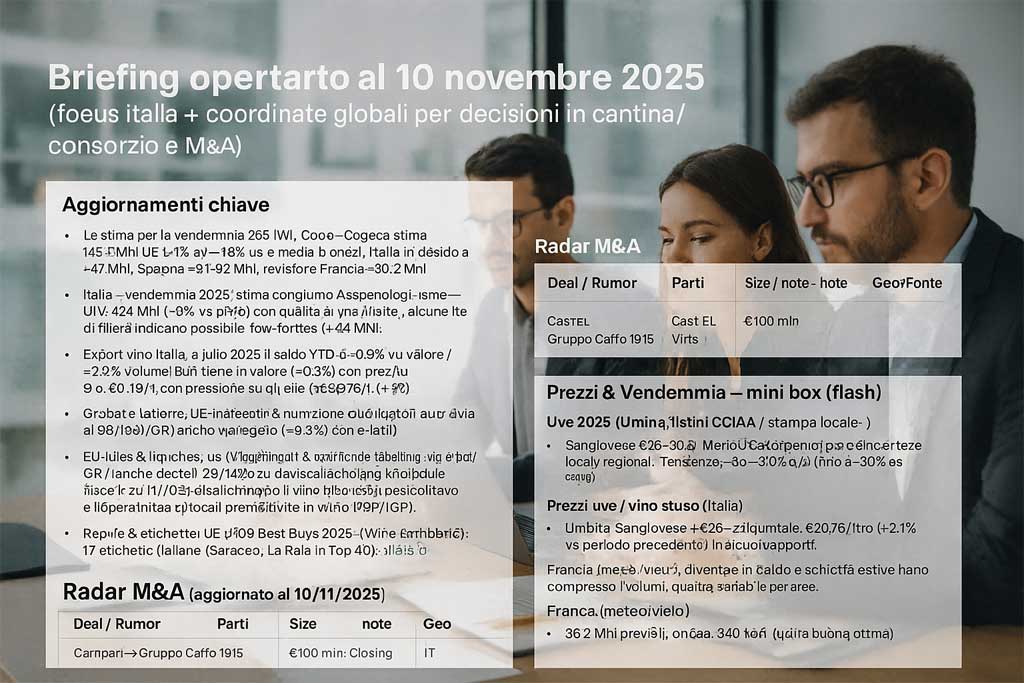
Daily Report – November 10 2025 on the World of Wine (Italy & Global)

Daily report – November 10, 2025 on the world of wine (Italy & global), designed for those who lead operations in wineries/consortia.

(Focus on Italy, global coordination for winery/consortium decisions and M&A)

  • 2025 harvest (EU/Italy/France): Copa-Cogeca estimates 145.5 Mhl EU (1% y/y; −7.5% vs. 5-year average). Italy leads with ~47 Mhl , Spain ~31–32 Mhl; France revised to ~36.2 Mhl due to heat and drought.
  • Italy – 2025 harvest: joint Assoenologi–Ismea–UIV estimate: 47.4 Mhl (8% vs 2024) with good/excellent quality; some supply chain readings indicate a possible “low-forties” (~44 Mhl) .
  • Italian wine exports: in July 2025 the YTD balance is −0.9% value / −3.4% volume ; USA in negative territory and affected by 15% tariffs (since August): −28% in value in the two-month period July-August .
  • Italian stocks: as of 09/30/2025 in the cellar ~36 Mhl (-9.6% vs July; 1.3% y/y) → pressure on bulk price lists.
  • Global market H1-2025: world trade −2.3% value / −3.7% volume ; bulk holds steady in value (−0.3%) with average price ~€0.78/L ( 2.1%) .
  • Rules & Labels: EU: Ingredients & Nutrition Facts mandatory from December 8, 2023 (also via e-label/QR ). OIV updates the 2025 standards (Codex/Practices/Labeling). In Italy, decrees of December 20, 2024, and May 14, 2025, regulate (partially) dealcoholized wine and its use in mixed-use premises; restrictions on PDO/PGI remain in place according to the current texts/amendments.
  • Awards/Rankings:Top 100 Best Buys 2025 ” (Wine Enthusiast): 17 Italian labels (Saracco, La Raia in the Top 10).

M&A Radar (updated 10/11/2025)

Deal / RumorPartsSize / noteGeoSource
Transfer of the Cinzano & Frattina brandsCampari → Caffo Group 1915€100 million ; closing expected by the end of 2025IT
Tannic (closing 06/10/25)CASTEL-Vins ↔︎ TannicndIT/FR
Talloria Valley (former Giordano complex, IWB)binding offerCaffo Group 1915 ↔︎ Italian Wine Brandsnd; “new Cinzano House”; move expected by the end of 2025IT (Piedmont)

Prices & Harvest — mini box (flash)

Grapes 2025 (Umbria, Chamber of Commerce price lists / local press – October):

  • Sangiovese €26–30/q; Merlot/Cabernet €28–30/q; Sagrantino DOCG €100–140/q. Trends: −~30% y/y (up to −50% vs 2023); the only exception is Trebbiano Spoletino, which is rising sharply due to scarcity.

Bulk wine (global):

  • H1-2025 average bulk price ~€0.78/L (2.1%), weak trade; in Italy demand is cautious with high inventories .

Stocks & Returns (Italy):

  • Stocks ~36 Mhl as of September 30; harvest ~47.4 Mhl (good/excellent quality) with possible reductions in some areas.

France (weather/yield):

  • 36.2 Mhl expected; heat waves and summer droughts have compressed volumes, quality varies by area.
Daily Report – November 9 2025

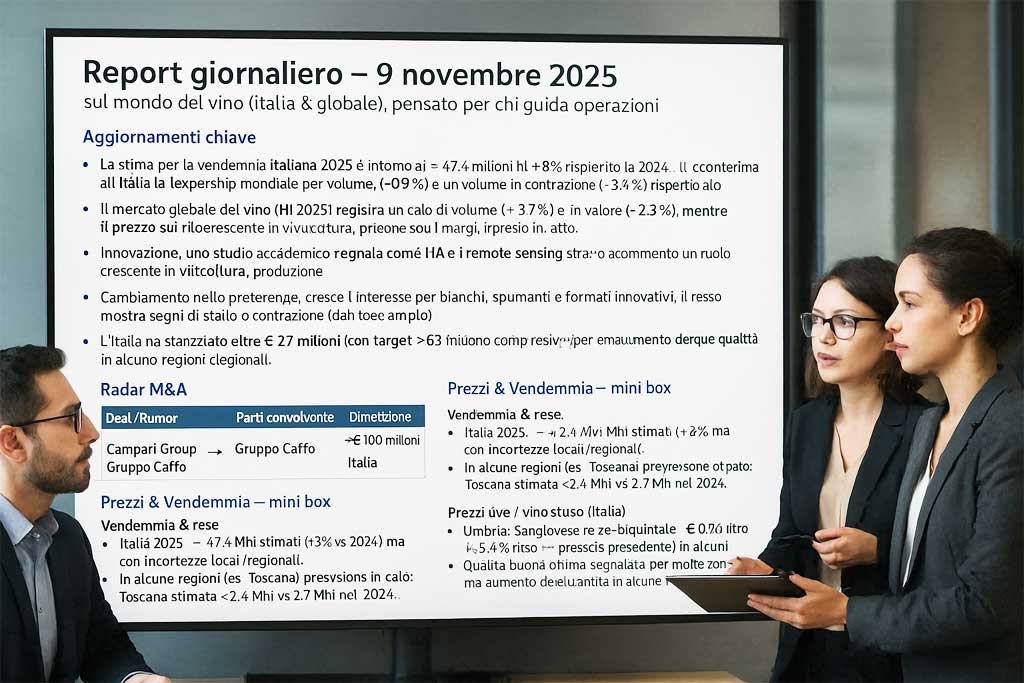
on the world of wine (Italy & globally), designed for those who manage operations in wineries/consortia.

Key updates

  • The estimate for the 2025 Italian harvest is around ~47.4 million hl , 8% compared to 2024, which confirms Italy’s world leadership in terms of volume.
  • Italian wine exports in the first seven months of 2025 show a slight decrease in value (-0.9%) and a contraction in volume (-3.4%) compared to the same period in 2024.
  • The global wine market (H1 2025) records a decrease in volume (~‑3.7%) and value (~‑2.3%), while the average price per litre in some segments (bulk) rises to ~€0.78/litre (approximately 2.1%).
  • Inventories remain high in the Italian bulk and bulk wine segment: large quantities clash with demand, putting pressure on margins.
  • Innovation: An academic study reports how AI and remote sensing are playing a growing role in viticulture, production, and wine tourism.
  • Changing preferences: interest in whites, sparkling wines, and innovative formats is growing; red wines are showing signs of stagnation or decline (specific data for Italy is not always disclosed). (Source: broader imported trend)
  • Italy has allocated over €27 million (with a target of >€63 million in total co-financed) to promote Italian wine in non-EU markets for 2025/26, considered strategic in a context of export challenges.

M&A Radar

Deal/RumorParties involvedSize (if stated)GeographySource
Transfer of the Cinzano Frattina brandCampari Group → Caffo Group 1915~€100 millionItaly

Prices & Harvest – mini-box Harvest & yields

  • Italy 2025: ~47.4 Mhl estimated (8% vs 2024) but with local/regional uncertainties.
  • In some regions (e.g. Tuscany) forecast decrease: Tuscany estimated ~2.4 Mhl vs 2.7 Mhl in 2024.

Grape / bulk wine prices (Italy)

  • Bulk market Italy: average price reported ~€0.78/litre (2.1% vs previous period) in some reports.
  • Price pressure in regions with large surpluses and weak demand. High inventories = compressed margins.

Weather/Quality Note

  • Good-excellent quality reported for many areas, but increasing quantities in some regions which may generate supply/demand imbalances.

Daily Report – November 8, 2025

on the world of wine (Italy & globally), designed for those who manage operations in winer.

Key Updates

  • Estimates for the 2025 Italian harvest indicate approximately 47.4 million hl , an increase of approximately 8% compared to 2024.
  • Italian wine exports in the first seven months of 2025 recorded a -0.9% in value and -3.4% in volume compared to the same period in 2024, with the US market declining for the first time.
  • The global wine market (H1 2025) recorded a decrease of –2.3% in value and –3.7% in volume, with the average price per litre increasing to around €3.57.
  • Italian inventories remain high and represent a potential pressure on margins in the loose and bulk segment.
  • Innovation: An academic study highlights how AI and remote sensing are playing a growing role in viticulture, production, and wine tourism.
  • The focus on younger consumers and on white/sparkling wines shows a change in preferences: in Italy, a recent analysis reports -6.8% in red wine sales, while white and sparkling wines are growing by ~5%.
  • In the M&A sector, although the sector is still in the process of stabilizing, signs are emerging such as the sale of the Cinzano brand from Campari Group to Gruppo Caffo 1915 for ~€100 million.

M&A Radar

Deal/RumorParties involvedSize (if stated)GeographySource
Transfer of the Cinzano Frattina brandCampari Group → Caffo Group 1915~€100 millionItaly

Prices & Harvest – mini box

Harvest & yields

  • Italy 2025: estimate ~47.4 Mhl (8% vs 2024).
  • Grape quality reported to be good, but with an increase in quantities in some regions and possible imbalances between supply and demand.

Grape / bulk wine prices (Italy)

  • Umbria: Sangiovese ~€26-30/100 kg; Merlot/Cabernet ~€28-30/100 kg; Sagrantino DOCG ~€100-140/100 kg.
  • Bulk wine in Italy: average price ~€0.78/liter, 2.1% lower than the previous period. Trend : grape prices in some regions are down compared to last year (e.g., Umbria: approximately -31% for Sangiovese).

Wine Trends in Italy – Week 3-7 November 2025 (Analysis by Eros Zago)

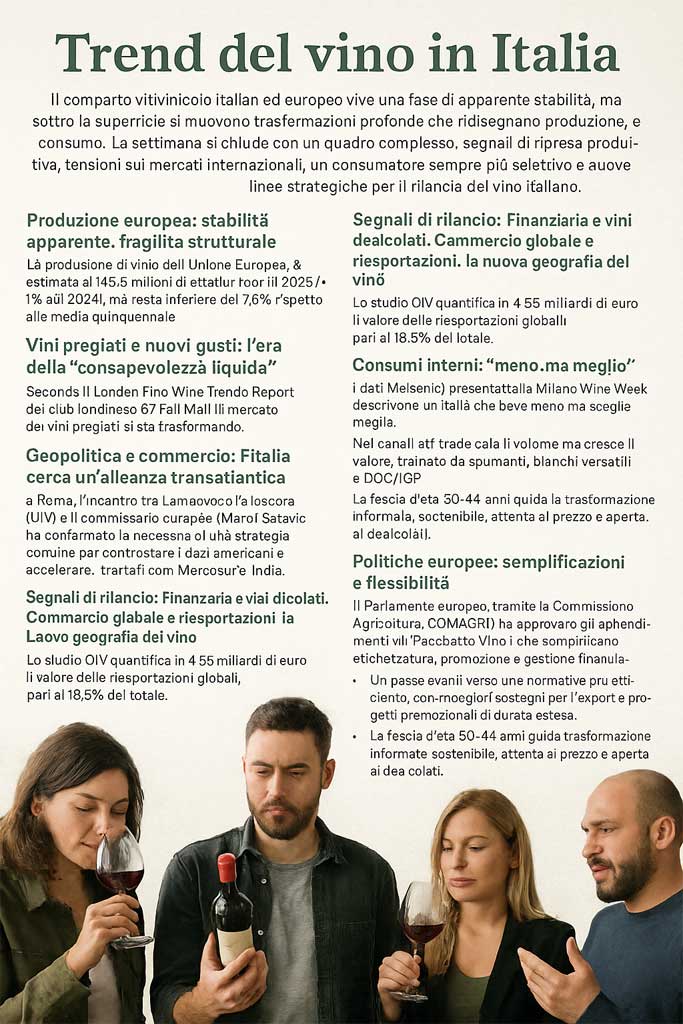
The Italian and European wine sector is experiencing a period of apparent stability, but beneath the surface, profound transformations are taking place that are reshaping production, trade, and consumption.

Wine Trends in Italy – Week 3-7 November 2025 (Analysis by Eros Zago)

The week ends with a complex picture: signs of production recovery, tensions on international markets, an increasingly selective consumer, and new strategic lines for the relaunch of Italian wine.

European production: apparent stability, structural fragility

European Union wine production is estimated at 145.5 million hectolitres for 2025 (1% compared to 2024), but remains 7.5% below the five-year average.
Italy confirms its leadership with 47 million hectolitres (8%), ahead of France (37 Mhl, 2.3%) and Spain (31.5 Mhl, -15%).
Behind the slight recovery in volumes lies a long-term downward trend: since 2018, EU production has fallen by over 40 million hectoliters. 2025 was marked by extreme weather events and a complex trade environment, exacerbated by new US tariffs on European wines.

Fine wines and new tastes: the era of “liquid awareness”

According to the London Fine Wine Trends Report from London club 67 Pall Mall , the fine wine market is transforming.
The evolved consumer favours authenticity, drinkability and immediate value , while the myth of big labels and the “en primeur” system is losing its appeal.
Interest in South Africa (26% in 10 years), English Sparkling Wine (79% since 2015) and consumption of Italian wines (37.5%) are growing, particularly from regions such as Sicily and Tuscany .
The future of fine wine will be driven by a more informed, digital and independent public, with increasing attention to sustainability, low alcohol content and lightweight packaging .

Geopolitics and Trade: Italy Seeks a Transatlantic Alliance

In Rome, the meeting between Lamberto Frescobaldi (UIV) and European Commissioner Maroš Šefčovič confirmed the need for a common strategy to counter American tariffs and accelerate treaties with Mercosur and India .
Italy is aiming for an alliance with American trade , emphasizing that every dollar invested in EU wines generates $4.50 for the US economy. Wine thus also becomes a tool of economic diplomacy .

Signs of recovery: Financial law and dealcoholized wines

Two pieces of news fuel confidence in the future of the sector:

  1. 2026 Budget Law – Budget law provides for an increase in funding for promotion and internationalization of up to €250 million annually for the three-year period 2026-2028.
  2. Decree on dealcoholized wines – currently awaiting final approval, will open a new production frontier, meeting the growing demand for low- and no-alcohol wines .

A double strategic step towards a more competitive, modern, and international Italian wine.

Global trade and re-exports: the new geography of wine

The OIV study quantifies the value of global re-exports at 4.55 billion euros , equal to 13.5% of the total.
New hubs are emerging: the UK, Belgium and Singapore , high-value clearinghouses for premium and super-premium wines.
For Italy, re-export represents approximately 8% of total exports , highlighting the growing importance of distribution as a strategic lever for competitiveness and profitability.

Domestic consumption: “less, but better”

The NielsenIQ data presented at Milan Wine Week depicts an Italy that drinks less but makes better choices.
In off-trade channels, volume is decreasing but value is increasing, driven by sparkling wines, versatile whites and DOC/IGP .
The 30-44 age group is leading the transformation: informed, sustainable, price-conscious and open to deal-alcohol .
In the Horeca channel, the “quality of the experience” dominates: a thoughtful wine list, local storytelling, and staff training.
The trend towards premiumisation is consolidating: less quantity, more identity and transparency.

European policies: simplifications and flexibility

The European Parliament, through the Agriculture Committee (COMAGRI), has approved the amendments to the “Wine Package” , which simplify labelling, promotion and financial management .
A step forward towards more efficient regulation, with greater support for exports and long-term promotional projects.

Conclusion: the future of Italian wine

Italian wine enters 2026 with solid foundations but decisive challenges : economic sustainability, market diversification, digitalization, and new consumption styles.
Italy maintains its manufacturing leadership, but must now consolidate it with a vision of value, identity, and innovation .
The watchword is clear: less quantity, more strategic quality —from the vineyard to the table, from the territory to the world.

Style Selector
Select the layout
Choose the theme
Preset colors
No Preset
Select the pattern