A network portal of Wine Idea. Discover the world of Wine idea

Agricultural land: why some increase in value and others lose it

Regulations, supply chains, and trends that are redrawing the value map.

Something less visible than a revolution, but much more impactful, is happening in the agricultural world: a silent selection of value.

Some lands are becoming increasingly sought-after, while others remain stagnant or are declining. This isn’t by chance, nor is it simply a matter of agronomic quality. What makes the difference today are the rules, supply chains, and consumption .

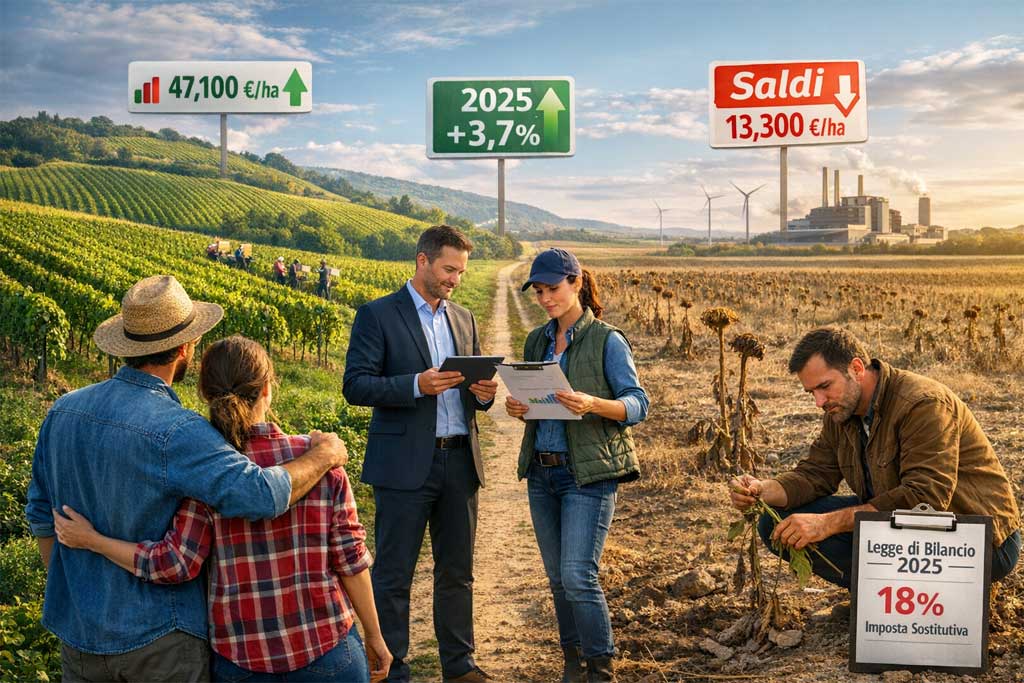
2024 captures this transition well. The average value of agricultural land in Italy reached €22,400 per hectare , a 1% increase. A modest but significant increase: after years, it outpaces inflation and signals that land is once again being viewed as an economic asset , not just an inherited legacy.

But talking about “land prices” in a generic sense is misleading. The market isn’t a single thing: it’s a constellation of local micro-markets, which react very differently to the same stimuli.

An increasingly polarized geography of value

The 2024 numbers show a clear divide:

  • Northeast : €47,100/hectare, the most expensive and competitive area
  • North-West : €35,200/hectare (2.3%)
  • Center : €15,100/hectare
  • South : €13,300/hectare (1.9%)
  • Islands : €8,600–9,000/hectare

These differences aren’t the result of market sentiment. They’re the result of concrete factors: logistics, water availability, the presence of structured supply chains, leading companies, strong brands, and the real possibility of turning land into income .

Where a major brand arrives, or where a denomination becomes a driving force, the landscape changes status. Where, however, a crop loses commercial appeal or is left out of the mainstream, its value tends to decline.

The 2025 signal: the market starts moving again

Another indicator deserves close attention. In the first half of 2025, sales showed a shift in pace:

  • –2% in the first quarter
  • 3.7% in the second quarter

It’s not a boom, but it’s a sign of a return to decision . After a long wait-and-see phase, investors and operators are beginning to evaluate concrete operations again. The main reasons are two:

  • CAP 2023–2027 , which offers a more stable framework for those investing in the medium to long term
  • More readable regulations , especially on the fiscal and patrimonial level

When the rules become less opaque, capital tends to come back into play.

Why land is worth (or isn’t worth) today

The value of a piece of land doesn’t depend on its size, but on its economic function within its context . The question to ask isn’t “how beautiful is it,” but: what can it realistically become in the next ten years?

The factors that have the greatest impact today are:

  • location and logistical accessibility
  • urban planning destination and constraints
  • water availability (often decisive)
  • inclusion in certified supply chains or strong brands
  • environmental and landscape constraints
  • exposure to climate risks
  • compatibility with energy or multifunctional projects

Land increases in value when it enters a credible economic narrative . It declines when it remains outside of the flows, or when it produces something the market no longer demands.

The fiscal lever that changes strategies: 2025 Budget Law

The real break comes at the regulatory level. With the 2025 Budget Law, the ability to revalue land for tax purposes becomes a structural possibility.

Owners of land owned as of January 1, 2025, can update the market value by paying a substitute tax of 18% (it was 16% in the previous two years).

Key conditions:

  • Expiration: November 30, 2025
  • certified appraisal drawn up by a qualified professional, based on technical-economic criteria

It’s not a technical detail: aligning tax value with real value changes the way we plan sales, generational transitions, corporate transactions, and investments . Land ceases to be an “uncertain” variable in the accounts.

Owners and investors: two different effects, same direction

For landowners, reassessment is a strategic assessment: updating today can reduce future rigidities . It’s not an automatic choice, but a tool to be evaluated with capital considerations.

For buyers, the effect is equally significant: more transparency means fewer negotiating deadlocks and greater fluidity in transactions. Real estate markets function better when values are legible.

Unused lands and new projects: the potential to change the map

In the long term, the real playing field is different. Italy has over 4 million hectares of uncultivated land and approximately 14,000 hectares of public land , with an estimated value of around 180 million euros .

Over €1 billion is planned for the 2024–2028 period for recovery, innovation, and sustainability, with a focus on young entrepreneurs and new management models.

If these policies become real projects, their value will not only depend on the initial price, but on the ability to transform the territory into a business , using modern tools: water management, technology, short supply chains, economic sustainability even before environmental sustainability.

It’s not a fad: it’s a phase change

The real turning point isn’t a single fact. It’s the changing climate:

  • prices that are holding up again
  • more stable tax rules
  • more selective investors
  • lands that are valuable if they are “useful” for something

Land is no longer an indistinct commodity. It has once again become a strategic choice , rewarding those who understand supply chains, anticipate consumption, and understand where major market flows are going—and where they are leaving.

My dad always told me, remember that the earth always gives you food!

Wine press review for Sunday January 4 – 2026

Wine news, Italian wineries and wines.

Italian wineries

La Gerla, Monteraponi, and Cavallotto: the podium of the “Top 100” by Kerin O’Keefe. Three iconic denominations of Italian red wine lead the ranking:

  • Brunello di Montalcino La Pieve 2021 – La Gerla (100 points)
  • Chianti Classico Gran Selezione Radda Bragantino 2021 – Monteraponi (100 points)
  • Barolo Bricco Boschis Vigna San Giuseppe 2019 – Cavallotto (100 points)

Only high-altitude vineyards: Baglio di Pianetto’s strategic choice. Focusing on mountain vineyards for freshness and elegance. The winery focuses production on Santa Cristina Gela and Piana degli Albanesi, ceding its vineyards in Noto.

The new has ancient roots: Siridia is born in Negrar. Samuela and Edoardo Speri’s project combines distinctive wines and an innovative liqueur offering, with an Amaro that integrates Amarone dried grapes and select botanicals.

Ungrafted vineyards and Roman cisterns: La Sibilla in the Phlegraean Fields. The Di Meo family promotes Falanghina and Piedirosso, along with native varieties rediscovered in a unique setting with volcanic soil and history.

Chiarli 1860: One Hundred Years and a Major Renovation The historic Modena winery is investing in a new bottling line and technological systems to meet an increasingly demanding market.

Epiphany toast: “Lumia” by Carlo & Marco Carini. Late harvest Sans Année, organic, from Sémillon grapes, aged in barriques. Limited production of 1,100 numbered bottles.

Vigna Laure Greco di Tufo DOCG Riserva 2023 – Cantine Di Marzo The Irpinian white wine wins the Gambero Rosso Tre Bicchieri award , confirming the value of the project led by Ferrante Di Somma.

Italian wine and Italian oenology

Sergio Mattarella : “Thanks to food and wine, we are appreciated around the world.” In his end-of-year speech, the President emphasized the cultural value of Italian food and wine, just days after UNESCO recognized Italian cuisine.

The return of Prünent, Nebbiolo from Val d’Ossola A historic Nebbiolo ecotype is reborn thanks to the work of the Garrone family, in one of the northernmost areas of Piedmont.

The future of Italian wine according to the Consorzio Italia del Vino. Keywords for 2026: enthusiasm, beauty, experimentation, stability, and resilience. Reflections from the leaders of 24 major groups representing 15% of exports.

Growing stocks: from major DOCs to “jewel” territories. Cantina Italia data (updated November 30, 2025) show 53.4 million hectolitres (8.6% year-on-year), with slow sales and declining consumption.

Alcohol-Dealcoholized Wines: The Decree Is Here With the interministerial decree between the Ministry of Economy and Finance (MEF) and the Ministry of Food and Agriculture (MASAF), Italy finally defines the regulatory framework for low-/no-alcohol wines, protecting historic denominations.

“Pazza Idea”: Ca’ di Frara’s alcohol-free wine. Luca Bellani’s project was born in Germany, using osmosis technology and Moselle grapes, anticipating the Italian market for dealcoholized wines.

How we will drink in 2026 According to sommelier Luisito Perazzo, indigenous will be the key word of the future, along with greater consumer awareness.

The 2025 harvest will be excellent, but 2026 looks set to be complex. Production estimated at 47.4 million hectolitres (8%), high quality but high stocks in a context of declining consumption.

International

The World’s Best Winery is Viña Vik According to The World’s 50 Best Vineyards 2025 , the Chilean project combines iconic architecture, experiential wine tourism and wines from unique microclimates.

April 2025: Italian and International Wine A key month marked by agricultural policies, surplus management, and structural reflections on the future of the sector.

Wine events

The Michelin Guide introduces the “Grappoli” Starting in 2026, a new selection will reward wineries with one, two or three Grappoli, alongside recommended vineyards.

Wine takes center stage once again: the countdown to Wine&Siena begins. Three days dedicated to the excellence selected by The WineHunter Award, with over 100 wineries and a new partnership with the Consorzio del Nobile di Montepulciano.

The Under-40s of Italian Wine: Talent, vision, and new energy, as told through the protagonists we met in 2025, ahead of Only Wine.

Strategic focus

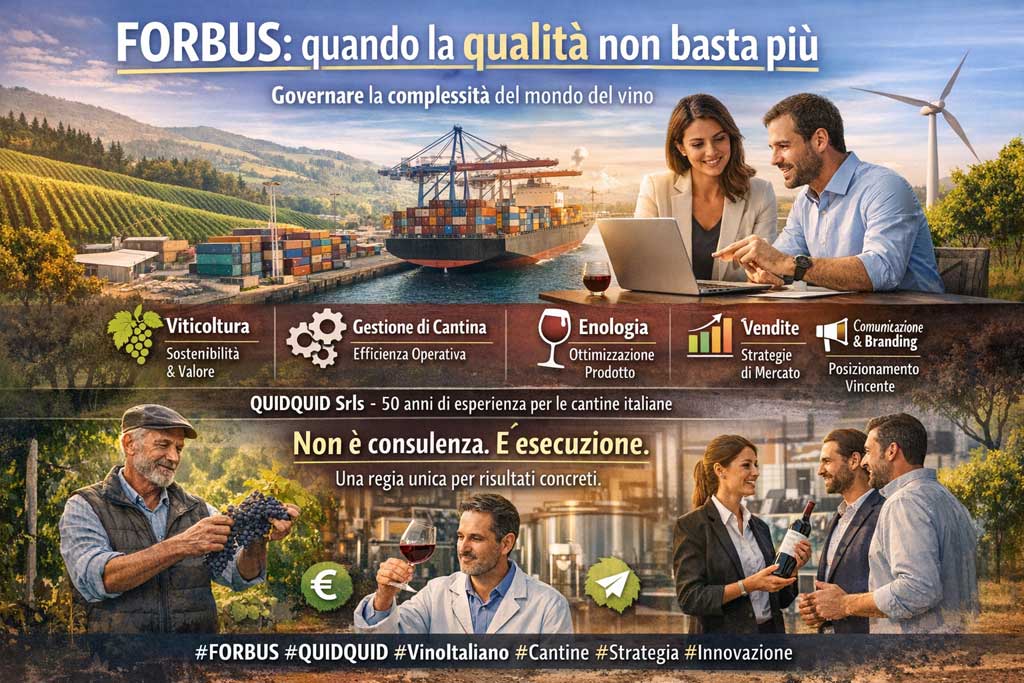
FORBUS: When quality is no longer enough. In wine, quality is a prerequisite. The difference lies in managing complexity: markets, costs, inventory, channels, wine tourism, low/no alcohol, and true sustainability. FORBUS, a network created by QUIDQUID Srls , works with a single management team covering viticulture, cellar management, oenology, sales, and branding, all the way to operating results.

Contact : info@quidquid.eu | +39 329 9298985

Today’s wine press review is brought to you by WINEIDEA.IT . See you tomorrow.

Wine press review for Saturday January 3 – 2026

Wine news, Italian wineries and wines.

Italian wineries

The most surprising wines of 2025 A selection that rewards not only absolute excellence, but the ability to amaze: authentic interpretations, respectful of the grape variety and territory, capable of exciting and standing out in the “ideal wine list” of the year just ended.

Vigna Laure Greco di Tufo DOCG Riserva 2023 – Cantine Di Marzo. This Irpinian white wine has won Gambero Rosso’s Tre Bicchieri award. A wine with great personality, created by Ferrante Di Somma and winemaker Vincenzo Mercurio, confirms the strength of the volcanic Greco di Tufo.

Schola Sarmenti: Salento among the world’s elite wineries. A 2025 packed with accolades for the Salento winery, recognized by major international guides and competitions. A coherent winemaking project, rooted in the Apulian bush vine system, capable of combining tradition and contemporary vision.

Pellegrino Winery and Pietro Russo MW launch a strategic partnership to promote Western Sicilian wines. The arrival of Italy’s first Master of Wine strengthens the winemaking development and international positioning of one of Marsala’s historic wineries.

La Gerla, Monteraponi, and Cavallotto: the podium of the “Top 100” Three iconic appellations—Brunello di Montalcino, Chianti Classico, and Barolo—lead the ranking compiled by Kerin O’Keefe, with wines rated full points.

Ruggeri and the new Cartizze Dry Millesimato 2024. A project that unites history and future in the most prestigious cru of Conegliano Valdobbiadene, focusing on identity, continuity, and territorial value.

Cantine Pellegrino 1880 – Nero d’Avola Gazzerotta 2022 Over 140 years of history and a production that exceeds 5 million bottles annually: one of the key players in the Sicilian wine scene.

Donna Elvira: from London to Irpinia. The story of a winery born from a return to its origins, amidst family ties, volcanic soils, and a winemaking vision rooted in the territory.

Cantine Risveglio becomes a Valtur Brindisi business partner. The sports partnership has been renewed for the 2025/26 season. The historic Brindisi cooperative confirms its leading role in local viticulture and innovation, including in the classic method sparkling wine sector.

Trentino Doc Riesling 2023 – Cembra Cantina di Montagna Heroic viticulture in Val di Cembra: terraced vineyards between 450 and 900 meters, 300 members and a cooperative model that protects the landscape and Alpine identity.

Italian wine and Italian oenology

The value of wine comes from its territory. Alessandro Profumo’s vision: wine as a strategic national asset, to be enhanced through territorial marketing, community, and production quality.

10 Questions for Winemakers: From Piwi to dealcoholized wine, from vineyard uprooting to the freedom of IGTs: an open discussion on the major issues facing the present and future of Italian wine.

Alcohol-free wine: production rules approved. The decree defining the tax and excise framework has been approved. Italian companies can now compete on equal terms in the rapidly growing no-/low-alcohol segment.

Wine and longevity Aging capacity remains one of the great challenges in winemaking: useful technical judgments, but always provisional, until time gives its verdict.

Carema: an ancient wine with a contemporary face. Mountain Nebbiolo establishes itself as a model of elegance, freshness, and lightness, in tune with current tastes and resilient to climate change.

After standardization: the wine bar we’d like in 2026. In Milan, the “wine bar with a kitchen” format is growing. Quality is widespread, but so is the risk of standardization in a model that has been too successful.

Gambero’s Lessons: A Review After 25 Years. A personal story that spans the press, communications, and Italian food culture, amid profound changes and new awareness.

International

Sparkling wines will continue to grow. According to FactMr, the global sparkling wine market will reach $59 billion by 2035 (28.3%). Premium, conviviality, and expanding product offerings are driving growth, with a CAGR of 2.5%.

France: Green light for chaptalization of PDO still wines. A historic turning point for AOC wines, designed to address the sector’s crisis and capture the tastes of new generations, with precise limits on residual sugars.

The world’s best winery isn’t in Italy. Wine tourism is growing at double-digit rates and now accounts for about a quarter of wineries’ global revenue. The “World’s 50 Best Vineyards 2025” ranking rewards the overall experience, not just the wine in the glass.

Wine events

Steve McCurry – Umbria Until May 3, 2026 in Montefalco, the exhibition tells the story of Umbria through food, conviviality, and agricultural culture, intertwining photography, territorial identity, and food and wine.

Cantine d’Italia 2026 – Go Wine 911 selected wineries, 270 Impronte d’Eccellenza (Imprints of Excellence) for wine tourism, and over 5,000 wines featured. A guide that invites you to journey through the territories, stories, and landscapes of Italian wine.

Tuscany tops the Go Wine Guide. With 56 Impronte d’Eccellenza (Imprints of Excellence), the region confirms its leadership in Italian wine tourism, thanks to its quality hospitality and diverse territories.

Thanks for listening. Today’s wine press review was brought to you by WINEIDEA.IT .

See you tomorrow.

Wine Trends and Performance in Italy, Week 29 December 2025 – 2 January 2026

The transition from late 2025 to early 2026 captures a sector that isn’t experiencing a “seasonal crisis,” but rather a paradigm shift: structurally lower consumption, price pressure, shrinking large-scale retail trade, more selective exports, and a single category that continues to clearly act as a driving force: sparkling wines, especially Prosecco.

Within this framework, the real issue is not “how much wine we produce,” but what value we manage to defend and build along the supply chain (brand, positioning, channels, real sustainability, territory).

1) 2025: “Prosecco, Prosecco and Prosecco”

In 2025, Prosecco (Docg Conegliano Valdobbiadene, Asolo and Doc) performed better than many other Italian types, even quality ones, intercepting two market forces that now count more than anything else:

  • drinkability (more “easy”, fresh, immediate profiles);
  • lower alcohol content and a perception of lightness, in line with health trends and new consumption styles.

Prosecco still has room for international growth, but maintaining its competitive advantage isn’t automatic: it requires a quantum leap in territorial and consortium governance. The critical issue cited is very real: the management of vineyards in the Conegliano Valdobbiadene area , where sustainability (agronomic, landscape, social) becomes a reputational and production risk factor. In other words: it’s not enough to sell well today; we must prevent the territory from becoming a bottleneck tomorrow (including on the UNESCO front).

2) Europe: the “defensive” response (uprooting) does not solve the market

The European context weighs heavily: since 2000, wine consumption in Europe has fallen by 35% , and by 2025, global consumption is estimated to reach 214 million hectoliters (an all-time low, according to the text). France, Spain, and Italy still produce approximately 60% of the world’s wine , but this primacy is no longer synonymous with strength: it becomes a problem if demand can no longer keep up with volumes.

The EU plan described focuses primarily on permanent eradication (structural reduction of supply). The critical point highlighted is twofold:

  • quantitatively it is often insufficient compared to the surpluses;
  • on an industrial level it is a technical measure , not a strategy.

The position reported by UIV (Lamberto Frescobaldi) is clear: uprooting won’t solve Italy’s problems and can create social and territorial risks , especially in the hilly areas best suited to this (landscape management, prevention of landslides). The proposed alternative is an ” accordion-style Italian vineyard ,” that is, more flexible, with tools capable of managing surpluses and poor vintages without destroying productive capital and territorial value. The underlying message: resources are needed for innovation and promotion , not to incentivize exit from the business.

3) Sparkling wines: record and centrality of the USA (but Italy is also changing)

The most impressive data of the week concerns Italian sparkling wines: the one billion bottle mark (1.03 billion) has been surpassed, with 2025 production set to increase by 1.8% over an already record 2024. Approximately 7 out of 10 bottles will go abroad, confirming that bubbles remain the most defensible asset for Italian wine on the market.

The United States emerges as a key point: in wine demand, Italian sparkling wines are becoming even more significant than white wines in the composition of “Italian wine consumed” (in the text: 37% sparkling wines , 36% white wines , 17% red wines ). This is a strategic indicator: sparkling wine is no longer just a “celebration wine,” but is entering everyday life and a premium positioning, competing not just on price but also on identity.

The domestic shift is interesting: in 2025, growth will also be driven by domestic demand (5% in the text), with over 106 million bottles uncorked during the holidays and a decline in imports of foreign sparkling wines (-8%). Therefore, bubbles are strong abroad, but also well-established in Italy , with a growing preference for Made in Italy.

Within this framework, Prosecco (in particular Conegliano Valdobbiadene) closes with double-digit growth ( 10% in the text), while the main classic method wines (Franciacorta, Trentodoc) grow steadily and the niche denominations consolidate their presence (Oltrepò Pavese, Alta Langa).

4) Large-scale retail trade: fifth consecutive year of decline, value stable only thanks to price

Large-scale Italian distribution remains the barometer of “mass” demand, and the diagnosis is clear: volumes down, values almost stable . In the first 11 months of 2025:

  • just over 552 million litres sold (–3%);
  • value 2.05 billion (–0.4%);
  • average price €3.72/litre (2.7%).

The 0.75-liter bottle holds up better: volume -1.8% but value 0.4% (average price €5.4/liter). The strategic interpretation reported is important: it should not be interpreted as resignation, but rather as an acknowledgement that consumption is settling at lower levels . The causes: demographics (an older Italy), cautious spending, a health-conscious attitude, and competition from alternatives in the glass and at times of consumption. The logical consequence: to compete, you need to work on the value chain (positioning, brand, channel mix, differentiation), not hope for a return to the volumes of the past.

5) Exports and markets: mixed signals, pressure on the average price

The Nomisma Wine Monitor reports a mixed picture for the first nine months of 2025: some markets are growing in value, others are declining. For Italy, the crucial data is not just where growth is occurring, but how :

  • Canada and Brazil are the ones with growth in both value and volume (therefore “healthy” expansion).
  • Germany is recovering in value (with a slight decline in volume), a sign of recovery after difficult years.
  • USA : Total bottled wine imports decline in value but remain stable in volume; for Italy, the decline is more marked in value but growth in volume, a typical indicator of a lower average price (competitive pressure and, in the text, the effect of tariffs).

Operational translation: exports remain crucial, but increasingly, success (or survival) is achieved with intelligent product mixes and pricing , and with meticulous attention to channels and distributors. It’s not enough to simply “be there”: you have to protect value .

6) 2026: keywords and direction (Italian Wine Consortium)

The key words proposed by the leaders of several large companies sum up the current climate well: enthusiasm, beauty, experimentation, stability, resilience . In market terms, they mean something very concrete: continuing to invest even in a challenging period, but shifting the focus to innovation, identity, perceived quality, communication, and industrial solidity.

Style Selector
Select the layout
Choose the theme
Preset colors
No Preset
Select the pattern