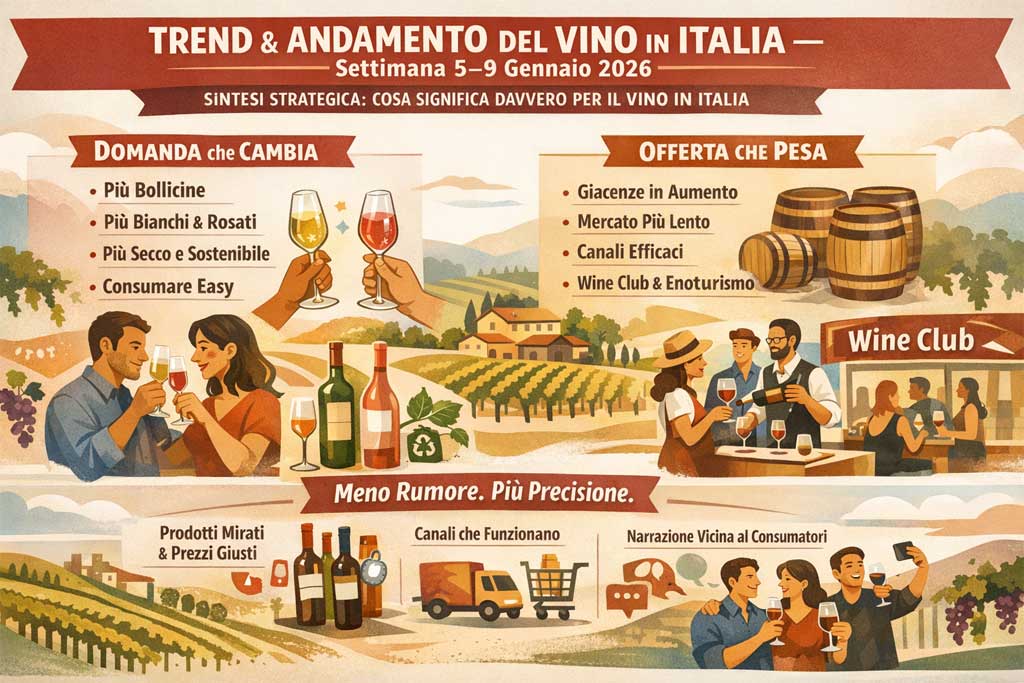
The week of January 5–9, 2026, captures an Italian wine sector undergoing structural transformation: on the one hand, the push for sparkling wines and “lighter” consumption; on the other, the growing weight of inventory and the need to rethink positioning, channels, and consumer relationship models.
Wine doesn’t “disappear”: it changes language, rhythm, and places where it’s purchased.
1) Bubbles: long-term growth, but with two caveats (price and competition)
The reported forecasts indicate a robust expansion of the sparkling wine sector over the next decade: global sparkling wine market reaching $59 billion by 2035 (from $46 billion in 2025), with a CAGR of ~2.5% . Growth is driven mainly by:
- premiumization (accessible medium-high ranges),
- increase in convivial/celebratory moments ,
- expansion of range and presence in retail and hospitality channels,
- increasing production capacity to meet the demand for “quality experience”.
Category drivers: According to the reported approach, the greatest boost will come from Prosecco and, more generally, Charmat/Martinotti method sparkling wines (value share around 39% ), favored by a perceived “easy” positioning and a competitive quality-price ratio. In terms of taste, Brut/Extra Brut prevail (around 54% ) and the off-trade channel (supermarkets/retail) dominates ( ~74% ).
Most dynamic markets: USA, Mexico, Germany, France, as well as South Korea, the United Kingdom and Japan.
Strategic note for Italy: While remaining very strong (expected share of ~18.9% in 2025 ), Italy’s market share could decline slightly by 2035 ( ~18.6% ), a sign of growing competition and the possible impact of regulatory constraints . In other words: demand is growing, but leadership isn’t “free.”
The (important) counterpoint: in the view of professionals (e.g. Perazzo), a risk of speculation/over-priced bubbles also emerges: if the perceived price “runs away”, the category could lose the daily and convivial function that makes it successful today.
2) Full cellars: Italy holds firm, but with the handbrake on (stocks on the rise)
The most significant figure of the week is the increase in inventories: as of November 30, 2025, there were 53.4 million hectoliters of wine in stock ( 8.6% year-on-year), in addition to 9.5 million hectoliters of wine in fermentation and 9.7 million hectoliters of must. This picture is consistent with three very different harvests (a poor 2023, a more generous 2024, and a plentiful 2025) and a market that is absorbing more slowly (health concerns, economic difficulties, tensions, and tariffs).
Top denominations by stock (main trend):
- Prosecco DOC : 5.03 million hl ( 2.8% ) and approximately 11.6% of the total Dop/Igp in the cellar.
- Among the most marked increases in the large ones: Igp Terre Siciliane ( 31.3% ), Doc Delle Venezie ( 20.5% ), Igp Toscana ( 18.1% ), Igp Veneto ( 13.5% ).
- Notable exception: IGP Puglia in slight decline ( -0.7% ).
Even the “jewel appellations” are increasing their stocks , with significant increases (e.g., Franciacorta, Chianti Classico, Barolo, Brunello, Soave, Etna, Bolgheri). A striking example is Rosso di Montalcino (62.8% ), also explained by increased production potential.
Operational interpretation: Higher inventories don’t automatically mean a crisis, but they do mean tied up capital , storage costs, the risk of price compression, and the need to accelerate turnover . The key point that emerged: “we’re drinking less” (or at least differently), and staying put is equivalent to losing margins and a future.
3) How we will drink in 2026: less ritual, more function (and more territory)
From the analyses and interviews cited, a clear cultural change emerges:
- Native varieties as a certainty : no longer a curiosity, but a “new normal” (even varieties considered minor become central again).
- Dry and drinkable : for everyday consumption/aperitifs/meals, we look for drier, fresher, more dynamic wines, with desserts relegated to a few occasions.
- Young adults: less is better : attention to proportion, more educational curiosity (courses, experiences), more sensitivity to the issue of sustainability.
- Whites and rosés on the rise , structured reds still present but with a more modern interpretation (greater enjoyability).
- Lifestyle bubbles : increasingly becoming more everyday and gastronomic; among the names capturing this trend, in addition to Prosecco, dry Lambrusco is cited as a versatile, distinctive, and accessible wine.
4) No/Low alcohol: in Italy it is still small, but the trajectory is clear
The “No and Low” segment in Italy is estimated to account for around 1.8% of consumption , while in the US it reaches around 7% : the gap signals potential growth . The week also saw a significant institutional shift: green light was given to the decree for the Italian production of dealcoholized wines , with the global Nolo market expected to reach $3.3 billion in 2028 (from $2.4 billion), with annual growth of ~8% in value .
Concrete implication: for many companies, this isn’t a “betrayal” of wine; it’s a product line that responds to new habits and can help reconnect with consumers who would otherwise shy away from the category.
5) Channels: e-commerce stable, but DTC and subscriptions (Wine Club) accelerate
On digital, the picture is less “boom” and more mature:
- Alcohol e-commerce will remain at around 3.5% of total value in 2024 and is expected to reach 3.8% in 2029; after the Covid surge, there was a correction and now stabilization with a return to modest growth (estimated at 3% in value 2024–2029 ).
- Spending remains cautious: many consumers are prioritizing essential goods.
The real sign of commercial innovation, however, is the explosion of Wine Clubs :
- market estimated at $12.4 billion in 2025 and expected growth CAGR ~9.7% up to $31.4 billion in 2035 .
- the “magic” lies in customization (algorithms/AI), convenience and storytelling, with a strong push from Direct-to-Consumer .
- Interesting paradox: in wine clubs, red is still the most popular type (value share ~43.7% ), a sign that red is not dying: it is changing context and sales/relationship methods.
6) Distribution and price: proximity still matters (and discount is now “normal”)
The Altroconsumo ranking cited highlights an Italian retail market where trust and proximity remain decisive:
- Online grocery shopping is still a minority (only a small percentage uses it on a weekly basis),
- the weight of discount stores is growing, perceived less and less as a “stopgap” and more and more as a stable quality-price channel,
- Local establishments often get the highest ratings for relationship, familiarity and service.
For wine, this means: shelf space and promotions matter, but the winner is the one who manages rotation, product visibility, and positioning without sacrificing identity.
7) Beverage M&A 2026: Less fireworks, more quality consolidation
2025 is described as a year of slowdown in M&A transactions (more caution, longer closing times), but with “solid” overall values. A moderate return of dynamism is expected for 2026, especially in the mid-market , with a focus on:
- premium and brands with international potential,
- ready-to-drink , functional drinks, no/low ,
- cross-border operations and the renewed role of private equity .
In Italian wine, operations remain more “local” and supply chain-based; in spirits, the movement is more lively (portfolio rationalizations and the valorization of historic brands). The water segment is also interesting: the market anticipates potential shocks from large-scale corporate transactions.
8) Wine tourism: it’s not a side dish, it’s a line on the income statement
The Global Wine Tourism Report 2025 reveals a key finding: wine tourism accounts for an average of 25% of wineries’ revenues (and more in many non-European regions). The majority of wineries offer experiences (tastings, tours, vineyard visits), and many plan future investments. Demand for authenticity, sustainability, gastronomy, and storytelling is growing.
Message for the Italian market: if stocks increase and consumption changes, wine tourism is not “marketing”: it is diversification and conversion (direct sales, clubs, contacts, loyalty).
9) European context: France in difficulty confirms that the change is systemic
The French crisis (long-term decline in AOP sales in large-scale retail trade) is seen as a sign that the problem is not “just Italian”: in mature markets, denomination wines suffer if they cannot find new forms of perceived value, channels, and consistent pricing.