A network portal of Wine Idea. Discover the world of Wine idea

Wine press review for Monday December 29 – 2025

Wine news, Italian wineries and wines.

Italian wineries

In Salento, a historic winery produces Italy’s best rosé for under €20. Puglia confirms the stylistic maturity of its rosés: territorial identity, targeted winemaking choices, and the centrality of Negroamaro give life to wines that are no longer “derivatives,” but rather a distinct and recognizable category.

Alta Langa DOCG, a year of leadership: 2025 report and 2026 calendar. The Consortium closes out 2025 with growth and visibility, including the launch of the Alta Langa Academy, participation in the Slow Wine Fair, and a record-breaking “Prima dell’Alta Langa” in Turin with 82 producers and over 20,000 toasts.

The Md cellar is among the best in Italian discount stores. The Md store on Via Pecchio in Milan stands out for its solid and well-structured wine department, enhanced by the house brand Enotrium, a rare example of winemaking identity in the world of discount stores.

Ert1050, the mountain bubbles project by Federico Veronesi A new project dedicated to Trentodoc Metodo Classico is born in Trentino: high-altitude viticulture, sustainability, and a “vertical” interpretation of the mountain at 1,050 meters on Monte Baldo.

The common thread that unites Dosimo to the Ferrari cellars of Trento. A historical tale reveals the connections between Giulio Ferrari and the Vini Ferrari cellars of Dosimo, intertwining the Cremona and Trentino regions in a little-known story of Italian wine.

The Ascheri Classic Method becomes “Metodo Classico 8pari”. The Bra winery structurally links one of its labels to a social inclusion project, making a permanent job placement program for people with disabilities and vulnerable groups.

Le Pievi: the new story of Vino Nobile di Montepulciano. The “Pieve” typology, 2021 vintage, debuts on the market: an identity-defining, mid-to-high-end interpretation that strengthens the connection between wine, history, and the territory of the Tuscan denomination.

Leaving London for (alcohol-free) wine Eleonora Spadotto’s story tells the story of her transition from international finance to an innovative winemaking project in Friuli, focusing on dealcohol-free wines and a new idea of contemporary rurality.

Dante’s Vernaccia wins legal battle with Spain. Intellectual property protection for Vernaccia di San Gimignano: a European ruling blocks the improper use of a trademark evocative of the Divine Comedy.

Tollo, political clash over municipal budget. The opposition is challenging the soundness of the 2026–2028 budget, denouncing waste and management issues: an issue that also indirectly affects the local economy.

Italian wine and Italian oenology

The ALTO wine list: over 1,000 labels by the glass. A rare approach in Italy: great Italian and international wines available consistently by the glass, with unprecedented accessibility even for iconic labels.

New Year’s Eve 2025: How to Choose the Right Wine for a Toast Light, crisp bubbles are best: Alta Langa Metodo Classico, Erbaluce Spumante, and Gavi Spumante are reliable options for a light, convivial toast.

Interview with winemaker Andrea Pala During the fourth edition of Vinodabere Sardinia, the story of a winemaking talent who follows some of the island’s most interesting realities.

International

Germany: Unprecedented crisis for wine producers. Selling prices below production costs, US tariffs, and rising minimum wages are putting vineyard acreage at risk, especially in sloping vineyards.

France: €130 million for vineyard uprooting. The government launches a support plan to reduce production potential: €4,000 per hectare and a structural response to the crisis in the European wine market.

Visit Markogianni Winery in the Peloponnese. A Greek family-run business that has focused on the recovery of native grape varieties and innovative production models, with results recognized by the market.

Nomisma Wine Monitor: Wine imports in 2025: Value growth in Germany, Switzerland, and Brazil; sharp declines in China, South Korea, and the United Kingdom. Canada and Brazil stand out as the most dynamic markets for Italian wine.

Wine events

Spirito Autoctono 2026: Italy’s artisanal spirits. The new guide lists over 900 labels and 200 producers, describing a sector in full evolution between tradition and experimentation.

The Gallura Award toasts aboard the Moby Fantasy. A symbolic ceremony uniting wine, territory, and economic development, confirming the award’s role as an incubator for new winemaking ventures.

Pietrabbondante DiVino 2025: Christmas Cellars and ‘Ndoccia In the heart of Alto Molise, an event that intertwines wine, gastronomy, and popular traditions, transforming the village into a journey of flavors and light.

Thanks for listening. Today’s wine press review was brought to you by WINEIDEA.IT .

See you tomorrow.

Wine press review for Sunday December 28 – 2025

Italian wine news, cellars and wines.

ITALIAN WINERIES

Barolo Monfortino Dominates International Auctions Giacomo Conterno’s 1978 Barolo Monfortino leads the ranking of the most highly valued bottles, exceeding €4,200 (up 9% year-over-year). It is followed by Sassicaia 1985 and Brunello di Montalcino Soldera 1990, confirming the solidity of fine Italian wine as a collectible asset.

Borgo Conventi: A New Phase in the Gorizia Collio Region The Moretti Polegato family is launching the first step in a targeted territorial expansion strategy in the Collio region, acquiring small, top-notch wineries outside the historic Valdobbiadene area.

Teresa Mincione: Five Harvests Between Identity and Vision From the legal profession to the vineyard: in Caiazzo, a young winery interprets Casavecchia and Pallagrello with a personal approach and winemaking expertise.

Tenuta San Filippo opens a 50/50 partnership with Maire Investments to support international growth without increasing production. Capital strengthening is the strategic lever, not volume expansion.

Avignonesi presents the Nobile Late Release 2015 Time as a productive ally: a choice that expresses the agricultural philosophy and identity of the historic Montepulciano winery.

Velenosi launches “Montagna”, a high-altitude Pecorino. A project that enhances the Marche grape variety through altitude, strengthening the link between terroir and varietal identity.

Terre del Barolo: record results and centrality of work in the vineyard. Turnover close to €22 million (8%) and growing net profit. A symbolic sculpture celebrates agricultural labor as the foundation of value.

ITALIAN WINE AND ITALIAN OENOLOGY

Etna Surprise: Whites Outnumber Reds. For the first time, Etna Bianco bottlings outnumber Etna Rosso. This is a structural, not a cyclical, sign, linked to demand and positioning.

L’Enologica awarded for one of Italy’s best Novello wines. Special mention at the national competition for student-produced wines, the only school to be a finalist among over 60 labels.

Organic Asprinio di Aversa 2023 – Tenuta Fontana Focus on an identifying denomination, with Aversana-style tree-trained viticulture and organic interpretation.

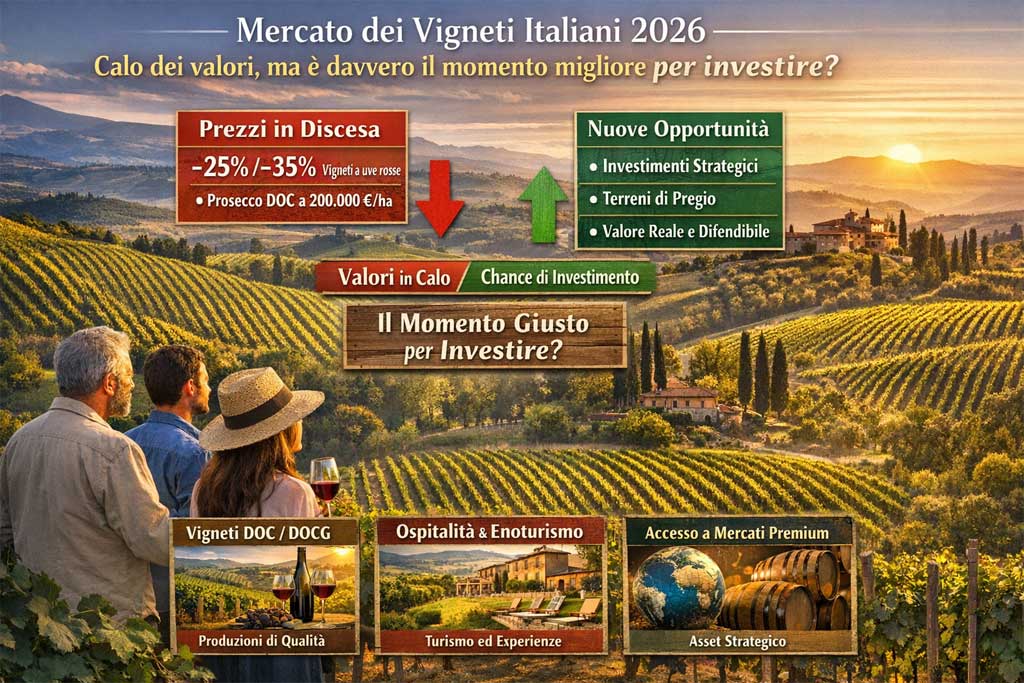
DOC Vineyards: Wine Increases the Value of Lands According to Scenari Immobiliari, property prices in DOC areas are expected to grow by up to 200% in ten years, thanks to production quality, wine tourism, and sustainability.

Food and wine pairing becomes a free and creative experience. Classic dogmas have been overcome: interest in unconventional pairings, guided by sensory experience and conscious consumption, is growing.

Large-scale retail trade: wine is headed for its fifth consecutive negative year. In 2025, sales totaled 552 million liters (-3%) for a value of €2.05 billion (-0.4%). Average prices are rising, volumes are declining: the market is driven by value, not quantity.

INTERNATIONAL

Italian sparkling wines are the leaders in the United States. Production has surpassed the 1.03 billion bottle mark. Over 70% is exported, with solid performances in foreign markets and a key role during the holiday season.

Once upon a time, there was wine: Europe is responding to the crisis by uprooting vineyards. European consumption has fallen 35% since 2000, with production still concentrated but no longer competitive. The EU plan is seen as defensive, not progressive.

EU Wine Package: The Compromise Explained from the Inside. An interview with Esther Herranz García clarifies the key points of the legislative package: crisis management, labeling of dealcoholized wines, grubbing-up, and political balance.

WINE EVENTS AND TERRITORY

“Bollicine” in Bresseo di Teolo: a confirmed success. The Boxing Day event is increasingly well attended, with a large audience and a strong focus on Italian sparkling wines.

Cortina and the 2026 Olympics: what to drink in the Queen of the Dolomites. With high-spending tourism, new openings, and iconic venues, wine is becoming an integral part of the lifestyle experience ahead of the Games.

Appia UNESCO World Heritage Site and wine tourism. This recognition opens up new prospects for territorial development, where wine can become a cultural and economic lever for areas undergoing transformation.

Thanks for listening. Today’s wine press review was brought to you by WINEIDEA.IT .

See you tomorrow.

Wine Trends and Performance in Italy, Week 22 to 27 December 2025

Between the end of the year and the beginning of 2026, Italian wine will enter a new cycle with a clear picture: weak domestic demand, margins under pressure, exports increasingly crucial but more difficult to defend, and a structural acceleration in sparkling wines, white wines, low/no alcohol, and wine tourism.

The signals are not seasonal “noise”: they indicate a market that is re-establishing itself at different consumption levels than in the past, with the need to shift attention from quantity to the value chain.

1) Italy: Large-scale retail trade in difficulty, declining consumption in volume and price as the only lever

The most recent data converge: Italian large-scale distribution is failing to recover and 2025 is heading towards the fifth consecutive negative closure .

  • In the third quarter of 2025 (Wine Monitor analysis based on NIQ data): volumes -2.4% , values -0.2% . The summer did not generate the expected “pull-through” effect.
  • January–September 2025 : values 0.7% with volumes -2.3% . The stability is due almost exclusively to average prices (3.1%) , a typical sign of demand under pressure.
  • Summary data January–November 2025 (Circana/WineNews): 552 million litres sold ( -3% ), value €2.05 billion (-0.4%) , average price €3.72/litre (2.7%) . The 0.75 bottle is holding up better: volumes -1.8% , values 0.4% , average price €5.4/litre (2.3%) .

Channels: Discount stores are cooling (expansion phase halted), while e-commerce is accelerating thanks to price competitiveness and the summer response; hypermarkets and supermarkets remain the most robust formats in terms of value retention, while cash & carry remains the most fragile (though losses are slowing).

Categories:

  • Still and sparkling wines : values -0.2% , volumes -3.3% , average prices 3.2% → consumption falls more than turnover.
  • Sparkling wines : volumes 2.8% and substantially stable values, but with average prices -2.8% → more “accessible” mix and more promotions: it sells, but generates less unit value .

Strategic reading: the domestic market is no longer the driving force. “Value” growth in large-scale retail is fragile because it is fueled by price, not demand. Consequently, competition is shifting to margins, efficiency, product portfolio, and positioning .

2) Cantina Italia: increasing inventories and pressure on supply management

As of November 30, 2025, the following were found in Italian winemaking plants:

  • 53.3 million hl of wine (8.6% vs 30/11/2024)
  • 9.7 million hl of must (12.5%)
  • 9.5 million hl VNAIF (stable)

Wine is concentrated in the North ( 60.7% , with a strong presence in Veneto). The breakdown by category confirms a “value” market but with significant stocks: 54.6% DOP , 26.5% IGP , varietals 1.7% , other wines 17.3% . Furthermore, IGP stocks are highly concentrated: 20 denominations out of 526 account for 58.4% .

Strategic reading: more inventory with declining consumption means greater risk of promotional pressure , financial tensions and the need to manage production with non-postponable choices (portfolio, rotation, channels, markets).

3) Export: central but more complex, especially USA (exchange duties)

With a prudent domestic economy, exports remain a vital lever. But in 2025, the external environment will become more “hostile” due to costs and volatility, particularly in the United States.

USA – double shock:

  1. Rush for shipments in Q1 2025 to anticipate the announced universal tariff (Liberation Day, April 2)
  2. From April to September the dollar lost about -10% against the euro , worsening the competitiveness on the shelf

The Wine Monitor analysis shows that in the first quarter, the increase in the average price in dollars primarily affected French wines (more “premium” hoarding, more sensitive to ad valorem duties). Over the rest of the year, the combined effect of exchange rates increases the complexity: it’s not just “how much the price rises,” but how much spending power can sustain along the three-tier system (markup multiplier).

Italian sparkling wine exports: volumes hold up, prices fall
In the first nine months of 2025 : €1.67 billion in sparkling wine exports ( -0.5% ), volumes down 2.19% → demand is present, but average prices are declining to remain competitive. Sparkling wines account for approximately 28% of wine exports .
Absolute driver: Prosecco DOP with €1.29 billion (0.5%) , 77% of total sparkling wines and approximately 23% of wine exports; volumes 4.8% .

Markets: USA stable and pro-Prosecco; UK and Germany showing signs of difficulty; France growing imports of Italian sparkling wine (a significant figure also for positioning purposes).

Strategic reading: the game is no longer about “exporting,” but defending margins and positioning with surgical commercial governance: consistent channels, tiers, assortment, pricing, and promotions.

4) Europe 2035: structural decline in consumption, production and exports

The EU Commission’s projections up to 2035 confirm a long-term trend:

  • EU consumption -0.9% per year to approximately 19.3 litres per capita (from 21.2 litres on average 2021–2025)
  • EU production -0.5% per year towards 138 million hl
  • vineyard areas -0.6% until 2035
  • EU exports -0.6% per year (imports -1.9%)

Drivers: health concerns, competition from other beverages, younger people drinking less alcohol, preference for higher-end but less frequent wines; declining demand for red wines, growth in whites and sparkling wines; increased interest in wine-based and no-/low-alcohol beverages (still small volumes).

Strategic reading: it’s not a short cycle: it’s structural change . Companies must redesign their models and markets, not “wait for it to pass.”

5) Alcohol Dealers: A Real Opportunity, But Italy Is Blocked by the Fiscal Decree

The Italian sector is “waiting” for the MEF-MASAF interministerial decree implementing the tax regulations: UIV is urging action because the stalemate (over two months in the Treasury) is leaving Italy with a four-year competitive disadvantage compared to other European producers (EU regulation, December 2021). In the meantime, many companies have already invested in equipment, training, and positioning.

Strategic reading: without an operational regulatory and tax framework, investments risk stagnation. This isn’t a trend: it’s about defending competitiveness in growing segments (low/no, hybrid beverages).

6) Trends for 2025/2026: fewer bottles, higher quality. White wines and sparkling wines are on the rise.

The Vinarius observatory (wine shop network, 120 locations, ~€50 million turnover) confirms:

  • volume consumption down, but value more “resistant”
  • more robust premium range, more stressed low range
  • growth of whites and bubbles (Classic Method in evidence)
  • preference for lightness, freshness, drinkability
  • the great reds “remain”, but are consumed with more selectivity

It is the same direction indicated by international analyses (Wine-Lister): a more elegant and approachable style of wine tourism as a lever, with attention to prices and sustainability.

7) Supply-demand imbalance: the Coface reading and the incomplete “cure”

Coface describes a structural imbalance: EU consumption down 35% since 2000 , world consumption estimated at 214 million hl (among its lowest levels) by 2025, with challenges outside the EU (China down 60% vs. pre-pandemic, the US facing more complex barriers). European measures, primarily based on grubbing-up, are helping, but they’re not enough , as the issue also involves demand and changing behaviors. For producers most exposed to the lower end of the spectrum, financial strength, market diversification, credit risk management, and liquidity protection become crucial.

8) Wine tourism: Italy’s great asset (and a “digital” accelerator)

The 2025 Italian Food and Wine Tourism Report (Roberta Garibaldi) positions Italy as the leading international destination for food and wine tourism . Return and spending intentions are growing: €155/day (€52 for restaurants, €28 for typical products). Tourists are younger and more digital; social media and platforms influence their choices; willingness to pay for personalized experiences is increasing. AI is becoming increasingly important in travel planning (already a significant share in the USA and France).

Strategic reading: wine tourism is not an “accessory”: it is a valuable channel, a generator of brand equity and a DTC (direct sales) lever in a world where traditional channels compress margins.

Final summary: What this week really says (and what to do)

  1. The domestic market is structurally slowing down : sales are decreasing in large-scale retail trade, and value retention is often price-driven.
  2. Rising inventories, weak consumption = risk of pressure on prices and finances: supply and rotation governance needed.
  3. Exports remain vital, but things aren’t getting any easier : the US is dealing with tariffs, the exchange rate, and the three-tier system; the UK and Germany are downgrading; clear decisions are needed.
  4. Sparkling wines and white wines are driving demand , but be careful: bubbles are holding up even while lowering prices, so the challenge is to protect value.
  5. Low/no alcohol and hybrid beverages are real trends: Italy must unblock the tax decree to avoid further competitive losses.
  6. The future is “less volume, more quality, and more experience” : premium is more resilient, entry-level segment is more fragile; wine tourism and DTC are becoming pillars.
  7. 2026 = “laser focus” : not dispersion, but clear priorities on brand, sales force, consistent pricing and sharing resources on foreign markets.
  8. Communication needs to be updated : fewer self-referential rituals, more authenticity, simplicity, and the centrality of the experience (in the cellar and in actual consumption).

In short: Italian wine isn’t experiencing a “product crisis,” but rather a model transition . The winners are those who can read the numbers without nostalgia and transform them into operational choices: a smarter portfolio, better-served markets, a more secure price, and a narrative finally aligned with how people (really) experience wine today.

Wine press review for Saturday December 27 – 2025

Wine news, Italian wineries and wines.

Italian wineries

Cantina Terre del Barolo: Growing cooperation (Langhe) Consolidating balance sheet: revenue close to €22 million (8%) and net profit of €2.7 million . The shareholders’ meeting on January 11th will be an opportunity to share investments and strategies, with a focus on the vineyard and supporting the local area.

Antica Cantina di San Severo: INNOWINE and low alcohol (Puglia) The INNOWINE research project has been concluded (final conference 16 October 2025): optimization of an innovative and sustainable process for producing low-alcohol wines, in collaboration with the University of Foggia and technical-scientific partners.

Colosi, Salina: Volcanic Wines and Family Identity (Aeolian Islands) A tale of generational continuity and island-based work: vineyards, volcanic soils, and Mediterranean style. The narrative focuses on authenticity, local tradition, and supply chain oversight.

Lea Winery / Franc Lizêr: 0% sparkling wine and sustainability (Friuli Venezia Giulia) A project launched in 2018: 132 hectares (105 hectares of vineyards), sustainability as an operational practice. The 0% alcohol line (rosé sparkling wine) uses membrane technology to preserve aromas and flavor profile, with a “contemporary drinking” positioning.

Tenute Carrisi (Al Bano): critical review. A deliberately provocative tone and clear judgment: a media case that reopens the issue of “celebrity wine” vs. perceived quality and coherence of positioning.

Camilla Lunelli: Female Leadership and the Ferrari Trento Model. Focus on governance and generational transition (“family pact”), with a key fact: in Italy, only a minority of wineries are run by women. The message: excellence as a daily operational culture, not a slogan.

Italian wine and Italian oenology

Holiday Pairings: The Right Wine to Avoid Ruining Dinner. From “fish” Christmas Eve to desserts: this article highlights the most common mistakes (wrong contrasts, mismatched intensities) and the real impact that an out-of-place wine can have on the overall taste of the meal.

Lambrusco: Identity and Future of a Popular Wine Lambrusco as a system (territories, grape varieties, styles) is undergoing a repositioning process: balancing volume and value, more informed storytelling, and stylistic consistency to meet a market that prizes recognizability.

Francesco Sorelli: “The Molecule of Civilization” Wine as a cultural and historical phenomenon: myth, art, philosophy, and “enography” to explain how wine has accompanied human social evolution long before writing.

International

Sotheby’s & Masters of Wine: Online Auction at £147,000. The Institute of Masters of Wine’s benefit auction achieved a positive result: some lots sold above estimate, others fetched collectors a bargain. The top lot by auction was a Champagne-themed experience tied to Bollinger.

Champagne and Meunier: the “accessible route” to luxury. With purchasing power under pressure, there is growing interest in more “entry-level” Champagnes based on Meunier grapes: same appellation, different composition, with the aim of capturing demand without sacrificing status.

Italian sparkling wines: the most popular bubbles in the US. Production by 2025 will exceed 1.03 billion bottles , with 360 million destined for the holidays. Exports dominate (about 7 out of 10 exports): an industrial axis that supports volumes and market shares, avoiding supply chain declines.

Wine events

Grosjean x Pila (Aosta Valley): When the mountains meet wine. Official collaboration starting December 28th between the winery, the resort, and the tourist consortium: tastings, mountain activities, and vouchers for winery visits (valid for 12 months). Wine tourism “without fireworks,” but with method.

Pietrabbondante “Divino” – Christmas Wineries (Molise) On December 28th, a food and wine tour of wineries, local cuisine, and culture (music, poetry, art). Wineries open at 7:30 pm with a sommelier and a selection of regional wines.

New Year’s Eve: bottle selections and “out-of-the-box bubbles.” Two “service” features: a bottle list to break the ice and a selection guided by a young sommelier (focusing on lesser-known territories and with a limited budget). A useful format for both the general public and restaurants.

Rovereto: the historic Due Colonne bar reopens. New management, a retro identity, and a wine-focused menu (in addition to cocktails and tapas) are a sign of how the wine bar experience continues to evolve.

QUIDQUID – Strategic Business Advisor Where value isn’t talked about: it’s demonstrated. Complex transactions, sectors we truly understand, management right through to closing.

Thanks for listening: today’s wine press review is brought to you by WINEIDEA.IT . See you tomorrow.

Style Selector
Select the layout
Choose the theme
Preset colors
No Preset
Select the pattern