All posts by admin

Wine Trends in Italy – Week 17–21 August 2026

A positive harvest, cellars still full and international markets to be rethought.

The week returns the image of a two-speed Italian wine.
On the one hand, the 2026 harvest is starting with encouraging signs of quality in many areas. On the other, wineries are approaching the new harvest with still-high inventories, more selective consumption, and a sharply contracting US market .

We’re not just facing a difficult business environment. The sector is entering a phase in which it becomes necessary to rebalance production and demand, protect the value of bottles, diversify markets, and rethink the relationship with consumers .

Alongside these critical issues, however, interesting signs are emerging: Brazil is growing, the fine wine market is showing an initial recovery, the reputation of European agri-food remains strong, and technological innovation continues to transform the supply chain.

1. 2026 harvest: good quality, but the problem is the stocks

From the Aosta Valley to Sicily, the harvest of early varieties and sparkling wine bases has generally started well, with the average harvest indicated in the text at least ten days early and the quality considered satisfactory, despite some critical climatic issues in the area.

The real point of attention, however, is what the wineries already have in the tanks.

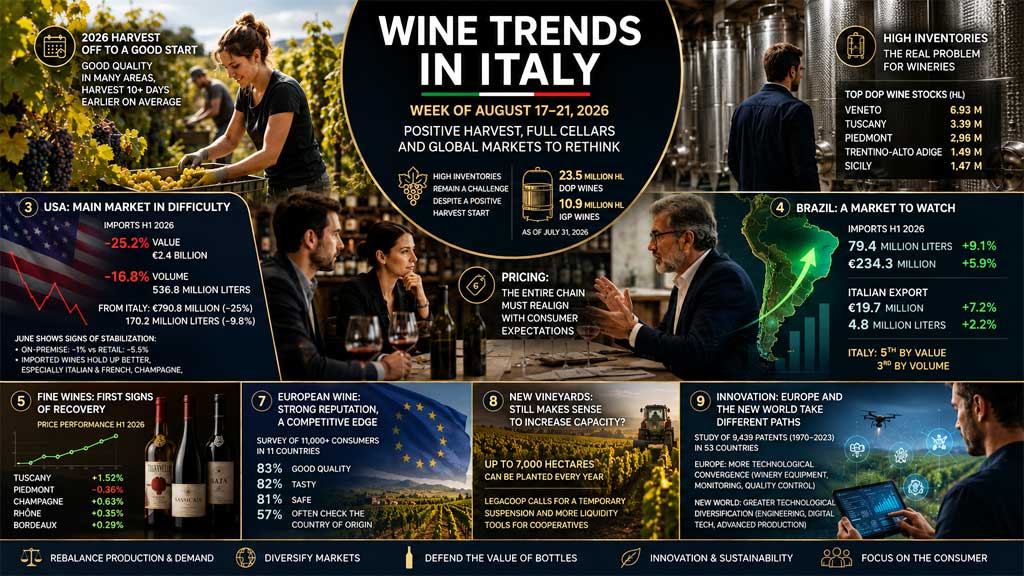
As of July 31 , over 23.5 million hectoliters of PDO wines and over 10.9 million hectoliters of PGI wines were in stock. The regions with the largest PDO stocks include Veneto with approximately 6.93 million hectoliters, Tuscany with 3.39 million, Piedmont with 2.96 million, Trentino-Alto Adige with 1.49 million, and Sicily with 1.47 million.

The point

A good harvest is not enough if the product of the previous campaign has not been absorbed by the market.

For many companies, the strategic problem of the coming period will therefore be less “how much to produce” and increasingly “how much and how to sell” .

2. Climate: early harvests and yields under pressure

Climate change continues to have a significant impact on viticulture.

The case of San Marino reported this week is particularly significant: high temperatures and very little rainfall have caused stress in the vineyards, with a forecast indicating up to 40% fewer grapes than in 2025 , despite the presence of high quality expectations.

The theme goes far beyond a single vintage.

Drought, water management, soil organic matter, varietals, agronomic techniques, and irrigation infrastructure are becoming key factors in the economic competitiveness of wineries.

3. United States: the main market for Italian wine remains in difficulty

Probably the most important data of the week comes from the United States.

In the first half of 2026, US wine imports decreased by 25.2% in value , stopping at around 2.4 billion euros , while volumes fell by 16.8% , to 536.8 million liters.

Italy remains central, but is also suffering from the contraction: 790.8 million euros of wine imported from the USA by Italy, -25% , while in volume our country remains the leading supplier with 170.2 million litres, -9.8% .

The data for Italian sparkling wines is particularly significant: 255.3 million euros, -18.4% , and 60.6 million litres, down 9%.

But June shows some signs of stabilization

The American picture remains negative, but the second quarter shows a slowdown in the decline.

According to data reported by SipSource, wine sales fell by 4.6% , while on-premise sales—restaurants, hotels, and clubs—remained almost stable, with a decline of just 1%, compared to a 5.5% decline in retail.

Also interesting is the greater stability of imported wines, particularly Italian and French, Champagne, sparkling wines and white wines .

The American market has therefore not yet reversed course , but some indicators suggest that the decline could gradually ease.

4. Brazil: a market to follow very carefully

If the United States slows down, it becomes even more important to identify new growth markets.

Brazil is one of the most interesting signals.

In the first half of 2026, Brazilian imports reached 79.4 million liters, 9.1%, for 234.3 million euros, 5.9% .

Italy is also growing: exports reach 19.7 million euros, a 7.2% increase, while volumes rise to 4.8 million liters, a 2.2% increase. Italy ranks fifth in value but third in volume among suppliers to the Brazilian market.

Even more interesting is the long-term perspective: between 2015 and 2025, Brazil recorded very significant growth in wine imports, both in value and volume.

The signal for Italian wineries

Dependence on a few large export markets is becoming a risk.

Brazil and other emerging markets cannot yet replace the United States, but they can become a second growth line in which to invest today to reap results in the coming years .

5. Fine wines: first signs of recovery, with Tuscany leading the way

After a long downturn, the international investment wine market appears to be showing the first signs of recovery.

According to the analysis reported by Cult Wine Investment, the market bottomed out in February 2026, subsequently recording price increases for four consecutive months.

The most interesting element concerns Italy.

In the first half of 2026, Tuscany recorded 1.52% , while Piedmont remained slightly negative at -0.36%. Champagne recorded 0.63%, Rhone 0.35%, and Bordeaux 0.29%.

The recovery, however, does not involve all the major labels uniformly: it is above all some strong or emerging wines that are supporting the recovery.

This suggests that even in the premium segment , awareness alone no longer automatically guarantees revaluation and demand .

6. Wine prices: the entire supply chain must return to reckoning with the consumer

One of the most interesting debates of the week concerns the final price of the bottle.

Luca Cuzziol, one of Italy’s leading distributors of quality wine, raises a very concrete question: producers, distributors, and restaurateurs must question the sustainability of prices.

The problem cannot be attributed to a single link in the supply chain.

After Covid, some price lists increased significantly, while restaurants, distribution, and production simultaneously attempted to protect their margins. The result can be a bottle of wine reaching consumers at a price the market no longer deems consistent with its perceived value.

The message is simple: a wine can be excellent, but if the consumer does not recognize the value of its price it becomes commercially difficult to sell .

7. European wine retains an enormous capital: its reputation

Not all international indications are negative.

European agri-food continues to enjoy a very high reputation on non-EU markets.

According to the survey cited in the text, conducted among over 11,000 consumers in 11 countries, 83% consider European products to be of good quality, 82% tasty, and 81% safe . Furthermore, 57% often or always check the country of origin of their food.

For Italian wine this represents an important competitive capital.

Made in Italy doesn’t start from scratch: it already has reputation, territory, history, perceived quality, and recognizability. The challenge is to transform these values into demand, distribution, consumer relations, and sales .

8. New vineyards: does it still make sense to increase production capacity?

While wineries have to manage significant stocks, Legacoop Agroalimentare draws attention to a strategic issue: the system would allow the planting of almost 7,000 new hectares of vineyards every year.

The Legacoop Wine Coordination Committee is calling for a temporary suspension of new plantings, along with increased liquidity resources for cooperatives.

The reasoning stems from the intersection of several phenomena: climate change, uncertain international markets, changing consumer habits, and growing pressure on corporate profitability.

This is a question the sector will have to seriously address: in a phase of weaker demand, automatically increasing production area can aggravate imbalances rather than resolve them .

9. Innovation: Europe and the New World take different paths

Even on the technological front, the world of wine is changing.

A study published in 2026 in the Journal of Wine Economics , based on the analysis of 9,439 patents filed between 1970 and 2023 in 53 countries , highlights two patterns.

Europe is moving toward greater technological convergence, especially in winemaking machinery, monitoring systems, and quality control.

In the New World, the opposite is happening: technological diversification is growing, especially in engineering, digital technologies, and advanced production and control systems.

Future competition will therefore not only concern terroir, denominations and wine quality, but also innovation capacity, production efficiency, data and technological differentiation .

Wine press review for Thursday August 20 -2026

Alongside the challenges, emerging territories, wineries, and initiatives capable of innovating and creating value.

Good morning,

Italian wine is facing a complex but transformative phase: early harvest, climate change, high inventories, new consumption models, growth in wine tourism and the search for new markets .

ITALIAN WINERIES

Cantina Tollo grows by 133 hectares

Cantina Tollo is expanding its production base with 133 new hectares of vineyards , increasing its total from 2,357 to 2,490 hectares . The new vineyards, distributed primarily across Abruzzo, Molise, and Puglia, include native varieties such as Montepulciano, Pecorino, Trebbiano, and Passerina.

The expansion is part of the Vigneto Avanzato project, which aims to guarantee greater economic stability for small winemakers through remuneration based on hectares worked rather than exclusively on quintals produced.

Cantine Monfort: From the Cembra Valley to 26 Countries

From Palù di Giovo, in Trentino, Cantine Monfort has built a commercial presence over eighty years that today reaches 26 countries .

International growth has occurred while maintaining strong ties to the Cembra Valley, local winemakers, and a family history passed down to new generations.

Belisario Winery: Good prospects for Verdicchio di Matelica

The harvest of grapes destined for the Belisario Winery , an important producer of Verdicchio di Matelica, has begun in the Camerte Sinclinale.

Initial indications point to a yield of around 90-95 quintals per hectare and an overall good harvest. The mountainous area’s temperature ranges helped mitigate the effects of the intense summer heat.

Feudo Antico: A winery becomes an open-air archaeological museum.

In Tollo, Abruzzo, Feudo Antico represents a unique blend of wine, land, and archaeology.

During the vineyard replanting works, the remains of a Roman-imperial-era rustic villa were discovered, likely connected to ancient winemaking activities. The archaeological site is now an integral part of the winery’s identity.

ITALIAN WINE AND OENOLOGY

Italian wine under pressure from climate, markets, and new consumption patterns.

According to Legacoop Agroalimentare , the Italian wine sector is simultaneously facing climate change, uncertainty in international markets, and a transformation in consumption.

Against this backdrop, the planning of the institutional campaign dedicated to Italian wine is also underway, with the aim of strengthening its image as a quintessential Made in Italy product.

The 2026 harvest: a difficult year to interpret

The Italian grape harvest varies greatly from region to region. In some areas, the harvest is much earlier, while in others, the timing is more traditional or even later.

Oenologists and agronomists therefore emphasize the need to avoid generalized assessments: climate, water availability, altitude, exposure, and characteristics of individual vineyards are producing very different results.

Friuli Venezia Giulia: Early harvest and priority given to water

In the Colli Orientali del Friuli and Ramandolo, the harvest of white grape varieties is already in full swing.

Heat and drought have accelerated ripening, revealing significant differences between irrigated and non-irrigated vineyards. Water management therefore becomes a strategic element for preserving the quality, balance of the grapes, and the identity of the wines.

Pinot Noir already in the cellar: early harvest in the North

The 2026 harvest started early in many northern areas.

The first 200 quintals of Pinot Noir destined for the sparkling wine base have already arrived at the Vicobarone winery in the Piacenza area. Early arrivals are also reported in Franciacorta, Asti, Ferrara, and Canavese.

The positive data is represented, in several areas, by the presence of healthy grapes and abundant bunches .

Sicily: cellars still full before the new production

The harvest has begun, but many Sicilian wineries still have significant quantities of wine from the previous harvest.

As of 31 July 2026, approximately 2.69 million hectolitres of wine were stored on the island, of which over 1.4 million in the province of Trapani alone .

The priority becomes to reduce inventory levels while avoiding excessive pressure on prices while the new production enters the cellars.

Ligurian wines resist market difficulties

The small production scale seems to offer Ligurian wineries greater flexibility than other Italian areas.

Many wineries produce fewer than 100,000 bottles and can thus adapt more quickly to changing demand. Pigato, Vermentino, Rossese, Ormeasco, and Granaccia continue to represent the regional identity, while interest in rosé wines is growing.

Roero: one of the great souls of Piedmontese wine

Roero has gradually gained an independent and recognizable position in the Italian winemaking panorama.

Located on the left bank of the Tanaro River, facing the Langhe, it is characterized by sandy soils, marl, and the spectacular Rocche del Roero. Arneis is its signature white wine, alongside local interpretations of Nebbiolo and Barbera.

Sardinia: Wine quality is growing

Vinodabere’s Guide to the Best Wines of Sardinia 2027 has tasted over 600 samples .

331 wines were selected for review , and 118 received a Standing Ovation , representing 35.6% of the wines reviewed. This result highlights significant qualitative growth, from rosés to whites, with a particular focus on Vermentino.

INTERNATIONAL AND NEW MARKETS

The weather is bringing forward the grape harvest in France too.

Climate change is profoundly altering the European viticultural calendar.

In Italy, many areas have brought forward the harvest, while in France , Champagne and Burgundy are recording exceptionally early harvests.

In Burgundy, Domaine Leflaive began the harvest on August 13th , even anticipating the documented historical precedent of 1556, when the harvest began on August 15th.

Ready to Drink is growing in the United States and Europe

Premixed cocktails continue to gain popularity.

In the United States, Ready-to-Drink represents about 8% of the alcohol market , while in Europe sales could more than double in the next decade.

A change in consumer habits that could create new opportunities for Italian groups like Campari , especially through the world of spritzes.

Italian wine in the USA: delivered to consumers within 24 hours

The Tuscan company Fieramente has developed a logistics model designed to transform Americans’ wine tourism experience into direct sales.

Through a hub in the United States , wines purchased or discovered during a visit to Italy can be distributed directly to American consumers with rapid delivery.

An interesting model for connecting wine tourism, B2C sales and the internationalization of wineries .

Giacomo Bartolommei is the only Italian among the 2026 Rising Stars.

Giacomo Bartolommei , president of the Brunello di Montalcino Consortium, producer and winemaker from Caprili, is the only Italian included by Wine Enthusiast among the 12 international “Rising Stars” of 2026.

The award recognizes a new generation of professionals called upon to address changes in consumption, climate, regulation, and international markets.

EVENTS, WINE TOURISM AND WINE CULTURE

Wine Tourism 2026: Wine increasingly meets the sea

Italian wine tourism is increasingly integrated with seaside holidays.

Among the most desired wine destinations for Italians are Cinque Terre and Salento at 20%, Chianti at 19%, Amalfi Coast and Etna at 18% .

Food and wine tourism would now involve approximately 18 million Italians , 4.5 million more than in 2024.

When choosing a winery , the landscape, experience and value for money are of particular importance.

The Etna Wine Train

On the slopes of Etna, an itinerary combines railway, vineyards, cellars, tastings, and gastronomy.

The Etna Wine Train departs from Linguaglossa and uses the Circumetnea Railway along with a Wine Bus to take visitors to the wineries on the northern slope of the volcano.

A concrete example of how wine, territory, mobility, and experiential tourism can create an integrated offering.

Tuscany: The growing phenomenon of vineyard dinners

From Bolgheri to Montalcino, large tables abound among vineyards, cellars, and historic sites.

The phenomenon has also attracted the attention of the international press and demonstrates how the food and wine experience is becoming an increasingly important part of a winery’s perceived value.

WineHunter Award Collection 2026

The new The WineHunter Award Collection 2026 is online, bringing together the selected excellences in the Wine, Food, Spirits and Beer categories.

After the Rosso and Gold awards, over 300 candidates are aiming for the prestigious Platinum. The winners of The WineHunter Award Platinum will be announced on October 7th in Rome .

Stintino Wine Festival: Wine and Territory Take Center Stage

The Stintino Wine Festival returns on August 21st and 22nd , now in its third edition.

Twelve wineries will participate in the event, along with food producers and artisans. In 2025, the festival attracted approximately 3,000 attendees .

Durazzano: Four days dedicated to Sannio wine

From 20 to 23 August , Durazzano, in the province of Benevento, hosts the tenth edition of Gustarte .

Tastings, workshops, music, and meetings will accompany three “Narrated Tastings,” dedicated to the Sannio-Chianti Rufina comparison, rare grape varieties and monumental vineyards, and the relationship between wine and the history of Campania.

Unusual Marsala 2026: Wine, Hospitality, and Artificial Intelligence

The third edition of Insolito Marsala returns to Marsala from September 30th , five days dedicated to wine, hospitality, innovation, artificial intelligence, and gastronomy.

Among the most original initiatives, temporary wine shops will be hosted in bookstores, jewelry stores, opticians, and design showrooms , experimenting with new ways of bringing wine outside of traditional commercial channels.

PICTURE OF THE DAY

The August 20, 2026, review paints a picture of a rapidly changing sector.

The first issue is climate : the early harvest is no longer an isolated phenomenon and affects both Italy and France. Water, agronomic management, and the timing of harvest are becoming increasingly crucial.

The second concerns the market . High inventories, particularly in Sicily, require careful attention to volumes and prices, while small areas like Liguria demonstrate how limited production, a strong identity, and the ability to adapt can become competitive factors.

The third signal comes from the consumer . Wine tourism, vineyard dinners, coastal tourism, international direct sales, and new formats like Ready-to-Drink indicate that wine is increasingly being purchased in conjunction with an experience, a region, or a method of consumption.

Finally, a strategic message emerges: the future of Italian wine will depend not only on how much wine is produced, but on the ability to transform territory, quality, hospitality, distribution, and identity into economic value.

Today’s wine press review is brought to you by WINEIDEA.IT .

See you tomorrow.

The main Italian and international news dedicated to wine, cellars, viticulture, oenology, the market, investments, harvests and wine tourism .

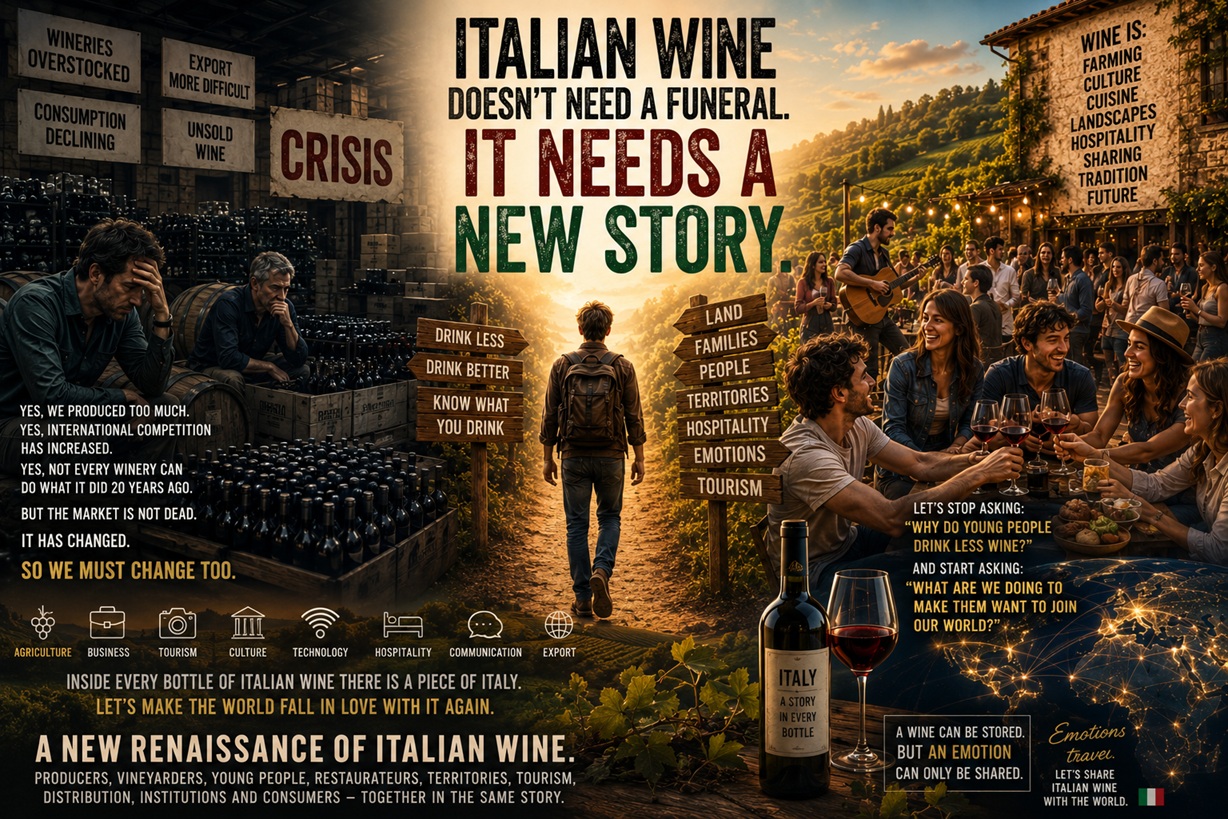
ITALIAN WINE DOESN’T NEED A FUNERAL-IT NEEDS A NEW STORY

Enough with the talk of full cellars and declining consumption. It’s time to bring wine back to the masses, engage young people, and transform a difficult period into a new Renaissance for Italian wine.

Cellars full. Consumption down. Exports struggling. Unsold wine. Industry crisis.
We’ve been reading headlines like this for months.

Problems exist, and it would be wrong to deny them. But continuing to describe Italian wine almost exclusively through the word “crisis” risks producing an effect even more dangerous than the crisis itself: convincing producers, consumers, and especially young people that wine belongs to a world destined to slowly shrink.

What if we started changing our perspective?

Not to hide the problems.

But to face them.

Because perhaps Italian wine doesn’t need to be protected from the future. It needs to return to being part of it.

Yes, Italian wineries have too much wine

Let’s start from reality.

According to the Italian Wine Union, in May 2026, stocks in Italian wineries, including wine and must, exceeded 53 million hectoliters , 7.3% more than the same period the previous year. At the same time, in the first months of 2026, both the domestic market and exports showed signs of slowing.

And the problem doesn’t just concern Italy.

The OIV estimates that in 2025, world wine consumption will have fallen to approximately 208 million hectoliters , while global exports have contracted in both volume and value. But there is another figure that deserves attention: approximately 46% of the wine consumed worldwide is traded internationally .

This means one very simple thing:

The market isn’t dead. It’s changed.

And that’s a huge difference.

Maybe we’ve produced too much. But above all, we need to learn to sell differently.

In recent years the world of wine has grown.

New companies, new brands, new labels, new vineyards and new entrepreneurial projects have been born.

Meanwhile, international competition has also increased.

Today many countries produce wine, invest in wine and export wine.

A consumer entering a wine shop in New York, London, Tokyo, Singapore, or Berlin can choose from bottles from many parts of the world.

We cannot therefore think that producing a good wine is enough for someone to automatically come and buy it.

Producing no longer means selling.

The real challenge of the coming years will be to realign production and marketing, but at the same time learn how to better describe, distribute, and enhance the value of what we produce.

Because competing solely on price would probably be the worst path for Italy.

Our strength is something else.

We don’t just sell wine. We sell Italy.

Inside an Italian bottle there are more than just grapes and alcohol.

There are hills.

Families.

Villages.

Farmers.

Cellars.

Oenologists.

Artisans.

Restaurateurs.

Sommelier.

Cooks.

Hotels.

Agritourism.

Landscapes.

History.

Design.

Culture.

Tourism.

And above all people .

When a tourist arrives in Tuscany, Piedmont, Veneto, Friuli-Venezia Giulia, Sicily, Puglia, Trentino-Alto Adige, or one of Italy’s countless wine-growing regions, they rarely simply look for a bottle.

Look for an Italian experience.

And this is where we must start again.

Wine is above all sociality

For too long we have allowed the debate about wine to be reduced almost exclusively to two extremes.

On the one hand, wine is portrayed as a sophisticated, technical, almost intimidating product.

On the other hand, wine is discussed exclusively through the topic of alcohol.

We must have the courage to bring it back to its most authentic dimension:

conviviality.

Italian wine has historically been synonymous with food, gatherings, family, friendship, territory, cuisine, and sharing.

Of course, consumption must be responsible and moderate , and no serious strategy can ignore the risks associated with alcohol abuse.

But responsibility doesn’t mean erasing thousands of years of culture.

It means building a contemporary wine culture.

Drink less, drink better, know what you drink.

And above all: let’s go back to talking to young people

Probably one of the most important matches is played here.

We can’t spend our time wondering:

“Why do young people drink less wine?”

We should ask ourselves:

“What are we doing to make them want to enter our world?”

A twenty-five-year-old doesn’t necessarily have to know a hundred appellations to feel part of the wine culture.

Let’s get him into the vineyard.

Let’s take it during the grape harvest.

Let’s introduce him to the young winemaker.

Let’s tell him who planted that vineyard.

We open our cellars to music, cuisine, art, events, and new forms of socializing.

We create less formal tastings.

We use understandable language.

Let’s bring wine to social media without turning it into a lesson.

We bring producers and new generations together.

We don’t ask young people to adapt to the old world of wine. We help the world of wine evolve with them.

A cellar should go back to being a place where things happen

This could be one of the great transformations of the next decade.

The cellar of the future will not just be the place where wine is produced and stored.

It could become a place where wine is experienced .

Open harvests.

Concerts among the vineyards.

Dinners with producers.

Events dedicated to the territories.

Meetings between young entrepreneurs.

Art.

Design.

Food.

Tourism.

Training.

Informal tastings.

Digital experiences.

Weekend in the vineyard.

Collaborations between wineries, restaurants, hotels, farmhouses, and tour operators.

Wine must once again generate a desire for participation .

Because a person who enters a cellar and knows the producer will hardly look at that bottle in the same way when he finds it on a shelf.

We need to stop just selling bottles

Perhaps this is the most important cultural shift.

A part of the sector continues to think like this:

I produce → I bottle → I distribute → I sell.

But the new model could be much broader:

territory → experience → relationship → community → product → value .

The bottle remains fundamental.

But we can build much more around the bottle.

Wine tourism.

Hospitality.

Catering.

Direct sales.

Wine club.

E-commerce.

Events.

Experiences.

International collaborations.

Digital content.

Community.

The future of Italian wine may depend less on the number of bottles produced and much more on the economic, cultural and emotional value built around each bottle .

Not all wineries will be able to survive alone

If we tell young people every day that wine is an old sector, in crisis and with no prospects, we can’t be surprised if they choose other worlds.

Instead, we also talk about what Italian wine represents.

Earth.
Family.
Business.
Work.
Landscape.
Culture.
Tourism.
Innovation.
Export.
Sociality.
Made in Italy.

We are facing a generation that seeks experiences, authenticity, territories, relationships, and true stories.

We have had all this for centuries.

Maybe we just need to learn to tell it again.

ITALIAN WINE IS NOT FINISHED. IT’S CHANGING.

There will be companies that will have to change.

Wineries that will have to join together.

Productions that will have to decrease.

New markets to conquer.

Business models to be rethought.

And probably some certainties will have to be abandoned.

But we still have extraordinary vineyards, territories known throughout the world, thousands of entrepreneurs, unique skills and above all a heritage that no international competitor can completely copy:

Italy.

This is why the message to the supply chain should change.

Not:

“There’s too much wine. Who’s going to buy it?”

But:

“We have one of the most distinctive and socially significant Made in Italy products. How can we make the world—and especially the younger generations—fall in love with Italian wine again?”

This question can be the starting point for something much more important than a promotional campaign.

A new Renaissance of Italian wine can begin.

A Renaissance in which producers, winemakers, young people, restaurateurs, regions, tourism, institutions, distribution, and consumers once again feel part of the same story.

Because a bottle can remain still in a warehouse for years.

An emotion, however, travels.

And perhaps this is where we need to start again.

Wine press review for Wednesday August 19 -2026

Italian wineries, Italian wine producers, and current wine news.

Good morning,

QUIDQUID presents the main news from the world of wine , organized by thematic area and summarized for quick reading, suitable for the web, search engines and Artificial Intelligence systems like ChatGPT.

ITALIAN WINERIES

Alto Adige, 2026 harvest arrives record early

Harvest has already begun in Alto Adige’s earliest vineyards, especially for grapes destined for sparkling wine. According to the Alto Adige Wine Consortium, this is the earliest start ever recorded. A particularly warm spring and summer have accelerated the growing season and ripening.

Conegliano Valdobbiadene DOCG: technical meetings before the harvest

The Consortium is organizing two pre-harvest meetings on August 20th in Conegliano and August 25th in Valdobbiadene . The meetings will focus on the vintage’s progress, weather anomalies, and technical recommendations for the 2026 harvest.

Sicily: Wineries are increasingly focusing on wine tourism.

The report “Wine Tourism in Sicily in 2026 ,” produced for Assovini Sicilia by Ceseo, highlights the growing value of wine tourism as a commercial lever. Sicily boasts strong international appeal and significant potential for converting visits into purchases and relationships with wineries.

Bolgheri: An Abandoned Quarry Becomes a Meraviglia Winery

Opening in 2025, Cantina Meraviglia was born from the redevelopment of an abandoned quarry in Bolgheri. The project by Alejandro Bulgheroni Family Vineyards integrates winemaking, architecture, sustainability, landscape, and hospitality, creating a new winery experience.

Lvnae: Vermentino and Albarola become Classic Method

The historic Ligurian winery Lvnae enhances the Colli di Luni area through its vineyards spanning approximately 85 hectares. The Cuvée Lvnae Duemilaventi brings Albarola and Vermentino to the world of Classic Method sparkling wines, with a strong territorial identity between Liguria and Tuscany.

Franciacorta: Harvesting at night to escape the heat

In Erbusco, the I Barisèi winery has chosen to begin harvesting at 3 a.m. , using LED lights in the vineyards. This solution protects workers from the high temperatures and allows them to deal with a harvest increasingly affected by the weather.

Six families tell the story of Italian wine

A journey through some of the families who have spanned generations of Italian viticulture, transforming tradition, terroir, and craftsmanship into companies and brands capable of reaching contemporary markets.

Piedmont, the harvest has never been so early

In southern Piedmont, the harvest began about ten days early, starting with the Pinot Noir destined for the Alta Langa and some white varieties. Despite the stress caused by the high temperatures, initial analyses indicate very good grape quality.

Shop: The heat is causing economic damage.

Sandro Bottega, CEO of Bottega Spa, draws attention to the economic effects of climate change and the need for structural interventions. The company emphasizes the investments already made in renewable energy, geothermal energy, and consumption reduction.

ITALIAN WINE AND OENOLOGY

2026 Harvest: Good Quality, But Inventories Are a Concern

Initial indications regarding the quality of the harvest are positive, but significant quantities of wine remain in cellars. As of July 31, over 23.5 million hectoliters of PDO wine and 10.9 million hectoliters of PGI wine were still in storage. Veneto, Tuscany, Piedmont, and Trentino-Alto Adige are among the regions with the largest PDO stocks.

Harvest 2026: Between social media and vineyard reality

On social media, the harvest often seems like a perfect moment, with bunches of grapes, sunsets, and tastings. The reality, however, is heat, hard work, late-night work, racing against the weather, and hasty decisions about ripening. In 2026, the significantly early harvest makes this gap even more evident.

Legacoop Agroalimentare: Wine is part of Italian culture

President Cristian Maretti emphasizes the cultural and economic value of Italian wine, but stresses the need for policies capable of addressing climate change, low yields in hilly areas, and the need for new irrigation infrastructure.

Italian wine: the debate on managing production potential reopens.

Discussions on the sector’s situation have returned to focusing on yields, stocks, and the potential reduction in vineyard acreage. The Italian debate is being compared to the French uprooting strategy, while the need to rebalance production and demand grows.

Wine Tourism 2026: Italians increasingly seek wine and seafood

Cinque Terre and Salento are among the most popular wine tourism destinations among Italians, both at 20%, ahead of Chianti at 19% and the Amalfi Coast and Etna at 18%. The report highlights a growing attraction towards areas capable of combining wine, landscape, and sea.

INTERNATIONAL

US: Wine imports down 25.2% in the first half of 2026

In the first half of 2026, the United States imported wine worth approximately €2.4 billion , a decrease of 25.2% in value and 16.8% in volume compared to the same period in 2025. Bottled wine remains the main category, while sparkling wines recorded a 19.8% drop in value.

US market still negative, but June shows signs of stabilization

SipSource data indicates the American market is still below 2025 levels, but the decline is gradually slowing. In June, wine recorded a 4.6% decline in value , while retail and restaurants suggest a gradual stabilization in the second half of the year.

France: Crisis also for barrel makers

The 67 member companies of the Fédération des Tonneliers de France reported an 11.7% drop in turnover, to €471 million, and a 14% decrease in volume. The slowdown in the wine market and a growing preference for styles less tied to oak aging are weighing heavily.

Portugal: The Alentejo forests are home to world-class cork.

Amorim Cork directly manages approximately 8,000 hectares of cork oak trees. Each tree requires long production cycles and can be debarked every nine years. The group, founded in 1870, now operates in over 100 countries with more than 25,000 customers.

Switzerland: Casa del Vino partners with FC Lugano

Casa del Vino SA has become a Classic Partner of FC Lugano for the 2026/27, 2027/28, and 2028/29 seasons. The partnership will include hospitality, commercial development, and initiatives for guests of the AIL Arena.

EVENTS, TASTINGS AND WINE CULTURE

Wine Nights in Conegliano

On August 21st and 22nd , Conegliano Castle will host 25 wineries featuring wines from Conegliano Valdobbiadene Prosecco DOCG, Piave DOCG, and other appellations. The program includes guided tastings, traditional products, street food, music, and a selection of Vulture wines.

Open Cellars during Harvest returns to Tuscany

From August 24th to October 25th, Movimento Turismo del Vino Toscana offers winery experiences during the harvest. The goal is to bring the public closer to the work in the vineyards and the grape transformation, highlighting culture, local area, and hospitality.

Open Cellars also in the Arezzo area

Wineries in the province of Arezzo are participating in Cantine Aperte in Vendemmia, offering visitors the opportunity to experience vineyards, producers, wineries, and one of the most important events of the winemaking year.

Cerveteri: Over 60 businesses at Piazza del Vino e dei Sapori (Wine and Flavors Square)

From August 27th to 30th, Cerveteri hosts four evenings dedicated to wine and food. Over 60 Italian producers and international representatives will be present, with a special focus on wineries from Lazio and the Ceriti Hills.

The WineHunter Award 2026: 1,506 wines earn Gold

Of over 7,000 wines tasted , 2,662 earned the WineHunter Award Red and 1,506 the Gold . There are also 213 wines nominated for Platinum. The winners of the highest recognition will be announced on October 7th in Rome .

Bubbles of the World: Summer Toasts

The August selection spans Italy, Croatia, and France with Metodo Classico, Metodo Martinotti, Champagne, Crémant, and ancestral wines, showcasing the international diversity of the world of sparkling wines.

Lower Lazio: Wine, Abbeys, and Territory

The 2026 edition of Vini d’Abbazia, held at Fossanova Abbey, brought together approximately 30 exhibitors, including consortia, producers, abbeys, and monasteries. The focus was on the quality of the products, the history, and the promotion of the area’s wine tourism.

PICTURE OF THE DAY

The August 19, 2026, review highlights four themes that are becoming central to the future of wine:

Climate and early harvest – Alto Adige, Franciacorta, and Piedmont confirm that climate change is altering harvest times and methods.

Production and Inventory – The quality of the grapes appears promising, but the large quantities still in the cellars require greater attention to balancing production and demand.

International markets – The United States remains challenging, although the first signs of a slowdown in the negative phase are emerging.

Wine tourism and experience – Sea, landscape, architecture, harvest, and hospitality are becoming increasingly important components of a winery’s economic and commercial value.

Italian wine therefore enters the 2026 harvest with good qualitative prospects but with a market that requires production balance, commercial capacity, climate adaptation and greater valorization of the experience linked to the territories .

Today’s wine press review is brought to you by WINEIDEA.IT .

See you tomorrow.

The main Italian and international news dedicated to wine, cellars, viticulture, oenology, the market, investments, harvests and wine tourism .