All posts by admin

Wine Report of September 18, 2025

Recent Updates (Italy & Global)

News from the wineries and the winemaking industry:

  • According to the 2025 harvest survey by Assoenologi UIV ISMEA, Italian production is estimated at ≈ 47.4 million hectoliters , 8% compared to 2024. Grapes in good-excellent general condition.
  • At the regional level, Veneto remains the leading producing region (~12 million hl), followed by Puglia and Emilia-Romagna. Tuscany recorded a sharp decline (-13%) compared to the previous year.
  • Foreign markets: Italian exports grew in value (1.5%) and volume (2.1%) in the first six months of 2025 in the main international markets, despite trade tensions, tariffs, and inventory postponements.
  • Wine prices and segmentation: slight increase in producer prices (Producer Price Index 1%), but differing trends: 4% for white table wines; decline for DOC‑DOCG red wines; slight increase for IGT.
  • Domestic consumption in Italy is slowing: in large-scale retail channels, value is stable or slightly increasing, but volume is decreasing; “traditional” formats (0.75 L, bottles up to 2 L, bricks) are declining, while alternative formats such as bag-in-box are seeing slight increases.
  • Innovation & Sustainability: Recent studies highlight the growing use of targeted agronomic practices, water management, preventative pest management, and technologies such as artificial intelligence to monitor vineyards, predict phenolic maturity, and optimize resources.
  • Awards / Prizes: Italy wins 138 medals at the 2025 Decanter World Wine Awards , with 6 “Best in Show”.

M&A Radar

Operation / RumorParties involvedDimensions / terms if availableGeographySource & Date
Acquisition of Tenuta Rapitalà by Gruppo Italiano Vini (GIV)GIV acquires 100% of the shares of Tenuta Rapitalà (already owning 90%)Organic Estate, with organic vineyards; size: 176 hectares of organic vineyards in the Camporeale area (Palermo-Trapani)Sicily, ItalyJune 9, 2025
Fantini Wines acquires former Venta la Vega in SpainFantini Wines (Abruzzo) takes control of the former Venta la Vega, integrating it with Finca FellaOwnership of 60 hectares with rights to 180 hectares of vineyards; potential production to be multiplied within 10 yearsCastile-La Mancha, SpainJune 12, 2025
Campari sells Cinzano and Frattina to Caffo GroupCampari sells the Cinzano and Frattina brands to Caffo Group 1915Value around €100 millionItalyJune 26, 2025

Ideas for professional posts

  1. Title: “2025 Harvest: How to Make the Most of a Blessed Harvest in a Saturated Market” Focus: Analysis of strategies wineries can adopt to avoid devaluing their production — product differentiation (premium, organic, sustainable), supply chain agreements, contractual financing, strong territorial branding.
  2. Title: “Wine M&A Transactions: Emerging Opportunities Between Internationalization and Consolidation” Corner: Recent case studies (Fantini, GIV, Campari/Caffo) to understand the drivers of acquisitions: access to land, geographic diversification, economies of scale, quality control; tax and organizational implications.
  3. Title: “Prices, Costs, Markets: The Delicate Balance Between Profitability and Competitiveness in Italian Wine” Focus: Production costs (labor, energy, transportation), the risk of US tariffs, the € exchange rate effect, and how these factors are pushing or compressing margins; practical suggestions for protecting them (market diversification, added value, premiumization).
Wine Report of September 17, 2025

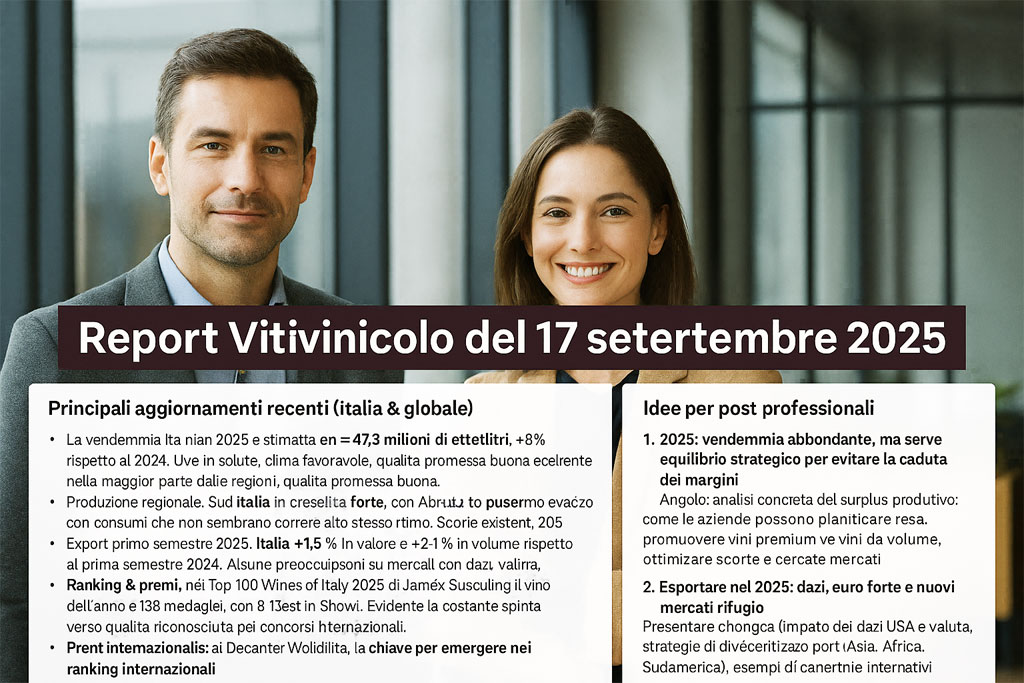
Recent major updates (Italy & global).

Today’s wine world update:

  • The 2025 Italian harvest is estimated at ≈ 47.4 million hectoliters , 8% compared to 2024. Healthy grapes, favorable climate, quality promised to be good-excellent in most regions.
  • Regional production: Southern Italy is growing strongly, with Abruzzo up 25%, Molise 25%, Marche 18%, and Umbria 10%. Tuscany is down approximately 13%. Veneto is stable/slightly increasing compared to 2024.
  • Production surpluses are forecast in some areas, with consumption not appearing to be growing at the same pace. Existing inventories in Italy are quite high.
  • Exports in the first half of 2025: Italy up 1.5% in value and 2.1% in volume compared to the first half of 2024. Some concerns about markets with tariffs, a strong currency (the euro) penalizing exports.
  • Ranking & Awards: In James Suckling’s Top 100 Wines of Italy 2025, the wine of the year is Etna Rosso San Lorenzo 2023 (Tenuta delle Terre Nere) — a sign of how Etna is gaining global clout and credibility.
  • Innovations/sustainability: Increasing use of precise viticultural practices and meticulous health management; interest in technologies such as AI for sensory analysis and spectroscopy to predict grape quality and origin.
  • International Awards: At the 2025 Decanter World Wine Awards , Italy received 138 medals, including six “Best in Show” awards. The constant push toward quality recognized in international competitions is evident.

Prices & Harvest (Mini‑Box)

Region / Variety / SegmentCurrent situationTrend vs last year / vs last few weeksNotes on yield, quality, weather
Generic Italian black grapes (wholesale, counter)~ €4/kg for non-varietal/undifferentiated black grapes.Prices stable compared to recent weeks; slightly higher than the 2024 low for similar varieties.Good health conditions; some critical issues in isolated areas, but overall a positive spring and early summer; modest yields in some denominations to ensure quality.
2025 Italian Harvest (Volume and Regional Distribution)National estimate ≈ 47.4 million hl; Southern and central regions growing, Tuscany declining.8% vs 2024; some regions 20-25% (e.g. Abruzzo, Molise), others physiological reductions (e.g. Tuscany -13%).Expected quality is good to excellent; relatively favorable climate, but regional volatility remains; controlled yields in premium appellations.
Stocks & bulk winesBulk wine prices ex-cellar stable vs. previous month; relative shortage of white wine/must stock; red wine supply/demand more balanced.No strong fluctuations but pressure on costs, reduced availability for certain segments.Especially white wines/musts: risk of supply gap; red wines more protected; climate and phytosanitary management crucial in regions with spring rains/hot summers.

Ideas for professional posts

  1. Title: “2025: Abundant Harvest, but Strategic Balance Needed to Avoid Falling Margins” Corner: Concrete Analysis of Production Surplus: How Companies Can Plan Yield, Promote Premium vs. Volume Wines, Optimize Inventory, and Seek High-Value Markets to Counter Cost Pressure.
  2. Title: “Exporting in 2025: Tariffs, a Strong Euro, and New Safe-Haven Markets” Focus: Details on the impact of US tariffs and the currency; export diversification strategies (Asia, Africa, South America); examples of wineries already moving into alternative markets; international co-marketing.
  3. Title: “Sensory Innovation and Sustainability: The Key to Standing Out in International Rankings” Focus: Presenting how technologies such as AI, spectroscopy, and sustainable vineyard management are no longer optional extras but rather required by critics and consumers; practical cases; and opportunities for those targeting premium brands or prestigious denominations

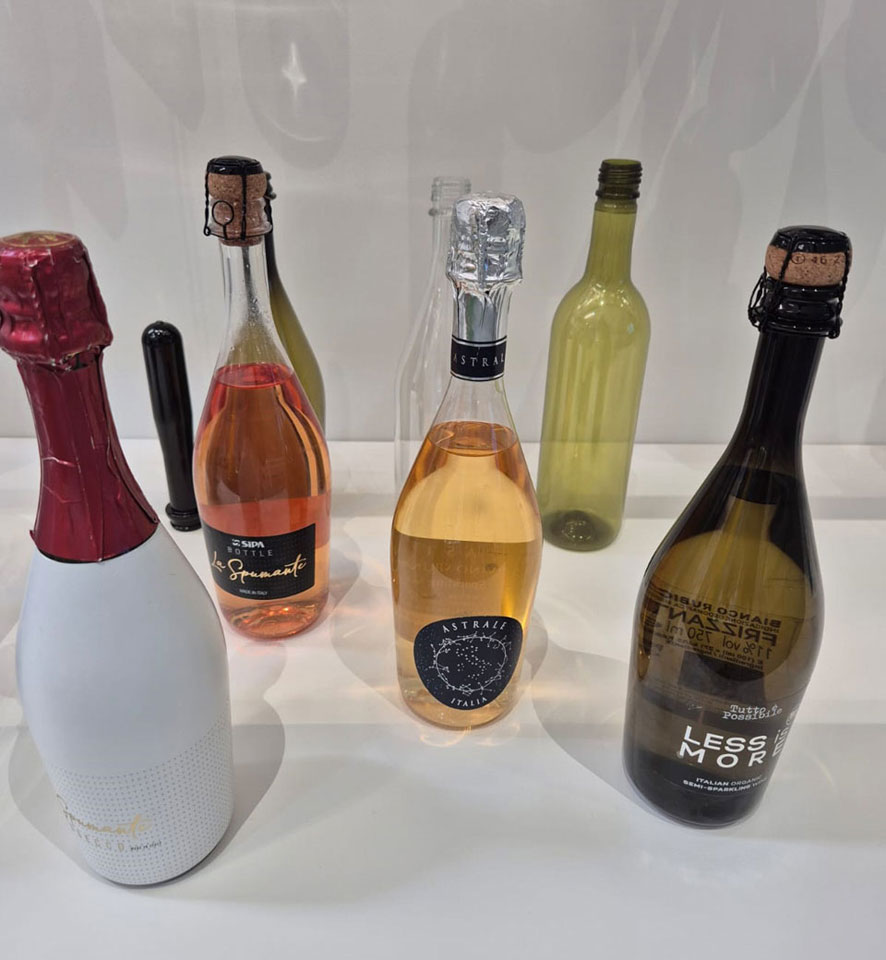
Alcohol-Free Wine and Spritz in PET Bottles: The Perfect Solution for Mobility, Events, and Large-Scale Services

The beverage world is undergoing a quiet but powerful transformation: the growing demand for low- and no-alcohol beverages that are convenient, safe, and suitable for high-traffic or high-volume environments.

In this scenario, dealcoholized wine and spritz in PET bottles emerge as innovative solutions for specific sectors such as naval, railway, events, public demonstrations, trade fairs and the military.

Why dealcoholized wine?

Dealcoholized wine is made from a selection of quality wines from which the alcohol is removed through advanced technological processes (reverse osmosis, vacuum distillation, cold techniques). The result is a beverage that retains:

  • Aroma and organoleptic profile of the original wine
  • Zero or very low alcohol content
  • Health benefits : fewer calories, responsible consumption

Perfect for those who want the wine experience without the limitations associated with alcohol, it is particularly suitable for contexts where safety and sobriety are essential: long journeys, work environments, supervised situations and large events.

The Spritz in a PET bottle: practical and sociable

The ready-to-drink spritz in a PET bottle combines the freshness and conviviality of an iconic cocktail with the safety and convenience of recyclable plastic packaging:

  • Ready to eat , no preparation required
  • Lightweight, resistant and unbreakable PET format : ideal for mass transport and crowded environments
  • Easy disposal : recyclable bottles, suitable for large-scale events and services

The proposal meets the needs of those seeking immediate social moments, without sacrificing logistical security.

Why PET bottle?

PET packaging is not a random choice but a strategy:

  • Safety : no risk of breakage like with glass
  • Lightness : up to 90% less weight, with reduced transport costs
  • Optimized volume : perfect for warehouses and intensive loads
  • Sustainability : 100% recyclable PET, integrable into circular economy circuits

The reference sectors

1. Naval

Cruise ships, ferries, and maritime services find PET the ideal solution: reduced onboard weight, elimination of glass risks, and safe drinks even in rough seas.

2. Railway

On long-distance and high-speed trains, dealcoholized wine and spritz in PET bottles guarantee a modern, safe, and suitable offering for all passengers, without restrictions on alcohol service.

3. Events and public demonstrations

Large crowds require simple logistics and rapid waste management. PET is unbeatable: rapid distribution, zero risk of glass accidents, and maximum access control.

4. Fairs

Alcohol-free wine takes center stage in the international pavilions, where simplicity is key but the sensory experience remains central. The PET spritz offers moments of convivial relaxation without the complexity of service.

5. Army

For the armed forces, the combination of a safe drink with durable and lightweight packaging represents an ideal solution: simple supply, convenient transport, and responsible consumption in operational contexts.

A choice that looks to the future

The combination of dealcoholized wine and spritz in PET is not only a market innovation, but a concrete response to the needs of mobility, safety, and sustainability. It is the meeting of winemaking tradition and technological innovation , paving the way for new opportunities for operators and distributors in the most logistical-intensive sectors.

In a world that demands practical, safe, and environmentally friendly solutions, these drinks are not a passing fad, but a strategic choice destined to grow.

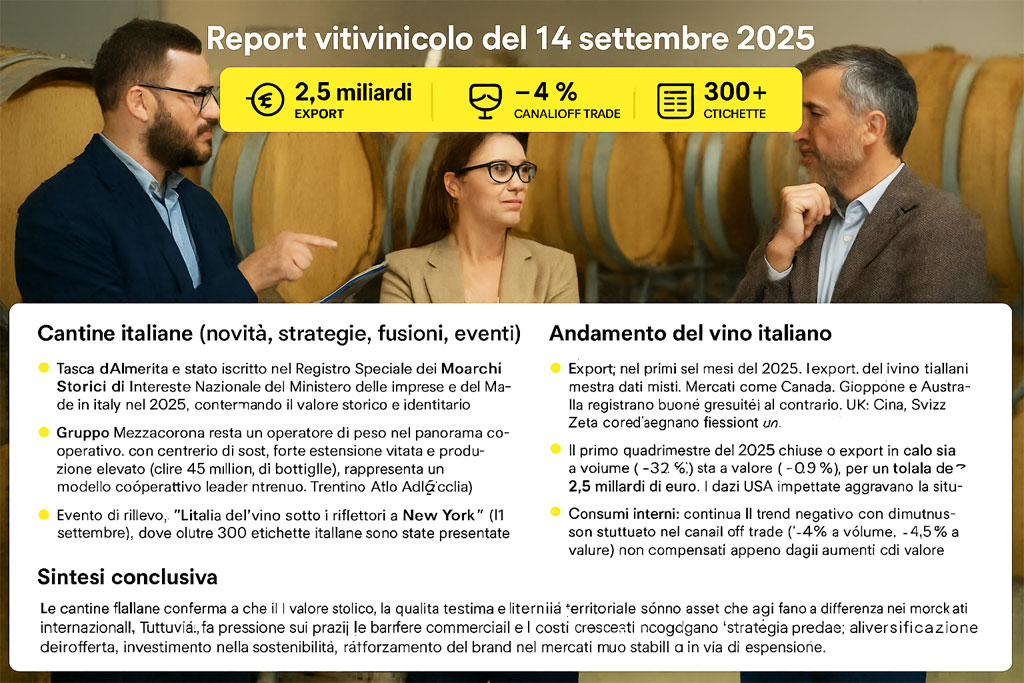
Wine Report of September 14 2025

Italian wineries (news, strategies, mergers, events).

Today, September 14, 2025

  • Tasca d’Almerita was registered in the Special Register of Historic Brands of National Interest by the Ministry of Business and Made in Italy in 2025, confirming the historical and identity value of its Sicilian estates.
  • Gruppo Mezzacorona remains a leading player in the cooperative landscape: with hundreds of members, a large vineyard area, and high production (over 45 million bottles), it represents a leading cooperative model in Trentino-Alto Adige/Sicily.
  • Highlighted event: “Italian Wine in the Spotlight in New York” (September 11), where over 300 Italian labels were presented to the public and foreign operators, a useful opportunity to strengthen the positioning of the US/international markets.

Italian wines (new labels, awards, trends)

  • New labels and restyling : Tenuta del Buonamico has revamped the labels of iconic wines such as Cercatoja, Il Fortino, Vasario, Mio, Vivi, and Dea Rosa to enhance the wines’ personality, an aesthetic pleasure that also supports marketing/positioning strategies.
  • International recognition : Ferrari Trento received a 100/100 score from Decanter for its 2009 Riserva Lunelli, and unveiled the new 2015 vintage of its Giulio Ferrari Rosé. This reinforces the reputation of excellence for Italian sparkling wines around the world.
  • Sparkling wine trends : according to Valoritalia 2025, sparkling wines recorded a 5% growth in value in the certified market, while red wines suffered a significant decline (-6.8%).

Italian wine trends (exports, consumption, economic data)

  • Exports : In the first six months of 2025, Italian wine exports showed mixed results. Markets such as Canada, Japan, and Australia recorded strong growth; conversely, the UK, China, Switzerland, and South Korea reported declines.
  • The first four months of 2025 closed with exports declining in both volume (-3.7%) and value (-0.9%), totaling ~2.5 billion euros. The impact of US tariffs exacerbated the situation.
  • Domestic consumption : the negative trend continues, with decreases especially in off-trade channels (-4% in volume; −1.5% in value) not fully offset by increases in unit value due to premiumization.

Final summary

Italian wineries confirm that historical value, distinctive quality, and territorial identity are assets that make a difference in international markets today. However, price pressure, trade barriers, and rising costs require specific strategies: diversifying the offering, investing in sustainability, and strengthening the brand in more stable or expanding markets.

Sparkling wines continue to be a key driver, while the decline in red wines highlights that without innovation, targeted marketing, and production cost control, it will be difficult to contain losses. Exports remain the key variable for 2025: balancing risks and opportunities in foreign countries will be crucial for sustaining growth and creating real value.