All posts by admin

Wine press review for Friday March 6 -2026

Italian wineries, Italian wine producers, and wine news.

Italian Wineries

Bottega grows despite tariffs and market uncertainty

The Veneto-based winery and distillery Bottega SpA closed 2025 with a turnover of 98 million euros (3%) , confirming the solidity of the brand despite international turbulence. With over 80% of production destined for export and a presence in 165 countries , the company strengthens its global positioning, with key markets such as the United States, Canada, Germany, and Scandinavia.

The Milan presentation also saw the launch of Alexander Whisky , the company’s first 100% Italian whisky, aged in Amarone, Brunello, and Chianti barrels. Among the new releases is Bottega Stardust Gold 2021 , a collectible Prosecco DOC Extra Brut worth €250 a bottle .

Vinicola Cherchi: Identity and Native Grape Varieties for Sardinia’s Future

In the Sardinian wine scene, the role of wineries that focus on terroir, authenticity, and native grape varieties is growing. The historic Vinicola Cherchi in Usini (Sassari) represents one of the most consistent examples of this strategy, with a project that values biodiversity and sustainability.

The new communication approach also aims to simplify the language of wine , bringing new generations and less expert consumers closer together.

Aglianico lands: Sannio, a land of quality and territorial identity

The Terre d’Aglianico winery, led by Libero Rillo at the foot of Mount Taburno, strengthens its international reputation thanks to the gold medal obtained at the Città del Vino International Wine Competition with the EBE 2024 Falanghina del Sannio Taburno DOC wine.

The recognition confirms the growing role of Sannio as a wine tourism and cultural destination .

Astroni Winery awarded for inclusive wine tourism

Hospitality manager Cristina Varchetta of Cantine Astroni (Campi Flegrei) received the award in the “Inclusive” category at the national Best Wine Hospitality Manager 2026 competition.

The award recognizes a wine tourism model capable of engaging diverse audiences: wine lovers, families, children, and even non-wine drinkers.

Ancient Migliaccio Cellars: History and Wine Between Naples and Ponza

The history of the Migliaccio winery dates back to 1734 , when Charles of Bourbon encouraged the repopulation of the Pontine Islands. Since then, the Migliaccio family has been linked to viticulture on the island of Ponza , producing wines such as Fieno Bianco Lazio IGT 2024 , an expression of a unique Mediterranean terroir.

Italian Wine and Oenology

Slow Wine 2026: Sardinia between tradition and new energy

The Slow Wine guide confirms the vitality of Sardinian viticulture. Fifty-one wineries are included , five of which have been awarded the Chiocciola , a recognition given to the companies that best interpret Slow Food values.

Among the most dynamic areas, the following stand out:

  • Mamoiada
  • Mandrolisai
  • Carignano
  • Winemakers of North West Sardinia

At the same time, the rediscovery of historic vines such as Arvisionadu, Nuragus and Malvasia is growing.

Chianti Classico: Growth Led by Riserva and Gran Selezione

Chianti Classico continues to strengthen its qualitative positioning thanks to the Riserva and Gran Selezione categories, which represent the premium range of the denomination.

The area is also considering becoming a UNESCO World Heritage Site , which could further strengthen the international value of the denomination.

Chianti and Morellino di Scansano: more elegant and drinkable wines

From the previews of Chianti Lovers & Rosso Morellino a new stylistic direction emerges:

  • less concentration
  • greater drinkability
  • reduction of wood influence

Chianti production in 2025 stood at 620,000 hectolitres , below the initial forecast of 750,000.

Major anti-fraud operation in Italian wine

The “Vinum Mentitum” operation, conducted by the Guardia di Finanza and Icqrf, led to the seizure of 2.5 million litres of falsely certified DOP and IGP wine , for a value of more than 4 million euros .

The investigations involved wineries in various Italian regions including:

  • Piedmont
  • Lombardy
  • Abruzzo
  • Lazio
  • Campania
  • Puglia

An important signal in the defense of denominations.

International

Russia: Italy still the world’s leading wine exporter

In 2025, Italy will confirm its position as Russia’s leading wine supplier , with exports worth 234.5 million dollars , despite a 16% drop compared to 2024 .

The following are:

  • Georgia: $170.7 million
  • Latvia: $120.7 million

The decline reflects the general decline in Russian imports (-11%).

China declines for Italian wine

According to Nomisma Wine Monitor , exports to China have fallen by around 15% in a year , confirming the difficulty of the Asian market.

At the same time, Italian companies are looking for new alternative markets , especially in:

  • Japan
  • South Korea
  • United Kingdom
  • Swiss
  • Brazil

France: National plan to reduce wine production

The French government has announced a strategic plan that will lead to a reduction in production of 5–6 million hectoliters by 2035 , with the elimination of around 100,000 hectares of vineyards .

The measure stems from the decline in domestic consumption and difficulties in exports.

This reflection also concerns Italy, where stocks have exceeded 61 million hectoliters according to Cantina Italia data.

Wine Events

Valdobbiadene: The Ancient Fair of San Gregorio returns

From 7 to 9 March 2026, Valdobbiadene will host one of the most historic agricultural events in the area.

The event will involve:

  • over 300 exhibitors
  • tens of thousands of visitors
  • events dedicated to young farmers and rural crafts

Oltrepò Pavese: “Pinot Noir, Women, and Flavors” tasting

On March 7th , a tasting dedicated to Oltrepò Pavese Pinot Noir will be held at the Táia Winery in Montecalvo Versiggia .

The sensory journey includes four interpretations of the grape variety:

  • Classic Method vintage
  • Pinot Noir Rosé
  • Blend Barbera–Pinot Noir
  • Pinot Noir Reserve

X-Bacco: Natural Wine in Community Centers

The X-Bacco vol.3 – Natural and Artisanal Wine Festival event brought attention back to the culture of “grassroots” wine, linked to the tradition of Critical Wine and the figure of Luigi Veronelli.

A cultural phenomenon that unites agricultural production, social activism, and new wine communities.

Wine Tourism

Winedering and the new tourism among vineyards

Wine tourism continues to grow thanks to platforms like Winedering , which allow you to book online:

  • cellar visits
  • tastings
  • wine tour
  • gastronomic experiences

Wine is increasingly becoming a reason for travel , not just a product to be consumed.

Strategic Insight of the Day

Looking at all this news together, a very interesting dynamic emerges.

Wine today moves on three simultaneous axes :

  1. more unstable global market (tariffs, falling consumption, China in decline)
  2. increasingly central territory (native vines, wine tourism, local identity)
  3. new business models (experiences, hospitality, digital booking)

In other words: the value is no longer just in the bottle. It’s in the system that surrounds it .

Those who govern territory, hospitality, branding, and distribution will continue to grow even in challenging market times.

This is exactly the kind of dynamic that makes structured wine estates and iconic territories increasingly sought-after strategic assets.

Today’s wine press review was provided by WINEIDEA.IT

See you tomorrow for the latest news from the world of wine.
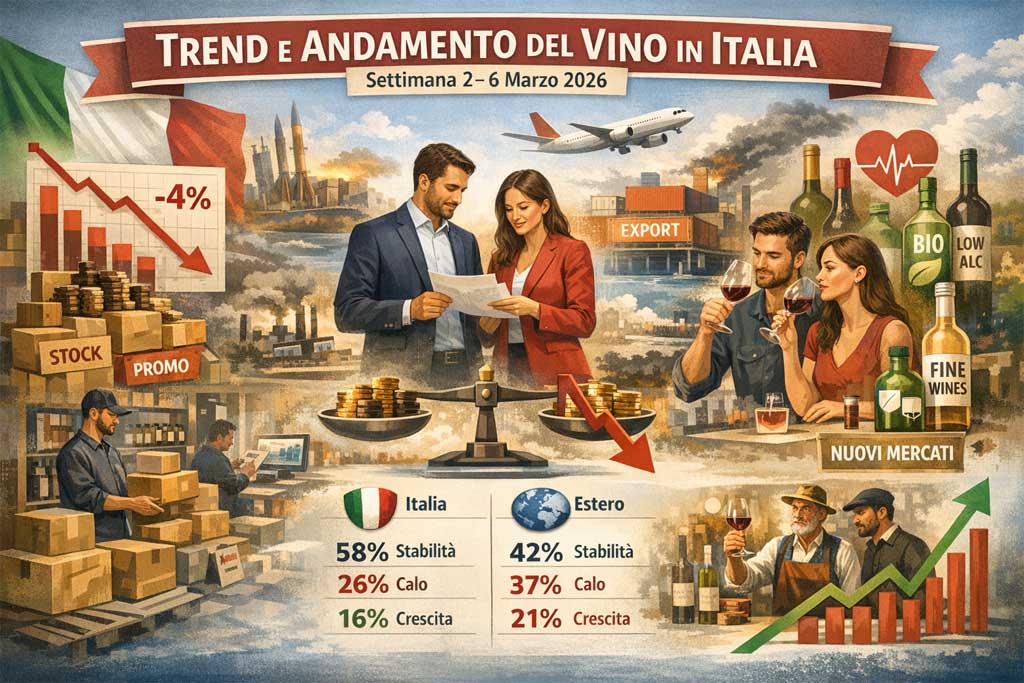
Wine Trends and Market Performance in Italy (Week of March 2–6, 2026)

The first full week of March 2026 portrays an Italian wine sector in a phase of “difficult resilience.” The industry is not collapsing, but it is moving in a fragile balance between structural declines in volumes, pressure on margins, geopolitical and trade uncertainty (tariffs and key export markets), and changing consumption patterns driven by new lifestyles and health awareness.

At the same time, some niches—particularly fine wines and top brands—are showing early signs of recovery, while price competition and consumer selectivity continue to increase.

1) 2025 Financial Results: More Stability Than Growth, Widespread but Limited Declines

Evidence from the sample of wineries analyzed (high-profile companies with aggregated revenues exceeding €2.5 billion) shows that 2025 closed as a complex year of consolidation.

  • 53% of companies: reported stable financial results.
  • Most of the remaining companies: recorded revenue declines mainly between -1% and -5%, with very few cases of slight growth.

However, the sector is coming from a high baseline:

  • 2024 was a record year for exports, reaching €8.1 billion, following several favorable post-Covid years.

The key issue is not only how much is being lost, but how companies are reacting. Many wineries are defending their results through tactical decisions involving:

  • pricing strategies
  • promotions
  • channel mix adjustments
  • tighter control over inventory and sales networks

2) Italy vs Export Markets: More Stability at Home, More Volatility Abroad

The gap between the domestic market and exports remains evident.

Domestic Italian Market

  • 58% report stability
  • 26% report decline
  • 16% report growth

Changes are generally limited (1–3 percentage points), but the signal is clear: the market is stable but lacks strong momentum, and growth remains a minority trend.

Export Markets

  • 42% report stability
  • 37% report decline (sometimes significant, from -3% to -15%)
  • 21% report growth (generally +1% to +3%)

Supporting data confirm a “cool” 2025 market environment:

  • Large-scale retail (GDO): -0.5% in value and -3.1% in volume
  • Exports (first 11 months of 2025): -3.6% in value and -2% in volume

In summary: the domestic market holds up better but does not accelerate, while exports remain more volatile, influenced by external shocks and shifting demand patterns.

3) Expectations for 2026: Operational Realism with Hopes for a Modest Recovery

Expectations for 2026 remain cautious but relatively stable.

  • 70% of companies expect stability or slight recovery
  • 30% fear a further (mild) decline

More specifically:

  • some expect results in line with 2025
  • some foresee a -3% to -5% decrease
  • others anticipate +2% to +4% growth — more a recovery than a boom

The strategic interpretation is clear: 2026 is not a year for inertia.
Performance will depend more than ever on:

  • commercial agility
  • channel management quality
  • price, packaging and format strategy
  • the ability to make brands clear, understandable and desirable

4) Investments: Communication Stable, Sales Strengthened

An important operational signal emerges from the sector: despite pressure on profitability, companies are not massively cutting the functions that drive sales.

  • Marketing & communication:
    • 79% expect stable budgets in 2026 compared with 2025
    • budget cuts exist but are not the norm (generally -5% to -20%)
  • Sales support:
    • no companies expect reductions
    • 37% plan to increase investments, typically around +5%, with peaks up to +10%

In other words, the industry message is clear:
“The market is tough, so we must strengthen our commercial engine and protect brand perception.”

5) Consumption and Drinking Culture: Less Automatic, More Selective (Gen Z and Beyond)

Changes in consumption are not simply a decline—they represent a shift in the grammar of drinking.

  • Overall consumption is decreasing across several countries.
  • Generation Z is not disappearing from the market — it is selecting more carefully.

Drinking is becoming:

  • more occasional
  • more aligned with personal wellbeing and identity
  • more sensitive to authenticity, sustainability and transparency

Interest is growing in:

  • sparkling wines
  • fresh white wines
  • lighter styles that are easier to drink

At the same time, low/no alcohol products are gaining attention, but there is no widespread belief that they will “save volumes.”

A notable divide emerges in the data:

  • 26% of wineries are investing or planning to invest in low/no alcohol products
  • 74% are not considering it (at least for now)

This reflects a sector split between those who see a strategic opportunity and those who fear brand dilution or low margins.

6) Pricing and Restaurants: The Challenge Is How Wine Is Sold

In the Ho.Re.Ca. channel, the challenge is not only fewer customers but also price perception and spending thresholds.

Wine lists become problematic when consumers are more cautious and psychological price limits decrease.

Signs of adaptation are emerging:

  • renewed interest in smaller formats (half bottles)
  • increased sensitivity to promotions and commercial formulas
  • experimentation with new packaging and formats

The strategic challenge here is critical:
transforming the wine list from a barrier into a lever, making it easier for consumers to choose—and easier for them to trade up without feeling overcharged.

7) International Markets: New Attractive Geographies and Trade Shocks

The international environment highlights two key messages.

  1. Increasing focus on intra-European markets

Markets perceived as more attractive in the short term include:

  • Germany
  • The Netherlands
  • Japan

The United States is dropping in priority, mainly due to tariff uncertainty and market volatility.

  1. Mercosur opportunities

The provisional implementation of the EU–Mercosur agreement is viewed positively, especially regarding Brazil, where tariffs historically have been very high:

  • up to 27% on still wines
  • up to 35% on sparkling wines

The operational idea:
today it remains a marginal market, but with growth potential if trade barriers decrease and structured promotion is implemented.

Another contextual signal:
Russia remains a market where Italy is the leading exporter, although volumes have declined compared to 2024, consistent with an overall contraction in imports.

8) Fine Wines: A Small Niche, But a Meaningful Signal

The secondary market for fine wines (Liv-Ex) shows moderately positive signals at the beginning of 2026:

  • main indices show slight growth
  • Italian labels are performing strongly in some top segments

This niche does not rescue the sector as a whole, but it indicates that:

  • brand equity and rarity remain resilient
  • the premium segment may recover earlier than the mainstream market
  • the premium strategy remains valid, provided it is supported by distribution, storytelling and coherent positioning

9) Strategic Implications for Italian Wineries

The picture emerging from the week of March 2–6, 2026 leads to a clear conclusion:
this is not a cycle to wait for—it is a cycle to manage.

Operational priorities emerging from sector data include:

  • Protect margins before volumes: pricing, promotions and formats must be managed as a strategic architecture, not reactive measures.
  • Strengthen sales networks and conversion capability: increased sales budgets highlight where 2026 will be won or lost.
  • Simplify value for consumers: clearer product ranges, consumption occasions, by-the-glass offerings, pairings and formats.
  • Reposition portfolios toward more demanded styles: whites, sparkling wines and freshness; reds more selective and better narrated.
  • Open alternative markets with real strategies: Germany, Northern Europe and urban Asia; Brazil as a strategic option if properly supported.
  • Low/no alcohol: a strategic decision, not a trend. For some wineries it may become an entry channel; for others it conflicts with identity. In both cases, the choice must be clear and deliberate.

Wine: With tariffs, war, and logistics in decline, is Italian wine at risk of default?

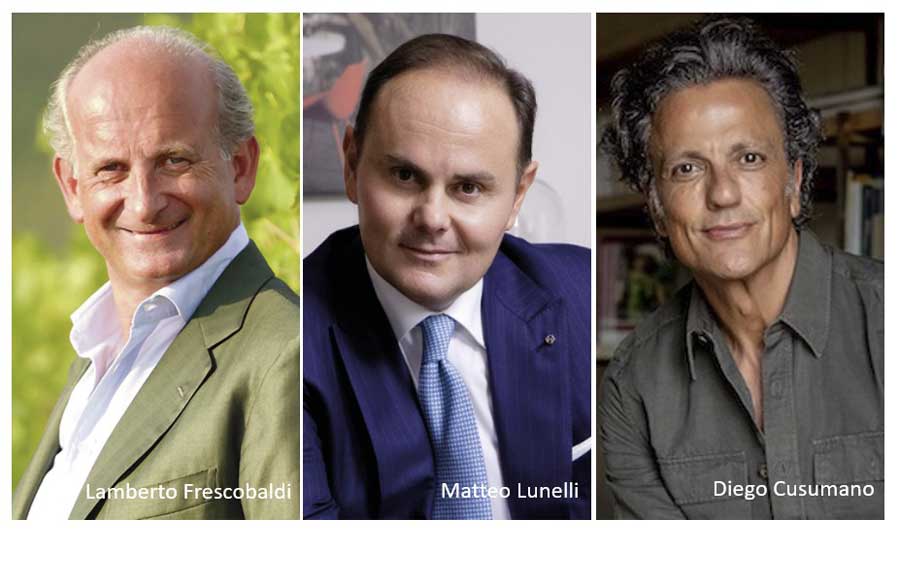
“The recently published Nomisma Wine Monitor analysis shows how, understandably, given everything that has happened and is happening in the world, the global wine market in 2025 has shown strong signs of slowing, with a drop of almost 12% in value and a market that has stabilized around 5.5 billion euros,” comments Diego Cusumano, one of the most recognized winemakers in Italy and abroad, and owner of the eponymous company with his brother Alberto.

Producers: “If exports don’t go well, there’s a risk of huge production surpluses.”

According to the report, the United States is at the center of this decline due to tariffs, with a 2.6% decrease in volume and 6.2% in value compared to the previous year. But even looking east, the situation isn’t improving, with China seeing a decline in value of Italian wine by over 15%, and Japan reducing purchases by 2.2% in volume and 1.7% in value. In Europe, the United Kingdom, Italy’s second-largest market, saw total imports decline by approximately 6% in both volume and value, and Switzerland also saw Italian exports decline by approximately 6% in value. Brazil, on the other hand, saw exports grow by 3.5% in volume and 1.9% in value, as did South Korea, where imports grew by 5.3%.

“This new war, which is spreading throughout the Middle East and beyond, represents a further aggravating factor not only for wine exports but for Made in Italy in general ,” explains winemaker Cusumano . ” If tariffs and price increases have caused a significant slowdown, now the threat is the interruption of supply chains, specifically in terms of logistics and transportation. International corridors, due to the war, are significantly narrowing, with the availability of operating carriers dramatically reduced to the real, even minimal, need, which will translate into transportation costs, where possible, much more expensive and therefore uneconomical. On the other hand, let’s also ask ourselves what we should do, already in 2026, with the harvest effectively upon us (end of August), with the probable surpluses due to the sharp slowdown not so much in foreign demand, which remains, but in the possibility of satisfying it logistically. And if we winemakers, for certain types of wine, are slightly lucky since It will age, I wonder what the impact will be on the entire Italian food and wine sector.”

Matteo Lunelli , CEO of the Lunelli group and CEO and president of Ferrari Trento, also agrees with Diego Cusumano . “The war,” the producer claims, ” will certainly have repercussions on the economy as well: it will cause problems in transportation because it compromises strategic routes, it undermines consumer confidence, it will raise energy costs and it will also affect the Middle East and the Emirates, which is a rapidly growing market and also important in general for Italian wine and Made in Italy products.”

Confirmation of the surplus also comes from Lamberto Frescobaldi , president of the Italian Wine Union, who already raised the alarm last July : “We have over 40 million hectoliters of wine in storage, and if the next harvest—or rather, the upcoming one, the UIV president explained—is average with around 50 million hectoliters, we will have approximately 90 million hectoliters of product available by the end of the year. A monstrous supply that risks depressing prices. There’s really nothing to celebrate.”

Wine press review for Thursday March 5 -2026

Italian wineries, Italian wine producers, and wine news.

Italian Wineries

Lungoparma: A New Identity for Parma Wine

Following the acquisition of the historic Antico Consorzio Vitivinicolo Parmense , the Gandolfi Group is relaunching the local winemaking project with the Lungoparma brand. The goal is to reinterpret Parma’s conviviality with a contemporary twist. Among the first products is Oro 99 , a brut sparkling wine made from Chardonnay grapes using the Charmat method, designed for aperitifs and to showcase the region’s convivial side.

Masi Agricola: lower turnover but higher profitability

Masi Agricola ‘s 2025 results confirm a widespread trend in the sector: slightly declining sales but improving margins. The company reported revenues of €64.4 million (-3.7%) , but EBITDA grew to €7.1 million compared to €6.7 million in 2024. A management model focused on quality and protecting value.

Fontanafredda launches the Barolo della Tenacia

The historic Piedmontese winery continues its “Renaissance” project, dedicated to the sentiments that drive collective rebirth. The new 2022 Barolo del Comune di Serralunga d’Alba is dedicated to Tenacity and is part of the winery’s “Green Renaissance” vision.

Veraison expands its wine platform

The group led by Edoardo Freddi continues its process of consolidating the sector with new strategic transactions. In 2025, Cantine Alcesti , the Conti Sertoli Salis brand, and the joint venture with Vallebelbo joined the group. The project aims to create distinctive production hubs geared towards foreign markets .

Cantina Produttori Valdobbiadene: protecting historic vineyards

The cooperative is introducing a direct vineyard management service to support suppliers who are no longer able to tend the vines. The initiative aims to preserve the quality of the grapes and the continuity of the supply chain in the delicate Prosecco Superiore region.

Villa Corniole among Forbes’ 100 Iconic Wineries

For the second consecutive year, the Trentino-based winery from the Cembra Valley has been included in Forbes’s international list of 100 iconic wineries , thanks to the quality of its wines and classic method sparkling wines.

Italian Wine and Oenology

Alcohol-free wines: the market is changing

The spread of no- and low-alcohol drinks signals a structural shift in alcohol consumption. New generations prioritize moderation, health, and more selective drinking opportunities, pushing the industry to rethink products and marketing.

Generation Z and wine: the way we drink is changing

Young people aren’t abandoning wine: they’re changing the rules of consumption. The key words are authenticity, sustainability, and identity . Consumption is becoming more occasional and conscious.

Wine Communication: A New Language Is Needed

According to several industry professionals, wine has gradually taken on an overly elitist aura. The challenge today is to restore it to an experiential and accessible dimension, especially to attract new consumers.

Three threats to Tuscan vineyards

Three main critical issues emerged during the Blood of the Earth 2026 technical meeting:

  • climate changes impacting Sangiovese
  • spread of flavescence dorée
  • increase in harmful insects such as the ficus moth and Planococcus ficus

Deadline for new vineyard plantings extended

The Ministry of Agriculture has extended the deadline for submitting permit applications for new vineyard plantings to April 17, 2026. Expansion remains limited to 1% of the national vineyard area per year .

Anti-fraud operation “Vinum Mentitum”

2.5 million liters of falsely certified DOC and IGT wine , worth more than €4 million , were seized. The operation was conducted by the ICQRF and the Guardia di Finanza to protect Made in Italy products.

Agrivoltaics: an economic opportunity for agricultural companies

According to studies presented at Fieragricola 2026 , an agrivoltaic system can generate 65,000–85,000 euros of annual value per hectare , with an operating life of approximately 30 years.

International

Fine Wines: Signs of Recovery in the Secondary Market

According to the Liv-Ex platform, the market for fine investment wines is showing positive signs at the beginning of 2026.

  • Liv-Ex 100: 0.6%
  • Champagne 50: 1.4%
  • Italy 100: 0.7%

Top performers include:

  • Barolo Bruno Giacosa 14.3%
  • Sangiovese Soldera 12%
  • Masseto 2022 7.8%

Italy remains a leading player in the collectible wine segment.

Campari: revenues exceed 3 billion

The group closed 2025 with a turnover of over €3 billion and a net profit of €386 million . The dividend grew by 54% , while the new generation of the Garavoglia family joined the board of directors.

Wine Events

Turin Wine Fair 2026

The event confirmed the growth of contemporary Piedmontese wine:

  • over 5,000 participants
  • more than 2,000 B2B operators
  • masterclass sold out
  • strong interest in minor grape varieties and young producers.

Wild Wines 2026 – Rome

From March 7th to 9th, the event dedicated to natural wine returns with:

  • over 120 European winemakers
  • tastings and direct market
  • inaugural event “Naturally Wild”.

Sources of Wine – San Casciano dei Bagni

On March 28th , a new event will be born that combines wine and spa treatments in the Tuscan village between Val d’Orcia and Valdichiana .

The Seasons of Wine – Spinelli Cellars Tour

The tour will continue on March 19th in Cadeo (Piacenza), featuring tastings and masterclasses dedicated to Abruzzo wines.

Women of Wine 2026

The Women’s Wine Days return until March 15th with the theme:

“Women, Wine, Food”

A national project that unites culture, sustainability, and the social role of wine.

Garda DOC at ProWein 2026

The Garda DOC Consortium will present the new regulations at the international fair ProWein in Düsseldorf (15-17 March) .

Territories and Wine Culture

Monferrato unites the consortia

The Barbera d’Asti , Asti Spumante , and Vini d’Acqui Consortia announce a strategic collaboration to promote the UNESCO territory with a shared vision.

The historic Vini&Oli wine shop in Naples

Since 1939, the La Marca family has run one of the city’s historic wine bars, also frequented by Vittorio De Sica , now in its fourth generation.

Today’s wine press review is brought to you by WINEIDEA.IT

See you at the next event, featuring the latest news from the world of Italian and international wine.