

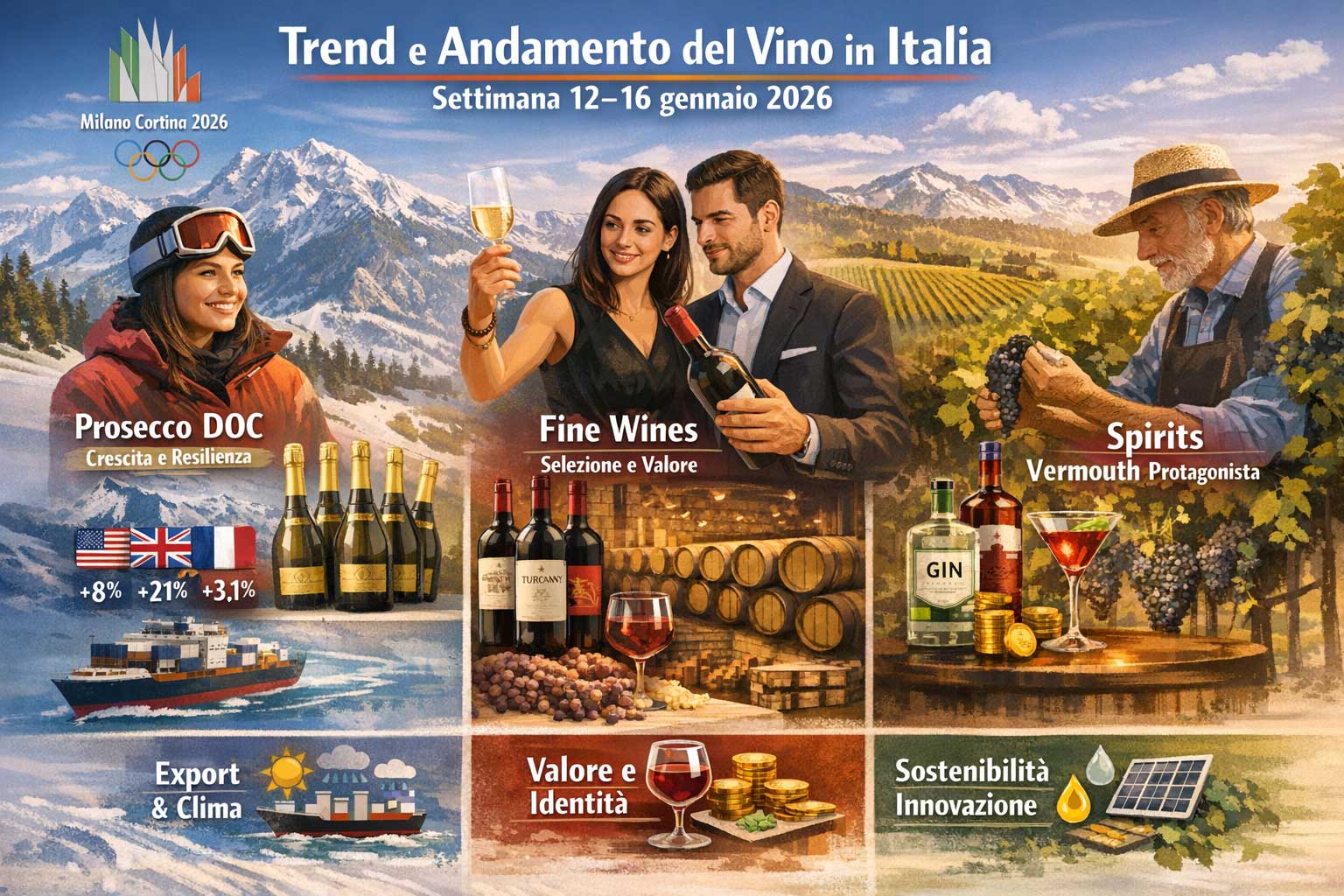



The week of January 12–16, 2026, captures an Italy of wine in the midst of a structural transition: on the one hand, the Prosecco “locomotive” continues to grind out volumes and value, on the other, the system as a whole must manage high inventories, more selective consumption and a 2026 that will reward those who defend margins, channels and identity.
In the middle, three decisive levers are at work: exports (with new opportunities but also tougher rules), repositioning towards value (not volume), and industrial adaptation to the climate.
1) Prosecco DOC: growth, resilience, and momentum 2026 (Milan-Cortina as a global showcase)
Prosecco DOC confirms its role as the driving force of Italian wine: 667 million bottles produced in 2025 (1.1% compared to 2024) , of which 60.3 million are Rosé (10% of the category) , for a total value of 3.6 billion euros . The denomination remains strongly oriented abroad: over 82% exports to 164 countries . The winning narrative is clear: an “easy” product in the best sense of the word (pleasantness, lightness, versatility, accessibility), supported by a consortium that links the brand to popular and high-visibility events.
Differentiated trajectories emerge in international markets (January–September 2025):
- USA is the leading market (23.8% of exports) and 8% , albeit with volatility linked to duties.
- UK 1.1% .
- France accelerates and becomes the third market with 21.1% , overtaking Germany.
- Germany 3.1% .
- Strong signals also from “less obvious” markets such as Greece (22.4%) and Mexico (14.5%) , while other countries are slowing down for economic and geopolitical reasons.
On the promotional front, the Consortium indicates campaigns in 39 countries with 2.1 billion impressions . For 2026, the symbolic card is powerful: Official Sparkling Wine Sponsor of the Milan Cortina 2026 Olympic and Paralympic Games , an opportunity to consolidate value and positioning.
Two textbook strategic directions for 2026:
- supply chain profitability (not just volume growth);
- measurable sustainability , with the aim of obtaining Sustainable Community certification according to ISO 37101 and the development of a Low Alcohol Prosecco (8–9 degrees) , consistent with new styles of consumption and responsible consumption.
2) Fine Wines Market: Liv-ex Power 100 2025 and the Return of Rationality
The Liv-ex Power 100 2025 indicates a fine wine market that isn’t “rebounding,” but rather stabilizing : prices appear to have found a floor, more orderly bids/offers, and greater interest in solid, correctly priced brands. Demand stops asking “how much further will it go?” and starts asking “what’s best to buy today?”, signaling a return to selectivity.
Key trends:
- Bordeaux is regaining its central role thanks to more consistent pricing policies: Cheval Blanc takes the top spot; Yquem remains in the top ten; cases like La Conseillante demonstrate the cost of a less “speculative” release and positioning strategy.
- Burgundy remains dynamic but more unstable (many entries/exits), with growing interest in more “drinkable” and less extreme price ranges.
- Champagne is experiencing one of its best results: 9 brands in the ranking, with Krug at the top and new entries such as Selosse and Salon .
Italy : Confirms its importance, but with clear internal differences. San Guido/Sassicaia soars (no. 2 overall), strengthening the role of Super Tuscans as “liquid assets” on the secondary market: global image, recognized quality, sufficient volumes, and still reasonable perceived prices. Some traditional big names, however, tied to a strong historical dependence on the US (Chianti Classico and Brunello), are struggling more, despite brands that are holding up (Ornellaia, Masseto, Tignanello, Solaia, and icons like Biondi-Santi/Soldera). In other words: in fine wine , price consistency, liquidity, and reputation are prized, not just aura.
3) 2026 Italian wine: less volume, more value (and clearer choices)
The strategic message running through all of this week’s content is one: 2026 will be a year of competitive maturity . The market no longer rewards indiscriminate offerings; it rewards those who can defend margins, manage channels, and sustain a credible identity.
Main drivers:
- Polarized demand in Italy : accessibility and simplicity in large-scale retail, while the willingness to spend on experiences and wines with a “reason” is growing when perceived quality, service, and brand are consistent.
- Horeca and wine tourism as platforms for loyalty and direct relationships (not just revenue).
- Exports remain the center of gravity, but with “strict rules”: mature markets sensitive to price; emerging markets requiring continuity and long-term investments.
- Financial management : bloated warehouses and slow turnover require planning and, where necessary, aggregation or more stringent supply chain agreements.
- Vineyards as an industrial variable : water management, rootstocks, shading, precision farming. Sustainability only works if it becomes a measurable benefit , not greenwashing.
- Product and language innovation : low/no-alcohol, new consumption opportunities, DTC and digital not as fashion, but as tools to reach different generations without losing authority.
4) Spirits: Vermouth returns to the forefront in 2026 (and gin risks natural selection)
Proposta Vini’s forecasts place the beverage market in a period of consolidation in 2026: wine is growing moderately, but the most dynamic trends are in spirits. The Proposta Spirits division closed 2025 with a 34% share of sales and identified Vermouth as the big bet for 2026: a bridge between winemaking and mixology, capable of appealing to diverse audiences (tradition for the over-50s, cocktail appeal for the younger crowd). Gin remains central and growing, but shows signs of saturation: too many brands, a potential bias toward those who can showcase local traditions and authentic foundations. The after-dinner segment is more challenging, also penalized by the regulatory and media climate surrounding consumption, while brown spirits (rum, whisky, brandy, cognac) are holding up.
5) Export and trade policy: EU–Mercosur as an “unlockable” opportunity
UIV welcomes the green light to the EU-Mercosur agreement: the South American region (over 250 million consumers) is seen as a potentially receptive market. The economic point is clear: currently, tariffs weigh up to 27% on still wines and 35% on sparkling wines exported to Brazil; their gradual elimination over eight years could improve Italian competitiveness. The Brazilian market imports nearly €500 million worth of wine annually , but Italy’s imports are worth approximately €40 million (8%) : real untapped potential, to be tapped with brand strategy, distribution continuity, and promotion.
6) EU Rules: “Wine Package” nears final approval (anti-crisis measures and No-Lo definitions)
The EU Parliament’s Agriculture Committee unanimously approved the text of the EU Wine Package (final vote expected in plenary session in February). The objective: to support a struggling sector with measures to rebalance production and demand, climate resilience, simpler labeling, wine tourism, definitions for No-Lo wines, export flexibility, plant diseases, and opportunities for aromatized wines.
Operational highlights:
- tools to manage excesses (including eradications);
- ten-year review of the plant authorization regime;
- more funds for climate-related investments;
- more streamlined labeling;
- clear definitions: alcohol-free <0.5% , 0.0% <0.05% , reduced-alcohol with a reduction of at least 30% compared to the standard;
- For exports outside the EU, exemption from the requirement to provide ingredients/nutritional values required for the domestic market (bureaucratic simplification).
7) “Cantina Italia”: high inventories, pressure on prices and need for commercial discipline
The most “heavy” figure for 2026 management is that of stocks: as of December 31, 2025, wine stocks reach 59.5 million hectolitres ( 11.6% compared to the end of November 2025 and 4.4% compared to December 31, 2024). To these are added 7.7 million hectolitres of musts and 2.8 million hectolitres of Vnaif . Stocks are concentrated in the North (58.6%), especially Veneto (27.3%) . In terms of “types”, the wine in stock is 54.2% DOP , 26.4% IGP , 1.6% varietals , 17.9% other wines .
Denominations with the greatest weight in stock: Prosecco Dop alone is worth 5.8 million hectolitres (12.2%) , followed by Igp Puglia (2.0 million hl) , Igp Toscana (1.75%) , Doc Delle Venezie (1.72%) , Igp Terre Siciliane (1.71%) , Igp Veneto (1.6%) , Doc Sicilia (1.5%) , Igp Salento (1.4%) , Chianti Docg (1.39%) , Igp Rubicone (1.3%) . This is the classic scenario in which “making wine” is not enough: channel discipline , rotation and commercial policies consistent with the inventory are needed, otherwise the warehouse becomes a financial brake.
8) Prices and consumption: Italy is the “cheapest” in Europe, but it’s not enough to increase consumption
A Destatis study reports that Italy is the EU country with the lowest wine/alcohol prices (about 19% below the EU average, October 2025). Yet, the issue isn’t just price: consumption is declining due to cultural dynamics, health concerns, competition from other beverages, and changing lifestyles. This data is useful because it refutes the simplistic idea that “increase the price and consumption falls” is the only lever: behaviors in different markets are not linear.
9) Quality-price and reputation: signs that the market wants “credible wines”
Two reputation indicators complete the picture:
- Wine Spectator Top 10 Values 2025 : Italian presence with labels with high perceived value at an accessible price (e.g. Chianti Classico Tenuta di Arceno, Barbera d’Asti Michele Chiarlo), a sign that the quality-price range is a strategic area, especially for sensitive markets.
- BWW 2025 : international awards and rankings (Petrus 2020 best wine; among the Italians cited Masseto 2020, Sassicaia 2021, Solaia 2020, Barolo Sperss 2018; Monteverro “Best New Winery”) reinforce the narrative: high-end wines thrive on reputation, but they work when supported by consistency and the market.