

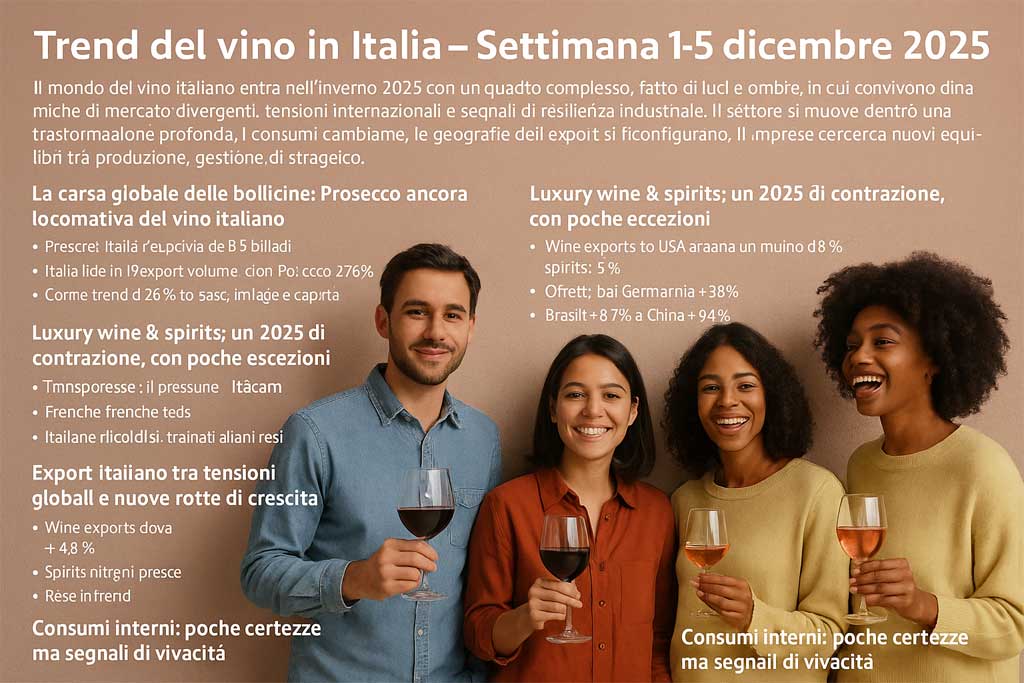


The Italian wine world enters winter 2025 with a complex picture, one of light and shade, featuring divergent market dynamics, international tensions, and signs of industrial resilience.
The sector is undergoing a profound transformation: consumption is changing, export geographies are reconfiguring, Prosecco continues to drive growth, while companies seek new balances between production, cost management, and strategic repositioning.
The global bubble race: Prosecco remains the driving force of Italian wine.
Del Rey Analysts’ snapshot confirms that sparkling wines remain the most dynamic axis on the global scene, with a turnover of 8.5 billion euros , despite a physiological slowdown in volumes.
Italy dominates in terms of quantity: 519 million liters exported , equal to almost half the world’s volume, and a value of €2.4 billion . The epicenter is Prosecco, which has seen exports grow 276% over the last 16 years, surpassing Champagne and Cava in growth dynamics, thanks to three key elements: taste, image, and distribution capacity.
On the price front, Italy has shown a 64% increase since 2009, higher than France and Spain, although it remains far from the value per litre of Champagne.
This week confirms one fact: Prosecco’s strength comes not from its price, nor from a technological advantage, but from its ability to interpret the desires of the contemporary consumer. It’s a global case study.
Luxury wine and spirits: a contraction in 2025, with few exceptions
The high-end segment is going through a delicate phase.
According to the Altagamma Observatory, luxury wines and spirits are expected to decline by 5% in 2025, penalized by more selective consumption, high prices, a slow pace of growth in the Chinese market, and a lower propensity to spend among those under 40.
Under pressure:
- premium spirits (-4/-6%)
- Cognac in decline
- high-end still wines
Going against the trend:
- French bubbles , driven by hedonistic consumption
- Italian reds , which resist thanks to the strength of their identity and origin
- rosé , increasingly in demand in international fine dining
A timid recovery is expected in 2026 (5%), but it remains a market phase where perceived value, experience and authenticity weigh more than the brand alone.
Italian exports amid global tensions and new growth paths
The Federvini Observatory confirms a phase of “realignment” of global flows, with Italian wine which, although slowing down, is holding up better than its French and Chilean competitors .
The US picture is the most critical part:
- wine: –4.8%
- spirits: –5%
- last quarter: –23% , combined effect of tariffs and drop in purchasing power
To compensate, new trajectories arrive:
- Germany 8.8%
- Brazil 8.7%
- Italian spirits boom in China : 94%
The sector is moving from “habitual” consumption to “choice” consumption: less frequent, more perceived value.
Domestic consumption: few certainties but signs of liveliness
In Italy, demand remains cautious, but the search for quality is growing.
The large-scale retail trade records:
- DOP IGP wine: 0.9%
- Total PDO and PGI products: 1.1%
The towing are:
- bubbles
- alcoholic aperitifs
- premium vinegars
No-low and ready-to-drink products continue to expand their reach, especially in urban consumption and among Gen Z and Millennials.
Bulk wine: a surprising segment
The World Bulk Wine Exhibition highlights an unexpected phenomenon:
Loose holds up better than bottled.
Exports fell by only 0.3% in value , while bottled wine recorded a 3.1% decline. Varietals and no/low-alcohol products are growing, driven by technological innovation in dealcoholization and the demand for flexible formats (cans, bag-in-box, RTD).
The bulk wine sector accounts for over a third of global volumes and will become increasingly strategic in the coming years.
Italy: High inventory levels and Prosecco tops the list
As of October 31st, Italian wineries recorded:
- 73 million hectoliters of total wine products
- 44.5 million wine
- 14.3 million musts
Inventories are growing (5.2% over 2024), a signal to monitor in a slow market context.
The most stocked wine in Italy is Prosecco Dop with 4.2 million hl .
Veneto dominates, followed by Emilia Romagna, Tuscany and Puglia.
Wine Companies in the “Perfect Storm”: Who’s Resisting and Why?
The Management DiVino study photographs a sector affected by structural criticalities:
- drop in consumption
- demographic changes
- fragmentation
- cost pressures
Resilience emerges from those who:
- innovate in the business model
- aggregates skills
- invests in wine tourism
- diversify products and markets
The “asset strong / asset light” dualism is no longer a dogma.
Hybrid models, capable of commercial flexibility and territorial roots, are winning.
Sparkling wines sold in 2024 surpass 1 billion bottles
Despite a difficult 2023 harvest, Italy surpassed a historic milestone. Prosecco DOC (8%), Asolo (20%), Pignoletto, and Lambrusco rosé all grew. Piedmont, Lombardy, and Trentino suffered.
The country remains a “Charmat republic”: 96% of the sparkling wines are produced in autoclaves.
DOP Economy: A Pillar of Italian Competitiveness
The ISMEA-QUALITY 2025 Report certifies a healthy sector:
- 20.7 billion production value
- DOP/IGP wine stable at 11 billion
- export: 7.19 billion (5.2%)
The Northeast remains the driving force, with Veneto, Emilia-Romagna, and Friuli experiencing strong growth.
Tariffs, the US crisis and the need for extraordinary measures
UIV calls for urgent intervention:
Between July and September, the average price of Italian wine destined for the USA dropped by 15.5% , an unsustainable self-taxation.
The Government is allocating €100 million annually from 2026 to 2028 to promote and internationalize its business.
The US case: an empire in difficulty
Napa and Sonoma are experiencing their toughest crisis since Prohibition:
- consumption down
- young people far from wine
- 30% of the grapes not sold
- Canada lost due to tariffs
A global warning about the end of the expansion cycle of traditional premium wine.
Conclusion: a sector that is changing its skin
The week of December 1–5, 2025 shows an Italy of wine going through a historic transition:
lower volumes, more competition, unstable markets, new languages of consumption.
But also a supply chain that doesn’t retreat: it innovates, resists, adapts, and finds new ways to create value.
The future will not only be written in the vineyards, but in strategic choices: innovation, positioning, aggregation, global market presence, and the ability to interpret a demand that changes faster than supply.
A continuous movement, like a grape harvest that never stops.