

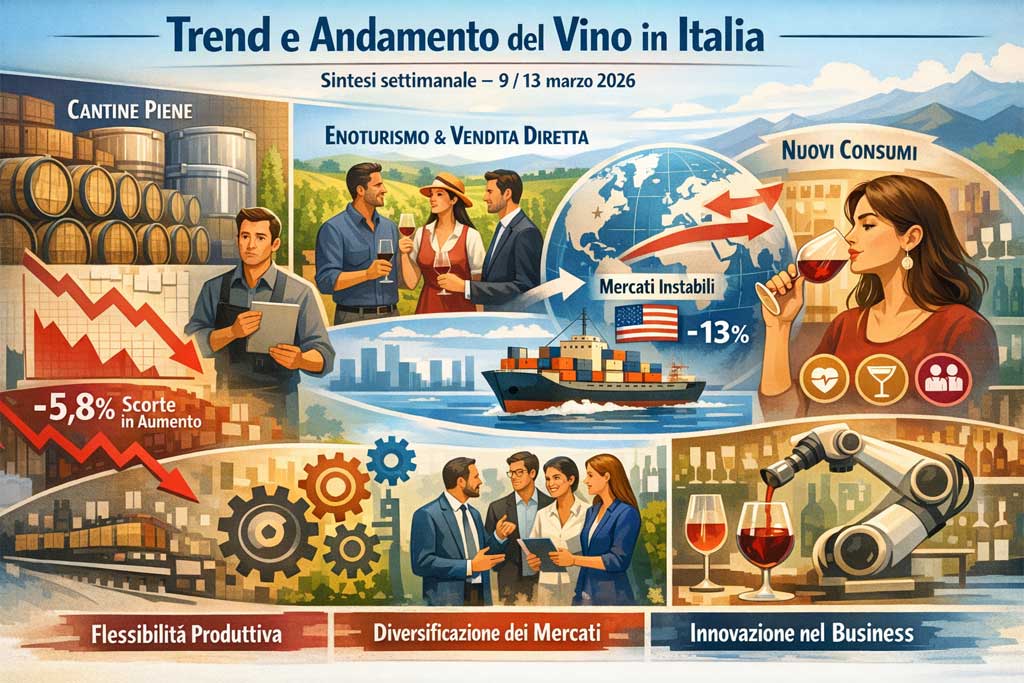


The Italian winemaking system is experiencing a fragile equilibrium, characterized by still-full cellars, declining global consumption, and more unstable international markets.
The sector remains structurally solid, but is entering a new economic cycle in which production flexibility, market diversification, and business model innovation are becoming decisive factors.
Cellars full: the problem is not production but the speed of sales
According to the ICQRF’s Cantina Italia report, in February 2026, Italian cellars held approximately 58.6 million hectoliters of wine , in addition to 6 million hectoliters of must . Compared to 2025, stocks increased by 5.8% , confirming a trend that had already emerged in previous months.
This level of inventory is not due to a particularly abundant harvest: 2025 production stopped at around 44.3 million hectoliters , in line with the previous year. The real critical factor is therefore the slowdown in the rate at which wine is absorbed by the market .
The trend reflects a broader phenomenon: world consumption fell from 276 million hectoliters in 2019 to around 227 million in 2024 , signaling a structural shift in global demand.
Slower consumption and new consumer behaviors
In mature markets—Europe and North America—wine consumption is changing. Among the main factors are:
- greater attention to moderation and health
- growing competition from other beverages
- new social models of consumption
- generational changes in habits
In the Horeca channel, data from the CDA consortium show a stable but changing market: in 2025, out-of-home beverage sales grew slightly in value (0.66%) , but fell in volume (-0.92%) .
The consumer mix is shifting toward categories perceived as lighter or more experiential. The following are growing:
- aperitifs and vermouth (9.39% value)
- energy drink (9.17%)
- short-term consumption formulas such as aperitifs and lunch breaks.
Traditional evening consumption, on the other hand, tends to lose its centrality.
Exports: the slowdown in the United States weighs on the sector
International trade in Italian wine remains strong but shows signs of slowing.
In 2025, Italian exports closed at 7.7 billion euros , with a decrease of -3.7% compared to 2024 and approximately 300 million euros less .
The main cause is the decline in the US market, the primary commercial outlet for Italian wine. In the United States:
- overall wine imports decreased by approximately -12% in value
- Italian exports lost approximately -13.2% , falling to 1.8 billion euros .
Several simultaneous factors were at play:
- tariffs introduced by the Trump administration
- devaluation of the dollar
- reduction of internal consumption
- process of clearing out stocks accumulated after the pandemic.
To keep prices competitive, many producers have absorbed part of the duties by reducing margins.
New markets and export geographies
The contraction of the United States is pushing Italian wine to seek new trade routes.
In 2025, the markets with the most dynamic signals are:
- Brazil , the only major market growing in both volume and value
- South Korea , with increasing wine imports
- Eastern European countries such as Poland and the Czech Republic
- emerging markets in Southeast Asia such as Vietnam and Thailand .
Despite these opportunities, many major global markets – China, Japan, the United Kingdom and Switzerland – still saw slowdowns in purchasing.
Strategies for managing surpluses
The issue of inventories brings the question of managing production potential back to the fore.
There are various tools available to the sector:
- product storage pending better conditions
- downgrading of wines from denomination to lower categories
- distillation as an emergency tool
- uprooting of vineyards to reduce production capacity.
Many consortia, however, underline that the drop in consumption is no longer a temporary phenomenon but a structural trend .
Wine tourism and direct sales: levers of value
In this context, models that bring the producer closer to the consumer become increasingly relevant.
Wine tourism represents one of the most important levers: according to Roberta Garibaldi’s report, for some Italian wineries the tourist experience can generate up to 60% of profits , while for approximately half of the companies it contributes up to 30%.
At the same time, interest in direct online sales (D2C) is growing. In the European market, this method can guarantee margins of up to 70% , compared to the 25–30% of traditional shelf sales.
A sector that needs to become more flexible
The debate currently raging in the wine world converges on one point: the production system must become more flexible.
In a global market characterized by geopolitical volatility, consumption fluctuations and cultural changes, the Italian wine sector will have to:
- adapt production to demand more quickly
- diversify markets and sales channels
- develop integrated models between wine, tourism and experience
- improve communication towards new consumers.