

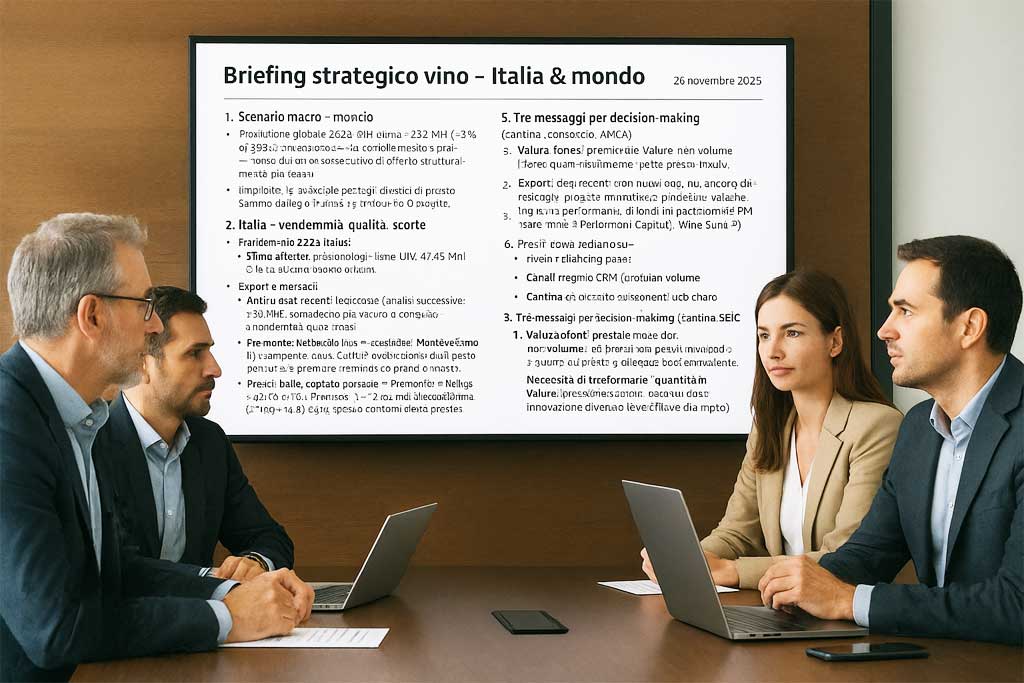



Here is a dry, “boardroom-style” briefing updated to November 26, 2025.
1. Macro scenario – world
- Global production 2025 : OIV estimates ~232 Mhl (3% vs 2024) but still ≈-7% below the 5-year average → third consecutive year of structurally lower supply.
- Implicit: The scope for drastic price cuts on Italian wine is limited; competition is shifting to mix, brand, and channel , not to “selling off volumes.”
2. Italy – harvest, quality, supplies
- 2025 Harvest Italy
- Official estimate by Assoenologi–Ismea–UIV: 47.4 Mhl (8% vs 2024), good-excellent quality.
- Alternative Legacoop estimate / subsequent analyses: ~44 Mhl , considered closer to the final figure with the harvest almost over.
- Stocks : the latest supply chain readings indicate that, adding pre-harvest stock and the new harvest, the system moves in the order of almost two equivalent vintages in the cellar → the problem is not “making wine”, but how to dispose of it with a margin .
3. Export & markets
- Italy in 2025
- 1st half: 2.1% volume and 1.5% value (L703.5 million; ~€2.8 billion) → still a positive signal.
- First 7 months: -0.9% value / -3.4% volume for the 12 main destinations; July-September US trade drops sharply (up to -30% value with a 15% tariff).
- Reading: Italian exports are split in two
- resilient in premium/well-served markets,
- in difficulty in the USA and part of the non-EU → geographical reallocation and pricing architecture revision needed.
4. Prices, bulk, operational harvest
- Global bulk : H1-2025 volumes -2.3% vs H1-2024, substantially flat values; average price ~0.78 €/L (2.1%) .
- Bulk Italy : same order of magnitude ( ~0.78 €/L ), but with a market defined by brokers as “weak trading, cautious demand”.
- Grape prices – partial photograph
- Piedmont: Nebbiolo from Barolo €2.4–€2.7/kg , Barbaresco €1.7–€2.2/kg , Moscato €1.15–€1.21/kg , Barbera d’Alba €0.9–€1.2/kg .
- North East: declines 2025 vs 2023 for Amarone (≈-13%), Valpolicella (≈-8%), Prosecco Conegliano-Valdobbiadene (≈-9%); Franciacorta (5%) and Lugana (7%) buck the trend.
- Central-Southern Italy (Umbria and surroundings): Sangiovese €26–30/q , Merlot/Cabernet €28–30/q , Sagrantino DOCG €100–140/q , often with strong corrections compared to the 2023 peaks.
Operational translation: pressure on generics and some “over-produced” DOCs , holding or growing in segments with a clear premium positioning.
5. M&A, capital and tech
- Tenuta Ulisse (White Bridge) acquires Montevetrano in Campania (after Cirelli): building a premium central-southern hub focused on brand and terroir.
- Other recent deals (not new today, but still directional): real estate-winemaking projects in Langhe-Roero (Tellus), Fantini expansion in Spain, performing entry of funds into wine CRM platforms (Wine Suite Performant Capital).
- Trend line : capital is betting on
- brands with pricing power ,
- premium land assets ,
- channels (digital/export) and tech platforms, rather than on mere hectolitres.
6. Three messages for decision-making (winery, consortium, M&A)
- Ratings: Reward value, not volume
- In due diligence, multipliers should be linked to brands, premium mix, healthy exports, and digitalization ; stocks represent working capital risk , not automatic capital gains.
- Export: derisking the US and redesigning the market portfolio
- With the US volatile and pricey, 2026 should be planned by shifting part of the allocations towards Northern Europe, Canada, APAC and LatAm , with dynamic price lists and targeted use of re-export hubs.
- Cellar 4.0 as a multiple driver
- The 2025 studies on the technological transformation of wine confirm that AI, sensors, CRM/wine tourism are becoming indicators in the evaluations of industrial and financial investors.
- Translated: a credible investment in data and automation today moves the multiple range by more than a few additional hectares.
This is the “working” picture as of November 26: little certainty about sales volumes, many indications about where the value is moving.