

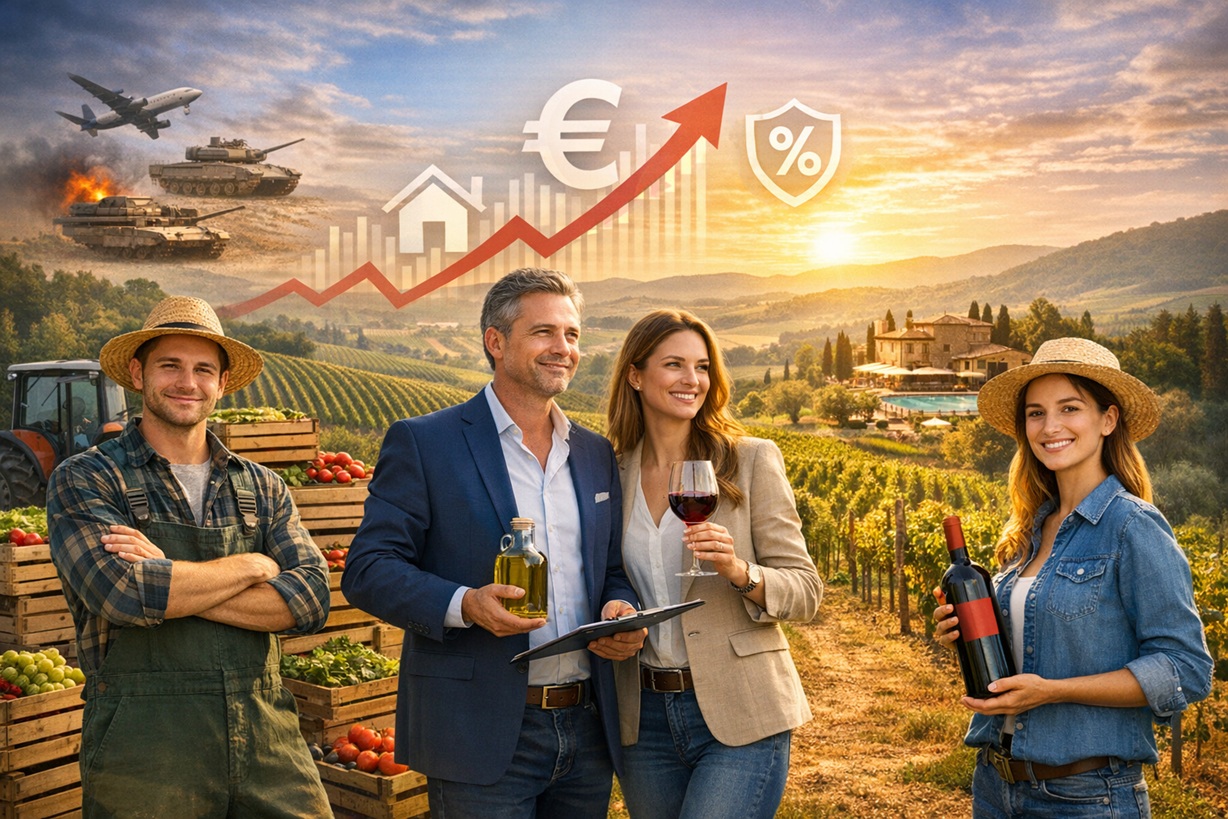

The world is going through a period of great instability.
Wars, geopolitical tensions, persistent inflation, and increasingly volatile and unpredictable financial markets are changing investors’ perception of risk.
In this context, much capital is returning to what in economic history has always been considered a real and tangible safe haven : land.
This is not rural nostalgia.
It’s about strategy.
An agricultural or winery estate is an asset that produces real value: food, wine, oil, hospitality, territory, cultural identity.
In other words, it generates income, wealth and security at the same time.
And in Italy this is even more true.
Land: the oldest safe haven in history
In modern economic language we talk about real assets .
They are physical goods that maintain value over time because they are linked to primary needs.
Agricultural land belongs to this category.
Three elements explain it very well.
1. It is a finite resource
Agricultural land isn’t growing. In fact, it has shrunk in recent decades due to urbanization. This structural factor supports its value over the long term.
2. Produces essential goods
Food, wine, water, oil, grains. Even in the deepest crises, these goods continue to be in demand.
3. Protects against inflation
Historically, farmland and food prices tend to rise over time, following or exceeding inflation.
For this reason, many institutional investors, funds and family offices are increasing their exposure to the agribusiness sector .
Italy: one of the most attractive agricultural markets in the world
Investing in land makes sense everywhere.
Investing in Italian land often makes even more sense.
The reason is simple: Italy possesses a unique combination of factors.
Territories with a very high international reputation
Chianti
Langhe
Eastern Hills of Friuli
Valdobbiadene – Prosecco DOCG
Montalcino
Bolgheri
These are territories that don’t just sell wine. They sell history, landscape, and culture .
The value of the Made in Italy brand
Italian wine is one of the global symbols of Made in Italy.
Each bottle embodies territory, tradition and premium positioning.
This allows companies to work on higher margins than many other agricultural productions.
Tourism and lifestyle
The hills of Chianti or Tuscany are not just places of production.
They are world-class tourist destinations.
Here an agricultural estate can become:
- winery
- farmhouse
- wine resort
- event location
- luxury hospitality
In other words, land produces income on multiple levels .
An investment that generates value from multiple sources
A modern farm is no longer just about agriculture.
It is an integrated economic system.
Sources of income can be different.
Agricultural production
- wine
- oil
- fruit and vegetables
- organic farming
- DOP and IGP products
Transformation and branding
The value increases when the product is transformed and sold under its own brand.
A bottle of wine tells the story of its territory, its history, and its identity.
And that creates margin.
Rural tourism
Food and wine tourism is one of the most dynamic segments of global tourism.
An estate can become:
- farmhouse
- wine resort
- country relais
- structure for tastings and events
Direct sales
More and more farms are selling directly to consumers, reducing middlemen and increasing margins.
Wine estates: high-value agricultural assets
Among all agricultural investments, one of the most interesting remains that in wine-making companies .
Wine is an agricultural product but also a cultural, identity-building, and commercial asset.
A well-located winery can generate value through:
- production
- brand
- international distribution
- wine tourism
- valorization of the territory
Areas such as:
- Prosecco DOC and DOCG
- Eastern Hills of Friuli
- Chianti Classico
- Langhe
They are considered territorial platforms of great interest to Italian and foreign investors.
Public contributions: an accelerator for development
Another element that is often underestimated is the presence of very significant public incentives .
The European Union and the Italian state strongly support agriculture.
Among the most important instruments we find the Rural Development Programmes (RDP) .
A significant example is the SRD01 call – Agricultural productive investments for competitiveness , which can offer:
- grants up to 60% non-repayable
- financeable investments between €80,000 and €800,000
In addition to this, there are other tools.
For example:
- INAIL contributions of up to 80% to improve machinery safety
- incentives for organic farming
- funds for technological innovation and sustainability
In practice, a significant part of the investments can be covered by public funds .
Heritage and sustainability: an increasingly strong combination
Agricultural land does not just represent an economic investment.
It is also an investment in environmental sustainability .
Modern farms can contribute to:
- landscape protection
- emissions reduction
- organic farming
- sustainable water management
- CO₂ absorption
More and more agricultural projects integrate:
- precision agriculture
- digital technologies
- environmental sensors
- intelligent resource management
This makes the agricultural sector one of the pillars of the European ecological transition .
The risks you should be aware of
Naturally, agricultural investment also presents some critical issues.
Among the main ones:
Illiquidity
Agricultural transactions take time. It’s not an immediately liquidable investment.
Climate variability
Climate change and weather conditions can affect production.
Bureaucracy
The agricultural regulatory system can be complex and requires specific expertise.
Management costs and taxes
Maintenance, personnel, machinery, and taxes (such as IMU on some properties) must be carefully evaluated.
For this reason, it is essential to always conduct thorough due diligence before purchasing.
Investing methodically: the key to success
An agricultural investment must not be improvised.
Precise analyses are needed on:
- soil quality
- vineyard planting rights
- access to water
- infrastructure
- tourist potential
- outlet markets
- available tenders and incentives
More and more farms are also using advanced technologies to increase productivity and efficiency.
Precision agriculture, sensors, digital vineyard management, and environmental monitoring systems are transforming the sector.
Land as a long-term strategy
In times of global instability, investors always return to what is real.
The earth is real.
It produces food.
It produces wine.
It produces value.
An Italian agricultural or winery estate can simultaneously represent:
- a capital investment
- an entrepreneurial platform
- a life project
- a defense against economic uncertainty
And perhaps the simplest truth is also the most powerful.
When the world gets complicated, the earth continues to do what it has always done :
to grow what humanity needs to live.
And this, for millennia, has been one of the smartest investments there is.