All posts by admin

Wine press review for Monday January 12 -2026

Wine news and Italian wine cellars.

ITALIAN WINERIES

Prosecco DOC Consortium: 667 million bottles sold by 2025. The Denomination confirms its global leadership with 667 million bottles sold (1.1%), a total value of €3.6 billion, and over 82% of this destined for export. This is a testament to resilience in an unstable global environment, based on the unity of the supply chain.

Settecani Winery in Castelvetro: 2025 revenues up 8.7%. The Modena-based cooperative closed 2025 with a turnover of €6.75 million. Deliveries, bottling, and the domestic market are growing, with grape yields stable at above €50/q.

Ascierto Winery in Sant’Agata dei Goti: third harvest. The winemaking project spearheaded by Professor Paolo Ascierto consolidates its identity between Solopaca and Sant’Agata dei Goti. The 2022 Falanghina marks the start of production.

Cerasuolo d’Abruzzo: value for money according to the Zappacosta family. A story of returning to the land and family continuity: the 2024 Cerasuolo d’Abruzzo has been recognized as the Best Regional Value for Money.

Cantina Moser and Trento DOC From the Cembra Valley, one of the most emblematic stories of the Trentino classic method, combining rural tradition, entrepreneurial vision, and territorial identity.

Vineyards and wines in Cembra: the Gottardi family An example of generational renewal in mountain viticulture, with a focus on Müller Thurgau, sparkling wine bases, and Trento DOC.

Quality Primitivo under €10 near Foggia. The qualitative growth of Apulian wine also comes from accessible labels, with more balanced, fresh, and territorial styles.

ITALIAN WINE AND ITALIAN OENOLOGY

Alcohol-free wine: the new decree changes the rules. The decree of December 29, 2025, introduces clear rules regarding production, excise duties, inspections, and authorizations for dealcoholized and low-alcohol wines. This regulatory breakthrough opens up a new market segment.

Getting Drunk on Words: The Cultural Debate on Alcohol-Free Wine A critical analysis of the linguistic, political, and identity implications of the new legislation on alcohol-free wine and the very concept of “wine.”

The Bastards of the Monks and Red Pecorino: A historical and cultural exploration that restores dignity to a winemaking tradition often simplified as a “rediscovery,” a blend of monastic heritage and territorial identity.

Vivai di Rauscedo presents Piwi Prosecco. Five new Glera varieties resistant to fungal diseases and climate change. See you on January 29, 2026, for technicians and producers.

Wine in Figures 2026 The statistical yearbook of the Italian Wine Union offers the most complete picture of production, areas, consumption, exports, prices and inventories, in Italy and around the world.

The Prospects of Italian Wine According to Derenoncourt: A strategic reflection on contemporary viticulture: soil, vineyard, and oenology interpreted as a single identity system.

Tasting: L’Autentica Basilicata Bianco IGT 2022 A passito made from Moscato and Malvasia, aged in barrique, which combines technique, elegance and territorial identity.

The Marche and its great red wines: A journey through Roman history, the Adriatic hills, and tastings, discovering a still underrated region.

INTERNATIONAL

Liv-Ex Power 100 2025 After two difficult years for collectors, a Bordeaux returns to first place. Italian brands also performed well, with Sassicaia coming in second and Gaja among the top performers.

BWW 2025: Petrus 2020 named best wine in the world . The Best Wine of the World competition crowns the renowned Pomerol. Among the Platinum winners is Masseto 2020, the only Italian wine to receive the award.

EU–Mercosur: New Opportunities for Italian Wine Exports The agreement opens up significant prospects in South America thanks to the progressive elimination of tariffs on still and sparkling wines.

WINE EVENTS

Vinacria 2025 in Syracuse The second edition of the event dedicated to Sicilian wine confirms its format: 89 exhibitors, contemporary language, and strong networking among producers.

AGRICULTURAL POLICIES AND REGULATIONS

CAP: €45 billion more for agriculture from 2028 The European Commission amends the multiannual budget, avoiding cuts and strengthening resources for the agricultural sector.

2026 Budget Law: Occasional Work in Agriculture. The rules for seasonal agricultural work of up to 45 days per worker per year have been stabilized.

ASSETS AND CONFIDENTIAL TRANSACTIONS – PROSECCO & NORTH EAST

Summary of selected opportunities:

  • Operating DOC and DOCG wineries (Valdobbiadene, Colli Asolani, Conegliano Valdobbiadene)
  • Wine estates with a wine tourism vocation
  • Storage and sparkling wine production plants
  • Integrated hospitality production projects. Confidential negotiations, ideal assets for industrial integration, family continuity, or service platforms.

Thanks for listening. Today’s wine press review was brought to you by WINEIDEA.IT .

See you tomorrow.

Wine press review for Sunday January 11 -2026

Wine news, Italian wineries and wines.

Italian wineries

Piedmont, a turning point in alcohol-free wine. From heresy to industrial opportunity: Piedmont is also opening up to alcohol-free wines, driven by foreign demand and now supported by a decree clarifying production and tax regulations. A key step: innovate without distorting the identity of Italian wine.

Regional funds for Alessandria winemakers: Over €1.5 million allocated to 108 companies for vineyard renovation. The goal is to increase the quality, profitability, and competitiveness of DOC and DOCG vineyards.

Planeta Chardonnay: 30 Years of Sicilian Revolution. An “anachronistic” wine by choice, it broke the mold in the 1990s and continues to spark discussion. The symbol of a Sicily unafraid to go against the grain.

Ascierto Winery in Sant’Agata dei Goti. This is the third harvest for oncologist Paolo Ascierto’s project: a return to the roots, combining family memories, historic vineyards, and a vision for the future.

Contemporary art and wine on Lake Garda. The Montresor brothers’ winery becomes a productive and cultural space. Wine and art as complementary languages of identity and entrepreneurial vision.

The historic wine shop that inspired Veronelli Da Vino Vino 1921 in Milan is the birthplace of one of the most iconic expressions of Italian wine culture. History, recycled materials, and a pioneering vision.

Italian wine and Italian oenology

Dry January and new consumption patterns: 71% of Europeans are cutting back on alcohol. The no-drinks market is growing (5.1%, €97 billion), especially among Gen Z and Millennials. Alcohol is becoming a choice, not a social obligation.

Sugar in PDO wines: the French decision. France is opening the door to chaptalization in PDO still wines to respond to a consumer crisis and new, softer flavors. This move places Italy at a strategic crossroads.

Regenerative agriculture and carbon credits. Carbon farming will grow in 2025, but credibility remains an issue. Direct agreements between multinationals and producers aim to strengthen the system.

Prosecco DOC, expected to grow again in 2025, with 667 million bottles sold (up 1.1%), valued at €3.6 billion, and exports accounting for 82%. The “locomotive” of Italian wine continues to drive the sector in a complex global context.

Inherited agricultural land: what to know Legal, tax, and management aspects of an asset that can become either an asset or a problem, depending on initial decisions.

International

EU-Mercosur Agreement: Divisions and Protests. First green light for the world’s largest free trade area. France and other countries oppose it. The wine sector is closely monitoring the risks and opportunities.

South Africa’s wine scene: freshness and tourism. New consumption styles, more agile wines, and a strong push for wine tourism. A country rethinking its global positioning.

Wine events, lifestyle and wine culture

Dry January in Naples: Not just dealcoholized wine, but also alternative fermentations, wine mocktails, and botanicals. Drinking evolves towards new sensory experiences.

Wine&Siena 2026: Countdown From January 31st to February 2nd, with “Wine Tasting” previews that anticipate the great Tuscan event.

Valentine’s Day in Sicily: a romantic getaway to a winery. Wine tourism experiences as an emotional gift: time, landscape, and wine become shared values.

Gintoneria Cellar Auction: Iconic bottles and great labels end up at auction: a case that intertwines news, collecting, and the fine wine market.

Special – Asolo, Conegliano Valdobbiadene, and Treviso Wineries

Strategic assets in the heart of Prosecco DOCG and DOC. Not announcements, but structured transactions: wineries, estates, and facilities ready for industrial integration, production growth, wine hospitality, or capital consolidation. From UNESCO-listed hills to complete sparkling wine production facilities, a select selection of highly strategic opportunities.

Thanks for listening. Today’s wine press review was brought to you by WINEIDEA.IT .

See you tomorrow.

Wine press review for Saturday January 10 -2026

Wine news, Italian wine cellars.

Italian wineries

Prosecco DOC: Growth Continues in 2025. Despite a challenging wine environment, Prosecco DOC closed 2025 on a high note: 667 million bottles (1.1% increase over 2024) for a value of €3.6 billion. Over 82% of production is exported to 164 countries, confirming its position as the world’s leading Italian sparkling wine.

Classese Effect in the Oltrepò Pavese: Pinot Noir becomes the leading varietal grown in the area, surpassing Croatina and Barbera. This signals a growing specialization toward sparkling bases and more structured positioning.

Terre d’Oltrepò: Towards a solution by January. The Lombardy Region is accelerating the future of Lombardy’s leading cooperative winery. At the center is the possible entry of Collis Veneto Wine Group. Institutions are aiming to ensure operational continuity ahead of the next harvest.

Collis nears acquisition of Terre d’Oltrepò. Discussions within the Region strengthen the possibility of a shared industrial solution. Final decisions are expected by the end of the month.

Cantina Alois (Pontelatone) Family history and rediscovery of the Alto Casertano grape varieties: micro-vinifications and the valorization of native varieties as a dual track with respect to the historic textile activity.

Tenuta di Trinoro, wild Tuscany. Andrea Franchetti’s vision has transformed a remote area into a winemaking icon. A project that demonstrates how vision and territory can create value even outside the “easy” areas.

Cantine Ascheri, Bra Cantina, boutique hotel, and spa: a model of integrated hospitality where wine is language, experience, and connection.

Cantina Bambinuto (Santa Paolina) Greco di Tufo Riserva on the lees and new interpretations moved: a small company that has chosen direct vinification to preserve its value and identity.

Contemporary art and wine on Lake Garda. A winery that combines production, hospitality, and art collecting, confirming the cultural role of the winery.

Italian wine and Italian oenology

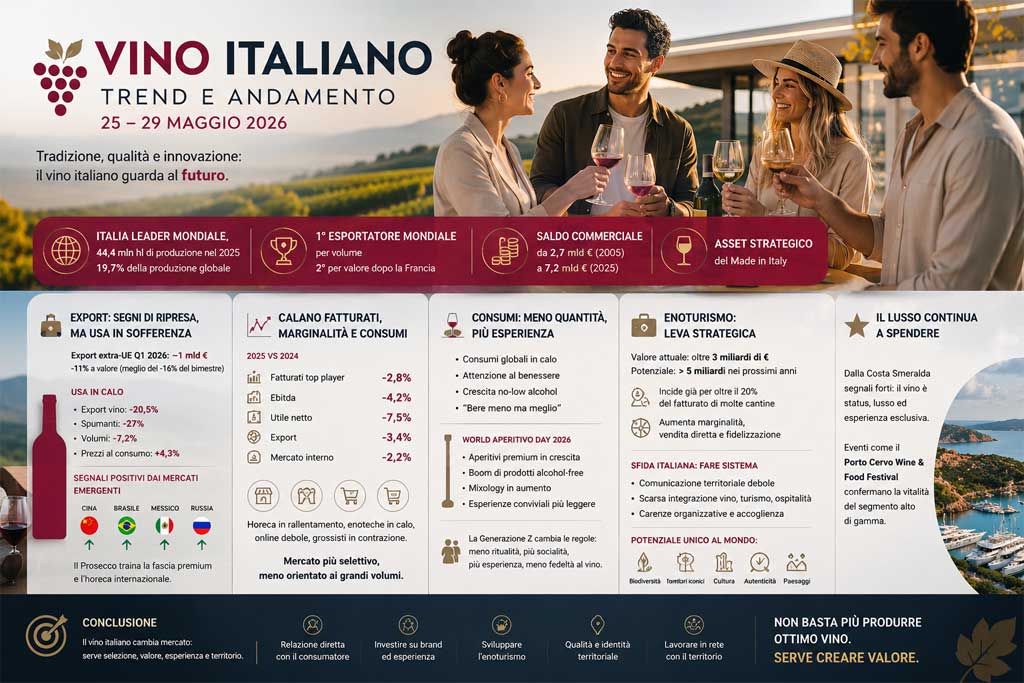
Italian wine 2026: lower volumes, higher value. The sector is entering a phase of competitive maturity: defending margins, developing the right channels, and establishing a credible identity. The importance of Horeca and wine tourism as platforms for building relationships and loyalty is growing.

Mastroberardino: the future of great reds lies in Taurasi. The 2018 Stilèma Taurasi, awarded by Wine Enthusiast, becomes a symbol of how great Italian reds can interact with international markets without losing their character.

Wine as a Foundation of European Culture A debate on culture, identity, and wine: Europe as a civilization also founded on wine, along with bread and oil, central elements of its history.

The Wine of the Key and the Mouse. An unconventional wine story: tasting as a narrative and sensorial experience, far removed from labels and immediate certainties.

International

Liv-ex Power 100 2025: Return to Stability The fine wine market is showing signs of stability after a difficult 2024. More stable prices, greater liquidity, and interest in reliable labels.

EU-Mercosur Agreement: Opportunities for Italian Wine. UIV welcomes the agreement: possible progressive reduction of tariffs in South America and expansion of trade outlets, especially in Brazil.

European stock markets: alcohol stocks rally. In a tense geopolitical environment, spirits and defense stocks support the markets. In Milan, the beverage sector stands out.

Wine events, market and controls

Alcohol-Free: Italy Enters the Global Market. Confindustria Veneto Est emphasizes the strategic value of the alcohol-free decree: new markets, new consumption styles, especially outside Europe.

No/low-alcohol drinks: consumption is changing. According to Circana, 71% of European consumers are drinking less alcohol. Non-alcoholic drinks are growing (5.1%), while alcoholic drinks are declining.

Wine Proposal: 2026 Forecast: Moderate growth for wine and spirits, with a focus on sustainability and repositioning. Vermouth emerges as one of the most interesting bets.

Value of agricultural land in the Verona area Valpolicella remains the most “precious” area: up to €500,000/ha for vineyards in the top areas, unique in terms of size and value in Italy.

NAS checks: bottles of Gutturnio DOC seized. Increased activity along the agri-food supply chain to ensure safety, traceability, and correct labeling.

Gintoneria Investigation: Auction of Seized Bottles. The judicial auction of high-quality champagne has begun following plea bargains in the trial.

Mourning in the wine world – Farewell to Carlo Speri, a key figure in modern Valpolicella. – Umbria’s wine region mourns Arnaldo Caprai, the entrepreneur who made Montefalco an international name.

Thanks for listening. Today’s wine press review was brought to you by WINEIDEA.IT . See you tomorrow.

Wine Trends & Performance in Italy — Week 5–9 January 2026

The week of January 5–9, 2026, captures an Italian wine sector undergoing structural transformation: on the one hand, the push for sparkling wines and “lighter” consumption; on the other, the growing weight of inventory and the need to rethink positioning, channels, and consumer relationship models.

Wine doesn’t “disappear”: it changes language, rhythm, and places where it’s purchased.

1) Bubbles: long-term growth, but with two caveats (price and competition)

The reported forecasts indicate a robust expansion of the sparkling wine sector over the next decade: global sparkling wine market reaching $59 billion by 2035 (from $46 billion in 2025), with a CAGR of ~2.5% . Growth is driven mainly by:

  • premiumization (accessible medium-high ranges),
  • increase in convivial/celebratory moments ,
  • expansion of range and presence in retail and hospitality channels,
  • increasing production capacity to meet the demand for “quality experience”.

Category drivers: According to the reported approach, the greatest boost will come from Prosecco and, more generally, Charmat/Martinotti method sparkling wines (value share around 39% ), favored by a perceived “easy” positioning and a competitive quality-price ratio. In terms of taste, Brut/Extra Brut prevail (around 54% ) and the off-trade channel (supermarkets/retail) dominates ( ~74% ).

Most dynamic markets: USA, Mexico, Germany, France, as well as South Korea, the United Kingdom and Japan.

Strategic note for Italy: While remaining very strong (expected share of ~18.9% in 2025 ), Italy’s market share could decline slightly by 2035 ( ~18.6% ), a sign of growing competition and the possible impact of regulatory constraints . In other words: demand is growing, but leadership isn’t “free.”

The (important) counterpoint: in the view of professionals (e.g. Perazzo), a risk of speculation/over-priced bubbles also emerges: if the perceived price “runs away”, the category could lose the daily and convivial function that makes it successful today.

2) Full cellars: Italy holds firm, but with the handbrake on (stocks on the rise)

The most significant figure of the week is the increase in inventories: as of November 30, 2025, there were 53.4 million hectoliters of wine in stock ( 8.6% year-on-year), in addition to 9.5 million hectoliters of wine in fermentation and 9.7 million hectoliters of must. This picture is consistent with three very different harvests (a poor 2023, a more generous 2024, and a plentiful 2025) and a market that is absorbing more slowly (health concerns, economic difficulties, tensions, and tariffs).

Top denominations by stock (main trend):

  • Prosecco DOC : 5.03 million hl ( 2.8% ) and approximately 11.6% of the total Dop/Igp in the cellar.
  • Among the most marked increases in the large ones: Igp Terre Siciliane ( 31.3% ), Doc Delle Venezie ( 20.5% ), Igp Toscana ( 18.1% ), Igp Veneto ( 13.5% ).
  • Notable exception: IGP Puglia in slight decline ( -0.7% ).

Even the “jewel appellations” are increasing their stocks , with significant increases (e.g., Franciacorta, Chianti Classico, Barolo, Brunello, Soave, Etna, Bolgheri). A striking example is Rosso di Montalcino (62.8% ), also explained by increased production potential.

Operational interpretation: Higher inventories don’t automatically mean a crisis, but they do mean tied up capital , storage costs, the risk of price compression, and the need to accelerate turnover . The key point that emerged: “we’re drinking less” (or at least differently), and staying put is equivalent to losing margins and a future.

3) How we will drink in 2026: less ritual, more function (and more territory)

From the analyses and interviews cited, a clear cultural change emerges:

  • Native varieties as a certainty : no longer a curiosity, but a “new normal” (even varieties considered minor become central again).
  • Dry and drinkable : for everyday consumption/aperitifs/meals, we look for drier, fresher, more dynamic wines, with desserts relegated to a few occasions.
  • Young adults: less is better : attention to proportion, more educational curiosity (courses, experiences), more sensitivity to the issue of sustainability.
  • Whites and rosés on the rise , structured reds still present but with a more modern interpretation (greater enjoyability).
  • Lifestyle bubbles : increasingly becoming more everyday and gastronomic; among the names capturing this trend, in addition to Prosecco, dry Lambrusco is cited as a versatile, distinctive, and accessible wine.

4) No/Low alcohol: in Italy it is still small, but the trajectory is clear

The “No and Low” segment in Italy is estimated to account for around 1.8% of consumption , while in the US it reaches around 7% : the gap signals potential growth . The week also saw a significant institutional shift: green light was given to the decree for the Italian production of dealcoholized wines , with the global Nolo market expected to reach $3.3 billion in 2028 (from $2.4 billion), with annual growth of ~8% in value .

Concrete implication: for many companies, this isn’t a “betrayal” of wine; it’s a product line that responds to new habits and can help reconnect with consumers who would otherwise shy away from the category.

5) Channels: e-commerce stable, but DTC and subscriptions (Wine Club) accelerate

On digital, the picture is less “boom” and more mature:

  • Alcohol e-commerce will remain at around 3.5% of total value in 2024 and is expected to reach 3.8% in 2029; after the Covid surge, there was a correction and now stabilization with a return to modest growth (estimated at 3% in value 2024–2029 ).
  • Spending remains cautious: many consumers are prioritizing essential goods.

The real sign of commercial innovation, however, is the explosion of Wine Clubs :

  • market estimated at $12.4 billion in 2025 and expected growth CAGR ~9.7% up to $31.4 billion in 2035 .
  • the “magic” lies in customization (algorithms/AI), convenience and storytelling, with a strong push from Direct-to-Consumer .
  • Interesting paradox: in wine clubs, red is still the most popular type (value share ~43.7% ), a sign that red is not dying: it is changing context and sales/relationship methods.

6) Distribution and price: proximity still matters (and discount is now “normal”)

The Altroconsumo ranking cited highlights an Italian retail market where trust and proximity remain decisive:

  • Online grocery shopping is still a minority (only a small percentage uses it on a weekly basis),
  • the weight of discount stores is growing, perceived less and less as a “stopgap” and more and more as a stable quality-price channel,
  • Local establishments often get the highest ratings for relationship, familiarity and service.

For wine, this means: shelf space and promotions matter, but the winner is the one who manages rotation, product visibility, and positioning without sacrificing identity.

7) Beverage M&A 2026: Less fireworks, more quality consolidation

2025 is described as a year of slowdown in M&A transactions (more caution, longer closing times), but with “solid” overall values. A moderate return of dynamism is expected for 2026, especially in the mid-market , with a focus on:

  • premium and brands with international potential,
  • ready-to-drink , functional drinks, no/low ,
  • cross-border operations and the renewed role of private equity .

In Italian wine, operations remain more “local” and supply chain-based; in spirits, the movement is more lively (portfolio rationalizations and the valorization of historic brands). The water segment is also interesting: the market anticipates potential shocks from large-scale corporate transactions.

8) Wine tourism: it’s not a side dish, it’s a line on the income statement

The Global Wine Tourism Report 2025 reveals a key finding: wine tourism accounts for an average of 25% of wineries’ revenues (and more in many non-European regions). The majority of wineries offer experiences (tastings, tours, vineyard visits), and many plan future investments. Demand for authenticity, sustainability, gastronomy, and storytelling is growing.

Message for the Italian market: if stocks increase and consumption changes, wine tourism is not “marketing”: it is diversification and conversion (direct sales, clubs, contacts, loyalty).

9) European context: France in difficulty confirms that the change is systemic

The French crisis (long-term decline in AOP sales in large-scale retail trade) is seen as a sign that the problem is not “just Italian”: in mature markets, denomination wines suffer if they cannot find new forms of perceived value, channels, and consistent pricing.