All posts by admin

Wine press review for Monday December 1 – 2025!

News on Italian wine and oenology.

Italian wineries

  • Borgo del Tiglio, a landmark winery hit by landslide and flood (Friuli). In Brazzano, on Mount Quarin, a landslide and flood devastated the historic Borgo del Tiglio winery: 17th-century buildings damaged, historic vineyards compromised, an archive of 10,000 bottles destroyed, and 60,000 bottles from the 2025 vintage trapped underground. The economic damage amounts to several million euros, and recovery times are long, due to the red zone and safety restrictions.
  • Oniwines (Oniverse) focuses on Trentodoc “mountain bubbles.” Federico Veronesi (Oniwines, Oniverse group – Calzedonia, Falconeri, Signorvino) describes a counter-current growth strategy in a shrinking market: six wineries in Lazio, Sardinia, Marche, Piedmont, and Veneto, and now the “Ert1050” project in Trentodoc, focusing on territorial identity and wine tourism.
  • “Cathedral” Trentodoc Altemasi: Cavit invests €26 million in Ravina. In response to the consumer crisis and competitive pressure, Cavit is investing €26 million in a new winery dedicated to Trentodoc Altemasi . This is a strong signal of the strategic role of mountain sparkling wines in the group’s future growth.
  • Rome Wine Award 2025: Lazio takes center stage with Famiglia Cotarella and Cantina Stefanoni. In the Hall of the Temple of Vibia Sabina and Adriano in Rome, the Rome Wine Award 2025 ceremony showcases Lazio’s finest wines. Recognition goes to the Viterbo-based wineries Famiglia Cotarella and Cantina Stefanoni , with the aim of supporting quality, exports, and new entrepreneurship (both young and female).
  • The Langhe is firmly established among the world’s elite of “fine wines.” In the 2025 international rankings of top wines and Europe’s best producers, the Langhe has firmly established itself among the world’s elite: among the names cited, Angelo Gaja (Barbaresco) and Giacomo Conterno appear alongside giants such as Egon Müller, Vega Sicilia, Krug, and Château Latour. Italy’s high-end winemaking is consolidating its global status.
  • Trevéz, three young people revitalizing old vineyards in Bologna. The Trevéz project was born from the meeting of three young winemakers and agronomists trained in Italy, Germany, New Zealand, Australia, and California. Their strategic choice: to lease very old, often abandoned, vineyards and enhance them with careful management. An example of a new urban entrepreneurship that reinterprets the land with technical expertise.

Italian wine and Italian oenology

  • Sondrio: €45 million for heroic agriculture and tourism. The Lombardy Region has approved the 2025 Territorial Development Framework Agreement for the province of Sondrio: over €45 million earmarked for projects that combine heroic agriculture, public water management, and tourism development in an entirely mountainous area. Key resources also for terraced vineyards.
  • “Lives of Langa and Roero”: Petrini and Tibaldi recount a peasant civilization. The book “Lives of Langa and Roero – Social Transformations of a Peasant Civilization” by Carlo Petrini and Paolo Tibaldi is being presented at the University of Gastronomic Sciences in Pollenzo. A journey that unites history, culture, wine, and collective identity, including Savoy courts, farms, the dignity of labor, climate change, sustainable tourism, and the future of local communities.
  • Budget and wine: between micro-regulations and the Wine Museum proposal. The package of amendments to the budget includes “micro-regulations” that also affect the sector: from strengthening the structure against blue crabs to the Wine Museum , including protection of the buffalo milk supply chain. These are signs of attention, but also regulatory fragmentation.
  • Primitivo “di Manduria” from a nonexistent winery: the K-Tipp case. An investigation by the Swiss monthly K-Tipp exposes the Primitivo di Manduria 1488 DOP “Fratelli Leporetti,” sold in Landi supermarkets: the producer in Puglia doesn’t exist. The label, designed to evoke authenticity and territory, is actually a fictitious one. The central theme: protecting denominations, transparency for consumers, and protecting the image of Italian wine abroad.
  • The Return of Autumn Wine: New Wine, Mulled Wine, and Rural Memories. Between San Martino and Christmas, the season of new wine , mulled wine , and cellar traditions returns: innkeepers and families once roamed Cellatica, Botticino, Garda, and Franciacorta to select the wine to keep at home year-round. A tale that intertwines rural memory, local tradition, and modern consumption.
  • Restaurants overwhelmed by storms: hospitality and resilience. From Tuscan restaurants like Osteria delle Terme in Massacciuccoli to chef Antonia Klugmann’s appeal in Friuli Venezia Giulia, the restaurant industry reports extensive damage but also impressive gestures of solidarity. Customers and communities shovel mud alongside restaurateurs: wine is once again a symbol of sociality, even in climate emergencies.
  • 2025 Harvest: Piedmontese Wine Cooperation Between Quality and Low Yields. The cooperative wineries belonging to Confcooperative Piemonte describe a high-quality 2025 vintage, but with low yields and a complex market. The cooperative model emerges as a tool for resilience: sharing expertise, supporting members, and the ability to transform challenges into opportunities for growth.
  • Varvaglione (UIV): More resources for promotion, exports must be protected. Marzia Varvaglione, vice president of the Italian Wine Union , welcomes the inclusion of €100 million per year for the three-year period 2026–2028 for promotion and internationalization activities. With tariffs, the falling dollar, and declining purchasing power, a significant portion of these resources is considered vital to protecting Italian wine exports.
  • Marsala nominated for UNESCO World Heritage status along with the wines of the “Sun Belt.” Marsala , a historic Sicilian wine, is nominated for UNESCO World Heritage status along with Jerez, Madeira, Porto, and Samos. The goal is to protect the landscapes, production practices, and traditions associated with the great fortified wines of the Mediterranean and Atlantic, strengthening the cultural and tourism positioning of these regions.

International

  • Global sparkling wine exports reach €8.5 billion, with Prosecco the global driving force. According to a Del Ray Analysts of Wine Markets analysis, global sparkling wine exports are worth €8.51 billion as of July 2025 (up 0.4% in volume, down 0.6% in value). The average price is €7.83/liter , the highest among all wine types, although slightly declining. Italy, France, and Spain account for 85% of the value and 75% of the volume; Prosecco is the sparkling wine that has grown the most in recent years, confirming its status as an international phenomenon.
  • The decline of the “American wine empire” (Napa and Sonoma) California viticulture is experiencing its most serious crisis since Prohibition: tariffs, excess inventory, changing consumer habits, and a recent, very generous harvest have saturated warehouses. Some Napa and Sonoma winemakers are even forced to uproot vineyards, raising profound questions about the business model of high-end American wine.
  • Swiss wine at 2.19 francs: the race to the bottom is crushing producers. At the meeting of the Swiss Farmers’ Union, the scandal erupted over bottles of Dôle and Chasselas selling for less than 3 francs (as low as 2.19). With such low margins, someone in the supply chain is footing the bill, and it’s not large-scale retail trade: producers are denouncing an unsustainable model, squeezed between rising costs and price pressure.

Wine events, culture and tourism

  • Alba: Presentation of “Vite di Langa e Roero” (December 10) At the Teatro Sociale G. Busca in Alba , on December 10th at 8:45 pm, Carlo Petrini and Paolo Tibaldi will present their book “Vite di Langa e Roero.” Free admission, an evening dedicated to rural memory and the relationship between history, wine, and community, in a region that is a symbol of Italian winemaking.
  • Orte in Cantina: a food and wine trail through the historic village. “Orte in Cantina” takes place between the last Sunday in November and the first in December: an itinerary featuring wine tastings, traditional products, and tours of the historic center. The event blends sensory experience and cultural discovery, transforming the village into a small, scattered wine city.
  • Christmas in the Cellar 2025 – Tuglie (Salento) In Tuglie , in the heart of the Ionian Salento area of Gallipoli, “Christmas in the Cellar 2025” kicks off at the Peparussu Winery – House of Traditions: music, food, crafts, solidarity, and popular memories until January 6th. On December 1st, the book “Da quando t’ho trovato” by Don Cosimo Schena will be presented, with a public discussion and free admission.
  • AIS Piemonte: 60 Years of the Italian Sommelier Association with Conferences and Tastings. To celebrate the 60th anniversary of the AIS, the Piedmontese group is organizing four days of events—until December 1st—including conferences, tastings, and training sessions. The key message: sommeliers are not a “caste,” but a cultural bridge between wine, the region, and the consumer.

Thanks for listening. Today’s wine press review was brought to you by WINEIDEA.IT .

See you tomorrow.
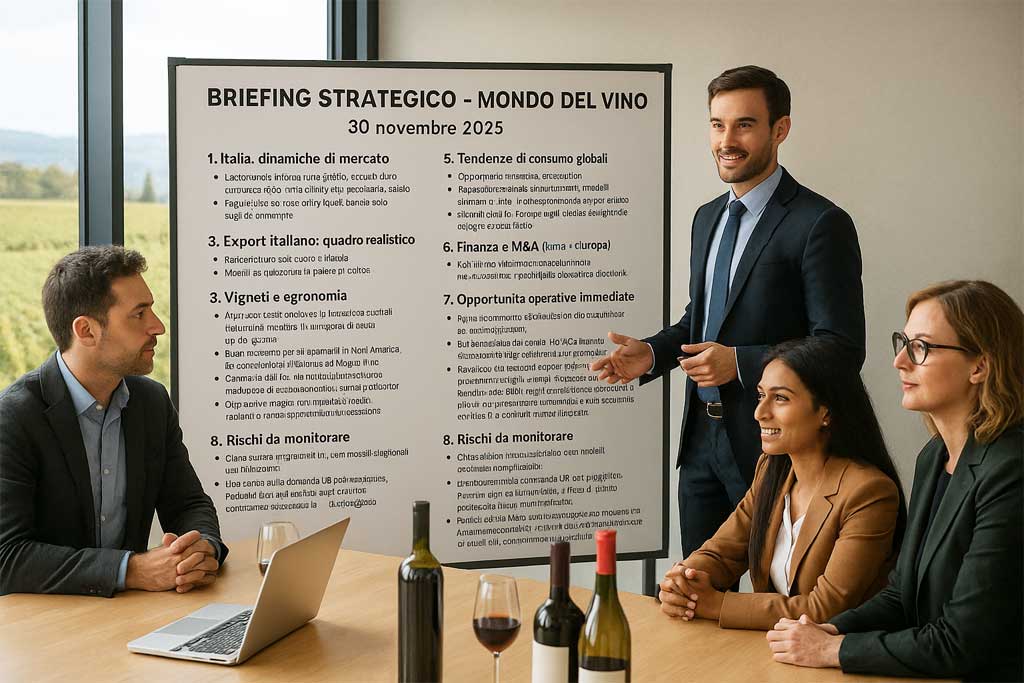
STRATEGIC BRIEFING – WORLD OF WINE

Information date: November 30, 2025

1. Italy: Market Dynamics Domestic demand remains flat: zero growth in the large-scale retail channel over the last eight weeks, negative growth in the entry-level segments, and only premium IGT wines held steady. Food service continues to represent the key driver of margins, but orders are more selective and focused on brands with strong storytelling or recent awards. Price pressure: food price inflation is receding, but internal logistics have not yet normalized and are impacting the costs of small and medium-sized wineries.

2. Italian Exports: A Realistic Picture. The US is holding up, although shelf rotation at major retailers has lengthened by about 10–12 days. Sparkling wines are performing well in North America, with Prosecco slightly eroding in the UK. Germany is stable, but lacking momentum: greater innovation is needed in positioning, not product. China remains fragile, with cautious importers and slow turnover: opportunities only for established and highly structured wineries. Interest is growing from Southeast Asia (South Korea and Vietnam are more reactive).

3. Vineyards and agronomy The 2025 harvest confirms a two-speed Italy: North and Central Italy with regular yields, while the South is under stress due to irregular climatic peaks. Many wineries are recalibrating their planting plans toward more resilient grape varieties. Agricultural costs remain high, but energy is more predictable and allows for more accurate planning for 2026.

4. International competition. France is relying on the narrative of excellence to defend its margins, while the Spanish are aggressively entering the medium-high segments with more competitive prices. The New World is showing signs of maturity: Australia and New Zealand are curbing production, aiming for a more premium repositioning. The United States is pushing the domestic market, rather than exports.

5. Global consumption trends: Consumers are seeking “readable” wines: less extraction, more drinkability. The most reactive categories are fresh whites and classic methods, while structured reds only thrive if they have a strong brand behind them. Sparkling wines are still growing, but at a slower pace. Selective premiumization only works where there is traceability and a real reputation.

6. Finance and M&A (Italy Europe) In the last quarter, there was a growing appetite for acquisitions of small and medium-sized producers with recognizable brands or valuable land assets. Funds are returning, but with two conditions: clean EBITDA and clear governance. Multiples remain largely stable: 6–8x for well-managed companies, higher for companies with a strong export share or high-value land. There is also growing interest in mineral water due to logistical and commercial synergies.

7. Immediate operational opportunities: Repositioning historic labels towards more contemporary lines. Strengthening the HoReCa channel through professional ambassadorships in key cities. Reviewing export contracts through 2026 to protect margins and payment terms. For those considering M&A: today, it is advantageous to target players with succession issues or with excess inventory that are squeezing liquidity.

8. Risks to monitor: Weather still unpredictable, with unreliable seasonal patterns. Uncertainty about post-energy UK demand. Possible US-EU tariffs on alcohol if the technology dispute resumes.

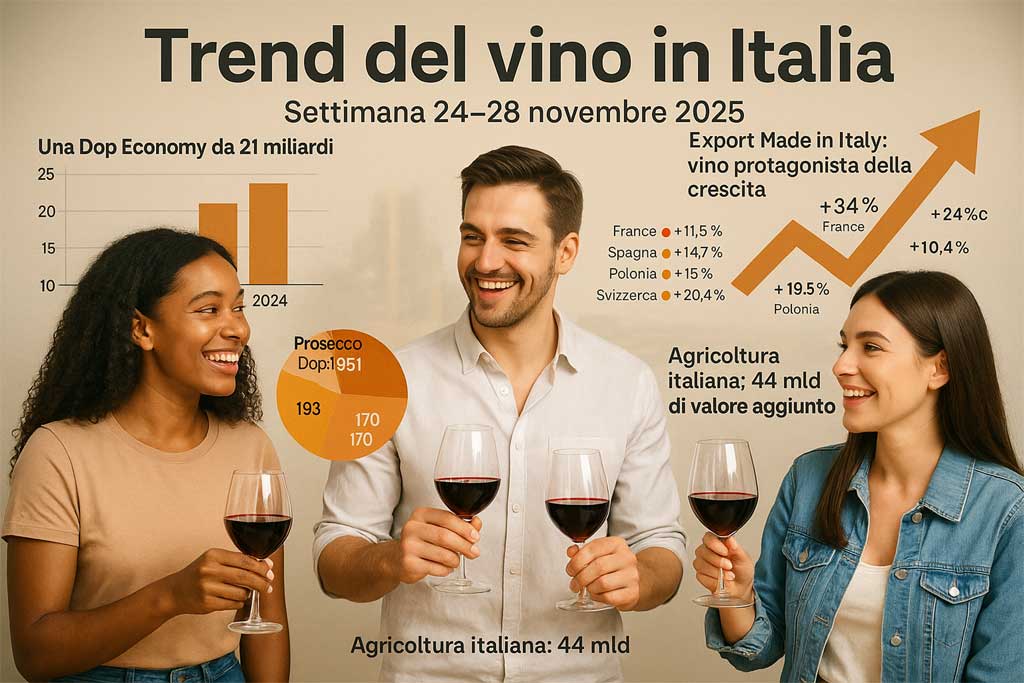
Wine Trends and Performance in Italy – Week of November 24-28 – 2025

The last week of November highlights a wine sector embedded in a rapidly growing national agricultural and agri-food landscape, driven by certified quality, dynamic exports, and a significant evolution in consumption.

The picture shows a solid Italian wine industry, increasingly premium and at the heart of high-value-added supply chains.

A €21 billion DOP economy: stable wine, accelerating exports

The XXIII Ismea–Qualivita Report confirms the strength of certified production: the PDO Economy will reach 20.7 billion euros in 2024 , 25% compared to 2020, with 328 Consortia , 184 thousand operators and an employment growth of 1.6%.
Bottled wine maintains a stable value of 11 billion , while overall PDO and PGI exports reach a new high: 12.3 billion euros (8.2%) , thanks to simultaneous records for food and wine.

The most dynamic areas are Lombardy (13%), Friuli Venezia Giulia (8%), and Puglia (12%). Veneto and Emilia-Romagna remain the epicenters of value, with a total of 8.9 billion .

Among the wines with the highest production value, the following stand out:

  • Prosecco Dop: 951 million (0.5%)
  • Delle Venezie Dop: 193 million (9%)
  • Conegliano Valdobbiadene-Prosecco DOP: 170 million (slightly down)

Made in Italy exports: wine leads growth

ISTAT data for September 2025 show foreign trade expanding: 10.5% in value , 7.9% in volume . Food and beverage grew by 6.9% in the month and 5% in the first nine months of the year, confirming its role as a cornerstone of the Italian trade balance.

Wine remains one of the most sought-after categories in premium markets, especially in non-EU countries. Exceptional performance:

  • United States: 34.7% , driven by wine and cheese
  • France: 19.5%
  • Spain: 14.7%
  • Poland: 15%
  • Switzerland: 10.4%
  • OPEC countries: 24.2%

Growth is based on certified quality, local identity, traceability, sustainable supply chains, and a structured presence on international markets.

Italian agriculture: €44 billion in added value

The Italian primary sector achieved a historic result: over €44 billion in added value , first in Europe. According to AGEA and INPS, government investments— €15 billion —have revitalized the sector, supporting:

  • recovery of 5 million hectares of abandoned land,
  • generational change,
  • increase in productivity and employment.

This agricultural solidity offers fertile ground for the entire wine industry, which benefits from policies geared towards production, legality, and the valorization of cultivated land.

Consumers, bubbles and new drinking cultures

The IULM analysis photographs a wine market in full transformation:

  • Italy is the third country in the world in terms of consumption by value .
  • Internal growth is driven by the pursuit of quality: less quantity, more value.
  • The sparkling segment continues to drive demand: 3.1 billion euros and 733 million litres in 2023 , with a clear premiumization dynamic.
  • Champagne sales are down (-8.4% globally), but Italian sparkling wines confirm their national and international leadership.
  • The low and no alcohol segments are increasing (5.9%) , especially among young consumers.

Gen Z is pushing for a different approach to wine: greater attention to sustainability, essential storytelling, light consumption opportunities, innovative formats, and greater health awareness.

Conclusion: a solid sector evolving towards quality, sustainability and premium positioning

Italian wine closes November 2025 with a strong structural picture: growing exports, certified production generating value, a national agriculture that invests, and a transforming domestic market.

The direction is clear:
Less volume, more value; less standardization, more identity; less tactics, more supply chain strategy .

This trend confirms the positioning of Italian wine as a crucial economic and cultural asset for Made in Italy and as a sector requiring informed industrial decisions, targeted investments, and a long-term strategic vision.

Wine Report of November 27 – 2025

Today’s wine trend.

1. Quick summary (Italy & the world)

  • World supply is still “short”, but recovering slightly: after the minimum production of the last 60 years in 2024, production in 2025 is estimated at around 232 mhl (3% compared to 2024, but below the five-year average) ; the dominant causes remain climatic extremes and a structurally weaker demand.
  • Italy returns to “full” volumes: 2025 harvest estimated at 47.4 million hl (8% on 2024) , with good to excellent quality and fears of overproduction in various basins (North-East and some red PDOs).
  • Italian exports are at a record high, but more competitive: in 2024, Italy exported 21.7 million hl for €8.1 billion (5.5%) , leading the world in volume and second in value. At the same time, pressure on prices and positioning is growing, with demand shifting toward whites, rosés, and sparkling wines , and strong growth in organic wines.
  • Producer prices: slight 1%, but polarized: ISMEA index 2024/25 1% overall: common wines 4% (whites leading), DOC/DOCG -2% (reds weaker), IGT 1%. In November, many bulk wine prices were stable w/w but below year-ago levels .
  • Selective but lively M&A: few buyers, many sellers; large groups only make targeted acquisitions (heritage brands, premium positions, strategic markets). Examples: the creation of Vinarchy from the Pernod Ricard Accolade wine portfolio, the acquisition of the historic Simi brand by WarRoom Cellars, and the integration of cooperative wineries in the Veneto region.

2. Export & demand

Italy

  • 2024: 48 million hl produced (13% vs 2023) and domestic consumption stable at 22 million hl (~37.8 l per capita) .
  • Exports 2024: €8.136 billion , with PDO at 68% of the exported value and sparkling wines at 29% (Prosecco DOC almost a quarter of the national PDO production).
  • Consumption trends: structured, everyday reds are decreasing, while fresh whites, rosés and Charmat methods are increasing, in line with the positioning of many Italian PDOs.
  • Markets: risk of tariffs on some key outlets (USA) pushes to diversify towards Canada, Asia and digital channels , with global wine e-commerce expected to grow strongly by 2025.

World

  • OIV: Global production and consumption in 2024 at their lowest since the early 1960s; inflation, geopolitical instability, and changing habits (less alcohol, less daily drinking) are weighing on volumes, while premiumization remains the value driver.

Operational analysis: for an export-oriented Italian company, it becomes crucial to narrow its portfolio around 2–3 strong axes (e.g., sparkling wines, gourmet whites, iconic red wines) and build targeted plans for the USA/Canada, Northern Europe, and select Asian markets.

3. Prices & Harvest (Italy)

Box – “Prices & Harvest”

  • Volumes & Quality 2025 (Italy)
    • Assoenologi–Ismea–Uiv estimate: 47.4 million hl (8% vs 2024) , with quality ranging from “very good” to “excellent” in most areas; specific critical issues where late rains or extreme events have affected health.
    • Signs of oversupply on some volume red varieties and on PDOs in already overexposed areas.
  • Grape and wine prices (trend)
    • 2024/25 campaign: producer price index 1% overall; common wines 4% (whites in particular), DOC/DOCG -2% (reds suffering), IGT 1% .
    • Weekly Ismea data on wine (November 2025): in some reference markets, basic white and red wines are around €4.5–5.4/hectoliter , stable compared to the previous week but in several cases between -4% and -22% on an annual basis , a sign of a market that is slowly absorbing the increased production.
  • Stocks & Inventory
    • According to Federdoc, Italian stocks as of June 30, 2025 were 43.6 million hl , slightly above the previous year, despite the 2024 harvest being the lowest in the last 60 years: the system therefore enters the 2025 harvest with warehouses still full .
  • Climate & yields
    • The 2024/25 reports confirm the need to revise yields and specifications to align supply with new climatic conditions and actual demand, with proposals to reduce yields/ha and review “surplus” production.

Practical implication: today the real margin driver is not “producing more”, but managing volumes (yields, inventory management, outlets such as distillation/musts) and protecting the average value per bottle.

4. M&A Radar (last period)

(actual deals and strategic signals, Italy and the world)

  • WarRoom Cellars – SIMI (California, USA)
    • Type: acquisition of a historic brand
    • Parties: WarRoom Cellars (California Central Coast) acquires the Simi brand from The Wine Group.
    • Size: Undisclosed; Simi produces ~340,000 cases/year, mid-premium.
    • Strategic message: focus on undervalued heritage brands to relaunch with a lean structure (production outsourcing, targeted marketing).
  • Pernod Ricard Vinarchy (Australia/Spain/New Zealand)
    • Type: Portfolio transfer to create a new global group
    • Shares: Pernod Ricard sells its international wine portfolio to Australian Wine Holdco (owner of Accolade Wines), creating Vinarchy as a new major pure wine player.
    • Strategic message: concentration of assets in specialized vehicles , with strong pressure to rationalize brands and production sites.
  • Vinarchy – Portfolio Streamlining
    • Planned cut of approximately 40% of brands (over 60 labels) to focus investments on global brands (e.g. Jacob’s Creek, Hardys) and on new low-alcohol products, small formats, and RTDs designed for young people.
  • Collis Veneto Wine Group – Monteforte d’Alpone Winery (Veneto, Italy)
    • Type: incorporation of social winery
    • Shares: Collis Veneto Wine Group integrates the Monteforte d’Alpone winery, strengthening its critical mass in the Veneto cooperative segment.
    • Strategic message: In Italy, the movement toward aggregation among cooperatives/POs continues to increase bargaining power and investment capacity.
  • Santa Margherita – Marsh Estate (Oregon, USA)
    • Type: acquisition of a foreign company
    • Shares: The Santa Margherita Group acquires the Marsh Estate in Oregon, continuing its expansion in the US after several previous transactions.
    • Strategic message: confirmation of the ” short supply chain in the target market ” logic: physically presence in key countries with local production assets.

General context: The M&A market is experiencing a phase with a few selective buyers and many potential sellers , especially undercapitalized family businesses and cooperatives under price pressure.

5. Regulation & Policy

  • EU Labelling – Ingredients & Nutritional Values
    • From 8 December 2023, all wines in the EU must provide a list of ingredients and nutritional values; the use of e-labels via QR code is permitted, provided that the information area is separated from the marketing area.
  • Italy – Revision of the Consolidated Wine Act (L. 238/2016)
    • Federdoc and other organizations are calling for a thorough overhaul : reduced yields, updated specifications, management of redundancies, simplified controls, and reform of the denomination system (including the possibility of regional mergers).
  • New tax stamps and traceability
    • A new, more secure and legible tax stamp model has been under testing since July 28, 2025 , designed to integrate with digital systems (QR, RFID, NFC) and strengthen the fight against counterfeiting.
  • Italian Parliament fact-finding inquiry into the wine sector (2025)
    • The Agriculture Commission has launched a process of analyzing the sector’s prospects in 2025, signaling possible future interventions regarding profitability, competition, and crisis management tools.

Translated for companies: compliance is no longer just an “obligation”, but a competitive lever : those who structure data, traceability and digital communication well today will be able to stay ahead of the curve on markets, controls and premium channels tomorrow.

6. Innovation (vineyard, cellar, market)

  • AI and robotics in the vineyard
    • Projects like Astibot in Spain and other European initiatives on pruning and vineyard management robots aim to reduce labor requirements and improve quality and safety.
    • International reports highlight the growing use of AI-powered tractors and sensors for precision irrigation, disease monitoring, and yield forecasting, with benefits in terms of costs and sustainability.
  • Digital platforms & decision support
    • Solutions like Scout (analytics for precision viticulture) and management software with integrated AI (e.g., Crafted and similar) are starting to provide insights into individual plots and for the integrated management of the vineyard, cellar, and warehouse.
  • E‑label, blockchain and Digital Product Passport
    • Several platforms (e.g. SwearIt, e‑label, WineOnChain) leverage QR codes and blockchain to create digital wine passports , combining EU compliance, brand storytelling, and anti-fraud traceability.

Key takeaway: It’s not necessary to immediately adopt “deep tech” solutions, but it’s a good idea to identify 1–2 pilot projects (e.g., e-labels for simple sensors in vineyards) that can deliver concrete data and benefits within 12–24 months.

7. Strategic reading for wineries, consortia, and M&A operations

  1. Excess supply = right time to reposition your portfolio
    • With a plentiful 2025 harvest and high inventories, those who continue to chase volumes alone risk a permanent compression of margins.
    • Priorities: redesign the mix (fewer “weak” labels, more focus on DOP/IGT with a clear value proposition), work on returns and inventory management, and negotiate industrial outlets to free up warehouses without damaging the main brands.
  2. Aggregation as a response to fragmentation
    • The Collis Veneto–Monteforte d’Alpone case shows that the cooperative/aggregative approach is concrete: greater critical mass means greater strength in large-scale retail trade/export and more resources for marketing and innovation .
    • For many small and medium-sized businesses, the choice is clear: seek an alliance/integration (horizontal or vertical) or strengthen their niche positioning with high margins and selective channels.
  3. M&A: From “Selling the Winery” to “Selling an Industrial Project”
    • The big players are buying stories, brands, and market access , not just hectares and tanks. Preparing a transaction means clarifying the identity, margins per line, growth potential over 3–5 years, and realistic synergies for a potential buyer.
    • In a context of few buyers, those who arrive with a well-constructed dossier have a better chance of closing and better defending the valorization .
  4. Compliance & data as an asset, not a cost
    • Digital labels, new taxation, and demands for traceability and sustainability will push us to organize our vineyard, cellar, stock, and market data .
    • A winery or consortium group that can accurately measure yields, costs per label, environmental impact, and performance per channel is in a strong position both with respect to distribution and in a potential M&A round.
  5. Innovation in steps, not in leaps
    • Technology today allows you to start with targeted interventions (e.g., an AI pilot project for irrigation on a few hectares, or a serious CRM for top foreign clients) and scale them up only if they generate clear returns.
    • The important thing is not to stand still : while large groups like Vinarchy are rethinking their portfolios and models, even family businesses and cooperatives can carve out space for themselves, if they move with determination and clarity.