All posts by admin

Wine press review for Friday January 30 -2026

Italian wineries and wines, wine news.

Italian wineries

Friuli’s wine world says goodbye to Daniela Coser. The Friulian wine world loses a key figure: Daniela Coser, co-founder of Ronco dei Tassi in Cormòns, has passed away. A discreet and decisive entrepreneur, she helped build one of Friuli Venezia Giulia’s leading wineries, combining vision, sensitivity, and daily dedication.

Le Carline, pioneers of organic and resistant grape varieties in Veneto. In Lison-Pramaggiore, Daniele Piccinin has led one of the most advanced sustainability practices for thirty years: organic, PIWI, sulfur-free wines, and experiments in the lagoon. Today, the winery boasts approximately 35 hectares and a solid, consistent production.

Vinchio Vaglio grows against the grain. The Piedmontese cooperative winery records a 20% increase in sales, €11.5 million in revenue, and strong member compensation. Their strategy: consistent quality and “good wine at the right price” in the heart of the UNESCO World Heritage site of Nizza Monferrato.

Maculan Winery, 50 Vintages of Creativity. In Breganze, Fausto Maculan celebrates half a century of his career with an event-wine that embodies his unpredictable style. A story that intertwines terroir, experimentation, and personal identity.

Three wine postcards from Sicily: Casa Grazia, Ramaddini, and Terre di Entella tell the story of three souls of the island: Gela, Marzamemi, and Contessa Entellina. Different grape varieties, soils, and visions, united by quality and a strong territorial identity.

Cantina Pirata, the path of experimentation in Campania In Guardia Sanframondi, Filippo Mancini produces small, unconventional wines from old vineyards and historic varieties to create wines with a strong personality.

Cantina Produttori Bolzano, the cooperative model that works With Alto Adige Bianco Tal 1930 2022, the South Tyrolean cooperative confirms a model based on quality, sustainability and the valorization of small winemakers.

Italian wine and Italian oenology

The future of Prosecco and Veneto denominations. The annual conference in Godega di Sant’Urbano addresses markets, new sources, and sustainability certifications, confirming its position as a point of reference for regional viticulture.

Producing “clean” and fair wine Slow Food reaffirms the need for a paradigm shift: environmental sustainability, biodiversity protection, and the dignity of labor as the pillars of Italian viticulture.

Amarone, not a mistake but an identity project On the eve of Amarone Opera Prima, it is reiterated that the great red from Valpolicella was born from a precise vision of typicality, not by chance.

Prices, margins, and storytelling: a change of pace is needed. A clear message emerged from the DB Conference in London: without alignment between price and perceived value, wine risks a structural crisis of profitability and appeal.

Bottles from the bottom of Lake Garda : 1,200 bottles aged underwater were recovered: an experiment in alternative maturation that continues to intrigue the market and enthusiasts.

International

USA: A struggling but resilient market. Between tariffs, the euro/dollar exchange rate, and new consumption patterns, the wine market in the United States is slowing but not collapsing. For many operators, it remains a key market, especially for the high-end segment.

New resistant grape varieties from Switzerland Agroscope presents seven new varieties with long-lasting resistance to downy mildew and powdery mildew, the result of over 15 years of research and advanced genetic selection.

Romania, Crama Corbuţ and the Crisana Palatin Reserve Romanian viticulture continues its path of valorization: focus on a small winery of the Crisana DOC and on a red wine made from Cabernet, Merlot and Fetească Neagră.

Chianti debuts in Africa. The Chianti Wine Consortium’s mission to Nigeria is a success: masterclasses and tastings in Lagos open a dialogue with an emerging and curious market.

From Hong Kong to Barolo: A Conversion to Wine A Vinitaly International Academy professor reflects on how to attract new audiences to wine at a time of intense pressure on the industry.

Wine events

Salone del Vino 2026 – Turin From February 28th to March 2nd, Piedmont’s largest “open cellar” returns to the OGR Turin. Two days for the public and one for professionals, with international buyers. The theme: “Tasting is discovery.”

Grandi Langhe 2026: Over 400 wines tasted in the press room in Turin. Focus on the new Barolo and Barbaresco vintages, with particular attention to the 2022 vintage, which was marked by severe drought.

Amarone Opera Prima 2026 From January 30th to February 1st in Verona: over 50 wineries and 100 international journalists. Featured, among others, are Pasqua Vini and Ilatium Morini with their new Amarone vintages.

Drink Let’s Drink South in Rome Southern Italy takes center stage at the Westin Excelsior: anticipation is growing for the Costa degli Dei and the future Calabrian wine denomination.

AIS Veneto: 2026 sommelier courses begin . Training for new wine professionals resumes, in a context where culture and skills are becoming increasingly central.

Milan-Cortina 2026, an opportunity for Italian wine According to Sandro Bottega, the Winter Olympics will be a powerful driving force for the wines of Lombardy and Veneto, with global visibility and a strong economic impact.

Today’s wine press review is brought to you by WINEIDEA.IT. See you tomorrow.

Wine Trends and Performance in Italy – Week 26–30 January 2026

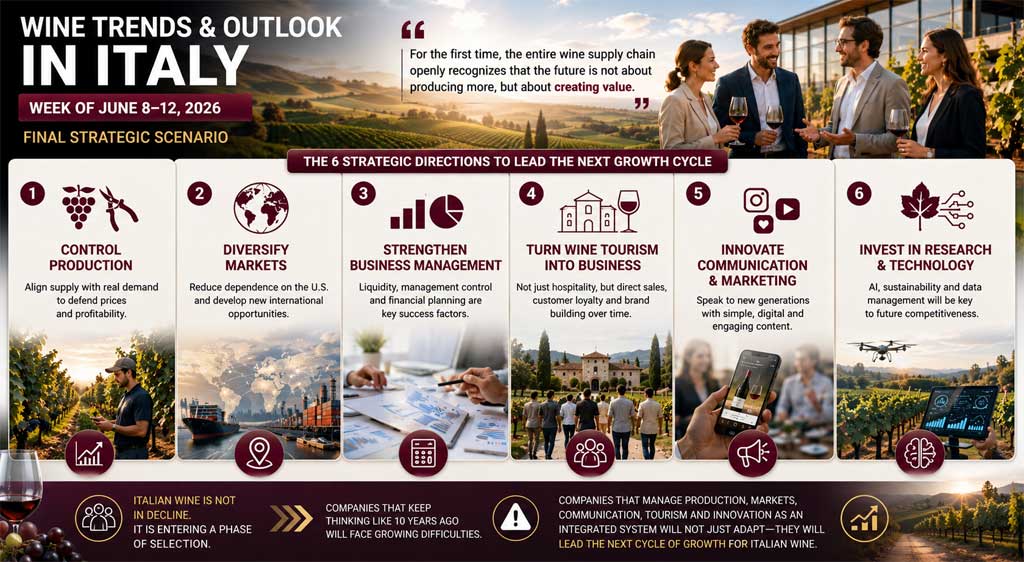
The week of January 26–30, 2026, captures an Italian wine sector undergoing a transition from a “mature system”: demand is slowing and changing, while supply remains high and generates financial and commercial pressure.

In the middle, two opposing forces coexist: enormous market potential (India and Southeast Asia, global digital interest) and a structural problem of surpluses (record inventories, stressed prices and margins).

The result is clear: in 2026, the winner is not the one who produces the most, but the one who controls the portfolio, channels, and positioning.

1) Export: India is opening up, but speed (and direction) are needed

The strategic event of the week is the EU-India free trade agreement, which is set to change the export landscape in the medium term. Currently, India has very little impact on Italian wine (exports are still marginal compared to the total value of over €8 billion ), largely due to a 150% federal tariff that has so far made entry prohibitive.

With the agreement, the trajectory changes: tariffs will be halved immediately and gradually reduced to 30% within seven years (down to 20% for wines over €10 a bottle). This doesn’t mean a “boom tomorrow morning,” but it does create minimum competitive conditions for quality European products for the first time, with a potential impact beyond India and potentially extending to Southeast Asia (Thailand, Indonesia, Vietnam), where wine culture is still low but the market is enormous.

Operational message: those who move first can “seize positions” (importers, channels, premium on-trade, hotels, training) before the market becomes crowded. But reducing tariffs alone isn’t enough: a promotional plan, distribution adaptation, and systemic efforts are needed (also because education and communication costs, in young markets, are the real barriers).

2) Italy: too many inventories, too much immobilization (end of 2025)

The other big data point of the week is domestic and very concrete: extremely high cellar inventories . 2025 closes with nearly 60 million hectoliters of wine in stock ; including musts and fermenting wines, the total exceeds 70 million hectoliters . This quantity, in a less than buoyant market, becomes a systemic problem: stagnant capital, pressure on prices, increased “discount” competition, and tensions along the supply chain.

The composition of stocks indicates that the issue isn’t limited to ordinary wine: over half is DOP , followed by IGP , and a significant portion is table wine. The territorial concentration is dominated by the North (with Veneto in particular), but there are also significant presences in key regions of Central and Southern Italy.

Operational message: in a surplus, the market rewards those who have good supply governance (production choices, inventory management, high-value channels) and penalizes those who remain tied to volume inertia. The risk is entering a “tank-emptying” spiral that burns margins and reputation.

3) From surplus to project: the crisis is not episodic, it is structural

This week’s cultural theme is powerful: the surplus isn’t just “too much wine,” it’s a sign that demand is demanding a different kind of wine and a more credible project. In the background, global data are pushing all producers to rethink the balance: global consumption, estimated by the OIV, will decline to 214 million hectoliters in 2024 (an all-time low), while in Europe, debate is growing over supply management tools (green harvesting, distillation, grubbing-up).

A clear line emerges here: simply “marketing” isn’t enough; we need simplification and consistency . More legible portfolios, fewer filler labels, greater alignment between style, alcohol content, and occasion of use. And above all, a push toward channels that transform value rather than chasing volume: hospitality, direct sales, clubs, experiences , transparent communication, and measurable sustainability.

4) Global digital interest on the rise: the “Italian Wine” brand remains strong

Despite market tensions, signs of desirability remain strong. In 2025, global online searches for “Italian Wine” are expected to grow by approximately 20% , with interesting dynamics:

  • Reds still central to the imagination (more contained growth),
  • Whites on the rise as a symbol of freshness and drinkability,
  • surge in searches for “best Italian wine” and curiosities about “most expensive Italian wine,” with pop influences (including from video games and digital culture).

At the same time, the more established wineries are working on websites, social media, and (with a cautious resurgence) e-commerce. LinkedIn is emerging as a platform with strong community growth: a sign that the wine industry is also experiencing a growing demand for more “professional” content (business, hospitality, investments, reputation).

Operational message: digital doesn’t replace the market, but it enhances the ability to manage demand and storytelling. In 2026, those who “find themselves online” with a clear and credible message will reduce the commercial cost of each channel.

5) Consumption and channels: “less, but better” (with a changing map)

This week’s debate confirms a shift in grammar: in mature markets, wine prices aren’t necessarily “collapses,” but rather the composition of shopping carts and the logic behind purchasing decisions are changing. The premium segment is holding up better, while segments that combine high prices with heavy styles and high alcohol content, no longer aligned with new consumers, are struggling.

The testimonies from the United States (a difficult but not collapsing market) are consistent:

  • the great iconic denominations can hold their own in fine wine,
  • growing interest in white wines and sparkling wines ,
  • “rotating” price range often between $15 and $25 ,
  • and the principle remains: fewer bottles, but better .

6) Wine and spirits: the ecosystem is changing in the out-of-home dining space (and wine must adapt)

From the distribution and Horeca side, trends are emerging that should be interpreted as competition based on “occasion of use”, not just on category:

  • slowdown in high-end Champagne ,
  • difficulties for large, “important” red wines in restaurants (price and alcohol),
  • interest in “cleaner” natural wines (fewer defects, higher sensorial quality),
  • and in the spirits world: strong growth, with the return of Vermouth , gin still on the rise but towards selection, and growth of brown spirits .

This picture tells us one thing: the contemporary consumer increasingly chooses by moment (aperitif, light dinner, after-dinner, socializing), and wine must preside over those moments with coherent offerings, not just with “textbook” names.

Wine press review for Thursday January 29 -2026

Italian wineries and producers, wine news.

Italian wineries

Milan–Cortina 2026: Italian wines at Casa Italia. Twenty-six labels represent the Italian winemaking biodiversity at the Winter Olympics. These include two wines from Romagna (Caviro and Tenuta Masselina) and Cottanera’s Etna DOC Rosso 2023, the only Sicilian wine selected. The selection, curated by LT Wine & Food Advisory for CONI, highlights native appellations and grape varieties, from cooperatives to small-scale producers.

Cantine di Verona: the strength of cooperation. The project born in 2021 from the merger of Valpantena, Custoza, and Colli Morenici has consolidated itself as one of the most structured wineries in the Veneto region. Under the leadership of Luigi Turco, Cantine di Verona demonstrates how cooperative integration can generate financial stability, a broad product range, and strategic continuity.

Settecani Winery: 2026 is the year of Lambrusco Grasparossa. The Modena-based cooperative is focusing on identity, local area, and communication to strengthen the positioning of Grasparossa di Castelvetro, a wine capable of capturing key trends: low alcohol content, gastronomic versatility, and territorial recognition.

Save the Grape: wine “without a tie.” Piero Scalambra’s project proposes a light, itinerant, and contemporary winemaking model. An alternative to the classic winery paradigm, it speaks the language of the new generations without chasing industrial trends.

Tenuta di Castellaro: no alcohol? A fad with no future. Massimo Lentsch recounts the winery’s founding in the Aeolian Islands and takes a stand on the issue of dealcoholized wines, championing an identity-based and territorial vision of wine, now primarily aimed at foreign HORECA markets.

Enrico Crola (Mezzomerico) wins the 2026 Wedding Award. The Novara-based winery and agritourism has been recognized for excellence in the wedding industry, based on direct reviews from couples. This recognition reinforces the role of wineries as places of experience and hospitality.

Terlano Winery: 100/100 Wine Advocate The 1991 Rarity becomes the first Italian dry white wine to earn the highest score from Wine Advocate. This recognition recognizes a winemaking vision rooted in time and longevity.

Italian wine and Italian oenology

Young people, no/low alcohol and zero calories: the narrative is changing. A study by the Burgundy School of Wine & Spirits Business overturns the paradigm: Gen Z and Millennials aren’t so much looking for no/low alcohol wines, but rather zero-calorie alternatives. This finding calls for strategic reflection on product, communication, and R&D.

Agriculture, Agrochemicals, and Misinformation The Agrea conference in Rocca Sveva addresses the relationship between agricultural innovation, the environment, and health, highlighting the regulatory complexity and the risk of ideological simplifications affecting the agricultural world.

Wine that creates jobs and inclusion. The “8pari = Social Wine and Equal Opportunities” project, born in the Langhe region, was awarded in Rome. A concrete example of social agriculture that can be replicated in other production chains.

Goodbye happy hour: the drinking ritual is changing. According to Wine Enthusiast, consumption is no longer the center of socializing. Gen Z drinks less and more selectively: wine becomes an option, not the primary experience.

Let’s Kiss About: Ten Wines for Valentine’s Day A cultural and sensorial tale that combines wine, art, and romantic imagery, offering editorial and storytelling inspiration for product communication.

International

Australian wine exports to decline by 8% in 2025. Value and volumes are declining, penalized by China, the US, and the UK. However, alternative markets such as Canada and Southeast Asia are growing, a sign of potential strategic diversification.

EU-India Agreement: Wine Tariffs from 150% to 30%. The signing of the free trade agreement opens up a new landscape for European exports. The Indian market remains complex, but it is finally becoming accessible for Italian wines and spirits as well.

Gambero Rosso in Nairobi: 45 Italian wineries showcased. The third edition of the Top Italian Wines Roadshow in Kenya, dedicated to importers, media, and hospitality, features a selection of premium Italian labels.

The Alto Adige–Tyrol Case: Wine, Identity, and Communication An ironic post by Tirol Werbung sparks a political and cultural controversy between Austria and Alto Adige, demonstrating how sensitive wine and territorial identity are even outside the market.

Wine events and wine experiences

Wine&Siena 2026 (January 30 – February 2) Four days of tastings, masterclasses, and seminars in the Santa Maria della Scala complex, with selected producers and The WineHunter events.

Slow Wine Fair 2026 (BolognaFiere, February 22–24) Over a thousand wineries from 30 countries, with a strong organic and biodynamic presence. The “Old Vintages” area debuts, featuring the heritage of the Pollenzo Wine Bank.

Wine Bank: events between January and February. The Timorasso corner opens in Pollenzo, featuring tastings, participating producers, and cultural influences from the Karst region.

Vermouth di Torino in Turin: PGI event a success. A large turnout and a qualified audience attended Turin’s only event dedicated to Vermouth di Torino PGI: 540 glasses were served and strong interest from the Horeca and media sectors.

BIT Milan: Moldova presents itself From February 10th to 12th, the Moldovan stand will host tastings, tour operators and wine resorts, strengthening the link between wine, tourism and territorial promotion.

Let’s Drink South: The Coast of the Gods in Rome Seven wineries from Vibo Valentia will be featured at The Westin Excelsior, showcasing Calabrian viticulture, from its identities to its new expressions.

Winery Experiences: From tasting tours in Valpolicella with Cantina Vogadori, to “Saturday in the Cellar” with Roberto Lucarelli in the Marche region, to the TerraViva competition for a contemporary boutique winery in eastern Veneto: wine as an experience, a narrative, and a place.

Thanks for listening. Today’s wine press review was brought to you by WINEIDEA.IT .

See you tomorrow.

Wine press review for Wednesday January 28 -2026

Italian wineries and producers, wine news.

Italian wineries

Langhe Nebbiolo DOC in bag-in-box: a divisive decision. The Barolo Barbaresco Alba Langhe e Dogliani Consortium has begun the process to allow Langhe Nebbiolo DOC to be packaged in bag-in-box containers of up to 5 liters. This decision, designed for export, is dividing Piedmontese producers between openness to markets and defense of tradition.

Valentino and wine: from Gavi to Brunello, luxury meets the vineyard. The dialogue between fashion and wine is growing stronger: Valentino and other big names in fashion share their attention to detail, vision, and identity with the wine world. This story is part of a broader trend of luxury investments in wine.

Solopaca Winery, a cooperative history in Sannio. Founded in 1966, this Campania cooperative is one of the oldest in the region. Created to respond to the agricultural crisis and rural depopulation, it still represents a model of local winemaking resilience.

Two visions of wine between Trentino and Alto Adige: Gaierhof and Sankt Pauls. Two wineries geographically close but distant in approach: family tradition and human warmth for Gaierhof, technical precision and international ambition for Sankt Pauls. Two complementary souls of Alpine winemaking.

Raspato di Saracena: the macerated white from Cantine Viola. Luigi Viola presents Raspato Calabria IGT, a radical and distinctive wine, suspended between land and sea. A project that unites memory, territory, and vision, after saving the Moscato Passito di Saracena from extinction.

Tedeschi: Enrico Giacomelli Tedeschi joins the company. Generational transition begins at the historic Pedemonte winery. Enrico Giacomelli Tedeschi will oversee the brand’s development in Italy, bringing his legal and strategic expertise to the company.

Valentino Galgani to lead Cantine Vivito. The Tuscan cooperative, with 1,300 members and €16 million in production, has a new president. Continuity and development are at the heart of his mandate, with a focus on the main regional appellations.

Tenuta Iacoangeli: wine as a family legacy in the Castelli Romani. A story spanning several generations, a symbol of the qualitative rebirth of the Roman vineyard and the rediscovery of volcanic soils as a winemaking capital.

Italian wine and Italian oenology

Gambero Rosso’s Top 9 Dolcettos from the Langhe and Monferrato Regions A focus on a grape variety often overshadowed by Nebbiolo and Barbera, but capable of great expressiveness in the Dogliani, Ovada, and Diano d’Alba appellations.

Maìa di Siddùra among Decanter’s 10 best Italian wines of 2025. The only white in the ranking: Vermentino di Gallura enters James Button’s top ten, confirming the qualitative growth of the Sardinian white.

“199 Extraordinary Wines”: Marco Pozzali Talks About Wine Beyond the Ratings. A manifesto-book that restores a narrative and cultural dimension to wine, far removed from the logic of ratings and closer to the human experience.

Fausto Maculan: 50 vintages of vision and experimentation The Breganze producer retraces half a century of winemaking research: from high planting densities to truncated cone-shaped vats, to the influence of Émile Peynaud’s thinking.

Wine, cellars, and vineyards: Italy told through images. Luca Merisio’s photography book Paese del vino, terre divine offers a poetic yet realistic look at the Italian winemaking landscape, its seasons, labor, and widespread beauty.

International

EU-India Agreement: Historic Turning Point for Italian Wine. With the progressive halving of tariffs (from 150% to 30% over seven years), India is opening up as a long-term strategic market. Italian exports are starting from minimal numbers, but the prospects are significant.

Italian Wine in Vietnam: Growth and Opportunities in Southeast Asia Vietnam is consolidating its position as an emerging market: a growing middle class, rising consumption, and export duties are favoring the Italian presence, now second only to France.

Chile: The allure of wine aged at the bottom of the ocean. Bottles aged 20 meters below the surface of Locos Island. An experimental practice that combines winemaking, environment, and storytelling.

Farewell to Jacques Beaufort, pioneer of natural wine in Champagne . A key figure in European biodynamic viticulture has passed away. Beaufort anticipated the “nature” movement by decades, with a radical and coherent vision.

Wine events and training

Milano Cortina 2026: the 26 ambassador wines at Casa Italia, a selection of the Italian Olympic Committee (CONI) to represent Italy’s winemaking biodiversity during the Winter Olympics. From major appellations to small producers.

Terre di Toscana XVIII edition – 22 and 23 March 2026 In Lido di Camaiore over 140 winemakers tell the story of a multifaceted and contemporary Tuscany, from the coastal territories to the heart of Chianti and Montalcino.

Strada del Barolo: training course for winery hospitality. A training project dedicated to wine tourism staff to further enhance their experience in the Langhe, now a mature international destination.

QdC® Fridays: Plant Health Register and Digital Mandatory Webinar on January 30, 2026, on the mandatory digital conversion of the spray register by December 31, 2026. A key step for future agricultural management.

Agricultural Taxation: A Paradigm-Changing Reform The conference “Economic and Fiscal News 2026” revealed a reform that broadens the concept of agriculture, including innovative crops and overcoming the exclusive constraint of land.

Umbria Top: the international trade fair season kicks off. The Umbrian winery cooperative kicks off 2026 with Wine Paris & Vinexpo, focusing on global relations and structured commercial development.

Today’s wine press review is brought to you by WINEIDEA.IT . See you tomorrow.