All posts by admin

Wine press review for Tuesday January 27 -2026

Wineries, Italian wine producers, and wine news.

Italian wineries

A Pinot Grigio from Collio at the world’s top for quality-price ratio Schiopetto’s 2024 Pinot Grigio Collio has been awarded by James Suckling as the best white wine in the world for quality-price ratio.

Kren, Doc Collio Friulano 2024 Portrait of the family company from Cormons: territorial identity, ponca, climate and classic interpretation of Friulano.

Cantina Bottenago toasts the white and blue of the partnership between Cantina Bottenago and Union Brescia: sport, territory, and wines that represent the identity of Valtenesi and Garda.

Viarte turns 50: Polegato invests €8 million. The Colli Orientali del Friuli winery is undergoing a new development cycle, with strong production growth and structural renewal.

Erste Neue celebrates Valentine’s Day with the Puntay line. Three South Tyrolean labels dedicated to the lovers’ holiday, a symbol of Alpine style and cooperative tradition.

Dialogue and responsibility: the pact for the relaunch of the Terre d’Oltrepò winery. An institutional meeting to address the crisis and build a shared path to protect workers, winemakers, and the region.

Wine, a Korean family buys Tenuta Cerbaia (Brunello di Montalcino) New foreign investment in a historic Brunello winery: the acquisition market is once again dynamic.

From London to the Brunello vineyards: the Lee family buys Cerbaia. An in-depth look at the transaction and the growing international interest in the Montalcino vineyards.

Italian wine and Italian oenology

Mercosur, Puglia and Lucanian DOP wines without European “shield.” Marzia Varvaglione (CEEV) comments on the EU-Mercosur agreement and calls for expanded protection for denominations.

Special agricultural VAT regime with no minimum duration. Clarifications on the agricultural VAT regime: “natural” nature, freedom of exit, and option for the ordinary regime.

In Friuli, between vine shoots and gangmastering. An investigation into work in the Rauscedo vine shoot farms: world-class excellence and social criticalities.

Wineries and starchitects: the new oases among the vineyards. The phenomenon of iconic wineries designed by great architects, combining design, tourism, and cultural experiences.

Enthusiasm, beauty, resilience: the future of Italian wine . The key words for 2026 according to the leaders of the Consorzio Italia del Vino.

Wine, web searches for Italian products are growing worldwide. Google Trends: 20% global interest in “Italian Wine” in 2025.

2026 trends according to Proposta Vini Distribuzione, small producers, and new Horeca dynamics as told by Gianpaolo and Andrea Girardi.

The history of wine in the “wine monasteries” WineNews docu-film with Attilio Scienza: a journey through abbeys and great places symbolic of Italian viticulture.

Marco Pozzali and the “199 extraordinary wines” Wine described beyond the scores, as a cultural and narrative experience.

International

The EU-India agreement is expected to reduce tariffs on wine and oil. New opportunities for European agricultural exports.

EU-India: With tariffs down to 20%, wine finds a new “El Dorado” India emerges as a strategic market for Italian wine.

“Wine cannot ignore Nigeria” Ambassador Mengoni points to Lagos as a strategic hub for Africa and Italian wine.

A World Tour of Wine at the Supermarket: 3 Value-For-Money Whites. A journey through France, the USA, and New Zealand on the shelves of large-scale retail outlets.

Wine events

Milan Cortina 2026: the wine list of the 26 “Olympic wines” at Casa Italia. The ambassador labels of Italian wine at the Winter Games.

Here are the 26 Made in Italy Ambassador wines at Casa Italia. Official selection by CONI and LT Wine & Food Advisory to represent Italian biodiversity.

Assovini Sicilia at Wine Paris 2026 with 32 companies Collective Sicilian presence at the major international fair in Paris.

Slow Wine Fair 2026: the “What does the right glass tell?” conferences: Vineyard work, sustainability, and social responsibility are at the heart of the program.

Grandi Langhe and the Piedmont of Wine 2026 The great professional event of Piedmontese wine on January 26-27 at the OGR in Turin.

Thanks for listening. Today’s wine press review was brought to you by WINEIDEA.IT .

See you tomorrow.

Wine press review for Monday January 26 -2026

Italian wineries and producers, wine news.

ITALIAN WINERIES

Schiopetto triumphs at James Suckling. Schiopetto’s 2024 Pinot Grigio Collio is #1 in the “Top 100 Value Wines 2025 – Everyday Gems.” It’s the best value wine under $40, gaining international recognition for its elegance, balance, and market availability.

Cantina di Lisandro (Campania), between historical restoration and distinctive grape varieties. A new winery focused on Pallagrello Bianco, Pallagrello Nero, and Casavecchia is born in Castel Campagnano, with an organic project, high-level technical consultancy, and targeted wine tourism.

Discover the Euganean Hills: La Costa Visit one of the area’s historic wineries, with clonal selection and experimental micro-vinifications to showcase local grape varieties.

Conti Zecca: Roots, Identity, and the New Generation. A family story and a vision for the future from Salento, combining loyalty to the land and adaptation to new consumer trends.

Cantina Valtidone launches “Grinta,” a new artistic label designed by street artist Luca Font to celebrate sport, the Olympics, and female leadership.

ITALIAN WINE AND ITALIAN OENOLOGY

The Two Wine Routes: The Crisis as an Opportunity for Rethinking High inventories and evolving consumption: the sector reflects on production models, the market, and inventory governance.

Record stocks: over 60 million hectoliters sitting in cellars. ICQRF data depicts a system under pressure: selective demand, cautious Horeca, and the need for new industrial strategies.

Ten million hectoliters of wine stopped: from a problem to an industrial platform. Wine as a noble biomass: ingredients, low-alcohol, functional products. An industrial vision for transforming stock into value.

Wines to drink in 2026: six denominations to bet on (two to rediscover). Focus on emerging trends and identity wines that are returning to prominence.

Gambero Rosso’s Best Italian Wines of 2026: Among new favorites and great returns, the Oltrepò Pavese Metodo Classico Classese stands out.

Brescia wine: stable production and growing quality. Production up 4%, prices stable, the sector holding up despite declining volumes.

Italian agri-food is on track for a new export record, according to ISMEA: €73 billion expected in 2025. Wine remains a cornerstone of Made in Italy on global markets.

INTERNATIONAL

EU-India agreement: possible cuts in wine and olive oil tariffs. After twenty years of negotiations, a historic turning point for European exports. The announcement is expected at the New Delhi summit.

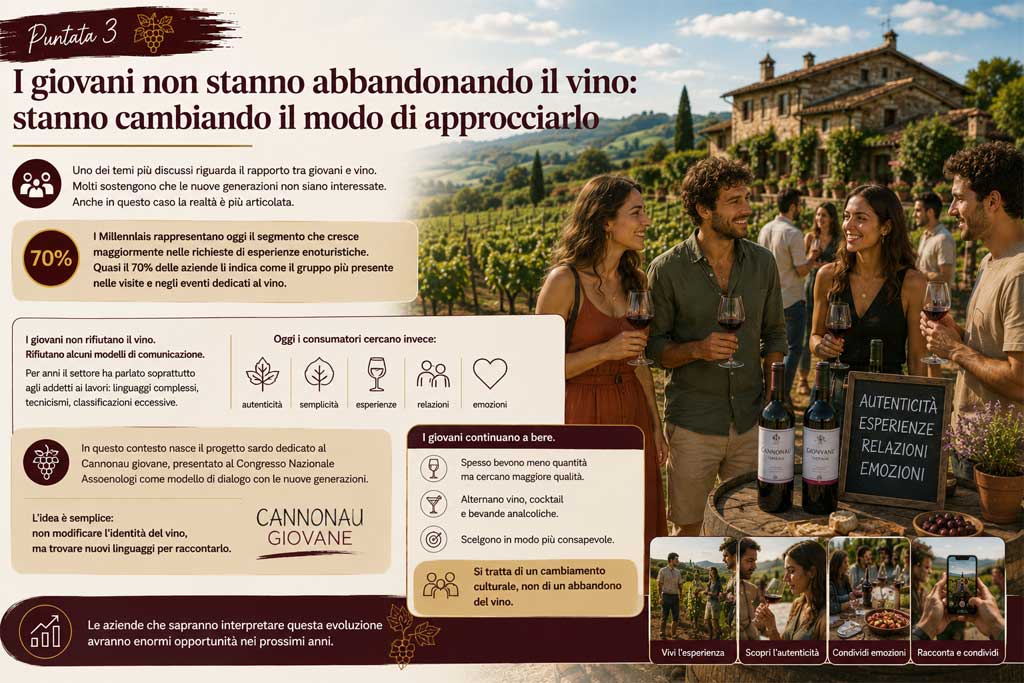
European wine tourism: young people are at the forefront. TUI Musement launches the first European Wine Tourism Index. 91% of 18-44 year-olds seek immersive wine experiences.

WINE EVENTS AND WINE CULTURE

Fieragricola 2026: Energy and Innovation at the Center From February 4th to 7th in Verona, the focus will be on agricultural technology, sustainability, and the evolution of the primary sector.

Grandi Langhe 2026: 3,000 labels and 515 wineries in Turin. One of the most strategic showcases for Piedmontese wine, between UNESCO territories and open to the public.

Amphora wine in Florence with Cantina Ottomani. A special evening on February 5th at Osteria Pratellino, combining Georgian tradition and Tuscan biodynamics.

“Vino in Circolo”: wine as conviviality. An association project is born to bring wine back to the center of gatherings and slow culture.

AIS presents “Vitae”, a new edition of the guide featuring 36 selected Lucanian companies.

Agraria al Valzani: scholarship for future winemakers. A generational pact between the school and the winery at the Due Palme cooperative.

SOCIETY, CONSUMPTION AND CURIOSITIES

The Vatican canteen menu: Mediterranean diet, DOP cheeses, and—in moderation—wine and beer for priests and nuns in Propaganda Fide facilities.

OPPORTUNITIES & STRATEGIC ASSETS (QUIDQUID)

Castelli Romani – Ariccia An established agro-winemaking and hospitality platform in the Rome area, with a DOC Roma designation and strong potential for scale.

Friuli Venezia Giulia – Export-oriented asset along the Venice–Trieste axis. 74 hectares, 9,650 hl cellar, 70% exports, turnover of ~€4 million, energy self-sufficiency and a complete real estate system.

Chianti Classico – Historic estate 18 km from Florence. 120 hectares, historic DOCG rights, a brand with 60 years of history and an iconic position in the Gallo Nero (Black Rooster) area.

Thanks for listening. Today’s wine press review was brought to you by WINEIDEA.IT .

See you tomorrow.

Wine press review for Sunday January 25 -2026

Italian wineries and producers, and wine news.

Italian wineries

Ca’ dei Zago – Valdobbiadene Prosecco Superiore DOCG Dosaggio Zero 2024 A small family-run business in San Pietro di Barbozza that interprets Prosecco DOCG by recovering historic vines and a strong territorial identity, led by the Zanatta brothers.

Cantina di Lisandro – Castel Campagnano (Campania) Restoration of a historic winery with a project focused on the native Pallagrello and Casavecchia grape varieties, organic farming, and integrated wine tourism.

My Casale (Rimini) triumphs at the Concours Mondial de Bruxelles. The Cabernet Colli di Rimini DOC awarded in Brussels: international recognition and regional valorization for a small excellence from Romagna.

Le Carline – Eastern Veneto Pioneers of organic and resistant grape varieties (PIWI), sustainability, experimentation, and structured growth in an area traditionally devoted to simple wines.

Cantina Valtidone launches “Grinta,” a new artistic label inspired by sport and the Olympics, combining wine, urban art, and local storytelling.

Italian wine and Italian oenology

Angelo Gaja: Fairs, Inventories, and the Future of Red Wine Strategic reflections on international fairs, overproduction, consumer education (“Rosso-Fresco”), and new wine languages.

Wine Defects: How to Recognize Them in Your Glass A practical guide to the main sensory defects and the chemical-microbiological causes that compromise the quality and identity of wine.

From “King Sangiovese” to terpenes. Winemaker Paolo Vagaggini’s book explores the genetics, aromas, and culture of Tuscany’s iconic grape variety.

60 million hectoliters in the cellar, but prices aren’t dropping. Record stocks, slow sales, and no price reduction: a system that postpones the problem of marketing and positioning.

Montalcino wines and cellars: no unanimity among the guides. WineNews analysis of the divergences among wine critics: the end of “certainties” and a plurality of interpretations regarding value.

Wine as a noble biomass: ten million hectoliters sitting in the cellar . From stock as a problem to wine as an industrial platform for ingredients, functional beverages, and alternative supply chains.

International

Tariffs and markets: Sandro Bottega’s position Criticism of European constraints and defense of a free but regulated market, based on brand protection and WTO principles.

Nicolas Joly’s biodynamic crusade The debate between radical naturalism and a balanced approach: the wine of 2026 transcends the “natural vs. modern” dichotomy.

TAP Air Portugal: wine as a travel experience 55 new Portuguese labels selected for the 2026 wine list: winemaking becomes part of the flight’s identity.

Names, protection and innovation

Fake Chianti on the web: over 2,500 illegal entries. Digital counterfeiting alert: improper use of the name in e-commerce, wine kits, clothing, and domains.

Wine you can touch and listen to. AIS Lombardia presents its Braille label with NFC: accessibility and inclusion enter the story of wine.

Territories, governance and wine communities

“Visione Vino Oltrepò” is born, a strategic community focused on Pinot Noir, supported by TEHA-Ambrosetti: an alliance between institutions and businesses for the territorial revitalization.

Women of Wine Tuscany: Donatella Cinelli Colombini reappointed. Female leadership and membership growth: Italy’s largest delegation renews its board.

Federica Fina elected president of MTV Sicilia. A new direction for Sicilian wine tourism: marketing, hospitality, and events at the heart of the 2026 strategy.

Wine and culture events

“Changing Stories” in Fagagna – I’ll Give You a Rose: A botanical and narrative workshop featuring gardens, cuttings, and storytelling, intertwining nature, memory, and culture.

Strategic wine assets (QUIDQUID – WineIdea)

Castelli Romani – Ariccia: Integrated agro-winemaking and hospitality platform in the Rome area: territorial value, the Rome DOC, and potential for scale.

Friuli Venezia Giulia – Export-oriented asset , 74 hectares, industrial winery, 70% exports, energy self-sufficiency: a platform ready for structured groups.

Chianti Classico – Historic estate 18 km from Florence. 120 hectares, historic DOCG rights, and premium real estate: a highly strategic asset acquisition.

Thanks for listening. Today’s wine press review was brought to you by WINEIDEA.IT .

See you tomorrow.

Strategic Analysis – From Unsold Wine to Industrial Platform (forbus)

New models for valorizing wine stocks: depletion, ingredients, and green chemistry.

From unsold wine to the industrial platform.

FORBUS – Strategic Governance for Italian Wineries
Strategic consulting network created by QUIDQUID Srls – Strategic Business Advisor

In wine there comes a point when stock stops being an asset and becomes pressure.
Ten million hectoliters sitting in the cellar aren’t a reserve: they’re a financial cost, a health risk, and a devaluation of assets.

But they can also be something else.

If managed with an industrial logic, those volumes become a platform of products, ingredients, and supply chains capable of generating value outside the traditional wine perimeter.

Because today the market no longer rewards “wine itself”.
It rewards specific functions: drinkability, serviceability, low alcohol content, sustainability, ingredients, industrial stability.
Wine is no longer just a bottle with a poetic label. It is an agricultural raw material with high chemical and functional content.

From this awareness a new strategy is born: managing wine as a noble biomass.

From wine to the product portfolio

Part of the stock can still be valorized by remaining in the beverage orbit, but with industrial logic.

The fastest solutions concern private label wines for large-scale European distribution, bag-in-boxes and lightweight formats, which allow for rapid rotation and immediate liquidity.

The bases for sparkling and semi-sparkling wines transform low-alcohol technical wines into cuvées for bubbles, one of the few segments still dynamic on international markets.

Dealcoholized and low-alcohol wines today represent the true “second life” of European wine. Demand is growing in Northern Europe, Canada, the United States, and Asia, while the supply of technical raw materials remains insufficient.

Finally, the RTD and mixology channel opens up to the world of industrial beverages: ready-to-drink spritzers, wine-based cocktails, and premium sangria. In this segment, what matters is not names or storytelling, but stability, alcohol content, color, and continuity of supply.

These solutions allow you to quickly reduce inventory.
But the real strategic leap occurs when we definitively exit the wine and spirits sector.

Wine as a “noble chemical broth”

Chemically, wine is an extraordinary mixture: structured water, alcohol, organic acids, polyphenols, residual sugars, aromas, mineral salts.

If we stop calling it wine and start calling it organic feedstock, a huge industrial ecosystem opens up: ingredients, cosmetics, nutraceuticals, pharmaceuticals, food processing, green chemistry.

There are at least seven main supply chains active today.

Tartaric acid and tartaric salts

Wine is the world’s leading natural source of tartaric acid.
Food additives, pharmaceuticals, fine chemicals, and green stabilizers represent a structural demand with stable prices and multi-year contracts.

Polyphenols and antioxidants

Resveratrol, flavonoids, and catechins are extracted from red wines for use in anti-aging cosmetics, supplements, and functional beverages.
Here the price is not per liter but per kilogram: one of the few cases in which an unsold wine becomes a premium ingredient.

Bioethanol and green chemistry

Renewable fuels, solvents, detergents, medical disinfectants.
Low unit margin, but the ability to absorb enormous volumes and guarantee constant flows.

Industrial vinegar and organic acids

Food processing, preserves, ready-to-eat products, and sauces.
Simple technology, stable market, massive uptake.

Natural flavors and aromatic waters

Premium soft drinks, iced teas, kombucha, natural perfumes.
The industry is moving away from synthetic flavors in favor of certified natural sources.

Fertilizers and biostimulants

Real circular economy: liquid fertilizers, fermented substrates, soil conditioners for intensive and organic agriculture.

Biomaterials and bioplastics

Natural resins, green solvents, additives for paper and fabrics.
Large European chemical groups enter here with multi-year agreements.

The industrial model: “empty warehouse, create business unit”

The real turning point isn’t choosing a product. It’s designing industrial architecture.

The most effective model today is the twin-engine one.

Engine 1 – Depletion (0–24 months)

Objective: drain volumes, generate cash, reduce risk.

Bioethanol and technical alcohol, industrial vinegar, fertilizers, and biogas allow for rapid inventory reduction, reduced health risks, and restored cash flows.

Here we are looking for speed, not margin.

Engine 2 – Valorization (12–60 months)

Objective: to create a new high-value industrial division.

The three strategic business units are:

  • antioxidant ingredients and polyphenols,
  • tartaric acid and tartaric salts,
  • natural aromas and flavours.

The winning model is the selective joint venture: the manufacturer supplies volumes and guarantees continuity, while the industrial partner invests in facilities, certifications, and customers.

The result is a radical transformation of the economic profile: no longer selling wine at a few cents a liter, but the creation of industrial participations.

From cellar to agricultural refinery

This isn’t a sales crisis. It’s a model crisis.

With ten million hectolitres there is no need to look for marginal alternative products.
We need to build a platform for the industrial valorization of wine, as already happens for sugar, corn and sugar cane.

Looking ahead, a “Bio-Ingredients & Green Chemistry” division could become worth more than the winery itself in just a few years.