

All posts by admin

Wine press review for Saturday December 20 – 2025

Wine news, Italian wineries and wines.

Italian wineries

The new Erbaluce labels that Olivetti would have liked. The Cantina Sociale della Serra is revamping its “Anfiteatro” line with embossed labels depicting the Canavese region: Serra, Lake Viverone, the Dora River, and the morainic amphitheater. This identity project complements the launch of their new e-commerce site and strengthens the connection between members, the local area, and direct sales.

Maculan and solidarity: 300 bottles for the Eye Bank. The Maculan winery is launching a charity auction featuring 300 limited-edition bottles of Santalucia 2024 to benefit the Veneto Eye Bank Foundation . The event will be held at Le Calandre restaurant: by 2025, the goal is to exceed €400,000 raised in 16 years.

La Roccola dei Colli Euganei opens a new store in the Polesine area. The La Roccola dei Colli Euganei winery opens a store in Grignano Polesine dedicated to bulk and bottled wines. This local operation brings quality and a direct relationship with consumers beyond its historic production area.

Tenute Lu Spada: organic rosés shine in 2025. The Tenute Lu Spada winery has won international recognition with its organic rosés, including a silver medal at the International Organic Wine Award in Germany. This project combines native grape varieties, organic production, and international positioning.

Ventiventi: When unity is strength. In Medolla (MO), the Ventiventi winery led by the Razzaboni brothers demonstrates how a new generation can reinterpret Emilian wine with a contemporary vision and a strong corporate identity.

Cantina Tollo: double-digit growth. The Cantina Tollo cooperative closed its 2024-2025 financial year with a turnover of €41.3 million (20%) and a 35% increase in production value. The remuneration of its contributing members also increased.

Terre de’ Trinci: Certifications and Territory The Terre de’ Trinci winery is strengthening its DOC/DOCG, organic, and SQNPI certifications, integrating sustainability, territorial identity, and events as levers of credibility on the market.

Canneddu Winery in Mamoiada: tradition and innovation. Canneddu Winery is investing in technology thanks to OCM Vino funds, aiming to establish a structured presence outside of Sardinia.

Saffirio: Sustainability as a Practice In Monforte d’Alba, Saffirio, led by Sara Vezza, confirms a consistent vision: organic and biodynamic as operational choices, not as slogans.

Torre di Terzolan: Amarone in amphora from the Squaranto Valley. Torre di Terzolan offers an original interpretation of eastern Valpolicella, combining history, biodiversity, and experimentation in amphora.

Italian wine and Italian oenology

The “monasteries of wine”: history and spirituality A cultural journey through Italian wine with contributions by Attilio Scienza , Vittorio Moretti and Renzo Cotarella , including historic abbeys and large estates such as Badia a Passignano and Praglia.

Mattia Vezzola: “Thirty Years of Wine Counterfeiters” The Costaripa owner reflects on the risk of narrative homogenization in Italian wine. A powerful call for authenticity, penned by one of Franciacorta’s key figures.

Savory Panettone and Wine: New Pairings With Motta and Chef Bruno Barbieri ‘s Savory Panettone with Arrabbiata, wine – especially sparkling rosé – becomes the protagonist of a less predictable Christmas.

Alcohol-Free Wine: The Debate. A survey reveals a divided industry: some consumers are open to innovation, while others defend tradition. This is a signal that deserves careful strategic attention.

Does wine always improve with age? An in-depth analysis that dispels common myths: not all reds improve with age, but some whites do. Technical knowledge at the service of drinking choices.

Fire Prevention in Cellars: The Fire Department’s clarifications on Presidential Decree 151/2011 specify that wine under 20% ABV is not classified as a flammable liquid. This is a relevant operational issue for many facilities.

International

Mercosur and wine: a national strategy is needed According to Città del Vino , the EU-Mercosur agreement should not be abandoned but managed with protection and vision, especially in a phase of difficulty on the US markets.

Coface: Structural Imbalance in European Wine Coface ‘s analysis highlights the structural decline in consumption in Europe (-35% since 2000) and the need to adapt the global production model.

Michelin enters the world of wine. The Michelin Guide introduces “Bunches” as a new winery rating system, following its acquisition of Robert Parker – Wine Advocate. A potential new international benchmark.

Wine events

Christmas in the Cellar 2025 in Tuglie Music, nativity scenes and workshops until January 6th at the Peparussu Cellar , with events dedicated to families and children.

Save the date – Veneto Wine Triptych 2025 The final focus organized by Veneto Agricoltura will be held on January 16, 2026 in Legnaro (PD): definitive data on the 2025 harvest and market scenarios.

Today’s wine press review is brought to you by WineIdea.it . See you tomorrow.
Wine press review for Friday December 19 – 2025

Wine news, Italian wineries and wines.

ITALIAN CELLARS

Cantine di Verona: 2024/25 revenues of €58.3 million. The cooperative (Valpantena, Custoza, Colli Morenici, Brolo dei Giusti) closed the fiscal year (11 months, ending July 31) with revenues of €58.3 million. On a 12-month basis: 1.57%. Exports accounted for 80% of the total (Scandinavia, UK, Netherlands, Switzerland, Germany). Profit was €420,000.

Cantine Riunite & Civ: revenue of €266.5 million, net profit of €1.8 million. Balance sheet as of July 31, 2025: revenue down but profit positive. Shareholders’ equity strengthened to €205 million and net financial position improved. 2025 estimate: consolidated revenue over €650 million, with presence in foreign distribution networks.

Vallepicciola “Best Winery of the Year” according to Le Guide de L’Espresso The Chianti Classico winery (owned by the Bolfo family) consolidates its reputation with the award and with a path made of solid winemaking, national and international criticism, and wine tourism development.

Schmid Oberrautner (Bolzano): Grand d’Or at the 2025 Mondial des Vins Extrêmes The 2022 Lagrein Riserva wins the Grand d’Or medal, a recognition linked to heroic viticulture, with an award ceremony at the Forte di Bard.

ITALIAN WINE AND ITALIAN ENOLOGY

“Wine is Europe’s Identity Card”: Gianfranco Ravasi on Culture, Food, and Symbols. A reflection on the value of wine as a European and Italian cultural and identity element, linked to the sense of the table, conviviality, and tradition.

Italian wineries as of November 30, 2025: growing inventories. In the factories: 53.3 million hectoliters of wine, 9.7 million hectoliters of must, 9.5 million hectoliters of VNAIF. On an annual basis: 8.6% wine, 12.5% must. Strong concentration in the North (Veneto in the lead). Shares: 54.6% PDO, 26.5% PGI. 20 denominations out of 526 account for 58.4% of the PGI inventories.

Nomisma: Weak domestic demand, exports more central but more complex. Wine Monitor highlights a slowdown in large-scale retail trade and more cautious consumers. On the US front, tensions over costs, exchange rates, and tariffs, putting pressure on margins and requiring a more structured trade strategy.

Rhetoric and wine: communication is a profession (and must be studied) A “systematic” reading: communication is an economic and reputational lever, but requires specific method and training, which is still not widely available in Italy today.

Wine in 300 words: Erbaluce di Caluso “La Rustìa” 2022 (Orsolani) Focus on a white wine from Canavese: ripe grapes, a fresh and vertical profile, citrus notes and aromatic herbs.

INTERNATIONAL

French Champagne Test: Major Brands Bottom of the Classification In Que Choisir’s test of 32 bottles, none exceed 15/20. Veuve Clicquot (22°), GH Mumm (24°), Moët & Chandon (26°): “Noise” affects perceived value for money.

Selosse: “Italian sparkling wine shouldn’t imitate Champagne.” The winemaker, a symbol of artisanal Champagne, reiterates his anti-standardization vision and focuses on still wines. He criticizes the collaboration with Feudi di San Gregorio on the Dubl project.

From iconic Champagnes to signature Metodo Classico: 15 bubbles for New Year’s Eve. A selection of Champagnes, Metodo Classico wines, and even a non-alcoholic Blanc de Blancs. A spotlight on historic houses (Billecart-Salmon, cuvée Nicolas François) and the theme of “time” as a production style.

“Do you want to be French?”: Christmas menu with French wines available in large-scale retail outlets. A selection of Christmas pairings featuring French wines available in Italian supermarkets (focusing on affordable quality and thoughtful selection).

MARKETS, CONSUMPTION AND TRENDS

Holiday trends 2025 by Partesa: great Italian wines are an international curiosity. For the HoReCa sector: demand for authentic experiences and excellent products. Champagne and American reds are joining Italian brands. There’s also room for beers, grappas, and bitters. The scenario: out-of-home consumption is slightly down, but consumers are more mature.

Vinarius: Premiumization confirmed, fewer bottles but higher value. Wine shops report declining volumes and increasing value. Wines with a distinct identity and a strong territorial identity are growing, along with a focus on low alcohol content and sustainability (green packaging).

Vinarius Trends 2025/2026: Whites and sparkling wines on the rise, with Classic Method leading the way. Confirmation of a changing market: lower-end wines under greater pressure, premium wines more resilient; a preference for freshness and lightness, without abandoning the great classic reds.

No/low-alcohol wines: readers divided. Survey (892 responses, closed December 18): 35% favor it as a health/conviviality compromise; 22% are curious about it, but it doesn’t replace traditional wine; 42% are opposed (“it’s not wine”).

REGULATIONS AND SYSTEM

UIV: Tax decree on dealcohol products still stalled, Italy lagging behind in competitiveness. The Italian Wine Union (Unione Italiana Vini) urges the MEF-MASAF interministerial decree: investments have already been initiated by companies, but regulatory stalemate. UIV reports a competitive advantage abroad that has been established for approximately four years (post-EU Regulation of December 2021). (The three news items on the topic converge on the same point: “conclude by the end of the year.”)

WINE EVENTS

AIS Veneto presents Vinetia: the best Veneto wines for the holidays. Twelfth edition in Venice (Hotel Ca’ Sagredo): prizes for the 7 winners chosen from 21 finalists, with blind tastings and a jury of 40 professionals.

“Foreign Wines” in Verona: ten producers at Osteria Ratafià (December 21) Event dedicated to natural and artisanal wine (ticket €15 including a glass and tastings), with winemakers from various Italian regions and a focus on community and discovery.

Villa d’Este: wine as an experience, a monumental cellar, and high-level hospitality. A Christmas lifestyle story on Lake Como: atmosphere, dining, and the cellar as the narrative heart of the place.

Marche: initiatives on well-being, the environment, and quality supply chains. Focus on regional policies (Law 7/2023) and initiatives: food education, districts, protection of quality products, collaboration with Slow Food, and territorial valorization.

QUIDQUID – Strategic Business Advisor

Where value isn’t talked about: it’s demonstrated. Thanks for listening: today’s wine press review is brought to you by WINEIDEA.IT . See you tomorrow.

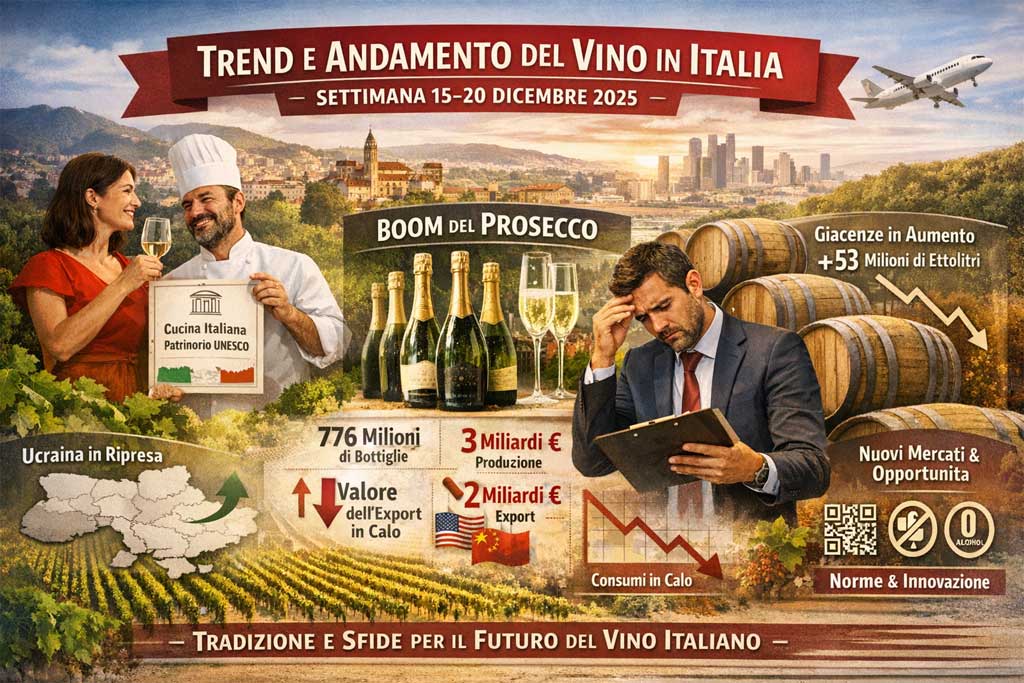
Wine Trends and Performance in Italy Week 15–20 December 2025

The week of December 15-20, 2025, paints a picture of an Italian wine sector marked by stark contrasts: on the one hand, unprecedented cultural and reputational recognition; on the other, structural tensions in markets, consumption, and inventory levels that require rapid and coordinated strategic decisions.

UNESCO’s recognition of Italian Cuisine as an Intangible Cultural Heritage of Humanity has significantly strengthened the international positioning of Italian wine, an integral and inseparable part of this heritage.

The sector emerges enhanced not only symbolically, but also economically: wine contributes significantly to the agri-food trade balance, with approximately €7.5 billion in annual revenue. It is an intangible asset that strengthens the Italian brand, tourism, and the overall attractiveness of the regions.

Within this framework, sparkling wines remain the true driving force of the wine industry , with Prosecco the undisputed star. The numbers for 2025 speak for themselves: 776 million bottles sold in the first nine months, a presence in 180 countries, a production value of €3 billion, and over €2 billion in exports. Growth is occurring across the three denominations—Prosecco DOC, Conegliano Valdobbiadene DOCG, and Asolo DOCG—which demonstrate their ability to work collaboratively, managing production expansion and jointly addressing crucial challenges such as declining purchasing power, US tariffs, and the search for new markets. Prosecco confirms its position as an accessible, intergenerational product with a winning quality-price ratio and extraordinary adaptability to new global consumption patterns, becoming a trailblazer for the entire Italian winemaking industry.

On the international front, mixed signals are emerging. Ukraine remains a recovering market, with consumption and imports growing in 2024–2025. Italy is a leading supplier, benefiting from a demand shift toward dry wines and Western styles, especially among younger, urban consumers. Conversely, the global picture remains complex: France also reports a decline in exports in 2025 (-2.5% in value), with sharp declines in the United States and China, demonstrating a crisis not limited to Italian wine.

In Italy, however, the most critical figure remains that of stocks . With the 2025 harvest concluded, Italian wineries held 8.6% less wine than in 2024, with over 53 million hectoliters in stock, in addition to musts and fermenting wines. The concentration of inventories in Northern Italy and in the main PDO and PGI designations highlights how even wines with higher added value are not immune to the slowdown in consumption. This structural imbalance between production and demand represents one of the main factors pressuring prices and companies’ profitability.

Italian exports continue to show signs of weakness: in the first nine months of 2025, their value fell by 2.2%, with the sharpest decline in the United States, the primary market. The recovery in volumes, despite declining values, indicates price compression to stimulate weaker demand. Some European markets, such as Germany, France, and the Netherlands, are showing positive signs, but they are not sufficient to offset the losses in non-EU markets and North America.

In this complex context, however, encouraging institutional signals are emerging. The green light for the European “Wine Package” introduces greater flexibility in crisis management tools, simplified labeling (QR codes and digital labels), strengthened promotional measures in third-party countries, and recognized wine tourism as a fundable lever. Regulatory frameworks for zero- or reduced-alcohol wines are also clarified, addressing one of the most significant global consumption trends.

Finally, the Christmas season confirms that, despite the crisis, the demand for quality remains resilient . According to Partesa, during the 2025 holidays, great Italian wines will remain central, alongside Champagne and premium international brands. There is a growing focus on authentic experiences, excellent products, and more informed consumption, with growing interest in low- and no-alcohol options as well.

Final summary
Italian wine closes 2025 suspended between an unprecedented strength of identity and reputation and an economic crisis that demands rigor, selection, and strategy. Sparkling wines—Prosecco first and foremost—lead the system and point the way: value, accessibility, supply chain coordination, and openness to new consumption styles. The challenge of the coming months will be to transform cultural and symbolic capital into economic sustainability, managing inventories, rethinking the offering, and strengthening its positioning in markets that, despite everything, continue to seek out Italian wine when it speaks the language of the present.

Wine press review for Thursday December 18 – 2025

Wine news, Italian wineries and wines.

Italian wineries

Barolo, Conterno to the Consortium: “No to rash decisions, let’s stop for three years.” The appeal from one of Barolo’s most authoritative voices urges caution: amid macroeconomic uncertainties, tariffs, falling grape prices, and instability in international markets, now is not the time to increase production. The proposal is to freeze eligibility for three years and then carefully evaluate how the situation evolves.

Cantina di Ramuscello, a growing balance sheet. Cantina Produttori Ramuscello e San Vito closed the 2024 wine year with a profit of €21,000 (23%) and a turnover exceeding €13 million. Consignments of over 122,000 quintals from 881 hectares of vineyards and a solid management structure benefiting its 171 members.

Cantine Riunite & Civ reported a turnover of €266.5 million, a net profit of €1.8 million, and a net equity of €205 million. Despite a challenging global environment, the cooperative consolidated its structure and strengthened exports to Europe and Asia.

Tenute Lu Spada, the 2025 of organic rosés. International awards and recognition for Puglia’s organic rosés: silver medal at the International Organic Wine Award in Germany and excellent scores in national competitions dedicated to rosés.

Ferraris Agricola, 10% revenue in 2025. Double-digit growth and a 30% operating margin for the Piedmontese company specializing in Ruchè. Over €1.5 million invested in innovation, food and wine tourism, and foreign market development.

Italian wine and Italian oenology

Italian wine exports decline: -2.2% in September 2025. Exports totaled €5.7 billion in the first nine months of the year. Volumes are recovering, but prices are falling. The United States remains the most critical market, with a 13% decline in September alone.

Wine inventories up 8.6% According to the “Cantina Italia” report (ICQRF), as of November 30, 2025, inventories reached 53.3 million hectoliters. This signals strong market pressure in a context already marked by international crises and tariffs.

The wine revolution in Piedmont: fewer rows, higher quality. Confagricoltura and the Asti DOCG Consortium propose a paradigm shift: reducing vineyard area, greater vineyard care, and innovation as a response to climate change and the consumer crisis.

Wine Trends 2025–2026: Lower Volume, Higher Value. The Vinarius analysis highlights a clear premiumization of consumption. Wine shops are becoming privileged observers of a more attentive, curious public, oriented toward wines with a distinct identity and a local flavor.

Wine Culture and the Mediterranean Diet. The study promoted by Signorvino, with the scientific contribution of Professor Giovanni Scapagnini, explores the relationship between moderate consumption and quality of life, placing wine within the cultural and social context of the Mediterranean Diet.

Scientific Research and Wine: New Studies on Well-Being and Cognitive Decline An interdisciplinary project relaunches the topic of varied-moderate wine consumption as part of a balanced lifestyle, in line with the recent UNESCO recognition of Italian Cuisine.

International

Rosé wine for one cent at Lidl in France The case of Sérignan, in Languedoc, becomes a symbol of the European wine crisis: falling prices, declining consumption, and growing pressure on the production chain.

South Africa, focus on Stellenbosch . Over 7.4 million hectoliters of wine will be produced in 2024. Stellenbosch is distinguished by its predominance of red grape varieties, with Cabernet Sauvignon, Merlot, and Shiraz being the mainstays.

German winemakers join EFOW The German Wine Association joins the European Federation of Wines with Geographical Indications, strengthening the representation of wines of origin in EU discussions and on international markets.

Wine events

Uniamo – Unconventional Wines and Dinners, Palermo, January 15–18, 2026. This is the third edition of the event that combines natural wine, contemporary cuisine, and cultural dialogue, featuring national and international chefs in a “contemporary tavern” open to the world.

®Vendemmia Solidale Charity Dinner. The Grand Hotel Villa Torretta hosted a fundraising event to build a school in Ghana. The Conegliano Valdobbiadene Solidale 2025, the result of the project’s 14th edition, was presented.

Masterclass Wine Experience – Terre de Trinci, Foligno Guided tasting and pairing of artisanal cheeses with Umbrian DOC and DOCG wines to promote the culture of denomination and informed tasting.

Bolzano wines on the podium at the Mondial des Vins Extrêmes The 2022 Lagrein Riserva from the Schmid Oberrautner estate wins the Grand d’Or medal, celebrating heroic viticulture.

Slow Wine recommends: “Drink and it’ll pass.” The eleventh edition of the event dedicated to Nebbiolo and its territories, including tastings and masterclasses for enthusiasts and professionals.

Markets, olive oil, and wineries: Christmas events From the Ossola Valley to the rest of Italy, food itineraries and tastings liven up the Christmas week with tradition, wine, and local products.

Thanks for listening. Today’s wine press review was brought to you by WINEIDEA.IT .

See you tomorrow.