All posts by admin

Santa Barbara Mining Trail Wins Komoot’s Global Choice Award

For the first time the prize is awarded to a Camino.

The Carignano del Sulcis Trails are among the honorees for 40,000 overnight stays in the 2024-2025 two-year period. To celebrate with the community, 2,000 nights are available to hikers at the symbolic price of 10 euros.

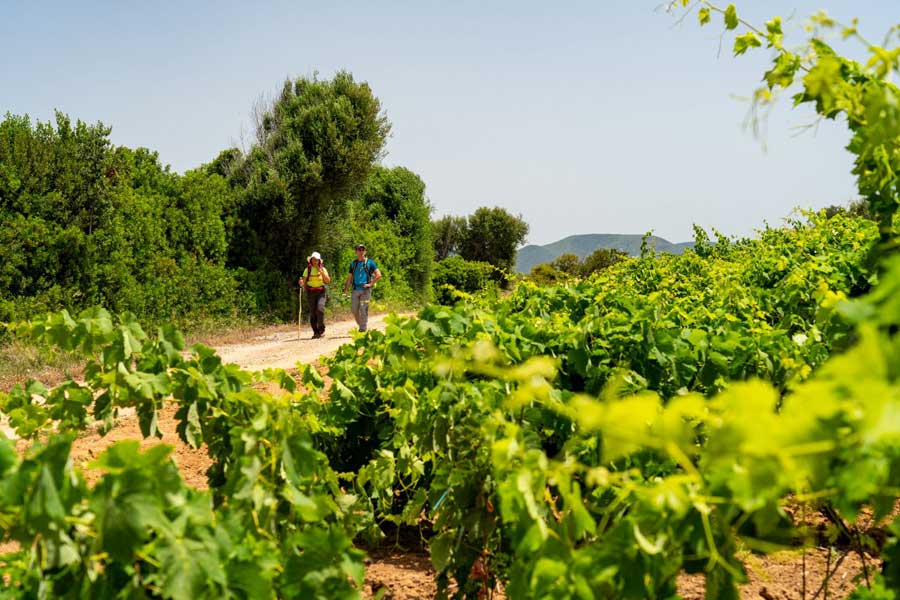
The Santa Barbara Mining Trail has received a highly prestigious recognition in the international hiking and slow tourism scene, winning the Global Choice Award from Komoot, the world’s largest outdoor platform with approximately 50 million users. The award, which the Santa Barbara Mining Trail Foundation dedicated to the memory of Giampiero Pinna , founder and former president of the Trail, was presented to Andrea Tarozzi , director of the administrative area, and his colleague Roberto Rossi , Komoot campaign coordinator, during a ceremony held during the CMT in Stuttgart, the most important international trade fair dedicated to tourism, leisure, and the outdoors.

Awarded for the first time to a Camino, the Global Choice Award is the result of a global consultation held in December 2025, which saw the Santa Barbara Mining Trail emerge from six internationally renowned finalists: Tourspain, the Municipality of Genoa, Trans Canada Trail (Canada), GT 20 Bike (Corsica), and Sauerland-Höhenflug (Germany). A distinctive feature of the award is its strong participatory value: not a technical jury, but the Komoot community expressed their preference, recognizing the Santa Barbara Mining Trail as an authentic, engaging experience capable of narrating the region through the journey.

The award recognizes a unique project: a circular route of over 500 kilometers in southwestern Sardinia, which crosses landscapes of extraordinary variety between Sulcis Iglesiente, Arburese and Guspinese, touching abandoned mining villages, historic mines, ancient forests, silent countryside and coastal stretches of rare beauty. In the two-year period 2024-2025 the Path has

approximately 40,000 overnight stays were recorded, with a 30% increase in 2025 compared to 2024. The international presence is also constantly growing, particularly among tourists from Germany.

The Camino is complemented by the CMSB Cycle Path, which largely overlaps with the pedestrian route, and the ” Sentieri del Carignano ” project, which combines slow tourism, landscape, mining history, and ungrafted viticulture. This route goes beyond hiking, becoming a living narrative of community, work, and identity, making a concrete contribution to the revitalization of the region. It is part of a growing international interest in Sardinia, chosen as a ” Top Destination 2026″ by Lonely Planet.

In the official citation for the award, Komoot emphasizes how the Camino has won over the community thanks in part to its dedicated Collection, which faithfully reproduces the official route and provides practical tools for planning the trip, making the experience accessible, exciting, and truly usable.

The Santa Barbara Mining Trail Foundation is deeply satisfied, viewing the award as a collective and strategic achievement. Mauro Usai, President of the Santa Barbara Mining Trail Foundation, stated: “This award represents further affirmation of the Santa Barbara Mining Trail, but above all, it is recognition for the communities through which hikers and cyclists pass, who bring it to life every day with patient, shared work, and collaborative efforts. The Global Choice Award confirms the validity of our approach: offering slow, sustainable, and profound tourism, capable of combining walking, knowledge, and human connection. The Santa Barbara Mining Trail demonstrates that it is possible to showcase a destination in an authentic, credible, and contemporary way, even through digital marketing.”

For its tenth anniversary, the Santa Barbara Mining Trail has chosen to transform the award into an opportunity for sharing, giving back to the true protagonists of this success: the hikers. To celebrate the Global Choice Award and thank the community that believed in the project, the CMSB Foundation is offering 2,000 nights at the symbolic cost of 10 euros in participating inns and accommodations along the trail. The initiative will be available during two ideal periods for experiencing the trail in a slow and authentic way— from February 10 to June 10 and from September 10 to December 10, 2026 —with vouchers available starting January 26 .

A concrete gesture that reflects the spirit of the Santa Barbara Mining Trail: a project born in the local area, growing thanks to the communities, and continuing to walk alongside people, transforming an international award into an open invitation to take up the journey.

Wine press review for Tuesday January 20 -2026

Wine news, Italian wineries and wines.

Italian wineries

Terre d’Oltrepò Crisis: A Landmark Winery Between Liquidation and Relaunch. Lombardy’s largest cooperative remains in forced liquidation: arrears to suppliers (2024 harvest), uncertainty for 2025, declining deliveries, and a future still unclear.

Sixty years of Cantine Lunae: Liguria’s wine according to Bosoni. In 2026, the company celebrates 60 years: focus on traditional grape varieties, vocation of the land, protection of the territory and constant qualitative growth.

Ampeleia renews its visual identity: new names and labels. A measured and consistent rebranding: new bottles debut (Ampeleia, 16 File, 30 File) and other styles coming soon. Distribution in Italy and international markets.

Wine tourism and sustainability: the Sicilian winery that has been innovating for nearly 200 years. A long entrepreneurial history, evolving towards a modern supply chain model and promoting indigenous products; a winemaking and aging cellar as a development asset.

The Collio winemaker who chose to wait. An “artisan” and rigorous profile: organic, low yields, densely planted and a distinctive choice of late release of the wines (at least 5 years), with a focus on depth and flavour retention.

Monks’ wines among frescoes: a 700-year-old vineyard oasis in Monte Oliveto Maggiore (Crete Senesi): a blend of art, spirituality, and agricultural tradition, with the vineyard as a historic part of the “Ora et labora” (work and labor).

Wine in the Castelli Romani: the wineries to know, according to a local chef. A detailed map of producers and territorial style: the story of an area undergoing transformation, more distinctive, more “eco-conscious,” and less standardized.

The 7 best Veneto wines: from Amarone to Prosecco. Overview by region/province: from the meditative face of Valpolicella to the convivial symbol of Conegliano Valdobbiadene Prosecco DOCG.

Should the innkeeper return to making his own wine? A story/experiment in Versilia: “Osteria-style” micro-winemaking as a contemporary return to a short supply chain and the recognizable origin of what you drink.

Tragedy in a cellar in San Polo di Piave: trial begins. The trial opens with a focus on safety in confined spaces (tanks) and organizational responsibilities.

Italian wine and Italian oenology

Resveratrol and red wine: how many glasses to “protect your heart”? An in-depth study on polyphenols and their potential cardiovascular effects (be careful how scientific data is translated into “recommended doses”).

Wine crisis? Beware of self-fulfilling prophecies. A critical analysis of “catastrophism”: confirmation bias, clickbaiting, and a partial understanding of trends risk influencing supply chain and market decisions.

Trebbiano Toscano Metella 2024 Di Marzio Focus on label/territory with cultural appeal (Cecilia Metella) and style story.

Barbera d’Asti Le Orme 2023 (Michele Chiarlo) in Wine Spectator’s Top 10 Wine Values International recognition for its quality-price ratio and diffusion on the US market, with significant scores and volumes.

International

Canada: Italian wine leads a growing premium market. ICE Toronto data: strong Italian imports (value and share), positive trends for whites/rosés/sparkling wines (Prosecco in evidence), and a dominant presence on restaurant menus.

The highest vineyard in the world (Tibet) at 3,700 meters: new ambitions Extreme viticulture and “geographical storytelling”: first exports (e.g. to Hong Kong) and certified record.

France: Grape sugar to sweeten the red wine crisis. Opening to an innovative practice also within the AOC perimeter: “consumer-driven” reading to capture softer tastes and new consumers.

From university to wine in the USA: the story of Salvatore Napolitano. A life change and cultural journey that led to wine production and marketing in the United States.

Wine events

Grandi Langhe 2026 at the OGR in Turin (26–27 January) Professional “en primeur” tastings of Piedmont: Barolo, Barbaresco, Roero and a wider panorama (Alto Piemonte, Monferrato, Astigiano, classic/charmat method).

Wine&Siena (January 31 – February 2, 2026): wine, art, and guided tours. Sensory itineraries and access to guided tours (Santa Maria della Scala) for a format that integrates tasting and cultural heritage.

Wine Tech Challenge: Innovation enters the cellar. A collaboration program between companies and startups: concrete solutions for climate, sustainability, traceability, and markets.

FORBUS Space / TenuteAgricole24

FORBUS: when quality is no longer enough Positioning: operational direction on complexity (costs, inventories, channels, wine tourism, digital, low/no, true sustainability) and 5 pillars of intervention.

You’re not looking for a listing. You’re looking for a deal. Deal-driven message: reserved access to select assets (wine/agriculture/mineral water) before they go public.

Strategic winemaking asset – Friuli Venezia Giulia 74 ha (52 irrigated vineyards), cellar >10,000 hl, 150k bulk bottles, 70% exports, water/energy autonomy, strong logistics between sea/tourism/export.

Thanks for listening, we remind you that today’s wine press review was brought to you by WINEIDEA.IT .

See you tomorrow.

Wine press review for Monday January 19 -2026

Wine news, cellars and Italian wine.

ITALIAN WINERIES

Terre d’Oltrepò, UIL’s fears over the sale. Unions are concerned about the possible acquisition by Collis Veneto Wines: guarantees regarding employment and territorial identity are needed to prevent a grape “shopping” that would distort the Oltrepò brand.

A winery at 2,000 meters above sea level: the Prié Blanc from Morgex La Cave Mont Blanc leads the promotion of heroic viticulture in the Aosta Valley, with Prié Blanc grown up to 1,200 meters as a symbol of extreme territory and Alpine identity.

From Cilento, Albamarina’s Valmezzana 2014. A portrait of longevity and slow living: a Campanian white that transcends time, evoking the value of patience and territorial expression.

Bio Cantina Sociale Orsogna welcomes the “winemakers of the future.” Eleven newborns in the families of its members: a symbolic gesture that speaks of community, generational continuity, and leadership in organic and biodynamic winemaking in Abruzzo.

A winery blending tradition and modernity in Frascati. From historic caves to a new, fully equipped cellar: a controlled supply chain and a production capacity of over 1,700 hl.

The excellence of Frascati DOC. Certified organic estate since 1996 in Montecompatri: 11.36 hectares in the heart of the Frascati DOC and DOCG regions, combining agricultural investment and cultural heritage.

ITALIAN WINE AND ITALIAN OENOLOGY

Wines to drink in 2026: six appellations to bet on. Eight Italian wines, including new ventures and rediscoveries: emerging appellations and wines penalized by changes in consumption.

EU Rural Development Funds: Italy Spends 99.43% of the Fund. Over €14 billion spent between 2014 and 2022: Spending capacity for the primary sector strengthened.

The horizons of the Veneto wine system. Harvest 2025: 1,000 hectares of vineyards, 104,397 hectares total, 75% white grapes. Veneto confirms its role as a national driving force.

Alcohol-free wine: why (for now) it’s not convincing. In Lazio, there’s little inclination to eliminate alcohol: high costs, regulatory limits for DOP and IGP products, and investments that are difficult to sustain.

Italian Wine – Key Trends | Week of January 12–16, 2026 2026 is a year of selection: lower volume, more commercial discipline, higher value per bottle.

FORBUS: when quality is no longer enough Strategic management as a true competitive factor: integrated management of viticulture, cellar, sales and branding.

INTERNATIONAL AND MARKETS

The myth of wine as an investment crumbles. The Liv-ex Fine Wine 100 Index has fallen 11% in two years. Bordeaux, Burgundy, California, and Italy are all down. Luxury wine is entering a phase of structural correction.

Garda DOC Consortium and the Euchronicles project: Four European PDOs come together to showcase their quality and origin: wine, cured meats, and cheeses as pillars of the EU agri-food model.

CULTURE, EDUCATION AND OENOLOGY

Monvigliero 2021 Barolo DOCG – Burlotto Portrait of a collectible Barolo: extreme finesse and territorial identity from Verduno.

How to Taste Wine with Quantum Physics. A thesis in Pollenzo: a philosophical-scientific approach to tasting, between consciousness and perception.

The Wine Gym Educational tasting for grape variety recognition: five single-varietal red wines to practice sensory analysis.

WINE EVENTS

Genoa – “All the Colors of White” Winter Edition January 19: tasting with wineries from 15 Italian regions, focusing on the biodiversity of white wines.

Valentine’s Day in the Cellar – Bortolomiol February 14th: Romantic candlelit visit with Prosecco DOCG and harp music.

Stories of the Langhe at the Cantina Comunale in La Morra, January 22: Theater and film on memory and emigration in the Langhe.

Native is born – Milan, January 22: Over 100 native grape varieties for tasting, closing of the national Go Wine tour.

Grandi Langhe 2026 – Turin, January 26–27: Over 2,000 accredited operators and 515 companies present at the OGR.

OPERATIONS AND STRATEGIC ASSETS

You’re not looking for a listing. You’re looking for a transaction. TenuteAgricole24 and RuralEstate24: reserved access to selected assets.

Strategic asset in Friuli Venezia Giulia: 74 hectares, 10,000 hl cellar, 70% exports: already an industrial platform, not a project to build.

If you like, in the next issue we can add a concluding editorial summary with 3–4 key messages for entrepreneurs and investors, useful for strengthening the strategic positioning of the review.

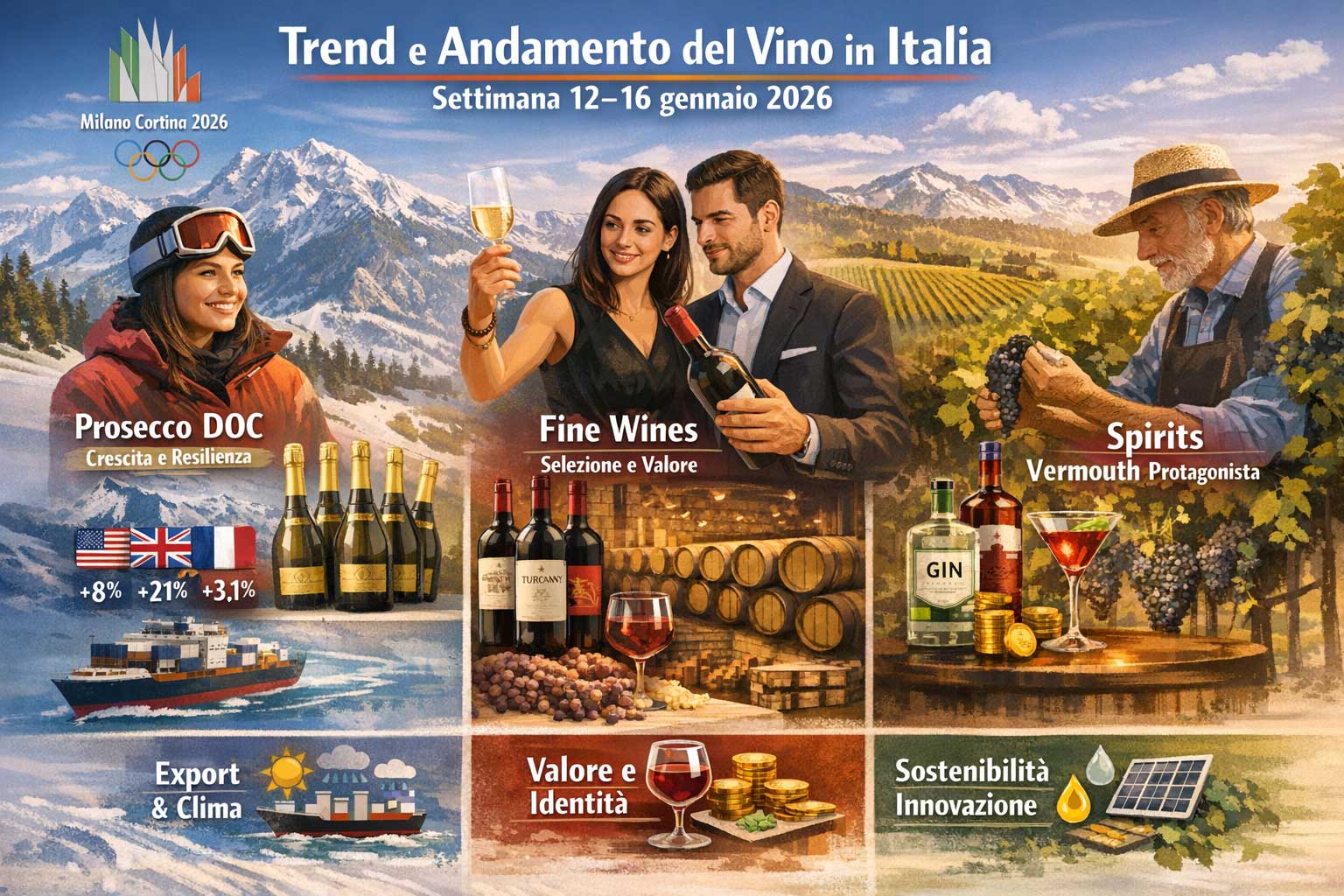
Wine Trends and Performance in Italy Week 12–16 January 2026

The week of January 12–16, 2026, captures an Italy of wine in the midst of a structural transition: on the one hand, the Prosecco “locomotive” continues to grind out volumes and value, on the other, the system as a whole must manage high inventories, more selective consumption and a 2026 that will reward those who defend margins, channels and identity.

In the middle, three decisive levers are at work: exports (with new opportunities but also tougher rules), repositioning towards value (not volume), and industrial adaptation to the climate.

1) Prosecco DOC: growth, resilience, and momentum 2026 (Milan-Cortina as a global showcase)

Prosecco DOC confirms its role as the driving force of Italian wine: 667 million bottles produced in 2025 (1.1% compared to 2024) , of which 60.3 million are Rosé (10% of the category) , for a total value of 3.6 billion euros . The denomination remains strongly oriented abroad: over 82% exports to 164 countries . The winning narrative is clear: an “easy” product in the best sense of the word (pleasantness, lightness, versatility, accessibility), supported by a consortium that links the brand to popular and high-visibility events.

Differentiated trajectories emerge in international markets (January–September 2025):

  • USA is the leading market (23.8% of exports) and 8% , albeit with volatility linked to duties.
  • UK 1.1% .
  • France accelerates and becomes the third market with 21.1% , overtaking Germany.
  • Germany 3.1% .
  • Strong signals also from “less obvious” markets such as Greece (22.4%) and Mexico (14.5%) , while other countries are slowing down for economic and geopolitical reasons.

On the promotional front, the Consortium indicates campaigns in 39 countries with 2.1 billion impressions . For 2026, the symbolic card is powerful: Official Sparkling Wine Sponsor of the Milan Cortina 2026 Olympic and Paralympic Games , an opportunity to consolidate value and positioning.

Two textbook strategic directions for 2026:

  • supply chain profitability (not just volume growth);
  • measurable sustainability , with the aim of obtaining Sustainable Community certification according to ISO 37101 and the development of a Low Alcohol Prosecco (8–9 degrees) , consistent with new styles of consumption and responsible consumption.

2) Fine Wines Market: Liv-ex Power 100 2025 and the Return of Rationality

The Liv-ex Power 100 2025 indicates a fine wine market that isn’t “rebounding,” but rather stabilizing : prices appear to have found a floor, more orderly bids/offers, and greater interest in solid, correctly priced brands. Demand stops asking “how much further will it go?” and starts asking “what’s best to buy today?”, signaling a return to selectivity.

Key trends:

  • Bordeaux is regaining its central role thanks to more consistent pricing policies: Cheval Blanc takes the top spot; Yquem remains in the top ten; cases like La Conseillante demonstrate the cost of a less “speculative” release and positioning strategy.
  • Burgundy remains dynamic but more unstable (many entries/exits), with growing interest in more “drinkable” and less extreme price ranges.
  • Champagne is experiencing one of its best results: 9 brands in the ranking, with Krug at the top and new entries such as Selosse and Salon .

Italy : Confirms its importance, but with clear internal differences. San Guido/Sassicaia soars (no. 2 overall), strengthening the role of Super Tuscans as “liquid assets” on the secondary market: global image, recognized quality, sufficient volumes, and still reasonable perceived prices. Some traditional big names, however, tied to a strong historical dependence on the US (Chianti Classico and Brunello), are struggling more, despite brands that are holding up (Ornellaia, Masseto, Tignanello, Solaia, and icons like Biondi-Santi/Soldera). In other words: in fine wine , price consistency, liquidity, and reputation are prized, not just aura.

3) 2026 Italian wine: less volume, more value (and clearer choices)

The strategic message running through all of this week’s content is one: 2026 will be a year of competitive maturity . The market no longer rewards indiscriminate offerings; it rewards those who can defend margins, manage channels, and sustain a credible identity.

Main drivers:

  • Polarized demand in Italy : accessibility and simplicity in large-scale retail, while the willingness to spend on experiences and wines with a “reason” is growing when perceived quality, service, and brand are consistent.
  • Horeca and wine tourism as platforms for loyalty and direct relationships (not just revenue).
  • Exports remain the center of gravity, but with “strict rules”: mature markets sensitive to price; emerging markets requiring continuity and long-term investments.
  • Financial management : bloated warehouses and slow turnover require planning and, where necessary, aggregation or more stringent supply chain agreements.
  • Vineyards as an industrial variable : water management, rootstocks, shading, precision farming. Sustainability only works if it becomes a measurable benefit , not greenwashing.
  • Product and language innovation : low/no-alcohol, new consumption opportunities, DTC and digital not as fashion, but as tools to reach different generations without losing authority.

4) Spirits: Vermouth returns to the forefront in 2026 (and gin risks natural selection)

Proposta Vini’s forecasts place the beverage market in a period of consolidation in 2026: wine is growing moderately, but the most dynamic trends are in spirits. The Proposta Spirits division closed 2025 with a 34% share of sales and identified Vermouth as the big bet for 2026: a bridge between winemaking and mixology, capable of appealing to diverse audiences (tradition for the over-50s, cocktail appeal for the younger crowd). Gin remains central and growing, but shows signs of saturation: too many brands, a potential bias toward those who can showcase local traditions and authentic foundations. The after-dinner segment is more challenging, also penalized by the regulatory and media climate surrounding consumption, while brown spirits (rum, whisky, brandy, cognac) are holding up.

5) Export and trade policy: EU–Mercosur as an “unlockable” opportunity

UIV welcomes the green light to the EU-Mercosur agreement: the South American region (over 250 million consumers) is seen as a potentially receptive market. The economic point is clear: currently, tariffs weigh up to 27% on still wines and 35% on sparkling wines exported to Brazil; their gradual elimination over eight years could improve Italian competitiveness. The Brazilian market imports nearly €500 million worth of wine annually , but Italy’s imports are worth approximately €40 million (8%) : real untapped potential, to be tapped with brand strategy, distribution continuity, and promotion.

6) EU Rules: “Wine Package” nears final approval (anti-crisis measures and No-Lo definitions)

The EU Parliament’s Agriculture Committee unanimously approved the text of the EU Wine Package (final vote expected in plenary session in February). The objective: to support a struggling sector with measures to rebalance production and demand, climate resilience, simpler labeling, wine tourism, definitions for No-Lo wines, export flexibility, plant diseases, and opportunities for aromatized wines.

Operational highlights:

  • tools to manage excesses (including eradications);
  • ten-year review of the plant authorization regime;
  • more funds for climate-related investments;
  • more streamlined labeling;
  • clear definitions: alcohol-free <0.5% , 0.0% <0.05% , reduced-alcohol with a reduction of at least 30% compared to the standard;
  • For exports outside the EU, exemption from the requirement to provide ingredients/nutritional values required for the domestic market (bureaucratic simplification).

7) “Cantina Italia”: high inventories, pressure on prices and need for commercial discipline

The most “heavy” figure for 2026 management is that of stocks: as of December 31, 2025, wine stocks reach 59.5 million hectolitres ( 11.6% compared to the end of November 2025 and 4.4% compared to December 31, 2024). To these are added 7.7 million hectolitres of musts and 2.8 million hectolitres of Vnaif . Stocks are concentrated in the North (58.6%), especially Veneto (27.3%) . In terms of “types”, the wine in stock is 54.2% DOP , 26.4% IGP , 1.6% varietals , 17.9% other wines .

Denominations with the greatest weight in stock: Prosecco Dop alone is worth 5.8 million hectolitres (12.2%) , followed by Igp Puglia (2.0 million hl) , Igp Toscana (1.75%) , Doc Delle Venezie (1.72%) , Igp Terre Siciliane (1.71%) , Igp Veneto (1.6%) , Doc Sicilia (1.5%) , Igp Salento (1.4%) , Chianti Docg (1.39%) , Igp Rubicone (1.3%) . This is the classic scenario in which “making wine” is not enough: channel discipline , rotation and commercial policies consistent with the inventory are needed, otherwise the warehouse becomes a financial brake.

8) Prices and consumption: Italy is the “cheapest” in Europe, but it’s not enough to increase consumption

A Destatis study reports that Italy is the EU country with the lowest wine/alcohol prices (about 19% below the EU average, October 2025). Yet, the issue isn’t just price: consumption is declining due to cultural dynamics, health concerns, competition from other beverages, and changing lifestyles. This data is useful because it refutes the simplistic idea that “increase the price and consumption falls” is the only lever: behaviors in different markets are not linear.

9) Quality-price and reputation: signs that the market wants “credible wines”

Two reputation indicators complete the picture:

  • Wine Spectator Top 10 Values 2025 : Italian presence with labels with high perceived value at an accessible price (e.g. Chianti Classico Tenuta di Arceno, Barbera d’Asti Michele Chiarlo), a sign that the quality-price range is a strategic area, especially for sensitive markets.
  • BWW 2025 : international awards and rankings (Petrus 2020 best wine; among the Italians cited Masseto 2020, Sassicaia 2021, Solaia 2020, Barolo Sperss 2018; Monteverro “Best New Winery”) reinforce the narrative: high-end wines thrive on reputation, but they work when supported by consistency and the market.