



Regulations, supply chains, and trends that are redrawing the value map.
Something less visible than a revolution, but much more impactful, is happening in the agricultural world: a silent selection of value.
Some lands are becoming increasingly sought-after, while others remain stagnant or are declining. This isn’t by chance, nor is it simply a matter of agronomic quality. What makes the difference today are the rules, supply chains, and consumption .
2024 captures this transition well. The average value of agricultural land in Italy reached €22,400 per hectare , a 1% increase. A modest but significant increase: after years, it outpaces inflation and signals that land is once again being viewed as an economic asset , not just an inherited legacy.
But talking about “land prices” in a generic sense is misleading. The market isn’t a single thing: it’s a constellation of local micro-markets, which react very differently to the same stimuli.
An increasingly polarized geography of value
The 2024 numbers show a clear divide:
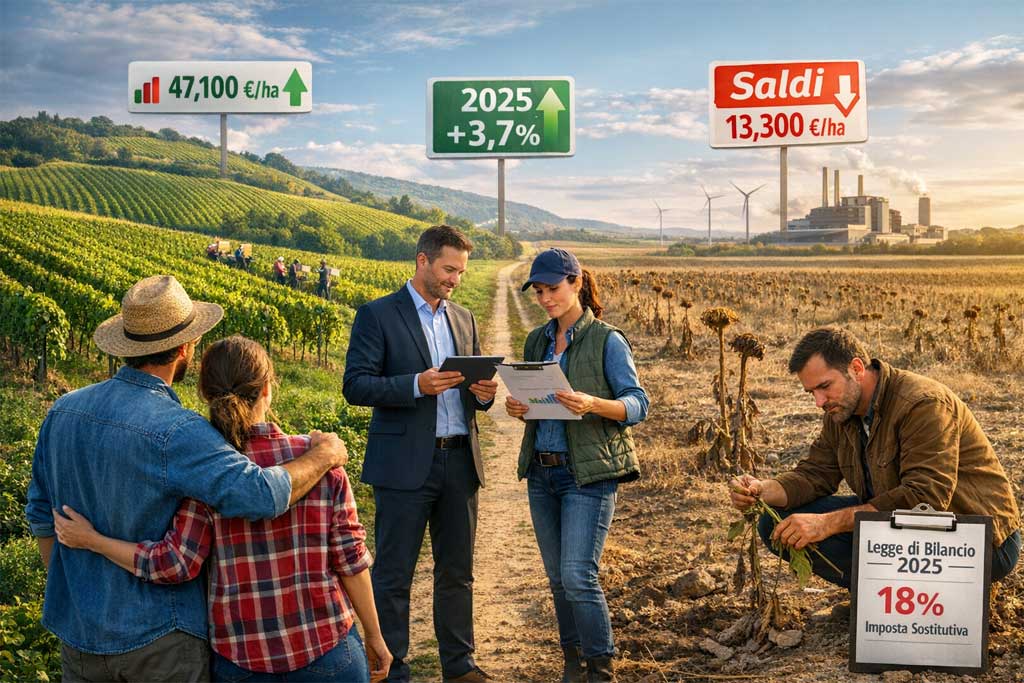
- Northeast : €47,100/hectare, the most expensive and competitive area
- North-West : €35,200/hectare (2.3%)
- Center : €15,100/hectare
- South : €13,300/hectare (1.9%)
- Islands : €8,600–9,000/hectare
These differences aren’t the result of market sentiment. They’re the result of concrete factors: logistics, water availability, the presence of structured supply chains, leading companies, strong brands, and the real possibility of turning land into income .
Where a major brand arrives, or where a denomination becomes a driving force, the landscape changes status. Where, however, a crop loses commercial appeal or is left out of the mainstream, its value tends to decline.
The 2025 signal: the market starts moving again
Another indicator deserves close attention. In the first half of 2025, sales showed a shift in pace:
- –2% in the first quarter
- 3.7% in the second quarter
It’s not a boom, but it’s a sign of a return to decision . After a long wait-and-see phase, investors and operators are beginning to evaluate concrete operations again. The main reasons are two:
- CAP 2023–2027 , which offers a more stable framework for those investing in the medium to long term
- More readable regulations , especially on the fiscal and patrimonial level
When the rules become less opaque, capital tends to come back into play.
Why land is worth (or isn’t worth) today
The value of a piece of land doesn’t depend on its size, but on its economic function within its context . The question to ask isn’t “how beautiful is it,” but: what can it realistically become in the next ten years?
The factors that have the greatest impact today are:
- location and logistical accessibility
- urban planning destination and constraints
- water availability (often decisive)
- inclusion in certified supply chains or strong brands
- environmental and landscape constraints
- exposure to climate risks
- compatibility with energy or multifunctional projects
Land increases in value when it enters a credible economic narrative . It declines when it remains outside of the flows, or when it produces something the market no longer demands.
The fiscal lever that changes strategies: 2025 Budget Law
The real break comes at the regulatory level. With the 2025 Budget Law, the ability to revalue land for tax purposes becomes a structural possibility.
Owners of land owned as of January 1, 2025, can update the market value by paying a substitute tax of 18% (it was 16% in the previous two years).
Key conditions:
- Expiration: November 30, 2025
- certified appraisal drawn up by a qualified professional, based on technical-economic criteria
It’s not a technical detail: aligning tax value with real value changes the way we plan sales, generational transitions, corporate transactions, and investments . Land ceases to be an “uncertain” variable in the accounts.
Owners and investors: two different effects, same direction
For landowners, reassessment is a strategic assessment: updating today can reduce future rigidities . It’s not an automatic choice, but a tool to be evaluated with capital considerations.
For buyers, the effect is equally significant: more transparency means fewer negotiating deadlocks and greater fluidity in transactions. Real estate markets function better when values are legible.
Unused lands and new projects: the potential to change the map
In the long term, the real playing field is different. Italy has over 4 million hectares of uncultivated land and approximately 14,000 hectares of public land , with an estimated value of around 180 million euros .
Over €1 billion is planned for the 2024–2028 period for recovery, innovation, and sustainability, with a focus on young entrepreneurs and new management models.
If these policies become real projects, their value will not only depend on the initial price, but on the ability to transform the territory into a business , using modern tools: water management, technology, short supply chains, economic sustainability even before environmental sustainability.
It’s not a fad: it’s a phase change
The real turning point isn’t a single fact. It’s the changing climate:
- prices that are holding up again
- more stable tax rules
- more selective investors
- lands that are valuable if they are “useful” for something
Land is no longer an indistinct commodity. It has once again become a strategic choice , rewarding those who understand supply chains, anticipate consumption, and understand where major market flows are going—and where they are leaving.
My dad always told me, remember that the earth always gives you food!