

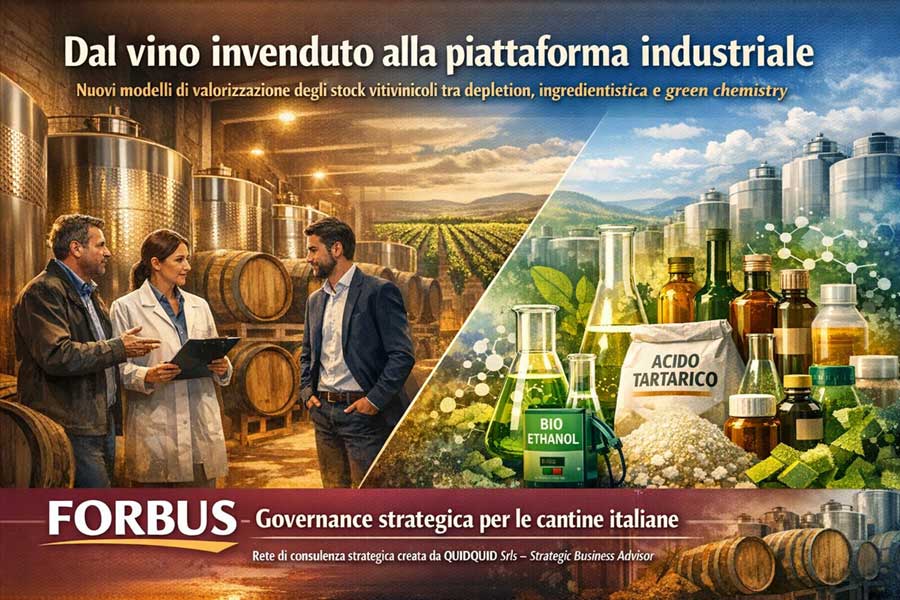

New models for valorizing wine stocks: depletion, ingredients, and green chemistry.
From unsold wine to the industrial platform.
FORBUS – Strategic Governance for Italian Wineries
Strategic consulting network created by QUIDQUID Srls – Strategic Business Advisor
In wine there comes a point when stock stops being an asset and becomes pressure.
Ten million hectoliters sitting in the cellar aren’t a reserve: they’re a financial cost, a health risk, and a devaluation of assets.
But they can also be something else.
If managed with an industrial logic, those volumes become a platform of products, ingredients, and supply chains capable of generating value outside the traditional wine perimeter.
Because today the market no longer rewards “wine itself”.
It rewards specific functions: drinkability, serviceability, low alcohol content, sustainability, ingredients, industrial stability.
Wine is no longer just a bottle with a poetic label. It is an agricultural raw material with high chemical and functional content.
From this awareness a new strategy is born: managing wine as a noble biomass.
From wine to the product portfolio
Part of the stock can still be valorized by remaining in the beverage orbit, but with industrial logic.
The fastest solutions concern private label wines for large-scale European distribution, bag-in-boxes and lightweight formats, which allow for rapid rotation and immediate liquidity.
The bases for sparkling and semi-sparkling wines transform low-alcohol technical wines into cuvées for bubbles, one of the few segments still dynamic on international markets.
Dealcoholized and low-alcohol wines today represent the true “second life” of European wine. Demand is growing in Northern Europe, Canada, the United States, and Asia, while the supply of technical raw materials remains insufficient.
Finally, the RTD and mixology channel opens up to the world of industrial beverages: ready-to-drink spritzers, wine-based cocktails, and premium sangria. In this segment, what matters is not names or storytelling, but stability, alcohol content, color, and continuity of supply.
These solutions allow you to quickly reduce inventory.
But the real strategic leap occurs when we definitively exit the wine and spirits sector.
Wine as a “noble chemical broth”
Chemically, wine is an extraordinary mixture: structured water, alcohol, organic acids, polyphenols, residual sugars, aromas, mineral salts.
If we stop calling it wine and start calling it organic feedstock, a huge industrial ecosystem opens up: ingredients, cosmetics, nutraceuticals, pharmaceuticals, food processing, green chemistry.
There are at least seven main supply chains active today.
Tartaric acid and tartaric salts
Wine is the world’s leading natural source of tartaric acid.
Food additives, pharmaceuticals, fine chemicals, and green stabilizers represent a structural demand with stable prices and multi-year contracts.
Polyphenols and antioxidants
Resveratrol, flavonoids, and catechins are extracted from red wines for use in anti-aging cosmetics, supplements, and functional beverages.
Here the price is not per liter but per kilogram: one of the few cases in which an unsold wine becomes a premium ingredient.
Bioethanol and green chemistry
Renewable fuels, solvents, detergents, medical disinfectants.
Low unit margin, but the ability to absorb enormous volumes and guarantee constant flows.
Industrial vinegar and organic acids
Food processing, preserves, ready-to-eat products, and sauces.
Simple technology, stable market, massive uptake.
Natural flavors and aromatic waters
Premium soft drinks, iced teas, kombucha, natural perfumes.
The industry is moving away from synthetic flavors in favor of certified natural sources.
Fertilizers and biostimulants
Real circular economy: liquid fertilizers, fermented substrates, soil conditioners for intensive and organic agriculture.
Biomaterials and bioplastics
Natural resins, green solvents, additives for paper and fabrics.
Large European chemical groups enter here with multi-year agreements.
The industrial model: “empty warehouse, create business unit”
The real turning point isn’t choosing a product. It’s designing industrial architecture.
The most effective model today is the twin-engine one.
Engine 1 – Depletion (0–24 months)
Objective: drain volumes, generate cash, reduce risk.
Bioethanol and technical alcohol, industrial vinegar, fertilizers, and biogas allow for rapid inventory reduction, reduced health risks, and restored cash flows.
Here we are looking for speed, not margin.
Engine 2 – Valorization (12–60 months)
Objective: to create a new high-value industrial division.
The three strategic business units are:
- antioxidant ingredients and polyphenols,
- tartaric acid and tartaric salts,
- natural aromas and flavours.
The winning model is the selective joint venture: the manufacturer supplies volumes and guarantees continuity, while the industrial partner invests in facilities, certifications, and customers.
The result is a radical transformation of the economic profile: no longer selling wine at a few cents a liter, but the creation of industrial participations.
From cellar to agricultural refinery
This isn’t a sales crisis. It’s a model crisis.
With ten million hectolitres there is no need to look for marginal alternative products.
We need to build a platform for the industrial valorization of wine, as already happens for sugar, corn and sugar cane.
Looking ahead, a “Bio-Ingredients & Green Chemistry” division could become worth more than the winery itself in just a few years.