

ANTINORI, CUSUMANO, AND FRESCOBALDI: “A UNIQUE WINE ASSET IN THE WORLD THAT PROMOTES QUALITY ITALY.”
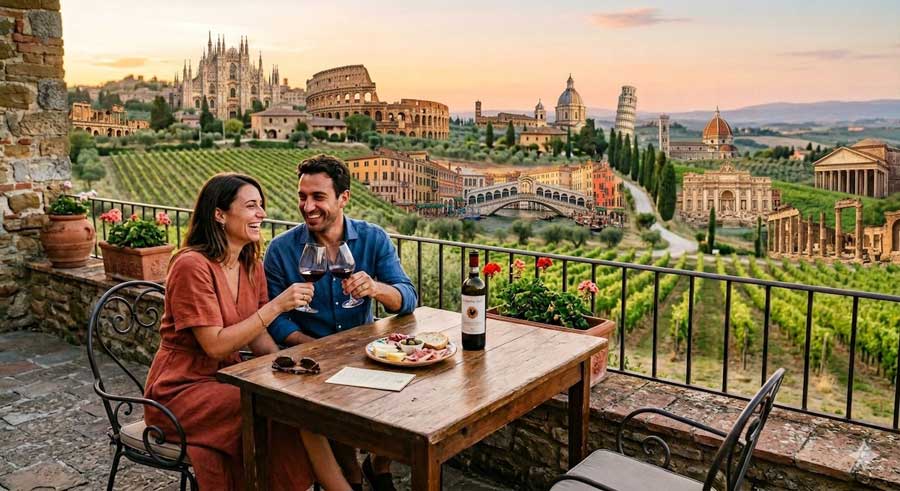
“Wine? I believe it’s currently the most effective marketing accelerator for tourism in Italy, attracting more tourists than fashion, Ferrari, and, without a doubt, more than any ‘Botticelli-esque’ influencer avatar or other ministerial advertising campaign,” said Davide Ciliberti, an expert from the Purple & Noise communications group, at the Vinitaly trade fair currently underway in Verona.
” Because wine enters homes and tables around the world, and is the protagonist of special occasions or happy moments. “ Unlike other iconic Made in Italy products,” the expert continues, “it is affordable for everyone and easily stimulates curiosity about its place of origin.”
“And, in terms of geomarketing, it is distributed throughout the world, because if it is true that there is an Italian restaurant in every corner of the world, it is even more certain that on those tables and in the homes of those who frequent them there will be an Italian wine ”, adds Vicky Gitto, an Italian advertiser well-known worldwide.
The data from the recent Aite-Italian Food and Wine Tourism Association Report (2025) confirm that 70% of those interviewed declared that they had taken at least one holiday in the last three years in search of food, wine, oil and all the other typical agri-food products of the Italian territory : with an average annual increase of approximately 13%.
Globally, wine tourism alone is worth nearly €40 billion annually. More than half of this goes to Europe, with France, Italy, and Spain being the preferred destinations, and an average annual growth trend of approximately 13%, even in times like the current one, when the wine market is suffering due to Trump’s various trade wars.
FRESCOBALDI: WITH ART, A COMBINATION OF EXTRAORDINARY ATTRACTIVE POTENTIAL.
“Wine tourism is also growing strongly in Tuscany ,” confirms Tiziana Frescobaldi, president of the Compagnia de’ Frescobaldi Holding and creator of the ‘Artisti per Frescobaldi’ patronage project , “and we see it on our estates: from Perano in Chianti Classico, to Nipozzano, to Pomino, to Montalcino . At Castel Giocondo, where the eponymous Castel Giocondo Brunello di Montalcino is produced, we also have a small hospitality facility where guests can stay and enjoy a unique and immersive experience among the vine rows and the cellar. People come to taste the estate’s wines and also to savor a bit of our history. And right at Castel Giocondo, since 2012, we have launched a project that unites wine and contemporary art: ‘Artisti per Frescobaldi’, which boasts a collection of works by Italian and international artists inspired by the region and the world of wine, open to the public. public” .
“We believe in the combination of wine and art: together with cuisine and the beauty of our landscape, they form a perfect alchemy, unique in the world .” In fact ,” Tiziana Frescobaldi continues, ” I was recently in Korea , at the embassy, to talk about Made in Italy and the perception of a country experiencing great and rapid growth and whose culture, even in terms of food tastes, is so different from our own. Art, wine, and cuisine represent the aspects of greatest appeal and interest . A unique example in the world, in which, in my opinion, we must continue to invest and progress in terms of quality, the value of our products, and care for the landscape and such generous nature.”
ANTINORI: WINE THAT TELLS ABOUT TERRITORY AND HISTORY, WHICH FASCINATES THE WORLD.
“Wine certainly represents an extraordinary vehicle for understanding local areas,” comments Allegra Antinori, Vice President of Marchesi Antinori , who oversees hospitality at the company . ” But for us, its added value lies above all in its ability to convey a deeply rooted and continually evolving tradition . Our wineries were created with precisely this intention: to be places that express and enhance the local area, fully integrated into the landscape where the wine takes shape. It is there that our history is preserved, but also the most contemporary and innovative side of our work. We see it every day; at the Antinori winery in Chianti Classico, where the long winemaking tradition is an integral part of the identity of a historic wine-producing area like Chianti Classico, as well as at Le Mortelle in Maremma, where we tell the story of a territory still partly undiscovered.
“Each of our properties,” continues Allegra Antinori , “has its own cellar and its own hospitality approach, designed to welcome our guests and guide them through a journey of discovery of a place, its history, and its identity. When this bond is created, wine becomes a memory: a story that continues through time and, once rediscovered in the glass, naturally draws us back to the land from which it originates. And it is precisely in this profound connection with the land that, in our opinion, lies its strength, even from a tourism perspective.”
CUSUMANO: ETNA TODAY A SUPER-DESTINATION THANKS TO ITS WINE AND ITS PRODUCERS
Producer Diego Cusumano, of the Sicilian winery of the same name , also agrees with the marketing managers. ” Our wine ,” explains the Sicilian winemaker, ” is distributed across five continents, both personally and through exporters, and is presented daily, exalted as a product of our land, Sicily. And our customers, in appreciating our wine, also become passionate about its place of origin, that territory, which the vineyard itself makes beautiful, makes a landscape. Just think ,” explains Cusumano, ” of Etna twenty years ago and Etna today: a super-tourist destination thanks to the wine and its producers, who, by promoting themselves over the years, first piqued the curiosity of wine lovers, then activated word of mouth, then won over wine tourists, and finally made it a world-class destination today. With the associated spin-offs and benefits.”
“And the same – continues the producer – is true for all the places in Italy, from the very famous Chiantishire to the small villages and territories, each of which gives us its product, its label, tells its story, its tradition, the ‘soul’ of that place” .
“ Add it all up and in one fell swoop you have the most massive territorial marketing campaign in our country which brings in so many new arrivals and is the best antidote to overtourism” confirms Vicky Gitto.
CRISTINA MERCURI, MASTER OF WINE: WINE BUILDS A QUALITY IMAGINATION THAT STRENGTHENS THE ENTIRE COUNTRY SYSTEM
“Wine can certainly be a marketing lever for Made in Italy and for tourism, but the definition is limiting: wine is above all a cultural and economic infrastructure capable of generating long-term territorial reputation and desirability,” says Cristina Mercuri, the first Italian woman to achieve the prestigious title of Master of Wine (MW), the highest and most prestigious title in the wine world (awarded by the Institute of Masters of Wine (IMW) in London, which certifies exceptional expertise not only in tasting, but also in viticulture, oenology, wine trade, and marketing – editor’s note). She continues, ” The case of the Langhe–Roero–Monferrato wine landscapes, recognized as a UNESCO World Heritage Site, demonstrates how wine can activate a broader ecosystem involving hospitality, gastronomy, and international investment. At the same time, it also highlights potential critical issues, such as the risk of tourism pressure and the standardization of local identity. This confirms that wine is a very powerful lever, but requires strategic vision to preserve authenticity and consistency.” ” Wine doesn’t just promote a product; it builds a sense of quality that strengthens the entire country . For this potential to be fully realized ,” the expert concludes, ” it’s necessary to invest in structured management and long-term strategic coordination.”
THE PROPOSAL: LESS PUBLIC MONEY FOR ‘ VENUS INFLUENCERS’ BUT INVEST IN ‘BACCHUS’
” And the great commitment of individual producers who, by promoting their products, tell the world about the best of Italy, ” adds Davide Ciliberti of Purple & Noise PR, ” should be concretely supported by the government and local administrations. Rather than squandering so much public money on ineffective marketing and communications campaigns, which are also uncoordinated and lack a medium-term plan, they should allocate to winemakers the vast amounts of funds that the state, regional governments, and even local tourist boards sell for tourism and spend without much return ( how much influx did the ‘famous’ influencer avatar of Botticelli’s Venus bring us? ). And if it’s not money, at least let it be tax breaks for those who communicate by contributing to a national communications plan.”