All posts by admin

Wine Trends and Performance in Italy, Week 29 December 2025 – 2 January 2026

The transition from late 2025 to early 2026 captures a sector that isn’t experiencing a “seasonal crisis,” but rather a paradigm shift: structurally lower consumption, price pressure, shrinking large-scale retail trade, more selective exports, and a single category that continues to clearly act as a driving force: sparkling wines, especially Prosecco.

Within this framework, the real issue is not “how much wine we produce,” but what value we manage to defend and build along the supply chain (brand, positioning, channels, real sustainability, territory).

1) 2025: “Prosecco, Prosecco and Prosecco”

In 2025, Prosecco (Docg Conegliano Valdobbiadene, Asolo and Doc) performed better than many other Italian types, even quality ones, intercepting two market forces that now count more than anything else:

  • drinkability (more “easy”, fresh, immediate profiles);
  • lower alcohol content and a perception of lightness, in line with health trends and new consumption styles.

Prosecco still has room for international growth, but maintaining its competitive advantage isn’t automatic: it requires a quantum leap in territorial and consortium governance. The critical issue cited is very real: the management of vineyards in the Conegliano Valdobbiadene area , where sustainability (agronomic, landscape, social) becomes a reputational and production risk factor. In other words: it’s not enough to sell well today; we must prevent the territory from becoming a bottleneck tomorrow (including on the UNESCO front).

2) Europe: the “defensive” response (uprooting) does not solve the market

The European context weighs heavily: since 2000, wine consumption in Europe has fallen by 35% , and by 2025, global consumption is estimated to reach 214 million hectoliters (an all-time low, according to the text). France, Spain, and Italy still produce approximately 60% of the world’s wine , but this primacy is no longer synonymous with strength: it becomes a problem if demand can no longer keep up with volumes.

The EU plan described focuses primarily on permanent eradication (structural reduction of supply). The critical point highlighted is twofold:

  • quantitatively it is often insufficient compared to the surpluses;
  • on an industrial level it is a technical measure , not a strategy.

The position reported by UIV (Lamberto Frescobaldi) is clear: uprooting won’t solve Italy’s problems and can create social and territorial risks , especially in the hilly areas best suited to this (landscape management, prevention of landslides). The proposed alternative is an ” accordion-style Italian vineyard ,” that is, more flexible, with tools capable of managing surpluses and poor vintages without destroying productive capital and territorial value. The underlying message: resources are needed for innovation and promotion , not to incentivize exit from the business.

3) Sparkling wines: record and centrality of the USA (but Italy is also changing)

The most impressive data of the week concerns Italian sparkling wines: the one billion bottle mark (1.03 billion) has been surpassed, with 2025 production set to increase by 1.8% over an already record 2024. Approximately 7 out of 10 bottles will go abroad, confirming that bubbles remain the most defensible asset for Italian wine on the market.

The United States emerges as a key point: in wine demand, Italian sparkling wines are becoming even more significant than white wines in the composition of “Italian wine consumed” (in the text: 37% sparkling wines , 36% white wines , 17% red wines ). This is a strategic indicator: sparkling wine is no longer just a “celebration wine,” but is entering everyday life and a premium positioning, competing not just on price but also on identity.

The domestic shift is interesting: in 2025, growth will also be driven by domestic demand (5% in the text), with over 106 million bottles uncorked during the holidays and a decline in imports of foreign sparkling wines (-8%). Therefore, bubbles are strong abroad, but also well-established in Italy , with a growing preference for Made in Italy.

Within this framework, Prosecco (in particular Conegliano Valdobbiadene) closes with double-digit growth ( 10% in the text), while the main classic method wines (Franciacorta, Trentodoc) grow steadily and the niche denominations consolidate their presence (Oltrepò Pavese, Alta Langa).

4) Large-scale retail trade: fifth consecutive year of decline, value stable only thanks to price

Large-scale Italian distribution remains the barometer of “mass” demand, and the diagnosis is clear: volumes down, values almost stable . In the first 11 months of 2025:

  • just over 552 million litres sold (–3%);
  • value 2.05 billion (–0.4%);
  • average price €3.72/litre (2.7%).

The 0.75-liter bottle holds up better: volume -1.8% but value 0.4% (average price €5.4/liter). The strategic interpretation reported is important: it should not be interpreted as resignation, but rather as an acknowledgement that consumption is settling at lower levels . The causes: demographics (an older Italy), cautious spending, a health-conscious attitude, and competition from alternatives in the glass and at times of consumption. The logical consequence: to compete, you need to work on the value chain (positioning, brand, channel mix, differentiation), not hope for a return to the volumes of the past.

5) Exports and markets: mixed signals, pressure on the average price

The Nomisma Wine Monitor reports a mixed picture for the first nine months of 2025: some markets are growing in value, others are declining. For Italy, the crucial data is not just where growth is occurring, but how :

  • Canada and Brazil are the ones with growth in both value and volume (therefore “healthy” expansion).
  • Germany is recovering in value (with a slight decline in volume), a sign of recovery after difficult years.
  • USA : Total bottled wine imports decline in value but remain stable in volume; for Italy, the decline is more marked in value but growth in volume, a typical indicator of a lower average price (competitive pressure and, in the text, the effect of tariffs).

Operational translation: exports remain crucial, but increasingly, success (or survival) is achieved with intelligent product mixes and pricing , and with meticulous attention to channels and distributors. It’s not enough to simply “be there”: you have to protect value .

6) 2026: keywords and direction (Italian Wine Consortium)

The key words proposed by the leaders of several large companies sum up the current climate well: enthusiasm, beauty, experimentation, stability, resilience . In market terms, they mean something very concrete: continuing to invest even in a challenging period, but shifting the focus to innovation, identity, perceived quality, communication, and industrial solidity.


Wine press review for Friday January 2 – 2026

Wine news, Italian wineries and wines.

Italian wineries

BWW 2025: Italy Leads the Way Among the World’s Best Wineries At the BWW 2025 – Best Wine of the World Competition , Italy confirms its global influence, with iconic wineries such as Gaja, Ornellaia, Monteverro, GB Burlotto, and Marchesi Antinori among the most voted. Monteverro also wins the title of Best New Winery of the Year . Among the award-winning wines, Masseto 2020 (Platinum) stands out, while among the Gold wines, Sassicaia 2021, Solaia 2020, Barolo Sperss 2018, and Monteverro 2019. This result is based on over 3.3 million votes cast by 449,000 professionals from 129 countries.

Elisa Dilavanzo and Maeli: Moscato among the top 100 wines. Colli Euganei producer Elisa Dilavanzo has named Maeli wines among the top 100 in the 2026 Vitae Guide. A journey studded with international recognition that highlights Moscato Giallo as an expression of the region’s identity.

Mourning in the wine world: farewell to Chicco Riccardi. Chicco Riccardi, the historic owner of Nettare dei Santi di San Colombano, has passed away at the age of 86. Under his leadership, the company grew to a production of approximately one million bottles, becoming a benchmark in the area.

Colonnella bids farewell to Umberto Camaioni. Umberto Camaioni, one of the founders of the Colonnella Social Winery (now Cantina Colonnella), has passed away at the age of 92. He was a key figure in the development of the Val Vibrata winemaking sector.

Donegato Winery: new winery in Montiano . The Berretti brothers’ Donegato Winery opens. A contemporary project that connects wine and the Romagna region, with a new facility featuring a tasting room.

Italian wine and Italian oenology

Europe’s wine industry: uproot or evolve? The structural decline in consumption (-35% since 2000) and continued overproduction present the European industry with a strategic choice. EU plans appear defensive, while the global market for 2025 is set to hit an all-time low of 214 million hectoliters.

Alcohol-Free Wines: Interministerial Decree Approves Green Light. With the Ministry of Economy and Finance (MEF)–Masaf (Masaf) decree, Italy officially opens the door to the production of alcohol-free wines. Companies can now compete on equal terms with other European countries, albeit with the exclusion of DOC, DOCG, and IGT designations.

Alcohol-free wines: an industrial opportunity and a key identity issue. Investments are growing, especially in the Northeast, but the Consortia reiterate their position: no alcohol-free wines under historic appellations. The debate between market innovation and value preservation remains open.

2025 Harvest in Valtellina: Positive Signs The year promises to be favorable thanks to an overall balanced climate, with good-quality grapes and regular ripening.

Tuscany tops the Go Wine 2026 Guide The region leads the ranking with 56 Impronte d’Eccellenza out of over 900 selected wineries, confirming its leadership in Italian wine tourism.

Agricultural Taxation: Focus on the Special VAT Regime The special VAT regime for agriculture, established by Directive 2006/112/EC and implemented in Italy, remains a key tool for the flat-rate compensation of input tax for agricultural producers.

Agricultural land: changing value landscape. In 2024, the average value of agricultural land in Italy will rise to €22,400/hectare. The Northeast leads the ranking, while the data signals a reversal from years of stagnation.

Agriculture and Education: Cotarella’s Proposal Riccardo Cotarella (Assoenologi) proposes a weekly agriculture lesson in primary schools to reconnect younger generations with the land and its productive culture.

Agriculture in the Marche region: red wine in difficulty. The Cia Marche is calling for more effective policies to support the sector, given market challenges, limited resources, and companies’ need for liquidity.

International

The 12 Grapes of New Year in Spain: History and Myth The tradition of the “12 Grapes of Good Luck” has roots dating back to the late 19th century, well before the famous reconstruction linked to the production surplus of 1909.

Back to February 2025: Wine and the European Union The international news story highlights the weight of EU policies on labeling, health, and communication, with strong concerns about the economic impact on the sector.

Wine in 300 strokes: Crémant de Bourgogne Pierre Bleue Focus on a French Extra-Brut sparkling wine from the Grand Chais de France group: freshness, citrus notes and a dynamic drinkability.

Wine events

From Grandi Langhe to Amarone Opera Prima The 2026 calendar promises to be packed: from Turin to Verona, passing through Bologna, with events such as Grandi Langhe, Salone del Vino, Amarone Opera Prima, Slow Wine Fair and Fieragricola.

The Vino Nobile di Montepulciano “Pieve” project in Milan. Official presentation of the project with a press conference and guided tasting, to explain the origins and future of the historic zoning.

Christmas in the Cellar and Nativity Scenes in the Village of Tuglie. Until January 6th, events will take place at wineries, courtyards, and oil mills in Salento, with free admission and guided tours.

Thanks for listening. Today’s wine press review is brought to you by WINEIDEA.IT .

See you tomorrow.

Wine press review for Wednesday December 31 – 2025

wine news, Italian cellars and wines.

ITALIAN WINERIES

Gaja, Ornellaia, Monteverro, GB Burlotto, Antinori: the top Italian wines for “BWW 2025.” In Tasting Book’s “Best Wine of the World” competition (over 3.3 million votes from 19,000 wines, with international participation), several Italian icons shine. Monteverro also won “Best New Winery of the Year,” while globally, major names from Bordeaux, Champagne, and the Rhône stand out.

Librandi’s Tenuta Rosaneti: Calabria’s winemaking laboratory. A journey through the Librandi group’s largest estate, between Rocca di Neto and Casabona (KR): its production heart and experimental space, described during a tour dedicated to discovering Calabria’s wine scene.

Adami – Valdobbiadene Prosecco Superiore DOCG Rive di Colbertaldo “Vigneto Giardino” 2024 Focus on one of the Adami family’s iconic labels: the history of the “Asciutto” cru and the sensory profile of the 2024, within an overall production that includes several Rive, Cartizze, and various types of Prosecco.

Cantina Settecani: Growth (8.7%) for the Modena-based cooperative in 2025. Positive results for the historic cooperative: rising revenues and growing grape deliveries, despite stagnant consumption. This is a sign of operational solidity and structural decisions that are paying off.

A selection of the “best” Italian wineries of 2025. A “vineyard by vineyard” review: not just labels, but companies evaluated for their identity, vision, technical consistency, and ability to interpret the territories.

Baglio di Pianetto: only high-altitude vineyards for freshness and elegance. A strategic choice geared towards contemporary taste trends: focus on mountain vineyards and sale of the Noto vineyard area (Tenuta Baroni) to a specialized agricultural company.

Santa Lucia: Argentario in a glass. The story of a winery nestled between the sea and vineyards in Maremma, in the Morellino di Scansano area closest to the coast, with historic family roots on the Argentario.

Assoenologi Sicilia: Giuseppe Figlioli new president. A change at the helm of the regional section: Figlioli (Birgi Winery) takes over after more than ten years as president, with a message of continuity and commitment.

ITALIAN WINE AND ITALIAN OENOLOGY

Italian sparkling wine beats Champagne: 1.03 billion bottles in 2025. According to UIV–ISMEA, production and sales of Italian sparkling wines will reach 1.03 billion; over 360 million destined for the holidays. Prosecco remains the driving force: growth estimates for Conegliano Valdobbiadene DOCG (8% vs. 2024) and substantial stability for Prosecco DOC.

No/Low-Alcohol Wines: Production Approved in Italy, Northeast Divided. The inter-ministerial decree (MEF–MASAF) unblocks alcohol-free drinking across the country, amidst enthusiasm (the opportunity for future production quotas) and “identity-based” caution, especially in areas most closely tied to tradition.

Decree on dealcoholized wines: rules, excise duties, authorizations, and circulation. The measure defines the fiscal and operational scope: licenses, requirements, product movement, and distinctions by production category (including based on quantitative thresholds). The requirement to use foreign facilities is eliminated.

UIV: Castelletti on the alcohol-dealcohol decree, “good news after a troubled 2025.” The position of the Italian Wine Union: a turning point to compete on equal terms in Europe and a call for support for the operational launch (licenses and authorizations) in the initial phase.

Veneto, sparkling wines & gangmastering: shadows over the supply chain. An investigation and complaint about the exploitation of workers (especially migrants) in seasonal agricultural activities, including those in the sparkling wine districts. An issue that impacts reputation, compliance, and the supply chain.

INTERNATIONAL

BWW 2025: the “Best of the World” and global benchmarks In the world rankings: Pétrus 2020 as best wine, Salon 2012 as best Champagne, E. Guigal as “Winery of the Year”, and the winemaker of Screaming Eagle awarded as best winemaker.

Global wine tourism: “World’s Best Vineyards” 2025 and the key word: “experience.” The winners clearly point the same direction: winery hospitality becomes a strategic (not an optional) channel. Among the best: Chilean and German wineries top the list; Ceretto is the best Italian winery, in the top 20.

WINE EVENTS

Cantine d’Italia 2026: Impronta Go Wine in Zidarich (Trieste Karst). The highest award for wine tourism: recognition for the ability to combine production excellence, hospitality, and landscape identity. The Trieste Karst region makes a strong entry into the list of destinations to watch.

Winemag: “Wine in 2025” month by month (series from January 1, 2026) An editorial project that retraces twelve months of news and changes in the sector, to interpret 2025 as a year of structural transformation (not just cyclical).

San Basilio: “La Cantina del Duca” opens at Casa Isabella (from January 4, 2026). A new tasting space in Puglia inside a renovated historic residence: open to the public with a focus on experience and hospitality.

AGRICULTURAL POLICIES, TERRITORIES AND SUSTAINABILITY

(Context section, useful for winemaking operators and related supply chains)

Lombardy: €4.6 million for sustainable agriculture in Valtellina. 25 projects in Sondrio have been funded (measure SRD02 CAP 2023–2027), with a focus on mountain farms and investments in the environment, climate, and animal welfare.

Lombardy: 12 projects funded in the Cremona area (14 million) Resources for concrete interventions: effluent management, optimization technologies, tools for corporate sustainability.

Agricultural ZES and income tax relief: measures for Southern Italy in the 2026 Budget. Extension of Irpef tax relief on agricultural/land-based income and new levers for investment and innovation: agricultural ZES and greater offsetting of tax credits.

Veneto Agricoltura: Federico Caner appointed director. Governance change at the agency for primary sector innovation: focus announced on ecological transition, competitiveness, and markets.

Thanks for listening. We remind you that today’s wine press review was brought to you by WINEIDEA.IT . See you tomorrow.

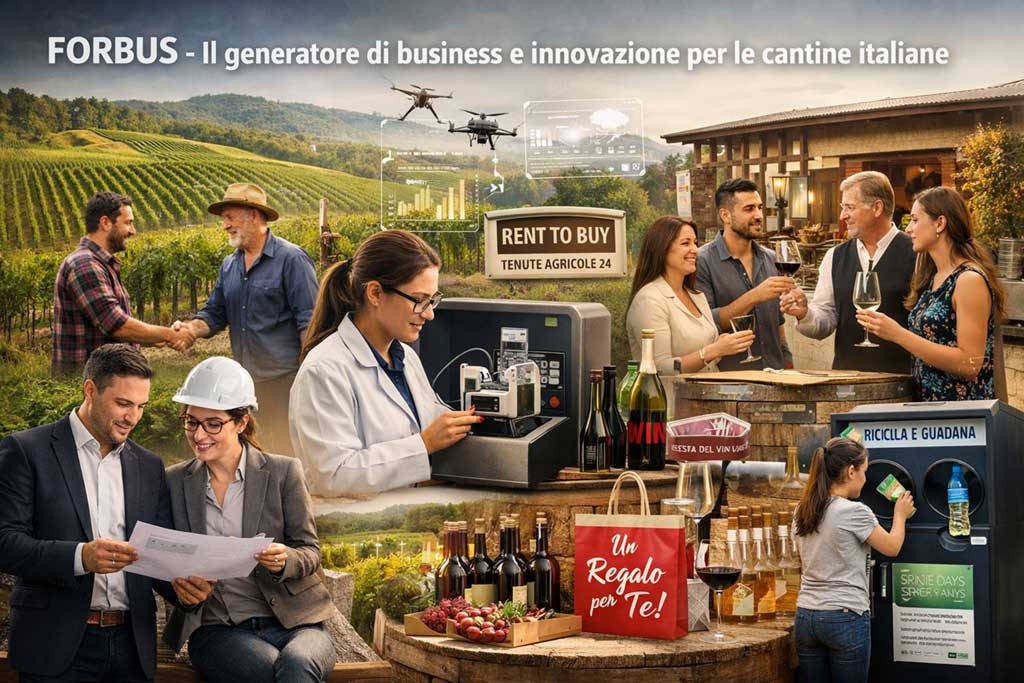
FORBUS – The business and innovation generator for Italian wineries

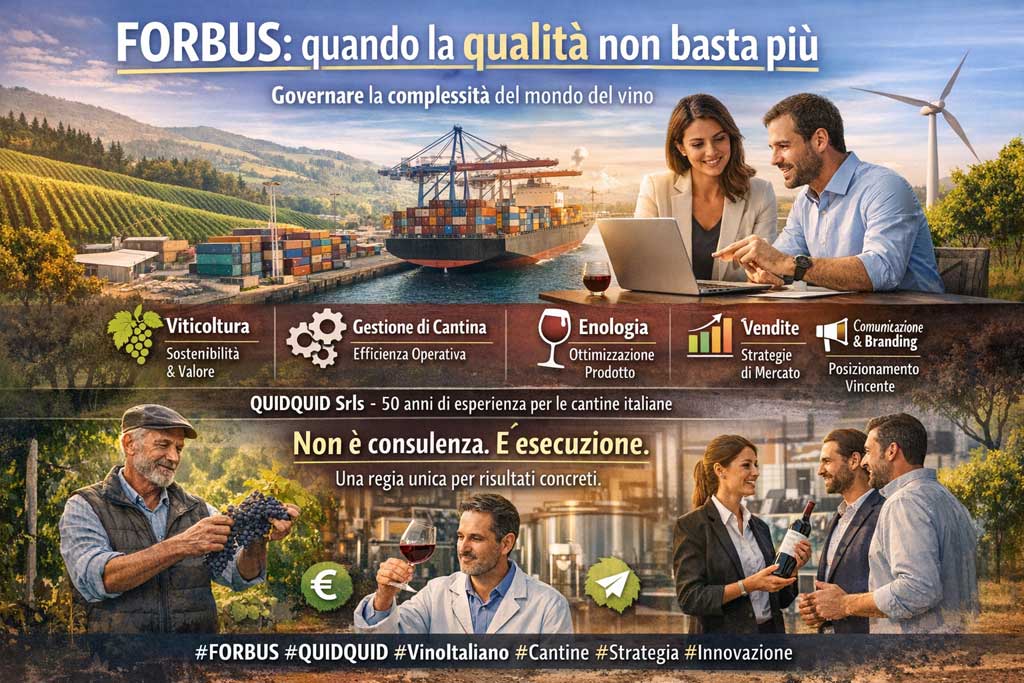
It takes method. It takes vision. It takes someone who knows how to manage complexity before complexity manages the company.

In wine today, quality is no longer enough.

It is from this awareness that FORBUS was born, the network of professionals created by QUIDQUID Srls , a company that for fifty years has supported entrepreneurs, industrial groups and investors in decisive moments:

acquisitions, divestments, expansions, joint ventures, industrial investments, and strategic repositionings.

We don’t sell theoretical advice.
We build operational solutions , accompanying companies until they achieve results .

What is FORBUS

FORBUS – Winery Business Generator is a joint venture, a structured network of professionals with real experience in the winemaking and oenological sector.
Not a container of services, but a single management capable of transforming a winery into a more solid, recognizable and profitable enterprise.

FORBUS works on five key pillars:

  • Viticulture – vineyard development and economic sustainability
  • Cellar Management – New Organizational and Decision-Making Tools
  • Oenology – product optimization and style consistency
  • Sales – concrete strategies to sell better and sell more
  • Communication & Branding – clear and credible market positioning

One goal: create measurable value .

FORBUS projects

1) Management lease & Joint Venture

To tackle complex phases without losing control of the company.

  • Lease of the business unit (5–7 years) with variable fixed rent
  • Redemption option at contracted values
  • Time to rebalance the accounts and evaluate a conscious sale
  • Joint ventures and new companies to share facilities and technologies (e.g., dealcoholized beverages, new beverages)

A smart solution to defend your business today and create options tomorrow .

2) Open the cellar on the weekend

Wine tourism is growing, but too many wineries remain closed just when the public is there.
FORBUS creates a simple and profitable model:

  • Cellar rental on Saturdays and Sundays
  • Guided tastings and organized visits
  • New visitor flows, direct sales and territorial visibility

The cellar returns to being a living place , not just a productive one.

3) Rent to Buy for agricultural and wine-making companies

We are looking for companies to acquire and sell using sustainable formulas.

  • Easier access for young farmers
  • Valorization of existing companies
  • Innovation and generational continuity

The project also operates through the Tenute Agricole 24 portal, which specializes in professional matching between supply and demand.

4) “Come to the cellar… there’s a gift for you”

A platform that brings real people into the cellar.

  • Dedicated corner with personalized gifts
  • Free basic tasting or branded gifts
  • Loyalty card valid in all participating wineries
  • Restaurant, hospitality and B&B reservations
  • Seasonal offers (harvest, new wine, special events)

Word of mouth becomes a structured sales tool .

5) “Water & Wine” Project

Smart vending machines with PET and glass eco-compactors.

  • The more you recycle, the more you earn
  • Points convertible into vouchers or cash
  • Real sustainability, not just a story
  • Involvement of the territory and consumers

Circular economy that generates value and reputation .

6) Electronic nose and palate

Technology applied to sensory analysis.
A portable device capable of:

  • Analyze wine vapors
  • Collect olfactory and gustatory chemical data
  • Compare them with reference databases
  • Return objective qualitative reports

Applied research, not science fiction.
A tool that opens new perspectives on product quality, consistency, and perception.

7) Wine Days – The Wine Festival in the Cellar

Eight days, once a year, before the grape harvest.

  • Unbeatable prices
  • Intelligent inventory emptying
  • Direct meeting with the public
  • New trade relations

An event that transforms a logistical necessity into a valuable celebration .

8) Connected Vineyard 4.0

Digital and predictive vineyard management.
Thanks to the HO-W system:

  • Real-time monitoring of weather, soil, plants and pests
  • Timely warnings and decisions
  • Fewer treatments, lower costs, more effectiveness

Technology that makes viticulture more sustainable and more profitable .

FORBUS is not for everyone

It’s for those who have understood that wine is culture, yes.
But it is also business, strategy and the future .

If your winery really wants to grow, FORBUS is the right place to start.