Italian wineries, Italian wine producers, and current wine news.
Good morning,
Wine Idea presents the main news from the world of wine, wineries, and Italian and international oenology.
ITALIAN WINE AND OENOLOGY
Italian wine exports: first half of 2026 down 6.2%.
Italian wine closed the first six months of 2026 with exports exceeding €3.6 billion , down 6.2% in value and 4% in volume . The average export price fell by 2.3%. The United States, the largest market, dropped by 14.1% , while Germany and the United Kingdom recorded -6.8% and -6.6%, respectively. Bucking the trend were China (19.8%), Brazil (8.2%), Mercosur (18.4%), and Russia (15.7%). Between July and August, the first signs of recovery emerged on the American market.
Veneto leads exports, Piedmont grows
Veneto remains the leading Italian region for wine exports, with approximately €1.3 billion , despite an 8.4% decline. Piedmont rose to €566.9 million (up 2.4%), surpassing Tuscany, which recorded €543.6 million (-7.4%). Veneto, Piedmont, and Tuscany together account for nearly 67% of Italian wine exports .
2026 Market: Wait-and-See Prevails
The sector is facing a period characterized by weak demand, economic uncertainty, and international tensions. Producers and wine groups are maintaining a cautious stance as they await developments in the final part of the year and the outlook for 2027.
Puglia: Alarm over production and “ghost” vineyards
Apulian producers are calling for increased controls against illegal vineyards, untraceable production, and improper processing of table grapes. Quality enhancement is also a key issue: at the end of the season, approximately 75% of regional production falls under the category of “common” wines , compared to 22% of PGI and just 3% of PDO.
2026 Harvest: Heat and Logistics Become Decisive
High temperatures and early ripening are changing harvest organization. In Franciacorta, some wineries are focusing on very rapid turnaround times between vineyard and pressing, new working hours, and more efficient logistics systems to safeguard grape quality.
Timorasso: positive expectations on quality
The Consorzio Vini Colli Tortonesi is reporting favorable harvest results: the Timorasso grapes are healthy and well-balanced, and recent rainfall has contributed positively to production conditions.
Orvieto, the return of a historic denomination
After a long period of losing its identity, Orvieto is experiencing a new era thanks to producers’ investments in viticultural and winemaking quality. The appellation is now aiming to regain its value and recognition while maintaining an attractive quality-price ratio.
Food consumption: Italians are going back to eating at home
According to the Coop Report, household food consumption continues to trend positive: since 2019, sales volumes have increased by 5.6% . Private label brands have reached 32% of the market value. This shift in consumer behavior should also be observed for its impact on wine.
ITALIAN WINERIES
Trentodoc: 79 medals at the World Sparkling Wine Championships
For the second consecutive year, Trentodoc has confirmed its position as a top contender at the 2026 Champagne & Sparkling Wine World Championships , winning 79 medals: 35 gold and 44 silver . This result strengthens the international standing of the Trentino classic method.
Cantina Futurista: An open-view urban winery opens in Treviso
Enrico and Alberto Fagotto have transformed 750 square meters of Cantina Futurista into a project that integrates production, dining, and a cocktail bar. The winemaking process takes place behind large windows, allowing guests to observe the winemaker at work: an intriguing example of the fusion of production, experience, and hospitality.
The Solopaca Social Winery turns 60.
The historic Campania cooperative celebrates sixty years of activity. Founded by 25 members, it has become one of Campania’s leading wine cooperatives, overcoming difficult times such as the 2015 Sannio flood and the pandemic.
Pellegrino Winery awarded for heroic viticulture on Pantelleria
Cantine Pellegrino won the CERVIM 2026 Special Prize and two Grand Gold Medals at the Mondial des Vins Extrêmes with ISesi 2024 and NES 2024. This recognition recognizes its work on heroic viticulture and the winemaking identity of Pantelleria.
Italy takes center stage at the 2026 Wine Star Awards
Several Italian companies have been nominated for international awards by Wine Enthusiast: Avignonesi as European Winery of the Year, Paolo Saracco among the Winemaker of the Year, Ethica Wines among the Importer of the Year, and Varvaglione 1921 in the Environmental Advocate of the Year category.
Vermentino Maremma Toscana: 90 Falstaff points
The Vigna Fiorini Vermentino Maremma Toscana DOC 2025 from Cantina Vignaioli del Morellino di Scansano obtains 90 Falstaff points , confirming the qualitative interest in Maremma whites.
Rosamora 2025: Paololeo’s Salento rosé
The Salento IGP Rosato Malvasia Nera Rosamora 2025 represents one of the expressions of the production of Paololeo, a family-run winery in Puglia with around 70 hectares of organic vineyards and a total production of around 6 million bottles.
Enrico Rivetto’s Barolo Riserva 2017
The 2017 Barolo Riserva expresses the tradition of the Rivetto family of Serralunga d’Alba, now in its fourth generation, with a focus on enhancing the territory.
INTERNATIONAL
Champagne 2026: High Expectations for the Harvest
Despite a climatically challenging year, Champagne is showing very positive signs of grape quality. Production expertise, vineyard management, and technical expertise could transform a difficult year into a high-quality harvest.
The United States remains strategic for Italian wine
Despite the sharp slowdown in exports in the first half of the year, the US remains the world’s leading market for Italian wine . The signs of recovery observed during the summer confirm the importance of continuing to monitor the market, even in a context characterized by shifts in consumption, price pressure, and trade uncertainty.
WINE, TERRITORY AND INNOVATION
The first therapeutic vineyard is born in a public hospital in Piedmont.
“Rivìtere,” a 900-square-meter therapeutic vineyard with 390 Piwi vines , has been created in the grounds of San Luigi Gonzaga Hospital in Orbassano. The project integrates viticulture, exercise, independence, and relationships into the rehabilitation programs of patients with various pathologies.
Agritourism: €770,000 call for proposals in Romagna
The L’Altra Romagna LAG is providing €770,000 to support agricultural investments in the creation and improvement of agritourism facilities and services, promoting diversification, hospitality, and development in rural areas.
Experiential harvest in Friuli-Venezia Giulia
The grape harvest becomes a wine tourism product: between August and September, several wineries open their vineyards to visitors for grape harvesting, cellar tours, tastings, and food tours. The experiences offered on the regional tourism portal range approximately from €18 to €60 per person .
Barolo 2026: A Symbolic Harvest in the UNESCO Hills
Agriculture Minister Francesco Lollobrigida attended the grape harvest in Cannubi, in the Langhe region, emphasizing the economic and identity value of Italian wine and the need to support the sector with targeted interventions.
WINE EVENTS
Vinitaly.USA 2026: Heading to its Third Edition
The countdown has begun for the third edition of Vinitaly.USA , featuring approximately 2,500 wines . The event takes on particular importance at a time when the US market remains strategic but more complex for Italian wine.
Franciacorta Winery Festival – September 18-20
The Franciacorta in Cantina Festival returns from September 18 to 20, 2026. This edition focuses on understanding the Metodo Classico, through tours, tastings, meetings with producers, and initiatives dedicated to the region.
FIVI Wine Market – Bologna, November 21-23
The 15th edition of the Independent Winegrowers’ Wine Market will be held at BolognaFiere from 21 to 23 November 2026. Around 1,000 Italian winemakers are expected, along with delegations from the Czech Republic, Bulgaria, Slovenia and Switzerland.
“The Wines of Love” in the Cinque Terre
On October 3, 2026 , the Via dell’Amore will host a group tasting with over 20 Cinque Terre producers. This event brings together wine, landscape, and terraced viticulture in one of Liguria’s iconic locations.
BEVI returns to Sansepolcro
On 24 and 25 October 2026, Sansepolcro will host the second edition of BEVI – Borgo Eccellenze Vinicole Italiane , with a selection of 100 Italian wineries entrusted to Luca Gardini.
Valdobbiadene: Aperitrekking through the vineyards and surrounding area
A 6.5 km evening hike through the hills of Santo Stefano di Valdobbiadene, including a stop at a winery, aperitif, local wines, and stargazing: a format that integrates wine, the outdoors, and a tourist experience.
Valtènesi: Wine and New Audiences at the Casa del Vino
The Casa del Vino della Valtènesi is offering an event dedicated to local wines with a more contemporary and informal format, also designed to engage younger consumers through tastings and experiences.
Langhe and wine regions take center stage during the grape harvest
“Io Barolo”, “Serralunga Day”, the events in Valtellina, Maremma and Alta Campania confirm the growing integration between wine, gastronomy, tourism, culture and territory .
Harvest for Dummies
In Romagna, the initiative returns, offering adults and children a chance to experience firsthand the grape harvest and pressing process, transforming the grape harvest into a moment of participation and rural culture.
SIGNAL OF THE DAY
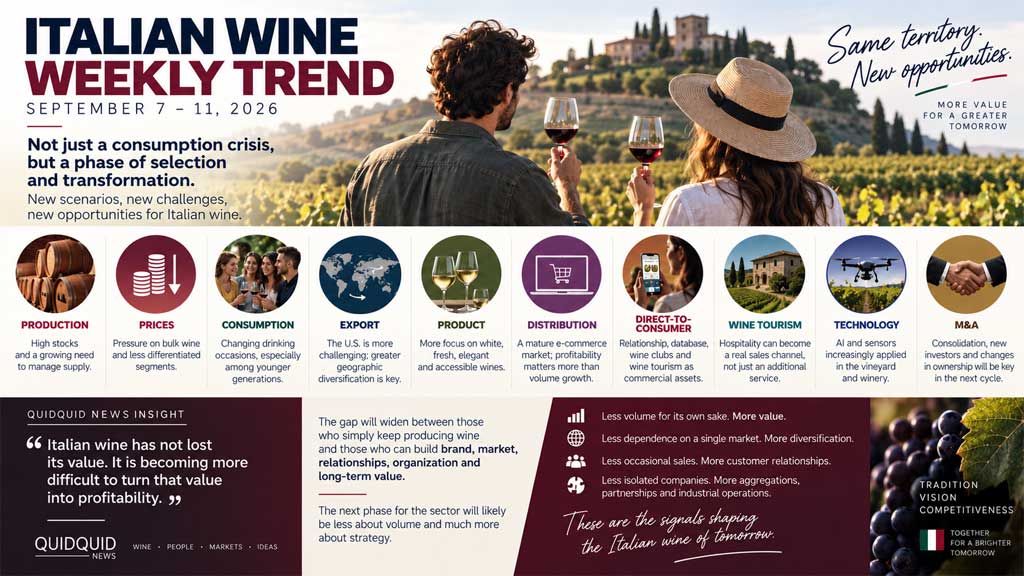
The picture that emerges from the news of September 12, 2026 is very clear: Italian wine is going through a phase of strong selection .
Exports in the first half of the year fell 6.2% , the United States declined significantly, and nine of the top ten markets were struggling. But at the same time, interesting signs emerged: Piedmont grew, China returned to positive territory, Mercosur accelerated, and in the US, the summer showed the first signs of recovery.
Above all, it is changing the way wineries try to create value.
It’s no longer enough to produce wine. We need to build value around wine.
Wine tourism, hospitality, harvest experiences, local area, sustainability, quality, Metodo Classico, heroic viticulture, and direct relationships with consumers are becoming increasingly important components of companies’ economic models.
For wineries, entrepreneurs, and investors, the message is therefore twofold: be cautious in the market, but pay attention to the opportunities generated by the transformation of the sector.
Today’s wine press review is brought to you by WINEIDEA.IT.
See you tomorrow.