


All posts by admin

Wine press review for Friday January 23 -2026

Canine and Italian wine producers, wine news.

ITALIAN WINERIES

Contini 1898 Winery: 2025 Vintage Gets Off to a Positive Start. The historic Cabras winery is returning to growth: increased quantity, confirmed quality, and a production schedule increasingly adapted to the climate.

Col Dovigo Winery (Breganze DOC): a family history and a wine tourism vocation. Profile of a Venetian winery of excellence, combining a volcanic microclimate, distinctive wines, and structured wine tourism.

Cantine Due Palme: Melissa Maci reappointed as president. Continuity at the helm of the Apulian cooperative amid a challenging market environment, amid declining consumption and new strategies for sustainability and value-for-money.

Bertolani Alfredo Winery: A shower of awards for its Brut di Spergola. The classic method “Bertolani Brut” receives 94 points and the 4 Viti in the 2026 Vitae Guide: a recognition of excellence for Emilia.

Argiano and Sarzi Amadè: an alliance for Brunello di Montalcino. Exclusive distribution agreement for the Italian market: a new strategic phase for Argiano in the high-end segment.

ITALIAN WINE AND ITALIAN ENOLOGY

Veneto is a national leader: production and exports grow in 2025. Vineyard area exceeds 104,000 hectares, Prosecco is central, and exports are on the rise: Veneto confirms its position as the driving force of Italian wine.

Record stocks: over 60 million hectoliters in the cellar. Surplus alert according to Cantina Italia: stocks at a ten-year high, pressure on prices and the supply chain.

Langhe Nebbiolo DOC now available in bag-in-box. The Consortium approves the modification to the specifications: an open debate on tradition and new formats.

Lambrusco, a plural identity between past and revival. A reflection on the ten souls of Lambrusco and its evolution after the “Italian red cola” era.

Diamond dust against counterfeiting Feudi Spada adopts Dust Identity technology (MIT) to protect bottles with unclonable physical signatures.

Fewer and fewer pesticides available. Drastic reduction in authorized active substances: a growing technical challenge for plant protection.

Wine in the Age of Surplus: From Quantity to Design. A Structural Analysis of the Global Consumer Crisis (OIV): Unbalanced Inventories, Incentives for Culling in France, and a Necessary Paradigm Shift.

Conventional wine according to Nicolas Joly The biodynamic pioneer criticizes industrial winemaking: “wine made in the cellar, not in the vineyard.”

In vino “novitas”: new Slow Food Presidia Promoting Abruzzo Cotta and Recioto della Valpolicella as wine and cultural heritage.

INTERNATIONAL

Champagne in crisis: 60 million bottles lost in three years. 2025 sales at 266 million (-2%): domestic market in decline and structural difficulties post-pandemic.

Oniwines strengthens its position in Champagne. The Oniverse group is looking at new acquisitions in Northern Italy and France and is focusing on hospitality in the cellar.

Dry January, Lonely January – The Economist The decline in wine prices speaks to a social crisis: less conviviality, less shared time, fewer rituals.

Alcohol-free debuts at Wine Paris 2026. The “Be No” area is born: a strategic response to new consumer trends and the changing market.

WINE EVENTS, CULTURE AND TRAINING

Prosecco and denominations conference – Godega di Sant’Urbano (January 30) Focus on markets, sustainability and new viticultural authorisations, prelude to the Antica Fiera di Godega.

Taste Alto Piemonte 2026 – Milan, March 9 Grand tasting of the 10 Alto Piemonte appellations at the Westin Palace.

5th PIWI Wine Show 141 labels from resistant grape varieties awarded: sustainability as a technical and commercial lever.

Sicilian Wine Tourism Movement: Federica Fina appointed new president. New governance to strengthen hospitality, territorial synergies, and regional promotion.

Wine changes its story – Rimini, January 24th. Meetings on wine, health, and the Mediterranean diet promoted by Enio Ottaviani and HeresLAB.

Wine and Health: A Discussion in Rimini. Scientific dissemination with Dr. Michele Scognamiglio on conscious consumption.

Call for Papers 2026 – Enotria, Rivista del Vino (UIV) The historic scientific journal is back: an interdisciplinary discussion on the future of the sector is underway.

Review brought to you by WINEIDEA.IT . See you tomorrow.
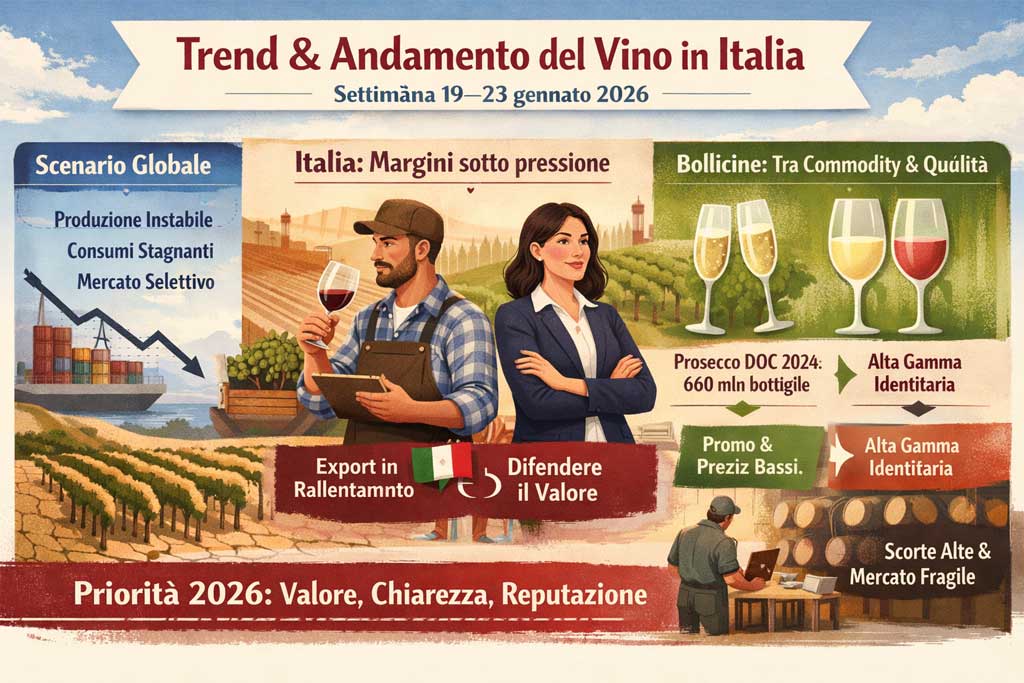
Wine Trends & Performance in Italy – Week 19–23 January 2026

2026 opens as a year of readjustment rather than growth: stagnant consumption, pressure on inventories.

agricultural volatility and a competition that is not won by “making more wine,” but by making more legible, more coherent, and more defensible wine in terms of price and reputation.

1) Global scenario: unstable production, stagnant consumption, selective market

After a phase marked by climate shocks and no longer expansive demand, the sector is entering a new “normality”:

  • 2024 world harvest : the lowest since 1961 (225.8 million hl worldwide).
  • 2025 : slight recovery, but without a return to historical averages.
  • Extreme weather becomes the new constant , with a structural effect: relative scarcity and production fluctuations as the hallmark of the next two years.
  • Consumption : IWRS data indicates zero growth in alcoholic beverages (volume and value) for 2026. Wine is part of this trend: the “tide” is no longer rising, so it’s not dragging everyone along.

Direct consequence: market share is not gained through industry inertia, but through commercial precision and a “clear” proposal to the consumer.

2) Italy: solid production base, but market fragility and margins to be protected

Italy remains strong in fundamentals, but growth is not automatic.

  • 2025 harvest Italy : ~ 47.4 million hl , with good quality level.
  • Exports: Italy maintains the world record in volume and one of the highest values (over 8 billion euros ), but with a less “easy” dynamic:
    • USA (first outlet) slowing down.
    • Germany and Canada are more regular in supporting flows.

Key message: in 2026, the priority is to defend margins and positioning , not to chase volumes at any price.

3) Bubbles: the engine that continues to push, but with a clear polarization

In the calm sea of global stagnation, bubbles remain the most dynamic segment, but the rules of the game are changing.

  • Prosecco DOC (2024) : 660 million bottles , estimated value 3.6 billion euros .
  • The category is polarized :
    1. Promotional offer (price pressure, commodity risk).
    2. Identity cuvées : parcels, maturation times, more precise agronomy, recognizable styles.

The most promising direction is the second: specificity and recognisability, i.e. sustainable value.

In parallel:

  • Franciacorta and Trentodoc consolidate their reputation thanks to a key driver: the demand for authenticity, transparency, and process (not just “brand”).

4) Contemporary whites and technical rosé: Italy has a natural competitive advantage

Outside the world of sparkling wine, two areas emerge where Italy “speaks the language” of the 2026 consumer:

“Contemporary” whites

Clear, saline, agile wines, with moderate alcohol content and fine textures: perfect for a more balanced and gastronomic drinking culture.
Examples cited: Verdicchio, Pinot Bianco, Fiano, Falanghina , Alto Adige and Friulian blends.

New generation Rosé

No longer “seasonal”, but gastronomic and long-lived , with an increasingly precise technical profile.
Examples: Chiaretto, Cerasuolo d’Abruzzo, Sicilian rosés .

In short: the winner is the one who produces usable , modern, coherent and easily described wines (even in international contexts).

5) Agricultural side: falling grape prices, high stocks, risk of discrepancies between denominations

Here the situation becomes more difficult and more strategic.

  • In 2025, grape prices are expected to plummet in many areas (up to 40% in some areas), with a knock-on effect on agricultural income and the perception of value.
  • A gap opens up:
    • Names capable of controlling the offer and valorising it (communication policies).
    • Areas most exposed to volatility and “volume alone”.

The lesson is brutal but true: volume without narration generates no value .

Stocks: the issue that weighs on everything

“Cantina Italia / ICQRF” data updated as of 12/31/2025 :

  • 59.5 million hl of wine in stock
  • 7.7 million hl of must
  • 2.8 million hl of new wine in fermentation
    In one year: wine 4.4% , must 16.8% , fermenting wine 32.3% .

The picture depicts a system that must dispose of and realign production and demand. Prosecco appears less worrisome in terms of sales potential; the situation is more critical for several “firm” denominations, where sales are not immediate.

6) Communication and “consumer culture”: the counter-offensive as a market lever

In this context, an industrial as well as cultural theme takes shape: how do we talk about wine in the health/sober era?

Sandro Veronesi (Oniverse/Signorvino/Oniwines) proposes a clear line:

  • wine is in a normal phase (supply > demand) and “now it needs to be sold”;
  • What is needed is joint work and communication that distinguishes moderate and convivial consumption, with scientific and cultural foundations, avoiding indiscriminate demonization.

This is a key point: in 2026, simply making a product well isn’t enough; we also need to legitimize its role (food, conviviality, Mediterranean style) in a credible and responsible way.

7) No/Low alcohol: from curiosity to laboratory (and opportunity)

No/low-alcohol is no longer a “trendy corner”: it is a laboratory where experiments are carried out to intercept new behaviors.

  • Forecast: Average annual growth 7–9% until 2026 .
  • Most favorable soil: aromatic and sparkling wines.
  • Real challenge: maintaining sensory integrity and texture, protecting the qualitative perception.

For many wineries it could become a parallel (not replacement) line to cover consumption opportunities that are currently “lost”.

8) Policies and finance: CMO Wine Investments 2026–2027 (AGEA)

On an operational level, this provides a concrete benchmark for those who want to invest in competitiveness and structure.

  • AGEA publishes instructions for the CMO Wine – Investment Intervention 2026/2027 .
  • Funds guaranteed until the 2027 financial year; for the 2026/2027 campaign, projects can only be annual .
  • Objective: improve overall performance (facilities, infrastructure, marketing, energy efficiency, sustainability).
  • Grants: up to 40% for micro, small, and medium-sized enterprises; lower percentages for medium-sized and large enterprises.
  • Application deadline : March 30, 2026 .

This is an important signal: in 2026, “defensible” investments are those that improve efficiency, sustainability, and commercial capacity, not those that simply increase volumes.

9) Abroad: USA, fine wines and Champagne show stress (and indicate a change of era)

United States (2025)

  • Value: -1.6% ($74.3 billion vs $75.5 billion)
  • Volume: -2% (329 million cases vs 335.9 million)
    Trend: Strengthening direct-to-consumer (DTC) sales as a driver of loyalty, not just a channel.

Fine wines as an investment

The Liv-ex Fine Wine 100 Index (referred to as the “Dow Jones” of fine wines) has lost approximately 11% in two years ; declines have been widespread, even across top regions. This signals a decline in wine’s status as an asset, with a return to more rational thinking.

Champagne

After the record 2022 (326 million bottles), in 2025 it will drop to 266 million (-2% on 2024): -60 million bottles in three years.
The tariffs/USA issue remains an unknown, with threats of very heavy tariffs.

Wine press review for Thursday January 22 -2026

Italian wineries and wines, wine news.

ITALIAN WINERIES

Tenuta San Guido and Produttori del Barbaresco are leading the Liv-Ex 2025. Sassicaia 2020 is the top wine in terms of value traded, while Barbaresco Cooperativa leads the way in terms of volume. Signs of recovery are emerging in the fine wine market, and the concept of “accessible luxury” is reaffirming.

Terre d’Oltrepò Crisis: Losito and Guarini Interested in Acquiring the Cooperative, Optioning Flexible Formulas and Involving Multiple Parties

Colli Zugna Winery: The legal case after years. The legal battle of a historic supplier implicated in the watered-down wine scandal.

Bonotto delle Tezze: six centuries of Raboso and identity. The Venetian dynasty defends the value of territorial identity against the standardization of tastes.

Paololeo – Negroamaro Orfeo 2023 Profile of a family-run Apulian winery producing 5 million bottles, both organic and as a négociant.

Cantina del Taburno: New direction with Enzo Rillo. Industrial and winemaking restyling for a historic Sannio cooperative, with a new winemaker and strategic relaunch.

Cantine Papa: Telling the Falerno Story Through the Territory. Historical and identity-building value as a lever for positioning.

A winery for Tanzania. The solidarity project of priest Kessy Baltazary: first African harvest after his training in Alba.

ITALIAN WINE AND ITALIAN OENOLOGY

Red wine and heart health: A scientific focus on resveratrol, moderate consumption, and cardiovascular benefits.

Luciano Spalletti’s “Rossodiretto” wine. Wine curiosities between football and Tuscan production.

New National Olive Oil Plan: nearly €500 million over 5 years. Public and EU resources to revitalize the olive oil sector.

Agriculture in the 2026 Budget Law: Tax relief on land and agricultural income for direct farmers and IAPs has been confirmed.

New rules for vine nurseries: Mandatory online reporting and new operating rules from 2026/27.

Vinext and Purcari Group: strategic agreement on biotechnology and advanced oenology innovation for the international market.

Confagricoltura Siena: Wine, Health, and Communication. Experts discuss the relationship between responsible consumption, culture, and health.

EU-Mercosur Agreement: What It Means for Wine New trade opportunities but strong political and agricultural tensions in Europe.

INTERNATIONAL

US: Wine industry to decline by 2025, down 2% in volume and 1.6% in value. Focus on direct sales and restructuring California vineyards.

Top Italian Wine Roadshow in Kenya Italian art and wine take center stage in Nairobi with PurpleRyta and Gambero Rosso.

WINE EVENTS

Borgo Capietaglio Restaurant Wine Resort (Bergamo) New wine resort offering hospitality, dining, and its own production.

Weekend in Veneto: 5 wineries to discover. Wine tourism itineraries between Valpolicella, Conegliano, and the Piave River.

Organic Guide 2026: The Award Winners Focus on organic wines and emerging territories in Lazio.

Cantine d’Italia – Go Wine all’Aquila Presentation, guide, and tasting with 911 selected wineries.

Slow Wine Fair 2026 – Bologna Central theme: “The right wine”, between social sustainability and the ethical supply chain.

Visione Vino – the national community is born. The “Cernobbio del vino” in Voghera: TEHA data and strategy for the future of the sector.

Bagnacavallo in a glass Over 500 labels from Italy and Europe in Romagna’s new wine lounge.

Voghera, Capital of Italian Wine. A high-profile national event for the wine sector.

Thanks for listening. Today’s wine press review is brought to you by WINEIDEA.IT . See you tomorrow.

Wine press review for Wednesday January 21 -2026

Wineries, Italian wines and wine news.

Italian wineries

Masciarelli joins Altagamma. The historic Abruzzo winery, led by Marina Cvetic, joins the Altagamma Foundation, strengthening the presence of Italian wine in the luxury and high-end segments (now comprising 22 wine & food brands in the network). A key sign: an increasingly institutionalized premium positioning, with positive effects on reputation and pricing.

Cantina del Taburno (Foglianise): new direction and restyling. Acquired by entrepreneur Enzo Rillo, the winery now boasts a new winemaker (Raffaele De Marco), updated labels, and new wines (including a Sannio DOC Barbera made from Camaiola grapes). Key developments include an industrial and commercial relaunch through product, image, and expertise.

Sankt Pauls: Evolution of the top-of-the-line wines (Appiano, Alto Adige) Historic cooperative (1907): new governance and sales team, focus on freshness and elegance in top-of-the-line wines, with a significant membership base (190 members, 187 hectares). Key signal: the cooperatives are “representing themselves” with a clearer identity and channel strategy.

Sankt Pauls relaunches itself: “Pinot Bianco flagship.” Repositioning on the domestic market: territorial identity, streamlining the range, and pushing into the HoReCa sector (a marginal presence in large-scale retail trade). Key signals: fewer labels, greater recognition, and greater commercial presence.

Colli Zugna Winery: 97-year-old supplier seeks justice. A landmark legal case (fraud/dilution) involving suppliers has resurfaced, reinforcing the issue of “responsibility and protection” along the supply chain. A key sign: governance, oversight, and transparency remain reputational assets.

Marchesi di Barolo: Monument in Turin to Marchesa Giulia di Barolo. A cultural and identity-building tribute that intertwines wine, history, and social impact (Opera Barolo). Key message: the value narrative (not just the product) continues to generate brand capital.

Italian wine and Italian oenology

Too much wine in the cellar: inventory on the rise (MASAF data) . As of November 30, 2025: 53.4 million hl of bottled wine in storage (8.6% vs. 2024), musts and fermenting wine . In the Northeast, Prosecco DOC is holding up, but Pinot Grigio DOC Delle Venezie, IGP Veneto, and Soave are growing strongly. Key signal: “oversized” market → pressure on prices, rotation, and inventory management.

Dealcoholized wines: Castel invests and pushes to expand to appellation wines. A €10 million investment in the Loire Valley, using low-temperature vacuum distillation technology (goal: preserving aromas and structure). Key signal: no/low alcohol goes from being a curiosity to becoming an industrial infrastructure.

Consumption: Ethical Quality (Food Wine & Co, Rome Tor Vergata – Gambero Rosso) Consumers, amid inflation and a decline in premium consumption, demand consistency: “good” isn’t enough; they need credible ethical choices. Key message: sustainability and values aren’t just claims: they become purchasing criteria.

Gambero Rosso: The best Barbera d’Asti wines receive awards. Focus on the grape variety and the Monferrato region (DOCG since 2008) and its diverse soil and climate. Key finding: “classic” appellations continue to generate engagement when well-presented.

Terroir and soil: identity irreplaceable by technology. Reflection (Corriere Vinicolo) on the role of soil and the distinction between “varietal” and “terroir” wines. Key message: identity and sustainability depend on understanding the soil’s limitations, not just on practices.

Distribution as a “sentiment hub.” From the discussion in Rome: after the post-Covid euphoria, 2026 is seen as a year of adjustment (cautious consumption, health, less cultural appeal, still high supply). Key signal: those who distribute filter the market reality: it pays to listen to them.

Volcanic Lazio and “outsider” choices (Federico Veronesi / Tenimenti Leone) A return to the land and agricultural practices as a counter-current strategic choice in a “difficult” territory. Key signal: true differentiation arises when the strategy embraces complexity, not when it avoids it.

International

Wine tariffs: European producers call for unity. EU-US tensions are resurfacing: producers are demanding a “unified” response, without hysteria. Key signal: geopolitical risk = concrete trade risk, especially in the US.

Wine events

Fattoria La Maliosa (Saturnia): “Love is Blind” – blind tastings (February 12–15) Experiential format for Valentine’s Day: blind tasting (3 natural EVO wines) and platter. Key takeaway: wine tourism = memorable experience, not just tasting.

Andar per Cantine – LIVE (Livorno, March 7–8, 2026) Launch event for the Tuscan wine tourism guide: “Wine Comes to the City” at the Officine Storiche di Porta a Mare. Key message: urban-territorial fusion to broaden audiences and accessibility.

Cantine d’Italia 2026 (Go Wine) Guide for wine tourists: 911 wineries, 270 “Impronte d’eccellenza” (Imprints of Excellence), over 5,140 wines featured; strong Piedmont presence. Key message: wine tourism is measured and rewarded: competition for the quality of hospitality is growing.

“Visione Vino” Community (TEHA Group) “Visione Vino” Forum (Voghera, 16–17 October 2026) Territorial research and positioning process, also focusing on Oltrepò Pavese; 2026 Strategic Report closing. Key signal: territories are seeking strategic direction (competitiveness, human capital, sustainability).

“Visione Vino Oltrepò” is born: Pinot Noir as ambassador. Presentation at Palazzo Lombardia: Oltrepò as a key area (Pinot Noir and sparkling wine growth). Key signal: Oltrepò is attempting to transform “potential” into a trajectory (branding system).

Umbria del Vino 2026: Competition tastings begin. A competition featuring 57 wineries and a jury led by Riccardo Cotarella. Key message: regional institutional events as a lever for selection and visibility.

Weekend of January 23–25, 2026: Food and wine festivals, fairs, and events. An overview of events, including tastings, workshops, and markets tied to local areas and supply chains. Key takeaway: wine remains an attraction, but it wins when integrated with culture and craftsmanship.

Closing: Thanks for listening: today’s wine press review was brought to you by WINEIDEA.IT . See you tomorrow.