QUIDQUID News presents today’s wine press review: a summary of the main news on Italian wineries, the wine market, the 2026 harvest, oenology, exports, wine tourism, and events..
Good morning,
The picture that emerges is very clear: the quality of the grapes appears generally good, but the market remains under pressure . Slowing exports and high inventories are the main challenges, while wine tourism, regional development, and innovation in consumption patterns offer new opportunities.
ITALIAN WINERIES
Terre Cevico brings forward the harvest: grapes delivered by 6 a.m.
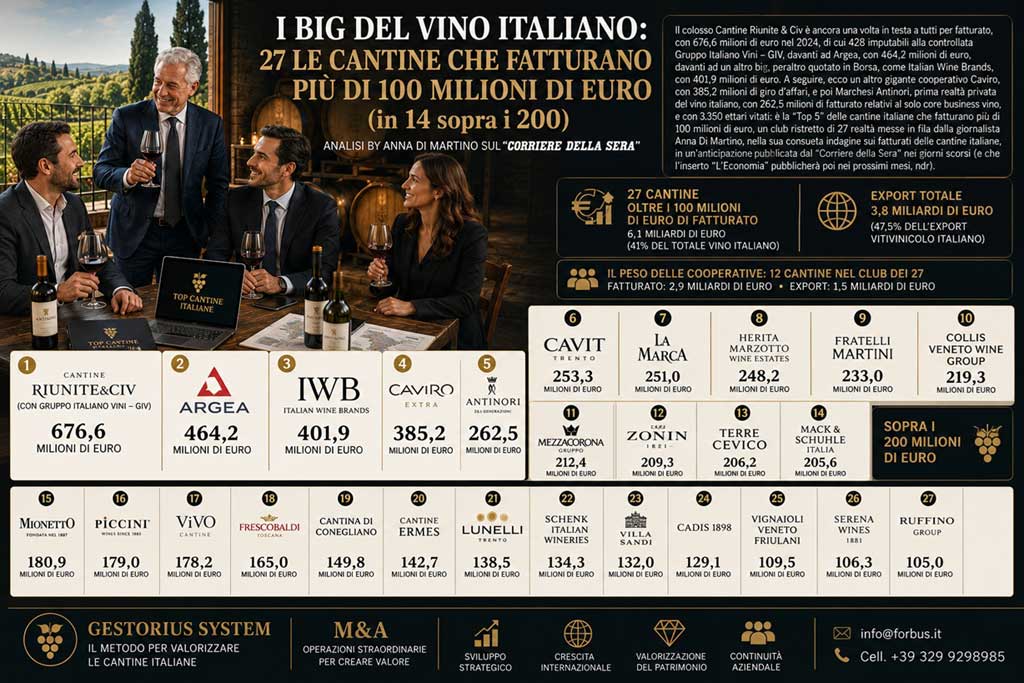
Climate change is also altering the organization of the grape harvest. Terre Cevico , a company with a consolidated turnover of €213 million, over 500 employees, and approximately 900 members, has consolidated its early harvest program, launched in 2024.
For Pinot Bianco, Chardonnay, and Pinot Grigio, the facilities are open from 6:00 a.m. to 1:30 p.m. The goal is to harvest and process grapes at lower temperatures, improving the quality and performance of the facilities and reducing workers’ exposure to the hottest hours of the day.
Berlucchi experiments with harvesting from 4am
In Franciacorta, Berlucchi also moved up its harvest schedule, starting at 4 a.m. for the first time. This decision was driven by high temperatures and the need to improve working conditions for the grape harvesters.
In the same area, the I Barisèi winery also experimented with night harvesting. This phenomenon confirms how the climate is significantly altering the timing and organization of wine production.
Siddùra launches Èros, the red wine designed to be drunk cold.
The Sardinian winery Siddùra focuses on the evolution of consumption with Èros , a red wine designed to be served at lower temperatures than traditionally.
The goal is to attract consumers who prefer more elegant, refined, and less structured wines, while also expanding the pairing options with raw seafood, fish, and light cuisine. A proposal that responds simultaneously to new tastes and increasingly warmer seasons.
Centopassi: Sicilian wine becomes a symbol of redemption
In the Alto Belice Corleonese area, Centopassi represents a project that goes beyond simple winemaking. Its name recalls the story of Peppino Impastato and the rebirth of lands confiscated from organized crime.
Vineyard, community, and wine production thus become elements of a single territorial and social narrative.
Merotto Space: In Prosecco Superiore, wine becomes an experience.
In the heart of the Conegliano and Valdobbiadene Hills, a UNESCO World Heritage Site , in Col San Martino, Merotto has developed a space dedicated to welcoming and enhancing the area.
The Merotto Space , created from the renovation of an old farmhouse, offers tastings, wine tours, direct sales, events, concerts, and cultural initiatives. It’s a concrete example of how a winery can transform wine into an experience and a connection with the local area.
La Roccola: Wine, Cuisine, and Territory in the Euganean Hills
Since 1972, the La Roccola winery and farmhouse in Cinto Euganeo has combined wine production, cuisine, and hospitality.
The company has 25 hectares of land, 20 of which are vineyards, and produces approximately 100,000 bottles annually. The company philosophy focuses on non-mass production, direct control from the vineyard to the cellar, and the valorization of the Euganean Hills terroir.
Cantina Fazio promotes the Erice DOC
In Sicily, the Fazio family continues to invest in the identity of the Erice DOC, a denomination created in 2004.
The winery has approximately 70 hectares of vineyards and produces approximately one million bottles a year. Its wines include the Erice DOC Brut Blanc de Blancs made from Chardonnay, alongside other sparkling wines.
Etna: Ciro Biondi focuses on quality to combat declining consumption
According to Etna producer Ciro Biondi , the market slowdown isn’t affecting all wineries equally. His company, with approximately seven hectares of vineyards and a production of around 25,000 bottles, continues to see demand exceeding supply.
The message is significant: after the strong growth of the Etna brand, the market is becoming more selective and quality can represent a decisive element of differentiation.
ITALIAN WINE, MARKET AND OENOLOGY
Italian wine exports: -6.8% in the first four months of 2026
International trade represents one of the main critical issues for Italian wine.
According to data from the Italian Wine Union Observatory, processed using Istat data, in the first four months of 2026 Italian exports decreased by 6.8% in value , reaching 2.34 billion euros .
Volumes fell 3.7% , reaching 641 million liters. The slowdown in international sales is increasing pressure on wineries and inventory management.
Stocks: 42.6 million hectoliters in Italian cellars
As of July 31, 2026, 42.6 million hectolitres of wine were present in Italian cellars, an increase of 6.9% compared to the same period in 2025 .
Added to these are 3.1 million hectolitres of must , an increase of 31.5%, and 42,000 hectolitres of new wine still fermenting.
55.9% of the stocks are concentrated in the northern regions, with Veneto alone accounting for 24.2% of the national wine stock. 55.4% of the stocks are DOP wines.
A particularly significant figure concerns concentration: just 20 out of 523 denominations represent 57.6% of the stocks of Geographical Indication wines . Prosecco DOC is among the denominations with the largest stocks.
2026 Harvest in Puglia: High Quality and Expected Growth in Production
Initial indications from Coldiretti Puglia describe a qualitatively positive 2026 harvest.
The grapes are healthy and regional production could grow by around 10% compared to 2025. Winter and spring rains have created good water reserves and favored the balance of the vineyards.
However, there remain uncertainties related to the market, grape prices and the presence of alien insects such as the leafhopper.
Langhe and Roero: early harvest but vineyards in good condition
According to Sergio Germano , president of the Consorzio di Tutela Barolo Barbaresco Alba Langhe e Dogliani, the prospects for the 2026 harvest are interesting despite almost two months of scarce rainfall.
For Pinot Noir and Chardonnay destined for the Alta Langa, ripening is in the order of four to five days early, reaching about a week in some areas.
However, the vineyards show a good capacity to resist water stress, favoured by the reserves accumulated thanks to winter rainfall.
Euganean Hills: Harvest begins at 5 a.m. to protect against the heat.
In the Euganean Hills, the harvest of grapes for sparkling wines began early. To avoid excessively high temperatures, work in the vineyards is concentrated between 5:00 a.m. and noon .
However, initial indications speak of intact bunches and positive qualitative prospects.
Tenuta Mariani: three weeks early ripening
At Tenuta Mariani too, high temperatures have significantly accelerated ripening.
Harvest began in early August, about three weeks earlier than in previous years. Despite the heat and drought, the health of the grapes raises positive expectations for final quality.
Sardinia: Quality on the Rise in the 2027 Vinodabere Guide
Vinodabere’s 2027 Guide to the Best Wines of Sardinia recorded over 600 samples tasted, a slightly lower number than the previous edition.
The quality, however, continues to grow: 330 wines deserved the review and 118 obtained the Standing Ovation , equal to 35.8% of the selected wines.
Valtenesi: Groppello and rosé tell the story of Garda
Valtenesi , on the Brescia shore of Lake Garda, continues to build its identity around Groppello and rosé.
The lake’s mild climate and moraine soils favor fresh, elegant wines. Valtenesi rosé is one of the most distinctive expressions of the appellation, while Groppello, Marzemino, Barbera, and Sangiovese constitute the area’s ampelographic heritage.
Incentives for the promotion of wine production
The Ministry of Agriculture, through the Ministerial Decree of 12 June 2026 , provides non-repayable contributions equal to 50% of expenses, up to 40,000 euros , for promotional events of local, regional or interregional interest.
The measures affect agricultural, agri-food, and wine production for the years 2026 and 2027.
INTERNATIONAL
US tariffs: Cottarelli emphasizes the strength of Italian quality
Economist Carlo Cottarelli highlights how agriculture is particularly exposed to geopolitical tensions and rising energy and fertilizer costs.
Regarding Italian wine in the United States, Cottarelli notes that the impact of tariffs may initially be absorbed by importers, while the quality of Italian production could help sustain demand even in the presence of higher prices.
It remains to be seen, however, what will happen if the increased cost is passed on entirely to the American consumer.
Italy and Spain meet in the center of Genoa
La Cava , a food and wine project that brings together Italian and Spanish products, was born in Genoa.
The selection favors small producers, limited production, local produce, and minimal cellar intervention. The format integrates wine, tasting, and gastronomy, with a special focus on preserves from the Spanish Atlantic coast and specialties from both countries.
WINE TOURISM
Wine tourism: 18 million Italians choose wineries and regions
As traditional wine consumption slows, interest in wine-related experiences grows.
According to the report Italians and wine tourism experiences , edited by Roberta Garibaldi in collaboration with ASCOVILO, in 2026 there would be approximately 18 million Italians who had wine tourism experiences during their travels , compared to approximately 13.4 million in 2024.
In two years the potential audience would have increased by over 4.5 million people .
The data highlights an important transformation: wine maintains a strong power of attraction when associated with territory, travel, gastronomy, meetings with producers and visits to cellars .
Friuli Venezia Giulia: Seven wineries open their harvest season to visitors.
From August 28th to the end of September, seven wineries in Friuli Venezia Giulia will allow the public to experience the grape harvest firsthand.
The experiences involve the Friuli Colli Orientali, Friuli Grave, and Collio DOCs and include grape harvesting, pressing, winemaking tours, tastings, picnics, grape harvesters’ lunches, and dinners featuring local products.
A concrete example of integration between wine production and tourism experience.
WINE EVENTS
Barolo showcases Piedmont’s short supply chains with COMPA
At Barolo Castle, the COMPA – Compagnia dei Sapori Piemontesi project promotes not only wine and agri-food products, but also producers, techniques, families, landscapes, and agricultural culture.
Through Agrilab and multimedia tools, the project reaches the tens of thousands of Italian and international visitors who visit Barolo every year.
Rimini: Rebola and Sangiovese take center stage at the Parco del Mare.
“ Dire Mare Mangiare 2026 ” brings three evenings dedicated to wine, gastronomy, oil, music, and the culture of hospitality to the Rimini seafront.
Rebola and Sangiovese become tools to narrate the Riviera’s food and wine identity and strengthen the relationship between wine, tourism, and the region.
Carosino celebrates 60 years of the Wine Festival
In Carosino, in the province of Taranto, the 60th Wine Festival relaunches the historic relationship between the territory and viticulture by introducing the Epops Wine Festival Award .
At the heart of the initiative is Primitivo , the symbolic grape variety of Puglia, described through discussions between producers, professionals and the public.
Vibo Marina: “Calici Sotto le Stelle” a success
The second edition of Calici sotto le stelle (Goblets Under the Stars) brought the Vibo Marina waterfront to life with local wine tastings, sommeliers, music, and entertainment.
The initiative confirms the growing use of summer events as a tool for promoting local wine production.
Ferragosto in a Tuscan cellar
On August 15th, Cantina Le Pietre is offering an evening dedicated to wine, food, and hospitality, with tastings, aperitifs, artisanal products, and cocktails.
A format that interprets the winery not only as a place of production, but also as a space for experience and socializing.
Manduria: music and culture at Fonte Pliniano
The evocative Fonte Pliniano in Manduria , a spring already described by Pliny the Elder, hosts “aquæ – A soundbath”, a performance built around sound, resonance and a relationship with a highly symbolic place.
The initiative connects historical heritage, water, territory, and contemporary culture. The most important strategic indications of the day for the future of Italian wine.
QUIDQUID – Wine Press Review