


All posts by admin

Wine press review for Monday March 16 -2026

Italian wineries, Italian wine producers, and current wine news.

Italian Wineries

Fontanafredda showcases Barolo through art, territory, and sustainability.

In the heart of the Langhe, the new edition of the Barolo del Comune di Serralunga d’Alba Renaissance 2022 is born, a cultural project by the Fontanafredda winery that each year interprets a universal human value. The theme chosen for this edition is Tenacity , symbolizing a new “Green Renaissance” based on sustainability, biodiversity, and responsibility towards the territory.

Montalbera and the challenge of ultra-fine bubbles

Entrepreneur Franco Morando continues to develop the Montalbera winemaking project. A curious episode led to the birth of a Metodo Classico aged for almost 12 years on the lees , after 20,000 bottles had been forgotten in the cellar for two years. Today the company boasts 130 hectares of vineyards and produces approximately 850,000 bottles annually .

Tenuta Santa Maria: Amarone and the Bertani Family’s History

In Negrar, in the Valpolicella Classica region, the Bertani family’s historic Tenuta Santa Maria continues a winemaking tradition that dates back to the 16th century. With 54 hectares of property and approximately 230,000 bottles produced annually , the winery is known for its Amarone, Valpolicella, and Soave wines, alongside crus of Merlot and Chardonnay.

Masi debuts in the Oltrepò with the Pinot Noir “del Re”

The Masi wine group is expanding its presence in Oltrepò Pavese with the Pinot Noir “del Re” , a new still red wine produced on the Tenuta Casa Re estate. The property, acquired in 2023, has 15 hectares entirely planted with Pinot Noir .

Petra Develops Montebamboli Project on the Tuscan Coast

The Petra group continues its Montebamboli project in the Montioni Park. Led by Master of Wine Andrea Lonardi, the plan aims to create a new winemaking identity for the Tuscan coast through high-altitude vineyards and an innovative terroir approach.

La Regola among the 100 iconic wineries of Italy

The La Regola winery, in Riparbella (Tuscan coast), enters the “Iconic Wineries 2026” ranking of Forbes Italy , a recognition awarded to companies that contribute to the qualitative renewal of Italian wine.

Torelle Winery: Emanuele Guardascione’s dream continues

The Campania-based Cantina Torelle winery, founded by the young agronomist Emanuele Guardascione , continues its journey thanks to his sister Giuliana. The 16-hectare vineyard in Sessa Aurunca today represents the legacy of an entrepreneurial vision dedicated to local viticulture.

Sassotondo and the rediscovery of the Nocchianello grape variety

In Maremma Toscana, Edoardo Ventimiglia and Carla Benini continue their work to recover the rare native Nocchianello grape variety, originally from the Pitigliano and Sorano areas, contributing to the protection of viticultural biodiversity.

Italian Wine and Oenology

Pinot Grigio delle Venezie launches digital wine passport

The Consorzio Pinot Grigio DOC Delle Venezie , which represents approximately 27,000 hectares of vineyards and over 230 million bottles , is working on the introduction of a digital passport to improve traceability and governance of the supply chain.

Wine tourism: a €46.5 billion sector

According to the study presented at Hospitality – Il Salone dell’Accoglienza, wine tourism today represents a strategic lever for the Italian wine sector with an estimated value of 46.5 billion euros .

The debate about restaurant wine and markups

More and more consumers are reporting excessive wine prices in restaurants. A more balanced markup policy could encourage consumption and improve the relationship between wineries, restaurants, and customers.

The logistical paradox of Sicilian wine

In the Trapani area, concerns are growing over transportation costs: expensive diesel fuel and geopolitical tensions in the Gulf are slowing shipments. The result is a paradox: wine sold but sitting in cellars.

Agricultural income tax relief extended to 2026

The 2026 Budget Law extends the IRPEF tax exemption on land and agricultural income for direct farmers and professional agricultural entrepreneurs.

Ethical work in the wine supply chain

Following the “Bitter Grapes” dossier, institutions and consortia in the Langhe region have established a permanent working group to combat the exploitation of agricultural labor in the vineyards.

International

Wine and Health: New Studies on the Mediterranean Diet

A study published in the European Heart Journal analyzes the relationship between moderate wine consumption and cardiovascular health, as part of the international Unati project coordinated by the University of Navarra.

The phenomenon of “sober sommeliers”

In the United States and Europe, there is a growing debate about the role of “sober sommeliers,” wine professionals who promote a more conscious and responsible approach to consumption.

The methanol scandal, 40 years later

Forty years have passed since the 1986 methanol wine tragedy, one of the most dramatic events in the history of the Italian agri-food industry, which profoundly affected the regulations on wine safety.

Wine Events

ProWein 2026: Prosecco DOCG Strengthens the German Market

The Conegliano Valdobbiadene Prosecco DOCG Consortium is participating in the international ProWein trade fair with tastings and meetings with German professionals, a strategic market for Italian exports.

The wines of Abruzzo on a mission to Düsseldorf

The Consorzio Tutela Vini d’Abruzzo is bringing 13 companies to ProWein to strengthen its dialogue with international trade, particularly the German market.

Meininger rewards Giancarlo Moretti Polegato

The president of Villa Sandi receives the title of “International Wine Entrepreneur of the Year” at the Meininger Awards, on the eve of ProWein.

Tipicità rewards the best organic wines of the Marche region

At the Biowine Marche 2025 competition, Rosso Piceno Cerì and Offida Pecorino Canapale were awarded as the best regional organic wines.

Piedmontese food and wine: tasting at the Francesco Rosso Winery

In Roero, the Francesco Rosso winery is offering a mini lunch with a tasting of three wines , a formula designed to promote local wine tourism.

“10,000 steps between sun and vineyards” in Friuli

A health trail through vineyards and the surrounding area has been created in Chiopris Viscone as part of the regional project FVG in Movimento .

Olio Capitale closes with 15,000 visitors.

The exhibition dedicated to quality extra virgin olive oil in Trieste closes with growing numbers and a strong presence of young people.

Strategic Observatory of the Day

Three structural signals emerge from today’s news:

  • growth of wine tourism as an economic lever
  • consolidation and new investments in iconic names
  • growing attention to sustainability, work and digital traceability

Wine is no longer just agriculture: it is a complex territorial economy .

And when a sector becomes this complex, something interesting happens: the value no longer lies solely in the bottle, but in the industrial vision that supports it . And it is precisely here that the greatest opportunities arise for those involved in investments, acquisitions, and strategic development of wineries.
Wine press review for Sunday March 15 -2026

Italian wineries, Italian wine producers, and current wine news.

Italian Wineries

Foss Marai celebrates 40 years in the heart of Prosecco DOCG. The historic winery in the hills between Conegliano and Valdobbiadene celebrates four decades of activity, producing approximately 1.5 million bottles annually . The company represents an example of heroic viticulture in the UNESCO hills, with a strong focus on design, territorial identity, and production quality.

Valdo Spumanti Completes Acquisition of I Magredi. On the centenary of its founding, Valdo Spumanti is strengthening its production presence with the complete acquisition of the Friulian winery I Magredi (revenues approximately 12 million euros ). The Veneto-based group aims to consolidate its growth, which will lead to a turnover of approximately 90 million euros by 2025 .

Emerging winery Amaracmand is reborn in Romagna. In Sorrivoli, in the Cesena area, Marco Vianello is relaunching the historic La Centenara winery, restoring vineyards and expanding the vineyard area with new land and old ungrafted vines dating back to 1964.

Clara Marcelli among the labels of the World’s Best Sommeliers Selection The Ruggine 2021 wine from the Castorano winery in the Marche region enters the international selection of the best sommeliers linked to the World’s 50 Best Restaurants network.

Perillo celebrates 25 Taurasi harvests The Castelfranci winery is celebrating a quarter century of producing Taurasi Riserva with a vertical tasting of ten vintages, confirming the central role of Aglianico in Campania’s winemaking.

Vermentino di Gallura Siddùra wins international awards The Spèra and Bèru labels have obtained important national and international recognition, including the gold medal at the Mundus Vini Spring Tasting 2026 .

Italian Wine and Italian Oenology

Argea invests €3 million in wine dealcoholization. One of Italy’s largest winemaking groups is launching a project for a dedicated dealcoholized wine facility, part of a €14 million industrial plan. The facility will be built in Northern Italy and marks the Italian industry’s decisive entry into the non-alcohol segment.

Circular economy from wine: medical bandages and cosmetics from waste. Federico Mencaroni, a farm in the Marche region, wins the 2026 Green Oscars with a project that transforms winemaking waste into biocellulose for use in medicine and cosmetics.

Marsala, a great historic wine still under-appreciated. The famous Sicilian wine, created in the 18th century by the English merchant John Woodhouse, remains one of the symbols of Italian winemaking but today suffers from limited awareness among the general public.

Wine must change its language to speak to young people. The wine sector is called upon to renew its communication and consumption methods: more informal languages, new formats, and greater cultural accessibility to prevent wine from becoming marginalized among the new generations.

Cerasuolo d’Abruzzo in strong growth The 2024 harvest marks a recovery in production with over 116,000 hectoliters , 22% compared to 2023. The rosé symbol of Abruzzo confirms growing interest in the market.

Vulture and Aglianico among the great emerging areas of Italian wine. The Lucanian region continues to gain international attention thanks to the quality of its Aglianico wines, characterized by structure, acidity, and a strong minerality.

Vino Nobile di Montepulciano generates an economy worth 1 billion euros. The district produces 6.3 million bottles annually , with an overall value of the companies estimated at around 1 billion euros , confirming the strategic role of the denomination.

Prosecco as a cultural as well as an oenological phenomenon The international success of Prosecco is also interpreted as a social and cultural phenomenon: a symbol of conviviality, light-heartedness, and Italianness around the world.

International

Brunello di Montalcino grows in the United States despite the wine crisis According to SipSource data, in 2025 Brunello sales in the USA increased by 7.7% in volume , in clear contrast to the general decline in Italian wines (-5.2%).

Wine Events

Grafting – new generation of producers in the Piacenza Hills The collective of young winemakers launches Malvasia Prima Vol.2 , an event dedicated to Malvasia di Candia Aromatica which will be held on March 30th at Corte Faggiola .

IO VINO 2026 in Rome Event dedicated to the native grape varieties of Marche and Campania , with tastings and meetings with producers at the Courtyard by Marriott Roma Central Park.

UMBRIAofWINE strengthens regional exports The third edition of the event involved 25 wineries and 27 international buyers , generating over 200 B2B meetings and promoting 13 Umbrian denominations.

BuyWine 2026: Brunello takes center stage. The event brought together leading companies in the Montalcino area to discuss economic prospects and international markets.

Territories, agricultural policies and economy

336 million euros for the agricultural system of Friuli Venezia Giulia The regional revolving fund supported agricultural investments for 336 million in 2025 , with a financing model based on collaboration between banks and institutions.

Trapani cooperative wineries are alarmed. Wine sold is not being collected by buyers due to rising logistics costs, creating tensions in the Sicilian cooperative supply chain.

Terre d’Oltrepò seeks a plan B for relaunch. Subscriptions to the Collis industrial plan are not reaching the necessary volumes: 100 thousand quintals of grapes compared to the 500 thousand processed in the best years.

High-Altitude Vineyards: Environmental Debate in Brentonico The municipality is launching a participatory process to regulate the expansion of high-altitude viticulture and protect biodiversity and the landscape.

Wine Tourism and Culture

“Room with a Vineyard”: 153 Italian wineries where you can sleep among the vines. Vincenzo D’Antonio’s new guide explores Italian wine tourism through a national map of wineries offering hospitality.

Wine and haute cuisine: eight Italian wineries where the gourmet experience is born. An itinerary of wineries and starred restaurants that combines gastronomy, territory, and wine culture.

Palazzo Te reopens the Spazio Te bistro with the Allegrini Group. The project combines art, wine, and hospitality in the heart of Mantua with the support of Villa Della Torre.

Territories and wine communities

The historic Ronco della Chiesa vineyard in Collio must be saved after the flood. The Collio Consortium and restaurateurs are supporting the Manferrari family in preserving one of the area’s iconic vineyards.

Lerma discusses the future of the mountain winery. Citizens and administrators are calling for the facility to be repurposed to promote Ovada grapes and relaunch Dolcetto.

Strategic signal of the day

Three dynamics emerge forcefully in the wine system:

  • growth of the dealcoholized segment and new consumption
  • strengthening of strong identity territories (Brunello, Etna, Vulture)
  • expansion of wine as a cultural and tourist experience

Wine is evolving from an agricultural product to an economic and cultural ecosystem . Those who manage the supply chain, its identity, and its relationship with consumers will have a competitive advantage in the coming years.

If you want, I can also prepare a more concise and much more viral version for WineIdea or LinkedIn , or a strategic reading for investors and wine operators , which in your work often becomes the most interesting part of the review.

Wine press review for Saturday March 14 – 2026

Italian wineries, Italian wine producers, and current wine news.

Italian wineries

Biondi-Santi restarts from the vineyard The historic Greppo estate, the cradle of Brunello di Montalcino, continues its renewal process after joining the Descours family group in 2017. The company has begun a thorough agronomic review of its 33 productive hectares with consultant Pedro Parra, also identifying a rare parcel from the 1930s.

PaoloLeo Wineries to grow in 2025. The Puglia-based winery in Salento closed 2025 with a turnover of €25.3 million (9.8%) and a production of approximately 6 million bottles . Exports grew by 15% , with new markets in the Middle East, Central Africa, and the United States.

Cantina Valle Isarco celebrates 65 years. Founded in 1961 by 24 winemakers, the South Tyrolean cooperative now has 135 members and 150 hectares of vineyards up to 1,000 meters above sea level. The Aristos line represents the high-altitude expression of its production.

Siddùra brings Sardinian Vermentino among the best Italian whites. The Spèra and Bèru wines, Vermentino di Gallura DOCG, obtain important national and international awards, confirming the qualitative growth of Sardinian winemaking.

Panerai celebrates Veronelli Paolo Panerai pays homage to the centenary of Luigi Veronelli’s birth with a dedicated event and a wine that symbolizes their historic relationship.

Italian wine and Italian oenology

Italian wine exports in 2025 slightly down. The value of exports stands at 7.7 billion euros (-3.7%) with 2.1 billion liters (-1.8%) . The regional podium remains unchanged:

  • Veneto: €2.92 billion – 36.7% of national exports
  • Tuscany: 1.17 billion (€)
  • Piedmont: among the protagonists of international sales

The decline is linked to tariffs, geopolitical tensions and the decline in global consumption.

Prosecco declines in the first months of 2026. The DOC sparkling wine recorded a 19% drop in January and a 14% drop in February in bottlings. This effect is also linked to the stocks built up for 2025 to anticipate possible US tariffs.

The “polycrisis” of wine Between tariffs, climate change, and new consumption styles, the global market requires greater flexibility: lower-alcohol wines, shorter supply chains, and certified value.

Wine Must Speak to Young People According to several industry observers, wine risks marginalization if it doesn’t update its language and consumption methods, making it simpler, more accessible, and more contemporary.

Freisa, the Piedmontese grape variety to be rediscovered Historically widespread since the 16th century and genetically close to Nebbiolo, Freisa is returning to the spotlight as a variety capable of expressing territorial identity.

Moderate wine consumption and cardiovascular health A study published in the European Heart Journal confirms that moderate consumption of red wine in the Mediterranean diet can contribute to reducing cardiovascular risk.

Women in Wine: Leadership and Economic Value Women-led companies cultivate 21% of the UAA but produce 28% of the agricultural GDP of the wine sector, with a strong focus on exports and wine tourism.

Illegal Work in the Vineyards: The Langhe’s Response Following the “Bitter Grapes” dossier, local institutions and operators reaffirm the region’s commitment to fighting exploitation and upholding legality.

Innovation and sustainability

Regenerative viticulture: the Bayer project The “Regenerate to grow” program, presented at San Patrignano, promotes agricultural practices capable of improving soil fertility and reducing environmental impact.

Wineries are increasingly green. From the Langhe to Etna, the adoption of sustainable practices is growing: organic, green manure, precision viticulture, lightweight glass, and recyclable materials to reduce emissions.

Intermediaries are increasingly strategic in the wine market. According to Med.&A. President Carlo Miravalle, mediation roles are evolving towards integrated consultancy services that combine technical, commercial, and regulatory expertise.

International market

ProWein 2026 looks to the European market. The international trade fair, with over 560 Italian exhibitors , will take place in Düsseldorf from March 15 to 17. Europe remains a key macro-region for Italy:

  • Germany: €1.4 billion
  • United Kingdom: €816 million
  • Switzerland: over €400 million

Overall, the European market is worth over 4 billion in Italian exports .

China: Wine Imports Decline Sharply In 2025, Chinese imports will drop to €1.25 billion (-14.6%) and 207 million liters (-26.7%) . Despite this, international operators continue to invest in the country.

Wine events and territory

Conegliano Valdobbiadene Prosecco Spring The XXXI edition offers 15 wine exhibitions from 13 March to 14 June , promoting the UNESCO hills of the Alta Marca.

Bertiolo Wine Festival The historic Friulian event returns with its 77th edition from March 14th to 29th , including tastings, culture, and entertainment.

Art at San Leonardo Tenuta San Leonardo presents the fourth edition of the artistic project with a limited-edition label designed by Chiara Camoni for the San Leonardo 2021.

Guida Cantine d’Italia 2026 in Rome Go Wine presents the new edition of the guide dedicated to wine tourism, with tastings and meetings between wineries and the public.

Harrykuminciamu: Sicily’s wine scene restarts. A solidarity tasting organized by Assovini Sicilia on March 28th in Catania to support the restaurant and hospitality industries affected by Cyclone Harry.

Wine tourism on the rise Despite declining consumption, demand for winery experiences is growing: wine is increasingly becoming a vehicle for culture, tourism, and the region.

New local projects in Rimini: The Wine and Flavors Route is considering opening a store dedicated to local products to strengthen its promotion of the area.

Conclusion

Italian wine continues to navigate challenges and opportunities. The sector is undergoing a rebalancing of production and demand , with more selective markets and diverse consumers. At the same time, new strategic levers are emerging: sustainability, wine tourism, agronomic innovation, and the ability to present wine in a more contemporary way.

Today’s wine press review is brought to you by WINEIDEA.IT .

See you tomorrow with new news from the world of wine.

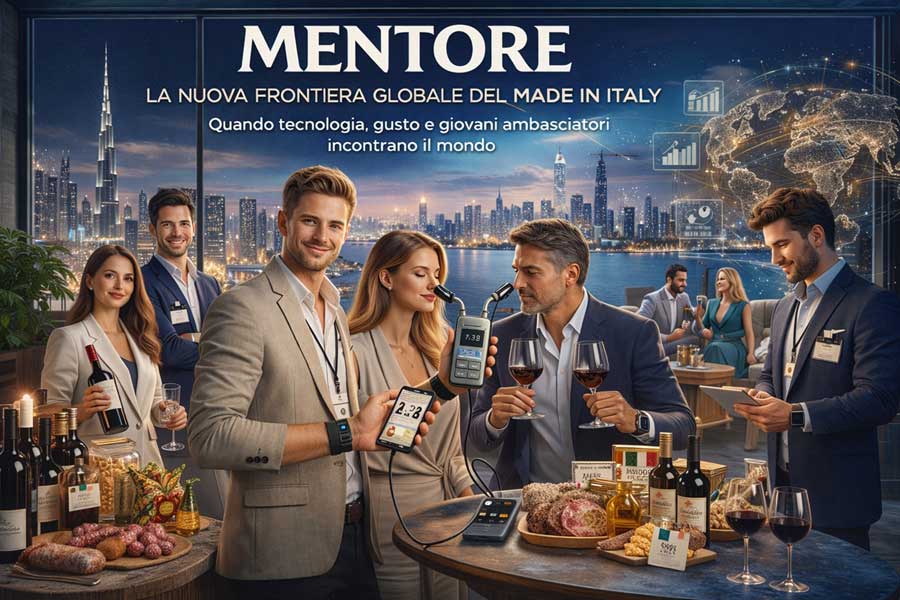
MENTOR – The new global frontier of Made in Italy

When technology, taste and young ambassadors meet the world.

A new need is emerging in the world of luxury and fine dining: it’s no longer enough to sell an excellent product, it needs to reach exactly the right person.

Made in Italy agri-food products—wine, oil, pasta, cured meats, cheeses, and agricultural products—represent one of the European economy’s most valuable assets. However, this heritage suffers from two major problems:

  • international counterfeiting , which subtracts value from authentic products
  • a commercial chain that is too long , which often distances the producer from the final consumer

From this need, the MENTORE Project was born, an innovative model that combines technology, young professionals, and international trade to create a new form of direct distribution of certified Italian products.

It’s not just about exports.

It’s about sensorial profiling of the consumer and targeted delivery of the perfect products for him .

The technological heart: the “electronic nose and palate”

The project is based on a portable electronic device capable of analyzing a person’s olfactory and gustatory characteristics.

The system uses two different probes :

  • one dedicated to olfactory analysis (nose)
  • one dedicated to taste analysis (mouth)

The device collects chemical data relating to the individual’s sensory response and sends it via a smartphone app to a central server in the cloud .

gustatory_olfactory_analysis_pro…

The process takes place in several phases:

  1. collection of aromatic components through the olfactory probe
  2. analysis of the taste response using the second probe
  3. processing of the person’s sensory data
  4. comparison with a database of certified products
  5. generating a personalized taste profile

This system creates an individual sensory map that allows you to pinpoint exactly which wines, oils, cured meats, pastas, or other Italian products are most compatible with your preferences.

In essence, the technology does something that no trading system does really well today:

translates human taste into scientific data usable by the market.

Wine Mentors: A New International Profession

Technology alone is not enough.

It needs a network of people to take it to the world.

The project envisages the creation of a structure composed of 500–700 trained young graduates , called:

Wine Mentor

The word Mentor comes from classical tradition and indicates a trusted advisor, a competent guide .

The Wine Mentor thus becomes an ambassador of Italian taste.

His work consists of:

  • visit customers around the world
  • perform olfactory and gustatory analysis with the device
  • collect customer sensory data
  • suggest the most suitable Italian products
  • manage the relationship between customers and producers

The Mentor is not a traditional salesman.

It is a hybrid figure between:

  • sensory consultant
  • cultural ambassador of Made in Italy
  • commercial facilitator

Each Mentor will be identified via a digital card and wearable device (e.g. electronic bracelet) that records activities, contacts and transactions within the central system.

A global digital platform

The system will be coordinated by a central multi-cloud technology platform that integrates various functions:

  • customer database
  • certified product database
  • supplier database
  • system for matching tastes and products
  • international e-commerce

After sensory analysis, the system automatically suggests the products most compatible with the person’s profile.

The customer will then be able to:

  • receive a personalized selection
  • purchase directly through the platform
  • receive products with rapid logistics

The goal is to create a short supply chain, where:

the Italian producer meets the global end consumer directly.

A new way to sell wine (and more)

The project was born with wine, but the model can be applied to many products.

Among the main ones:

  • Italian DOC and DOCG wine
  • extra virgin olive oil
  • artisanal pasta
  • DOP cured meats and cheeses
  • premium agricultural products
  • preserves and regional specialties

In the future the system could become a complete ecosystem of Italian taste .

A customer in New York, Dubai, or Singapore could have their own digital sensory profile and automatically receive Italian products perfectly matched to their tastes.

Fight against counterfeiting

One of the most important effects of the project concerns the protection of Made in Italy.

When a client enters the Mentor system:

  • buy only certified products
  • receives directly from the producer or from a controlled supply chain
  • avoid imitations and fake products

This creates a business network where authenticity becomes part of the service .

Opportunities for young professionals

The project also has a strong social and economic dimension.

It could create hundreds of new professional opportunities for young graduates in:

  • economy
  • oenology
  • agriculture
  • marketing
  • gastronomic sciences
  • hospitality

The Wine Mentor thus becomes a new international professional figure linked to the world of taste and Italian food culture.

Towards a new export model

Today, a large part of agri-food exports still follow traditional models:

producer → distributor → importer → restaurant → customer

The Mentor system proposes a different paradigm:

producer → platform → Mentor → client

Fewer steps.

More relationship.

More customization.

Conclusion

The Mentor Project represents a new vision for Made in Italy.

It doesn’t just export products.

Export experience, knowledge and taste customization .

A system where technology, young talent, and agri-food tradition meet to create a new global distribution model.

In an increasingly digital and competitive world, Italy’s real advantage could be precisely this:

transform taste into relationship and relationship into value.