
All posts by admin

Wine press review for Friday March 27 – 2026

Italian wineries, Italian wine producers, and current wine news.

Below is a wine press review for the web, organized by topic, focusing on the most relevant news for businesses, wineries, operators, and investors in the sector.

Italian wineries

Donatella Cinelli Colombini presents “Cenerentola 2020,” the new expression of the Orcia DOC Riserva.

At Fattoria del Colle in Trequanda, Donatella Cinelli Colombini presented the new vintage of Cenerentola 2020 Orcia DOC Riserva , with an original format that intertwined tasting, fashion, design, music, and history. The message was clear: wine is not just a production technique, but a cultural interpretation of the times in which it was born. Also central was the call to revive the native Foglia Tonda grape, promoted alongside Sangiovese.

Due Santi Vineyard, the winemaking miracle of Bassano del Grappa

In Bassano del Grappa, an area better known for grappa than wine, the Zonta family’s Vigneto Due Santi project continues to be an example of entrepreneurial tenacity and the creation of local value. This story demonstrates how identity, quality, and continuity can foster new wine regions, even outside the most obvious areas.

Moncalisse, the Walch sisters’ new sparkling wine project

Julia and Karoline Walch launch Moncalisse , a new project dedicated exclusively to sparkling wines in Trentino, in the heart of the Trento DOC region. The project stems from a plot of land purchased in 2016 on Monte Calisio and is based on a clear vision: to create a new specialized winery, focusing on altitude, temperature range, and the strong identity of the place.

Mionetto renews its governance structure: Fabio Boldini is the new CCO Italy.

The historic Valdobbiadene winery is strengthening its organizational structure with the addition of Fabio Boldini to the management board as Chief Commercial Officer for Italy . The goal is to consolidate the brand’s positioning in the domestic market and more effectively support its international growth.

Carpi and Sorbara wineries, concerned about the crisis

The mayor of Carpi, Riccardo Righi, expressed grave concern about the situation at the Cantina Sociale di Carpi e Sorbara , underlining how a crisis of this magnitude could have not only corporate effects, but systemic effects on the entire winemaking and processing chain in the area.

Monte Rossa hosts the Buon Ricordo assembly

The annual meeting of the Ristoranti del Buon Ricordo (Good Memory Restaurants ) took place at the Monte Rossa winery in Franciacorta, an event that strengthened the bond between fine dining, regional cuisine, and local wine. It was an important sign of the alliance between hospitality, gastronomic storytelling, and the promotion of appellations.

Cantine dell’Angelo: Focus on “Del Nonno” Irpinia Coda di Volpe DOC 2023

From Irpinia comes a confirmation of the value of Southern Italy’s historic grape varieties: Cantine dell’Angelo’s Coda di Volpe DOC 2023 “Del Nonno” stands out for its stylistic precision, minerality, and territorial identity. This wine reinforces the image of an Irpinia region increasingly capable of producing white wines with great personality.

Italian wine and Italian oenology

Prosecco on tap: Masaf begins checks

Inspectors from the Italian Food and Agriculture Organization ( MASAF) are conducting checks on the serving and marketing of Prosecco DOC and Conegliano Valdobbiadene DOCG in public establishments. They are also monitoring the phenomenon of wine served “on tap” or in bulk, improperly labeled as Prosecco. Fines can reach up to €5,000 . This is a strong reminder to protect designations and promote fair trade practices in the HoReCa sector.

Agricultural diesel: the sector remains on the margins of aid

Legislative Decree No. 33 of March 18, 2026, created to combat rising energy prices, includes measures that, however, have little impact on agricultural diesel fuel . For the primary sector, the real benefit amounts to a few cents per liter, quickly absorbed by rising prices. This is a key issue for agricultural and winemaking businesses, which continue to face cost pressures.

Fine wine, first signs of recovery

The fine wine market is showing signs of stabilization. According to Liv-ex estimates, the Fine Wine 100 could close 2026 with a 2.1% gain, supported by price readjustment and more favorable financial conditions. This is of interest not only to collectors, but also to premium Italian brands focused on the high-end segment.

Derthona Timorasso, steady growth for a distinctive denomination

From March 28th to 30th , Derthona Due.Zero , an event dedicated to Timorasso, returns to Tortona, involving 50 producers. The Colli Tortonesi Consortium emphasizes how Derthona has played a crucial role in the growth of the denomination, which continues to demonstrate resilience during a delicate period for Italian wine. It’s a prime example of the successful revitalization of a once marginal grape variety.

Drones in the fields: Coldiretti welcomes the green light from the Agriculture Commission.

Coldiretti welcomes the advancement in the use of drones in agriculture , considering it consistent with the need for innovation, greater efficiency, and a response to climate change. For Italian wine, the topic opens up interesting prospects in terms of precision agriculture, sustainability, and rationalized treatment.

Wine consumers in Italy are growing thanks to young people

The UIV-Vinitaly Observatory paints a less pessimistic picture than is often portrayed: in Italy, wine consumers number approximately 30 million , equal to 55% of the population , with a stable base and even slightly increased compared to 2011. However, the way people drink is changing: less daily consumption and more occasional consumption, guided by the principles of moderation and quality. The data on the preferences of Gen Z is striking, attracted by great reds such as Amarone, Barbaresco, Taurasi, Bolgheri, and Chianti.

Italian wine in search of a new narrative

The launch of Vinitaly has revealed a strong strategic direction: Italian wine must strengthen three crucial levers, also highlighted by Luigi Scordamaglia of Filiera Italia: reputation, biodiversity, and territorial brands . In a context of high costs, new consumption patterns, and unstable markets, the sector’s language must become more understandable and less self-referential.

The “pioneers” of Italian wine reflect on the future

The reflections of figures such as Piero Antinori, Marco Caprai, Paolo Damilano, Gaetano Marzotto, and Josè Rallo bring the theme of the transition between eras back to the forefront: from a period of building modern Italian wine to a phase in which it is necessary to rethink positioning, the industrial model, and the relationship between wine and its territories.

Pinot Grigio Delle Venezie will be the Official Wine of the 2026 Giro d’Italia.

The Consorzio DOC Delle Venezie is tying its image to the 2026 Giro d’Italia , strengthening Pinot Grigio’s positioning as a national excellence capable of reaching a broad, popular, and international audience. This is a particularly interesting territorial marketing and reputational initiative.

International

The US needs an extraordinary plan to relaunch Italian wine after it is hit by tariffs.

Coldiretti and Filiera Italia are calling for a special promotional plan to support Italian wine on the US market, following a sharp decline in value in 2026. The United States remains a key market, accounting for approximately 23% of global Italian wine exports .

Exports to the United States in sharp decline

Matteo Zoppas, president of the Italian Trade Agency (ITA) , notes that the start of 2026 for Italian exports to the US has been very difficult, with January down 35% according to his forecast. Among the pressure factors: tariffs, the euro-dollar exchange rate, consumer behavior, inventory management, and international geopolitical tensions.

Victor Schwartz: Clear rules needed to combat illegal tariffs

American importer Victor Oscar Schwartz , who led the Supreme Court appeal against the tariffs, reiterated how these measures have generated instability and damage to the entire supply chain, from producers to importers. His remarks emphasize a key point: wine exports require regulatory predictability, not political shocks.

Wine events

Vinitaly Design Award 2026: Packaging and Identity at the Center

The Vinitaly Design Award reaches its thirtieth edition with 284 finalist projects and Michelangelo Pistoletto as honorary president of the jury. The award confirms the strategic importance of labels, bottles, and visual language as competitive positioning tools in the wine and spirits market.

Trento hosts a conference on sustainability and Geographical Indications

On April 9 and 10, 2026, the University of Trento will host the conference “The regulation of Geographical Indications under the test of sustainability: the case of the wine supply chain.” This high-profile event will address the relationship between GIs, sustainability, supply chain governance, and legal instruments.

Vinitaly 2026: Italian wine relaunches its central role

The 58th edition of Vinitaly , scheduled to take place in Verona from 12 to 15 April 2026 , with OperaWine on 11 April, was presented in Rome. Vinitaly confirms its position not only as a trade fair, but also as a strategic platform for the repositioning of Italian wine in a period of great international complexity.

4,000 exhibitors and operators from 140 countries expected

The message emerging from the Vinitaly presentation is one of reaction and confidence: the sector aims to transform the crisis into a competitive lever, leveraging biodiversity, quality, reputation, and commercial capacity. Wine is confirmed as one of the strongest assets of the Italian agri-food system.

Vinitaly-NoLo Experience: The area dedicated to low- and dealcoholized wines debuts.

Vinitaly 2026 sees the debut of the NoLo Experience , a new space dedicated to low- and no-alcohol wines. This project captures the growing interest of Italian companies in a segment that is still young but destined to make its mark, especially in international markets and new consumption opportunities.

The Wine Net at Vinitaly Tourism 2026

The Wine Net cooperative network will be present at Vinitaly with a shared stand in the Vinitaly Tourism area, strengthening the narrative of cooperative wine as an experience of territory, hospitality, and local identity. This is an important signal of the role of wine tourism as a driver of development.

Wine tourism in San Casciano dei Bagni: nine wineries join forces

With “Fonti di Vino – Tra calici e acque termali,” San Casciano dei Bagni seeks to transform wine into a unifying tool for the region’s narrative. The nine wineries involved represent an interesting model of alliance between production, tourism, and local identity.

Final summary

Today’s photograph depicts an Italian wine sector that moves along four very clear lines.

The first is the protection of value , with stricter controls on denominations, greater attention to packaging, reputation and commercial protection of the product.

The second is the transformation of the market , where there are growing signs of change in consumption, communication, the use of technology and even in the openness towards emerging segments such as dealcoholized products.

The third is external pressure , especially on international markets, with the United States remaining decisive but today also particularly fragile for Italian exports.

The fourth is the centrality of the territory : from small, distinctive denominations like Timorasso to major events like Vinitaly, the wine system continues to find strength in its ability to network, better communicate its story, and transform the territory into an economic, cultural, and tourist asset.

Thanks for listening. Today’s wine press review was brought to you by WINEIDEA.IT.

See you tomorrow.

If you wish, I can also transform this review into a more journalistic version, ready for web publication , with even stronger titles and shorter paragraphs.
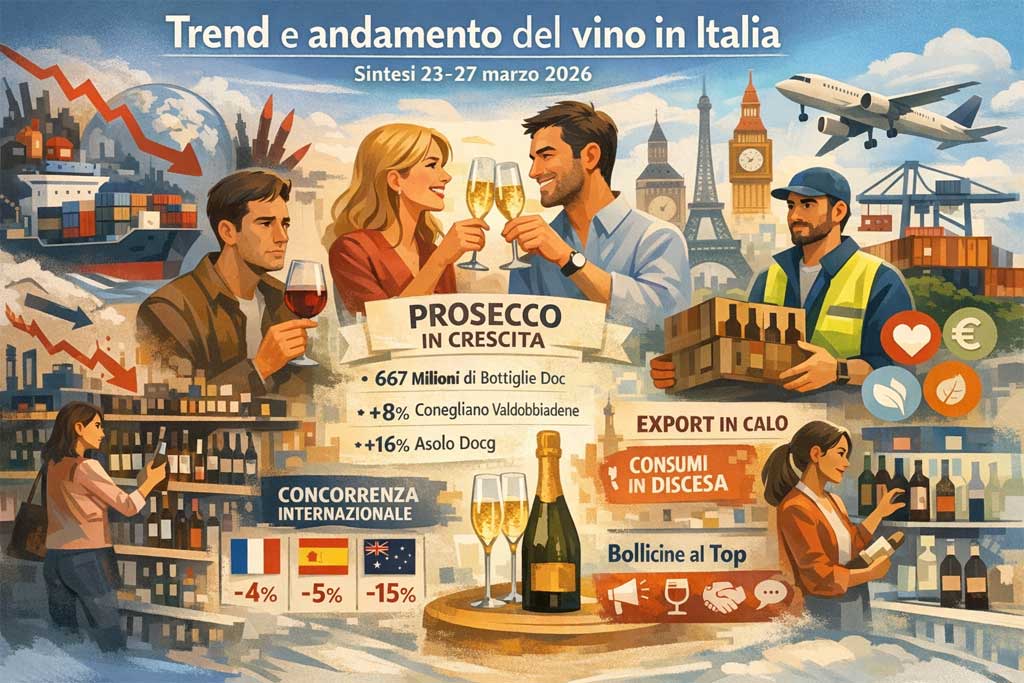

Wine Trends and Performance in Italy – Final Summary – Week 23–27 March 2026

The picture that emerged during the week of March 23-27, 2026, depicts a market that continues to face pressure on multiple fronts—declining domestic consumption, geopolitical tensions, slowing exports, logistical challenges, and growing consumer sensitivity to health, price, and simplicity of language—but which, at the same time, shows some areas of strong resilience and even growth.

The Italian wine sector continues to experience a complex, but uneven, phase.

The most obvious fact is that Italian wine is not facing a linear crisis. Rather, it is immersed in a structural transformation that clearly distinguishes categories, markets, sales channels, and consumption patterns. In this scenario, sparkling wines, and Prosecco in particular, remain the most resilient segment, while the rest of the industry is being called upon to rethink its positioning, communication, and consumer relations.

1. Prosecco confirms itself as the true strength of Italian wine

In a challenging overall environment, Prosecco once again emerges as the most robust product in the national wine scene. In the run-up to Easter 2026, orders are expected to increase by 4%, a sign that Italian sparkling wines continue to naturally satisfy convivial and festive consumption.

The numbers of the three denominations confirm this strength:

  • Prosecco DOC : 667 million bottles in 2025, 1.1% more than in 2024
  • Conegliano Valdobbiadene Prosecco Superiore DOCG : approximately 98 million bottles, 8%
  • Asolo Prosecco DOCG : over 32 million bottles, 16%, the most dynamic growth among the three denominations

Prosecco DOC maintains a strong international appeal, with over 82% of production destined for export and an estimated production value exceeding €3 billion. Even the data for the first two months of 2026, which indicates a technical decline in bottling, is not interpreted as a weakening of demand, but rather as strategic inventory management, particularly with the US market in mind. Cellar stocks have increased by 5.8%, a sign of a system that has preferred to modulate flows to accommodate the absorption of foreign inventories.

On the international front, it is worth noting the excellent performance of France, which recorded double-digit growth (18%) and consolidated its position as the third most profitable market for the denomination after the United States and the United Kingdom.

The strategic interpretation is clear: Prosecco continues to win because it perfectly captures the dominant drivers of contemporary consumption—accessibility, immediacy, conviviality, international recognition, and compatibility with less formal consumption occasions.

2. 2025 closed in decline, but Italy held up better than many competitors

2025 ended with a decline in Italian wine exports of -3.7% in value and -1.8% in volume , but this data must be read against an even more negative international backdrop for many competitors. According to an analysis by Denis Pantini (Wine Monitor Nomisma), Italy lost ground, but held up better than other major exporting countries:

  • France: -4%
  • Spain: -5%
  • Australia: -15%
  • Chile: -10%
  • United States: over -33%

This means that, despite a contraction, Italian wine maintains a relatively stronger competitive edge compared to its main competitors. The German and Brazilian markets have shown positive signs, partially offsetting the greater difficulties experienced in other areas.

For 2026, the forecast remains cautious but not dramatic. If the weaker markets were to rebound, if the geopolitical situation improved, and if Italian consumers regained confidence, the year might not even end in negative territory. This forecast doesn’t warrant easy optimism, but it does confirm that we’re not facing a systemic collapse, but rather a very delicate phase of rebalancing.

3. The start of 2026 is weak: Italian exports slowing, agri-food under pressure

However, the first signs of 2026 point to a difficult start. In January 2026, Made in Italy products fell 4.6% compared to January 2025, while the agri-food sector recorded an even more significant decline, at 7.7% . The United States’ performance was particularly severe, with the agri-food sector contracting by 26.4% .

These figures are also affected by the comparison with the beginning of 2025, when many companies had brought forward orders and inventories in anticipation of possible US tariffs. However, the data confirms the fragility of the international context: Germany (-4.8%), France (-7.5%), and the United Kingdom (-12.3%) also saw declines, while positive signs emerged from Switzerland (-15.5%), China (-14.6%), and Austria (-5.1%).

The message for the wine industry is very clear: dependence on traditional markets increasingly exposes it to geopolitical, fiscal, and distribution cycles. It is therefore crucial to strengthen its presence in high-potential markets, with more flexible commercial strategies and greater direct reach.

4. Large-scale retail trade confirms the decline in consumption, but saves sparkling wines

The most immediate thermometer of the domestic market remains the large-scale retail trade, and the 2025 data show a clear contraction:

  • 737 million liters of wine and sparkling wine sold
  • 20 million liters less than in 2024
  • -3.4% in volume
  • -1.1% in value
  • total turnover of around 2.36 billion euros

The data points to a two-pronged decline: purchases are decreasing, and rising prices are no longer sufficient to offset the decline. Bottled wines with designations of origin (DOC, DOCG, IGT) are also down 2.6% in volume, while fortified wines remain the weakest category.

The only segment that continues to grow is that of sparkling wines :

  • 1.5% by volume
  • 1.2% in value
  • approximately 109 million liters
  • approximately 750 million euros

Growth is more moderate than in the past, but it’s significant because it confirms a distinct trajectory compared to the rest of the market. Italian consumers continue to prize wines that combine freshness, ease of consumption, gastronomic versatility, and a sense of accessible gratification.

5. Best-selling wines: Prosecco dominates, many traditional reds suffer

Among the most purchased wines in large-scale retail trade in 2025, the podium is very clear:

  • Prosecco : over 53 million liters, 2.6%
  • Lambrusco : over 28 million liters, -7.2%
  • Trebbiano : over 23 million liters, 0.3%

Prosecco remains not only the best-selling wine, but also the dominant value, with approximately €392 million spent in large-scale retail trade. Chianti and Vermentino follow, but are far behind.

On the consumption front, some consolidated trends emerge:

  • Italians choose more still wines than sparkling ones
  • they choose more whites than reds
  • but the most purchased individual wine is still still red , with over 261 million litres

Among the growing categories, the following stand out:

  • Grecanico : 13.7%
  • Nebbiolo : 9.7%
  • Pinot Noir : 7.8%
  • Classic Method : 6.3%
  • Ribolla Gialla : 4.2%
  • Primitivo di Puglia : 3%
  • Vermentino : 2.5%

This is an interesting signal: while part of the market is declining, some typologies are growing thanks to a more defined identity, greater recognisability or better harmony with new consumer tastes.

6. Prices are rising, but wine in Italy remains among the least inflated products in Europe.

One of the most significant aspects is that wine continues to suffer in consumer perception, but not because it has seen particularly sharp price increases in Italy. On the contrary, according to Eurostat data compiled by FRED and analyzed by the American Association of Wine Economics, between 2015 and 2025, consumer wine prices in Italy increased by only 7.4% , one of the lowest levels in Europe.

For comparison:

  • Germany: 22.6%
  • France: 25.7%
  • Spain: 27.4%

Even in Italian large-scale retail trade, the average price of bottled wines with a designation of origin stood at 5.69 euros/litre , up 2.1% on 2024, in line with the 2% increase already recorded the previous year.

This data leads to an important reflection: the problem with wine today isn’t just its absolute price, but the relationship between price, perceived value, frequency of consumption, and available alternatives. In other words, it’s not enough to say that wine prices haven’t increased significantly; we need to ask ourselves whether consumers still perceive wine as a natural, simple, and justified purchase.

7. Foreign markets are becoming more selective: Germany is more solid, the United Kingdom is more difficult

On the export front, two different signals emerge.

Germany

Germany remains a major market for Italian wine. In 2025, Italian wine imports exceeded €1 billion , accounting for over 40% of the market. Italian PDO wines are:

  • 5.4% by volume
  • 4.2% in value

Prosecco remains the most exported Italian wine, but Veneto whites, Piedmont reds, and PDO sparkling wines other than Prosecco and Asti are also growing. Germany remains a highly price-oriented market, yet very open to Italian wine, which maintains a competitive advantage thanks to cultural familiarity, the variety of its offerings, and the strength of its appellations.

United Kingdom

The British picture is more challenging. In 2025, wine imports to the UK will decline:

  • -4.6% in value
  • -6% in volume

Italy remains the leading supplier in volume, with 298.3 million liters , but recorded a 2% decline and a 2.4% reduction in average price. Italian sparkling wines still generate more value than still wines, with £440 million versus £431 million , but the British system is clearly showing signs of tightening due to taxation, changing consumption, and increased competition.

Here, the issue isn’t just selling, but selling better: a comparison with France clearly demonstrates this. The French generate almost the same value as Italy on sparkling wines, but with much lower volumes and much higher prices. This signals a strategic difference in positioning that Italian wine will increasingly have to address.

8. The sector must change its language, not just its product

One of the strongest themes that emerged this week is cultural rather than commercial. The most effective summary is this: it’s not consumers who are turning away from wine, it’s wine that’s losing them .

The problem isn’t just tariffs, conflicts, or the Highway Code. The problem also lies in wine’s difficulty in speaking to new generations, simplifying its language, making itself accessible without losing depth, and presenting itself as an experience and not just a technical term.

Wine continues to have enormous symbolic, territorial, and emotional power, but it often presents itself with codes that are too elitist, self-referential, or unsuitable for new audiences. This is why everything that creates a direct connection becomes central:

  • wine tourism
  • opening of the cellars
  • hospitality
  • authentic storytelling
  • commercial training
  • simple but not trivial communication
  • conscious drinking culture

In essence, the industry must shift from a product-centric approach to one that focuses on the consumer, the relationship, and the experience.

9. New directions: dealcoholized products, logistics, geopolitical tensions and supply chain imbalances

Alongside market themes, this week also highlighted new lines of transformation.

Alcohol-free wine

Alcohol-free wine is emerging as a niche with high potential, especially in Northern European, American, and Australian markets. In Italy, the sector is still in its infancy, but the fact that it can be produced in our country as of this year, albeit excluding DOP wines, opens up new opportunities for diversification.

Logistics under pressure

The war in the Middle East is creating significant complications for wine transportation: airspace closures, maritime diversions via Africa, longer lead times, higher costs, temperature risks, and unpredictable deliveries. For a seasonal and promotional industry like wine, the impact on planning can be significant.

Imbalance between wine and grapes

In areas like the Oltrepò, another critical signal is emerging: while bulk wine prices may be rising, grape prices continue to plummet, in many cases to levels close to production costs. This imbalance is challenging the agricultural base and risks structurally weakening entire production areas.

10. Final picture: Italian wine holds up, but needs to reposition itself

The week of March 23-27, 2026, therefore paints a very clear picture. Italian wine isn’t in decline, but it is experiencing a very tough competitive selection process.

Wine press review for Thursday March 26 -2026

Italian wineries, Italian wine producers, and current wine news.

The Italian wine sector continues to navigate structural market transformations, designation innovation, international consolidation, and new economic challenges . Below are the day’s key news items, organized by topic.

Italian wineries

Mezzacorona awarded as the best Italian cooperative of the last 25 years

The Mezzacorona Group confirms its position as a leading player in Italian wine cooperatives. At Mundus Vini 2026 , during ProWein in Düsseldorf, the Trentino-based company received the award for “best Italian cooperative of the last 25 years.” The group, active in over 60 countries , includes companies such as Rotari (Trentodoc) and Feudo Arancio in Sicily , while the subholding Nosio manages international marketing. The award confirms the path taken by several Italian cooperatives, which have focused on quality, price positioning, and global growth .

Cantina di Carpi activates protective measures for a €12.8 million debt.

Cantina di Carpi, Sorbara e Bazzano has requested the activation of the protective measures provided for by the Corporate Crisis Code to address debt of approximately €12.8 million . The procedure allows for a freeze on creditors’ claims for twelve months, allowing management to develop a recovery plan.

Compulsory liquidation for Cantine Leonardo da Vinci

The historic Tuscan cooperative Cantine Leonardo da Vinci , founded in 1961, has been placed into compulsory administrative liquidation by the Ministry of Business and Made in Italy. As of August 31, 2025, it had short-term debts of over €13 million , against a negative net equity. Despite the liquidation, operational continuity of production for its members has been guaranteed.

Centopassi, the wine from land confiscated from the mafia

In Sicily, Centopassi , a winemaking project linked to the Libera Terra cooperatives, represents a virtuous model for valorizing lands confiscated from organized crime. The winery combines native grape varieties, territorial identity, and a presence on international markets , demonstrating how a strong ethical project can also generate solid commercial results.

Feudi di San Gregorio celebrates 40 years of wine and design.

The Campania winery celebrates forty years of activity with an exhibition at the Milan Triennale dedicated to its collaboration with designers Lella and Massimo Vignelli , who contributed to the company’s visual identity. The project explores how wine can become a cultural object through design, graphics, and storytelling.

Italian wine and Italian oenology

Wine remains central to Italians’ habits

According to an analysis by the Nomisma Wine Monitor Observatory , 9 out of 10 Italians have consumed wine in the last year . However, the sector is changing:

  • Global consumption fell from 236 to 215 million hectoliters between 2019 and 2024
  • Italian consumption is stable ( 22.6 22.3 million hectolitres )
  • Over the last twenty years , Italian exports have grown by 141%

Territory is increasingly emerging as a determining factor in purchasing choices .

Asti Rosé arrives: a new typology for the denomination

Piedmont officially introduces a new style: Asti Rosé , made with Moscato (70–90%) and Brachetto (10–30%) using the Martinotti method. The wine will be available in various versions, from sweet to extra brut , to meet the demands of international markets. Its commercial debut is expected at Vinitaly .

The return of Nas-Cëtta to the Langhe

Once nearly extinct, the native Nas-Cëtta grape is experiencing a resurgence in the Langhe. In the 1990s, experiments brought this rare white wine back to life, and today it is promoted by producers like Elvio Cogno and Le Strette , becoming a symbol of Piedmont’s viticultural biodiversity.

The “Italian model” of moderate consumption

A study promoted by Federvini and La Sapienza University highlights how Italy maintains a moderate and convivial drinking style. Over 80% of wine is consumed during meals, and average consumption is 8 liters of alcohol per capita , lower than the OECD average.

Prosecco still the driving force for Italian wine

The Prosecco system continues to grow:

  • Prosecco DOC : 667 million bottles in 2025 (1.1%)
  • Conegliano Valdobbiadene DOCG : 98 million (8%)
  • Asolo Docg : 32 million (16%)

Over 82% of production is intended for export and Easter orders are estimated to grow by 4% .

High stocks in Italian cellars

The Cantina Italia report highlights 61 million hectolitres of wine in stock , an increase compared to 2024. This figure highlights the need for the sector to redesign production and market strategies .

Local wines prevail in restaurants

According to an analysis of the HoReCa market carried out by Trinko , between 70% and 75% of the labels in Italian restaurants come from the same region as the restaurant , confirming the strong link between wine, cuisine and territory .

Roero relaunches Arneis and Nebbiolo

The Roero area aims to strengthen its winemaking identity through the promotion of Arneis and Nebbiolo , with the aim of definitively emerging from the shadow of the Langhe.

Valoritalia expands its sustainability certifications

The Valoritalia certification body, which controls approximately 60% of Italian bottles with a denomination of origin , is expanding its activities towards environmental and sustainability certifications, such as Equalitas, VIVA and the ISO standard on carbon footprint .

“Consumers are confused”: the industry demands clarity.

Wine expert Graziana Grassini highlights how conflicting messages about health, prices, and alcohol consumption are creating confusion among consumers , highlighting the need for clearer communication from the industry.

International

Napa Valley in trouble

According to Silicon Valley Bank ‘s annual report, the U.S. wine industry saw declining revenues and production in 2025, with demand expected to bottom out between 2027 and 2028. Major groups such as E.&J. Gallo and Constellation Brands have announced staff reductions and industry reorganizations.

The EU-Australia agreement and the name Prosecco

The new trade agreement between the European Union and Australia stipulates that the name Prosecco cannot be used for Australian exports for ten years , although it will remain permitted on the domestic market as a varietal indication.

British viticulture is growing

In the United Kingdom, viticulture continues to expand. WineGB’s 2025 Harvest Report highlights a “mast year,” or exceptionally abundant vintage, confirming the consolidation of the quality of English wines.

Wine remains the favorite drink of the French

According to the SoWine Barometer 2026 , wine remains the most popular alcoholic beverage in France with 52% of preferences , ahead of beer and Champagne, despite a general trend of moderation in consumption.

The phenomenon of collectors with too many bottles

More and more collectors find themselves with cellars that are too large for their consumption. This phenomenon is fueling the secondary wine market and new strategies for managing private collections.

Wine events

Vinitaly 2026: over 4,000 exhibitors

The next edition of Vinitaly will see:

  • 4,000 exhibitors
  • 18 pavilions
  • over 100,000 m2 of exhibition area
  • more than 2,000 accredited journalists

The event confirms its position as one of the main international wine hubs.

OperaWine 2026 celebrates great Italian wine

The Wine Spectator event pays homage to the history of Italian wine and its protagonists, from Sassicaia to Tignanello , recounting the journey that has brought Italy to the pinnacle of world quality.

The “Cantine d’Italia 2026” guide has been presented.

The Go Wine guide dedicates ample space to winery visits, with information on production, hospitality, and wine tourism itineraries.

Sicily Trophy 2026

The event dedicated to the great Sicilian wines highlights the role of native vines , with Nero d’Avola as the protagonist of the island’s qualitative rebirth.

Wines of the Heart 2026 in Genoa

The guide, born from a social media project conceived by Olga Schiaffino, brought together producers and enthusiasts in Genoa for a tasting of the community’s most popular wines.

Italian wine also arrives at the cinema

The film “It’s Not the End of the World” , shot in Verona, brings the world of Valpolicella to the big screen, starring iconic wines such as Amarone Costasera and Campofiorin by Masi Agricola.

Strategic summary of the day

Today’s news shows a sector undergoing profound transformation :

  • global consumption down but Italian exports still strong
  • continued growth of some denominations such as Prosecco
  • return of native vines and territorial identities
  • increase in wine stocks in cellars
  • economic tensions affecting some historic cooperatives
  • increasingly intense international competition.

Italian wine remains one of the pillars of the national agri-food sector, but its future will increasingly depend on the ability to enhance territories, quality and global positioning .

Thanks for listening. Today’s wine press review was brought to you by WINEIDEA.IT .

See you tomorrow with the next wine news.

Prosecco, Confindustria Veneto Est: Exports are resisting tariffs and are ready to accelerate, with 4% orders for Easter 2026.

The President of the Settimo Pizzolato Wine, Spirits and Liqueurs Group: «The demand from international trade fairs is booming.

The challenge is to preserve the value built over time and make it grow through quality, identity and the ability to work together.

Prosecco is limiting the impact of tariffs and is poised to accelerate, with demand booming and orders estimated to grow 4% ahead of Easter 2026 compared to the previous year. “Prosecco is one of the Veneto’s strongest symbols worldwide and the result of long-standing collective effort. Veneto has established itself globally thanks to this wine, rich in aromas, freshness, and balance, which must be constantly promoted, showcased, and its identity protected. The real challenge today is not growth per se, but the ability to continue protecting this heritage without ever taking it for granted,” said Settimo Pizzolato, President of the Wine, Spirits, and Liqueurs Group of Confindustria Veneto Est , upon returning from Wine Paris and ProWein, the leading international trade fairs in the sector.

The most recent data confirm the system’s solidity. Prosecco DOC closed 2025 with 667 million bottles bottled (1.1% more than 2024) and over 82% of production destined for export, for an estimated production value of over €3 billion.

Conegliano Valdobbiadene Prosecco Superiore DOCG recorded approximately 98 million bottles (8% compared to 2024), confirming the central role of quality and territorial identity.

The Asolo Prosecco DOCG remains the most dynamic denomination, with over 32 million bottles bottled and a 16% growth compared to 2024.

In the first two months of 2026, Prosecco DOC recorded a technical decline in bottling compared to the same period in 2025. Pizzolato comments: “This phenomenon does not indicate a decrease in demand: cellar inventories increased by 5.8%, demonstrating that companies have managed bottling to allow foreign markets, particularly the US, to sell off the stocks accumulated in the first few months of 2025 to protect themselves from potential tariffs.”

While the first two months of the year saw this technical decline, inventory data and the surge in orders ahead of Easter 2026—estimated to have increased by 4% compared to the previous Easter —confirm that the sector is poised for further growth, supported by exports that surpassed the €2.2 billion mark in 2025, confirming the segment’s consolidation. France recorded a double-digit increase (18%), confirming its position as the third most profitable global market for this denomination after the US and the UK.

“The Veneto wine sector has already demonstrated a strong capacity for resilience and adaptation in recent years ,” Pizzolato emphasizes .We remain attentive to the global context: the current economic and geopolitical instability is affecting the costs of raw materials and energy, with direct effects on producers. This is why the joint work of the three consortia—the Consortium for the Protection of DOC Prosecco, the Consortium for the Protection of Conegliano Valdobbiadene Prosecco Superiore DOCG, and the Consortium for the Protection of Asolo Prosecco DOCG—along with the companies and cooperatives is essential. Only through a shared vision, founded on quality and consistency, can we continue to generate true value: for the product, for the region, and for the communities that represent it,” concludes President Pizzolato .

Prosecco’s strength also lies in its ability to unite: it is one of the few Italian wines capable of appealing to diverse audiences, both in Italy and abroad, thanks to its elegance and immediacy. This inclusive power can continue to promote Veneto throughout the world, opening up new cultural spaces, even before commercial ones.