

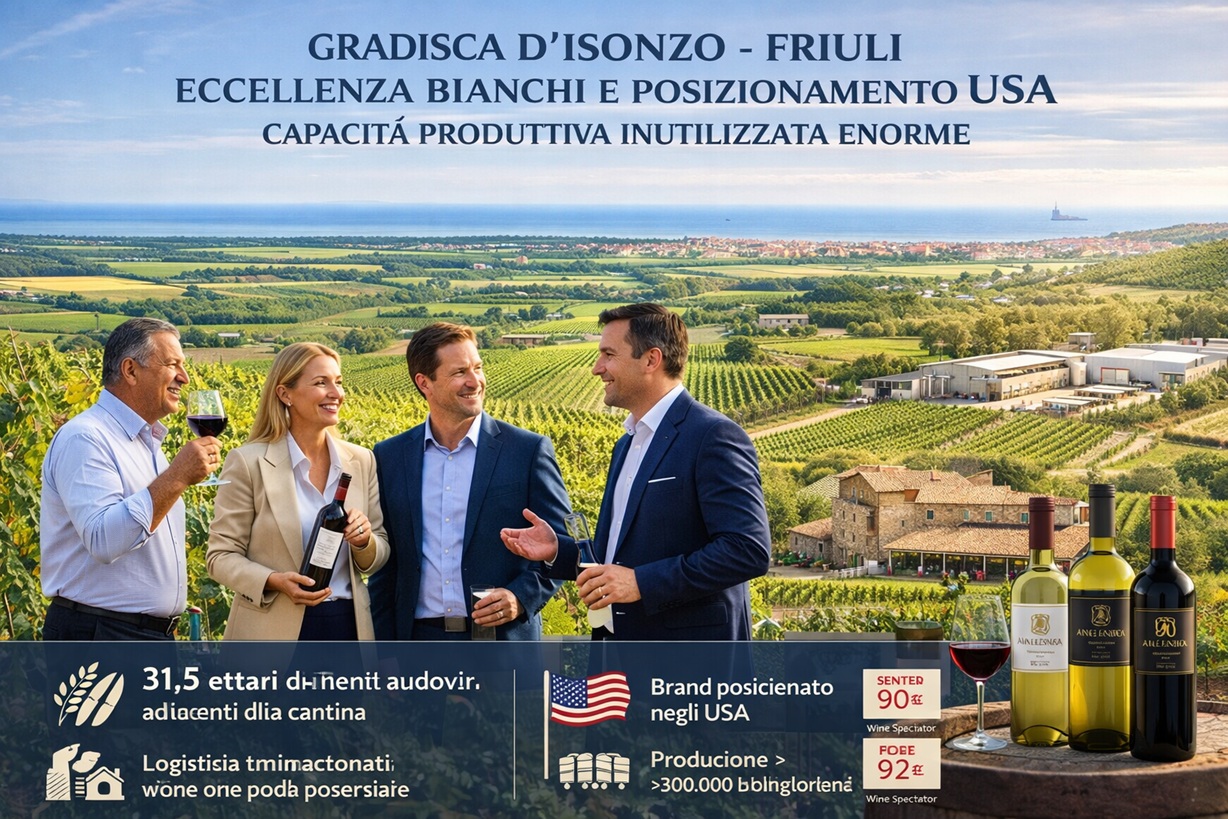
A wine estate already recognized on international markets, featuring a rare combination of three key factors:
an exceptionally high-potential territory, a brand already positioned in the United States, and a vast amount of unused production capacity.
We are in Gradisca d’Isonzo, within one of the most strategic wine corridors in North-East Italy:
between Collio, Isonzo, Slovenia, and the Central European axis.
Here, wine does not live on terroir alone. It thrives on logistics, export, and historical reputation.
Why this territory is a value multiplier
Eastern Friuli is one of the very few Italian areas where the following elements converge:
- deep alluvial soils of the Isonzo River
- a mitigated continental climate
- a natural vocation for premium white wines
- direct proximity to foreign markets (Austria, Germany, Slovenia)
This creates a structural advantage:
- more stable agronomic costs
- consistent quality
- very high varietal recognizability
- ease of export positioning
In addition, Gradisca is geographically central:
wine, slow tourism, cycling routes, cultural crossroads, Central European flows.
Here, wine tourism is not folkloric.
It is a natural extension of the export business.
The structural strengths of the asset
This asset has a feature that investors consider pure gold:
the entire value chain is concentrated in a single, compact corporate structure.
- 35 hectares in one flat, contiguous block
- 5 hectares of vineyards directly adjacent to the winery
- perfect internal logistics
- extremely efficient agricultural management
Another key element:
the gap between current production and potential production is enormous.
Today:
- 60,000 bottles sold
- 9,000 bottles bottled for the high-end segment
- 200 quintals of grapes sold
At full capacity:
- up to 300,000 bottles per year
- without planting new vineyards
- without building a new winery
- with facilities already fully dimensioned
This means one very precise thing:
value is created here by saturating existing capacity, not by agricultural expansion.
Very few assets allow for this kind of clean industrial growth.
A distinctive element: an already established U.S. brand
Many wineries sell export dreams.
Here, export already exists.
- Brand well known in the United States
- Long-standing, consolidated distribution channel
- Parker and Wine Spectator scores above 90
- Pignolo recognized among the best in the world
This dramatically reduces:
- commercial risk
- time to market positioning
- entry costs into premium markets
For an international group, this is a strategic accelerator.
Ideal buyer profile (clear target audience)
This estate is suitable for very specific profiles.
1. Medium-to-large wine groups
Looking for:
- a production base in premium Friuli
- a brand already positioned in the U.S.
- immediate production capacity
- integration with an existing export network
Here they can double or triple volumes without new agricultural investments.
2. International importers or distributors
Seeking to:
- integrate production upstream
- control quality and margins
- own a proprietary European brand
This is a textbook case of perfect vertical integration.
3. Structured entrepreneurial families
Looking for:
- a healthy company
- debt-free
- stable revenues
- significant real estate assets
- programmable growth
This is a true patrimonial asset, not a speculative one.
4. Platform-oriented investors
Aiming to:
- create a premium Friuli white-wine hub
- develop hospitality within the farmhouse
- integrate tourism, wine club, and events
Not suitable for:
- micro artisanal producers
- operators without a commercial structure
- purely passive financial projects
This asset requires industrial and commercial governance, not hobby-level management.
Why it is on the market now
This is a classic case of a virtuous entrepreneurial end-of-cycle.
The story is linear:
- noble foundation
- managerial relaunch in 1995
- construction of an international brand
- today: a healthy, debt-free company with stable revenues
But a structural limit has emerged:
production and asset capacity exceed the scale of the current management.
To fully exploit:
- the potential 300,000 bottles
- the 1,300 sqm farmhouse
- the U.S. positioning
what is needed:
- capital
- a broader commercial structure
- managerial organization
This is a sale driven by a need for scale, not by crisis.
And that is precisely the best moment to buy.
The nature of the transaction
This is a platform operation with integration and selective relaunch, structured on three very clear levels.
1. Production platform
- 5 ha of compact vineyards
- fully equipped modern winery
- 4,050 hl capacity
- plants and machinery already in place
- potential of 300,000 bottles
An industrial base already built.
2. Commercial integration
For groups or importers:
- synergies on U.S. export
- synergies on European distribution
- direct control of the supply chain
- immediate margin expansion
Here, value is created along the commercial chain.
3. Wine tourism and real estate relaunch
An often underestimated element:
- 1,300 sqm historic farmhouse
- perfect location for hospitality
- potential for wine resort, residence, or club house
This enables:
- revenue diversification
- brand strengthening
- premium customer loyalty
Strategic summary
This asset is rare because it combines:
- 130 years of real history
- top-tier Friulian territory
- compact vineyards adjacent to the winery
- a brand already positioned in the U.S.
- international recognition
- massive unused production capacity
- a debt-free company
- stable revenues
- available real estate leverage
It does not promise miracles.
It offers something far more valuable:
a ready-to-use industrial platform, with low risk and very high upside.
And that is exactly what serious buyers in the North-East wine sector are looking for today.