A network portal of Wine Idea. Discover the world of Wine idea

Historic winemaking platform already positioned

We’re in Vulture, one of the very few Italian regions where the connection between soil, grape variety, and reputation is so strong that it creates a natural territorial income. Aglianico del Vulture isn’t a grape variety: it’s a geographical brand.

With an industrial and wine tourism potential that today is worth much more than just wine production.

Here the asset unites three rare levels in the same perimeter:

high-quality DOCG production, unique historical heritage, wine tourism project already authorized.

Because the territory is a value multiplier

Vulture is an almost unrepeatable winemaking case.

Deep volcanic soils, high altitudes, strong temperature variations.
Result: wines with structure, longevity, and a recognizable taste signature.

But today the true value isn’t just agronomic. It’s strategic:

  • Aglianico del Vulture DOCG is one of the Southern Italian denominations with the greatest potential for premium repositioning.
  • Limited offering, identifiable terroir, growing international attention.
  • Area still undervalued compared to Barolo, Brunello, Etna: evident territorial upside .

Furthermore, Vulture is a narratively powerful territory:
monasticism, caves, wine presses, historic farmhouses.
Here, storytelling isn’t invented. It’s inherited.

The structural merits of the asset

This asset has a feature that many do not have:
it is already complete as a system .

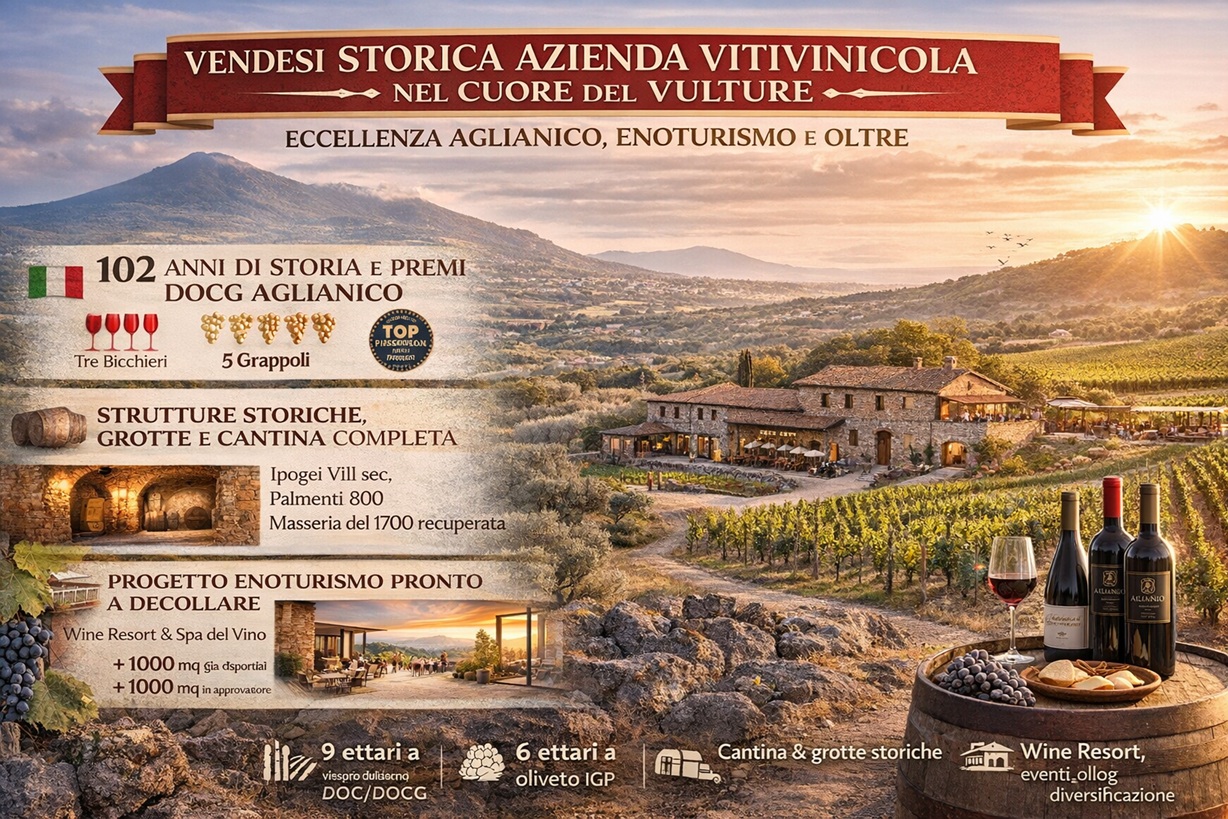
  • 102 years of real, unreconstructed history.
  • Award-winning and recognized brand (Tre Bicchieri, 5 Grappoli, Top Hundred).
  • Vineyards in the first DOCG zone, with recent plantings and perfect exposure.
  • Functional cellar with authentic underground caves.
  • Historic real estate assets already recovered.
  • Wine tourism project already sized on a serious scale.

Key element:
Today, only a portion of the grapes are vinified for qualitative reasons.
This means something very specific for an investor:

there is latent production capacity already available , without new plants.

Few assets allow this kind of internal growth without heavy agricultural CAPEX.

Who is it suitable for (clear buyer profile)

This property is not for those looking for a 30,000-bottle “boutique” winery.

It is ideal for four very precise profiles.

1. Medium-large wine-growing groups

Looking for:

  • a premium production base in Southern Italy
  • a strong identity denomination
  • a historic brand already recognized
  • possibility of volume growth without new vineyards

Here they can build a reference Aglianico hub .

2. Wine & hospitality operators

What they want:

  • control reception production
  • develop high-end wine resorts
  • using wine as a lever for tourist traffic

Here, wine tourism isn’t a project: it’s already authorized infrastructure.

3. Structured entrepreneurial families

Looking for:

  • a real capital asset
  • agricultural real estate profitability
  • a brand to grow in 10–20 years

This is a real farm, not a toy farm.

4. Investors oriented towards territorial platforms

For:

  • create a premium Southern Italy platform
  • integrate production, hospitality, events, museum, retail
  • diversify with agritourism, oil, cosmetics, grappa

It is not suitable for:

  • artisanal micro-producers
  • purely passive financial projects
  • operators without managerial governance

What we need here is industrial government , not romanticism.

Why is it on the market now?

This is a classic case of a healthy end to the generational cycle .

Since 1922 the family has:

  • built land assets
  • created a recognized brand
  • invested in structures and vineyards
  • a serious wine tourism project has been launched

But today something typical happens in historical assets:

the potential future value exceeds the development capacity of current management .

It’s not a crisis sale.
It is a sale due to lack of financial and managerial scale for the next leap.

The project is ready.
All that’s missing is someone capable of bringing it into operation.

This is when the best assets change hands.

What kind of operation is it?

This is a selective bidding platform operation .

Three very clear levels.

1. Production platform

  • 9 hectares of DOCG in the first zone
  • expandable production capacity
  • complete cellar
  • already awarded brand

Solid, already functioning agricultural base.

2. Industrial relaunch

Possible:

  • progressive increase in vinified volumes
  • range rationalization
  • strengthening exports
  • development of premium lines

Here the margin is created on internal growth , not on explants.

3. Wine tourism and real estate development

Distinctive element:

  • 1000 m2 already designated as a wine resort
  • wine spa, museum, events, conferences
  • additional 1500 m2 in recognition
  • other high-level hospitality buildings

This allows for real diversification of revenues :

  • wine
  • welcome
  • events
  • oil
  • cosmetics
  • spirits

It’s not an agricultural bet.
It is a multifunctional platform already authorized .

In strategic summary

This asset is rare because it combines:

  • 102 years of royal history
  • Aglianico DOCG in the first zone
  • volcanic soils of the highest value
  • already recognized brand
  • latent production capacity
  • wine tourism project ready
  • historic real estate heritage
  • strong media visibility

It doesn’t promise any shortcuts.
It offers territorial control, a strong identity and real space to create value .
Strategic Asset – Winery in Chianti Classico (18 km from Florence)

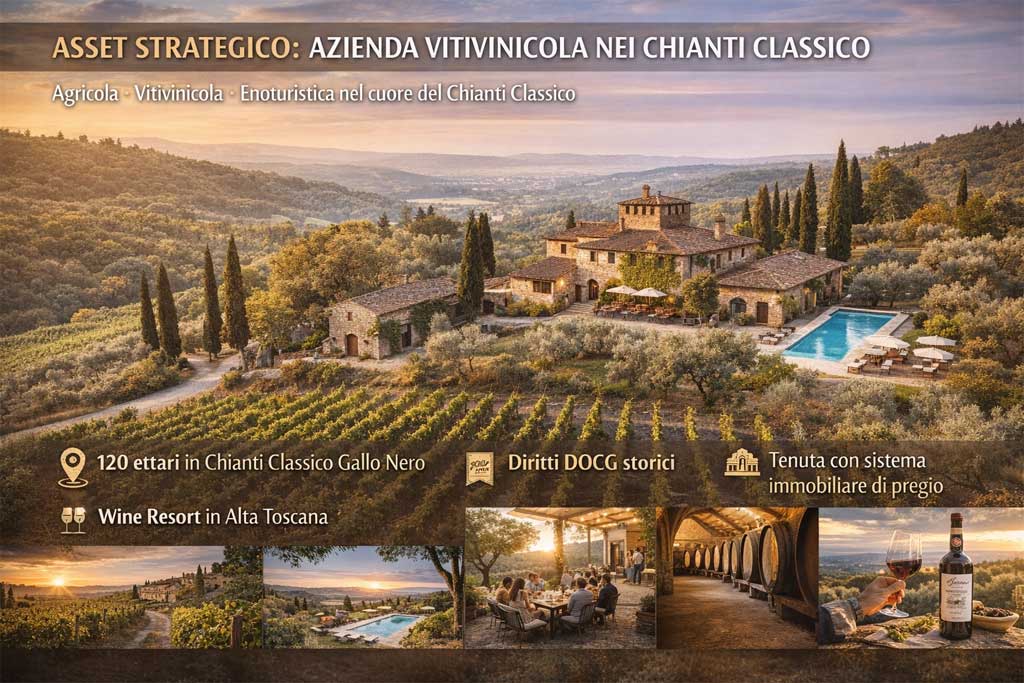
In the heart of Italy’s most iconic viticulture—the Chianti Classico Gallo Nero region—just 18 km from Florence, we offer a 120-hectare agricultural and winemaking property that combines three factors that are extremely rare on the market today: prime terroir, historic DOCG rights, and a prestigious real estate system.

Here you don’t buy a company to build.

We are acquiring an already recognized platform , with a brand that has been present for over 60 years and a historic member of the Chianti Classico Consortium.

The territory: why this context multiplies the value

We are in the heart of the Chianti Classico region, on perfectly exposed hills at an altitude of 350 meters, with a direct view of Florence and the entire Ema Valley.

Three elements make this territory strategic today:

1. Core denomination of Italian wine
Chianti Classico is one of the few DOCGs in the world with:

  • international historical reputation
  • stable structural demand
  • strong attractiveness for foreign investors and high-end tourism

2. Proximity to Florence: a unique multiplier
18 km from the historic center means:

  • immediate wine tourism
  • premium hospitality
  • defensive real estate value even in difficult market scenarios

3. Complete agricultural vocation
120 hectares with a rare balance between:

  • 15.2 ha of vineyards (14.2 ha of Sangiovese Chianti Classico)
  • 17 hectares of olive groves (3,400 Leccino and Moraiolo trees)
  • forest, arable land, pastures

A truly self-sufficient agricultural system , not an isolated vineyard.

The asset’s strengths

Production and branding

  • Brand present on the market for over 60 years
  • Historic member of the Gallo Nero Consortium
  • Historical production at full capacity:
    • 40,000 bottles of Chianti Classico DOCG
    • 6,500 bottles of Chianti Classico Riserva
    • IGT reds, whites, Vin Santo, EVO oil

This is fundamental: you don’t start from scratch .
The brand exists, the rights exist, the name is active.

Cellar and infrastructure

Complete winemaking facility (400 m2):

  • cement capacity over 3,000 hl
  • large barrels, small barrels for Vin Santo
  • winemaking, refinement, and bottling premises
  • historic jar cellar with 19th century terracotta jars

A “real” cellar, not a symbolic one.
Ready to quickly return to normal operations with targeted investments.

Real estate system: the real multiplier

Here the asset becomes a wine hospitality real estate platform :

  • Historic 800 sq m manor house with swimming pool and panoramic view
  • 2 independent housing units (200 sq m 150 sq m)
  • Farmhouse with 280 sq m barn to be restored
  • Panoramic 440 sq m stone farmhouse on the ridge

An ideal base for:

  • charming relais
  • wine resort
  • clubhouse for hosting customers and investors

Real estate value already estimated at over 2.8 million for buildings alone.

Who is it suitable for (ideal buyer profile)

This operation is perfect for three very clear profiles:

1. Medium-large wine-growing group

For:

  • enter or strengthen in the Chianti Classico
  • integrate a “core” denomination into the portfolio
  • have a proprietary hospitality base in Tuscany

Typical profile: already structured group, active export, industrial vision.

2. International wine & lifestyle investor

For:

  • acquire a historic brand in an iconic DOCG
  • build a high-end wine resort
  • combine agricultural yield with real estate and tourism

Ideal profile: foreign entrepreneur, family office, lifestyle funds.

3. Italian entrepreneur in asset diversification

For:

  • enter the wine industry with a “protected” asset
  • invest in a real asset with very high value retention
  • building a family wine-hospitality platform

Why is it on the market now?

This is a typical passage of many large historic properties:

  • the company has not been operated at full capacity since 2019
  • vineyards, olive groves and buildings need maintenance and revitalization
  • Today, ownership requires a structured operator , not a family management

In other words:
it’s not a quality issue,
it is a generational and industrial passage .

This creates a rare window:
primary asset, aligned price, enormous potential for value creation.

What kind of operation is it?

This is not a simple agricultural acquisition.
It is a multiple strategic operation :

1. Industrial integration

For those who already have cellars:

  • immediate increase in top DOCG areas
  • strengthening of the denomination portfolio
  • possibility of restructuring range and positioning

2. Relaunch of a historic brand

Here is a brand with 60 years of history.
With:

  • new wine project
  • new storytelling
  • new distribution

a medium-high range Chianti Classico brand can be built in just a few years.

3. Wine hospitality platform

It is perhaps the most powerful aspect:

Vineyards, winery, villa, farmhouse, swimming pool, panoramic view, Florence, 18 km away.

This is a natural wine resort already written into the property.

4. Defensive asset diversification

120 hectares in Chianti Classico, Black Rooster rights, historic buildings.

This type of asset:

  • defends the capital
  • grows over time
  • it is always liquidable on the international market

Strategic conclusion

This asset is not bought to “make wine”.
It is bought to govern an iconic territory .

It is a rare platform because it combines:

  • primary denomination
  • historic brand
  • significant land mass
  • top-level real estate system
  • unique location near Florence

An ideal operation for those who want to: enter the heart of Italian wine,
with an asset that holds value, generates image and builds the future.

Email: e.zago@quidquid.eu Cell. 39 349 8142125

A strategic winemaking asset in the heart of one of Italy’s most iconic and fertile regions, Frascati!

In the vicinity of Rome, strong brands and structural tourism create a rare combination of stability and potential.

The territory: because here the context really makes the difference.

Montecompatri, on the slopes of the Alban Hills, 200 meters above sea level: we are in the operational heart of the Frascati system , not in an agricultural periphery.

Three elements make this territory strategic:

1. Strong and recognizable names
Frascati DOC, Frascati Superiore DOCG, DOC Roma.
These are names that appeal to the international market, with a clear, historical, and marketable identity.

2. Volcanic soils: a real natural capital
Volcanic soils mean:

  • natural freshness in whites
  • structure
  • longevity
  • sensory recognition

Here terroir is not marketing, it is soil chemistry.

3. Proximity to Rome: a value multiplier
Rome is:

  • direct market with very high absorption
  • permanent tourist basin
  • media platform
  • premium Horeca polo

Very few estates have this combination: historical designation natural capital geographical capital .

The substance of the asset: structure, not promise

Clear numbers, without futuristic hypotheses:

  • 11.36 hectares in total
  • 9.56 hectares of DOC and DOCG vineyards
  • 200 olive trees in production
  • Certified organic since 1996: long-standing credibility, not a recent fad

Complete, self-contained, industrially readable cellar:

  • Capacity 1,710 hl
  • Historic concrete modern steel
  • Complete winemaking, storage and bottling line
  • Historic cellar under the manor house: narrative production value

Production already diversified:

  • Typical still white wines (Malvasia di Candia and native varieties)
  • Traditional reds
  • Charmat white and rosé sparkling wines

There is no need to “build” a cellar here.
Here you have to manage an already functioning platform .

Real estate and hospitality value: a real strategic lever

This is one of the most interesting elements of the asset.

Structures already operational:

  • Tasting room seating 40 with kitchen and panoramic terrace
  • 3 independent housing units
  • Master apartment on two levels
  • Historic farmhouse to renovate
  • Working Roman spring: a unique storytelling element

This means one specific thing:
There’s no need to invent hospitality, it’s already there.

The transition from a farm to a winery hospitality experience is immediate, not theoretical.

Who is it suitable for (clear buyer profile)

This estate is ideal for:

1. Entrepreneurial families or HNWIs
Looking for:

  • a real agricultural asset
  • near Rome
  • with production, branding, real estate and hospitality
  • and a solid capital component

2. Medium-small winemaking groups
What they want:

  • a garrison in Central Italy
  • a historical denomination
  • a brand that can be easily positioned in the Horeca and tourism sectors

3. Wine & hospitality operators
Looking for:

  • a ready-made platform
  • tasting, apartments, farmhouse
  • food and wine tourism can already be activated

4. Industrial investors in food and wine
For:

  • asset diversification
  • low-risk premium platform
  • integration with existing distribution or catering

It is not suitable for those looking for

  • Industrial volumes from large-scale retail trade
  • Rapid speculative operations
  • Passive assets without agricultural management
  • Projects without direct presence on the territory

What we need here is entrepreneurial governance , not hit-and-run finance.

Why is it on the market now?

This is a very important step.

It does not arise from a crisis.
It arises from the end of a successful entrepreneurial cycle .

The owners have:

  • built
  • certified organic for 25 years
  • consolidated structures and cellar
  • activated hospitality
  • preserved natural capital

Today the maximum value is expressed by a subject who knows:

  • strengthen commercial positioning
  • develop hospitality in a structured way
  • give the brand a higher scale

Strategic Asset: Winery in the Eastern Friuli Hills

This property isn’t a “farm for sale.” It’s an integrated winemaking system, located in one of the Italian regions currently attracting significant attention from sophisticated buyers, mid- to high-end importers, and investors seeking authenticity, biodiversity, and the possibility of controlled development.

We are in the northeastern portion of the Eastern Hills, between the Julian Alps and the Adriatic, in an area that combines three factors that are rare when they coexist: recognized terroir, unspoiled landscape, and the potential for regulated growth (urban planning already approved).

The regional context reinforces its attractiveness: high quality of life, strong institutional promotion of food and wine tourism and a denomination perceived as “emerging but serious”, not inflated.

Why this territory really matters

The Colli Orientali are built on Eocene soils (the famous ponca ), today interpreted by geologists and winemakers as one of Northern Italy’s most interesting substrates for long-lived white wines and distinctive reds. Here, native grape varieties with over two thousand years of history (Friulano, Picolit, Refosco, Pignolo, Schioppettino) coexist with international varieties, which, in this microclimate, find expressions unmatched elsewhere.

The fact that Savorgnano del Torre is in the process of being recognized as a microzone strengthens the prospect of qualitative and patrimonial revaluation. This isn’t a commercial promise: it’s a technical-administrative process already underway.

The structural merits of the asset

  • A single hilly estate of ~83 hectares : 18 hectares of vineyards, the rest woodland, meadows, and biodiversity. This balance is a competitive advantage, not a limitation.
  • Modern terraced vineyards , aged 20–60 years: already mature production heritage, not to be “waited for”.
  • Certified organic farming with a biodynamic approach : consistent positioning with the Northern European, USA and Japanese markets.
  • Complete and autonomous cellar , from vinification to bottling, with a capacity of ~1,200 hl.
  • Current production ~50,000 bottles , with room for growth without stressing the vineyard.
  • Sales network already active : Italy (qualified Horeca) structured export.
  • Integrated hospitality (B&B tastings) already up and running.
  • Existing photovoltaic expansion in progress : cost reduction and concrete ESG narrative.
  • Implementation plan approved by the Municipality of Povoletto : space ready for production and hospitality development, without authorization uncertainties.

Who is it suitable for (clear buyer profile)

This estate is ideal for:

  • Small and medium-sized winemaking groups seeking to establish a high-end presence in the Northeast, with a strong identity and credible territorial narrative.
  • Entrepreneurial families or HNWIs looking for a real, non-decorative agricultural asset with production, branding, hospitality, and real estate potential.
  • Operators oriented towards foreign premium markets (Northern Europe, USA, Asia) who understand the value of biodynamics, microzones and limited runs.
  • Industrial investors in the food and wine sector who want a functioning platform on which to build gradual growth.

It is not suitable for those looking for:

  • High volumes from large-scale retail trade.
  • Short-term speculative operations.
  • Turnkey assets without conscious agricultural management.

Why is it on the market now?

The transition wasn’t born out of a crisis, but rather the end of a business cycle : the owners built, consolidated, and protected the company’s balance. Today, the greatest value is expressed by a player capable of making a dimensional and strategic leap , maintaining the production philosophy but accelerating:

  • real estate development already authorized,
  • commercial strengthening,
  • international brand positioning.

This is the classic moment when selling well makes more sense than continuing “on the defense.”

What kind of operation is it?

This isn’t a simple agricultural transfer. It’s a platform operation with a relaunch option :

  • Platform : production base, mature vineyards, winery, brand, active markets, hospitality.
  • Selective relaunch : increased value per bottle, expanded hospitality, exploitation of cubic capacity, strengthening exports.
  • Integration (for existing groups): immediate synergies in sales, administration, and distribution.

The presence of a wine warehouse (bulk and bottled), developable properties and expanding photovoltaic systems makes the operation industrially legible , not romantic.

In strategic summary

This estate is a rare asset because it combines:
Growing territory → Already structured company → Possibility of conflict-free development → Positioning consistent with the markets that matter.

It doesn’t promise miracles. It offers control, identity, and the space to create real value , which is exactly what serious buyers in Italian wine are looking for today.

    Your name

    Your email

    Your message

    Style Selector
    Select the layout
    Choose the theme
    Preset colors
    No Preset
    Select the pattern